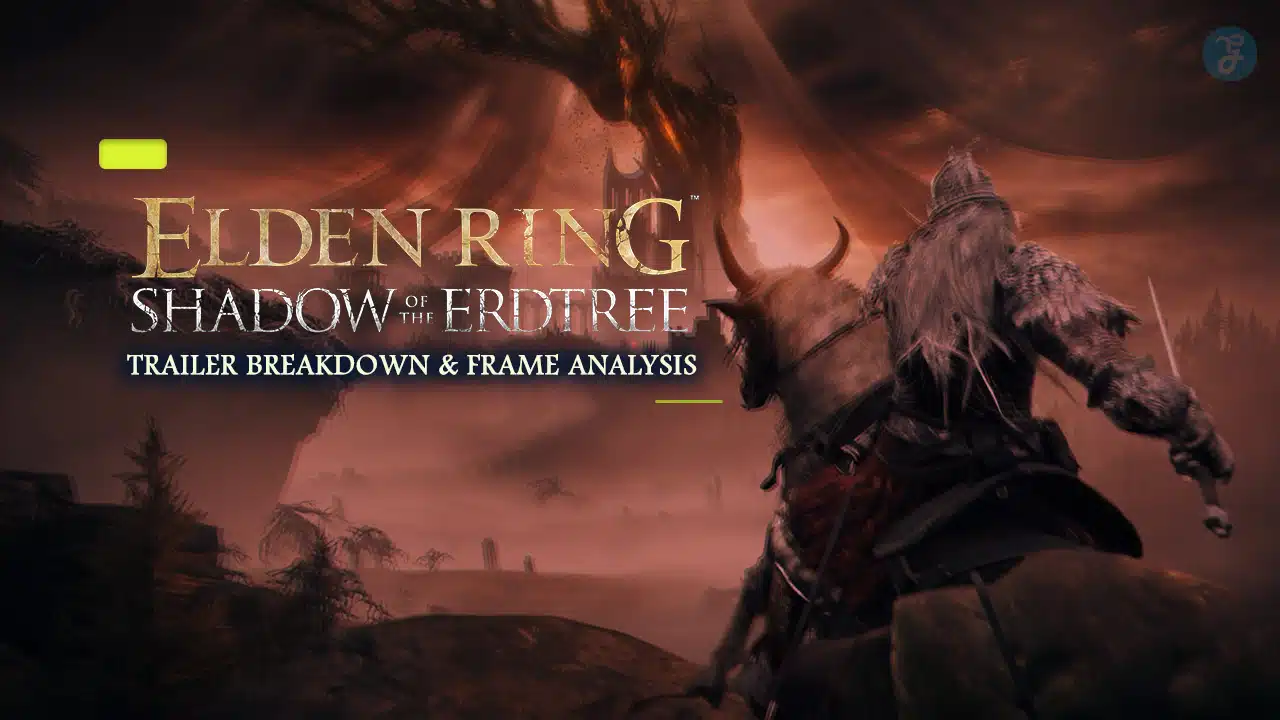
The Shadow of the Erdtree trailer wasn’t just a marketing asset; it was a masterclass in narrative misdirection that redefined how open-world expansions are introduced. Two years after its release, and with the Elden Ring ecosystem now expanded by 2025’s Nightreign spinoff, the original DLC trailer remains a pivotal case study.
It promised a war, teased a villain, and hid a tragedy—establishing a visual language that continues to influence the industry’s approach to “show, don’t tell.” This analysis deconstructs the key frames, the lore they obscured, and what FromSoftware’s strategy tells us about their upcoming 2026 slate.
Key Takeaways
- Visual Misdirection: The trailer mastered the art of “lying by omission,” framing tragics as villains and monsters as saviors.
- Commercial Powerhouse: The DLC’s 5 million sales in 3 days (58% of Bandai Namco’s Q1 sales) proved that expansions can financially outperform standalone AAA releases.
- Lore Closure: It resolved the Miquella mystery not with a hero’s journey, but with a tragedy of godhood, cementing George R.R. Martin’s influence on the mythos.
- The 2026 Pivot: FromSoftware is using the capital from Elden Ring to experiment with risky genres (co-op survival in Nightreign, PvPvE in Duskbloods) rather than immediately churning out Elden Ring 2.
The “Shadow” of Hype: How We Got Here
To understand the weight of the Shadow of the Erdtree (SotE) trailer, one must contextualize the landscape of 2024. Elden Ring had already sold 20 million copies, creating a vacuum of anticipation. When the trailer dropped in February 2024, it didn’t just show gameplay; it weaponized the community’s hunger for answers regarding Miquella, the Empyrean twin of Malenia.
By 2026, the Elden Ring IP has sold over 28.6 million units, with SotE achieving a staggering 30% attach rate (approx. 10 million copies). The trailer was the catalyst for this second wave of success, successfully pivoting the narrative from the Golden Order to the brutal history of the Realm of Shadow. It bridged the gap between the base game’s “high fantasy” and the expansion’s grim “historical purge” aesthetic.
Deconstructing the Deception
The brilliance of the trailer lay in its ability to show everything while explaining nothing. Looking back with 2026 hindsight, we can identify four distinct pillars of visual storytelling that defined this era of FromSoftware.
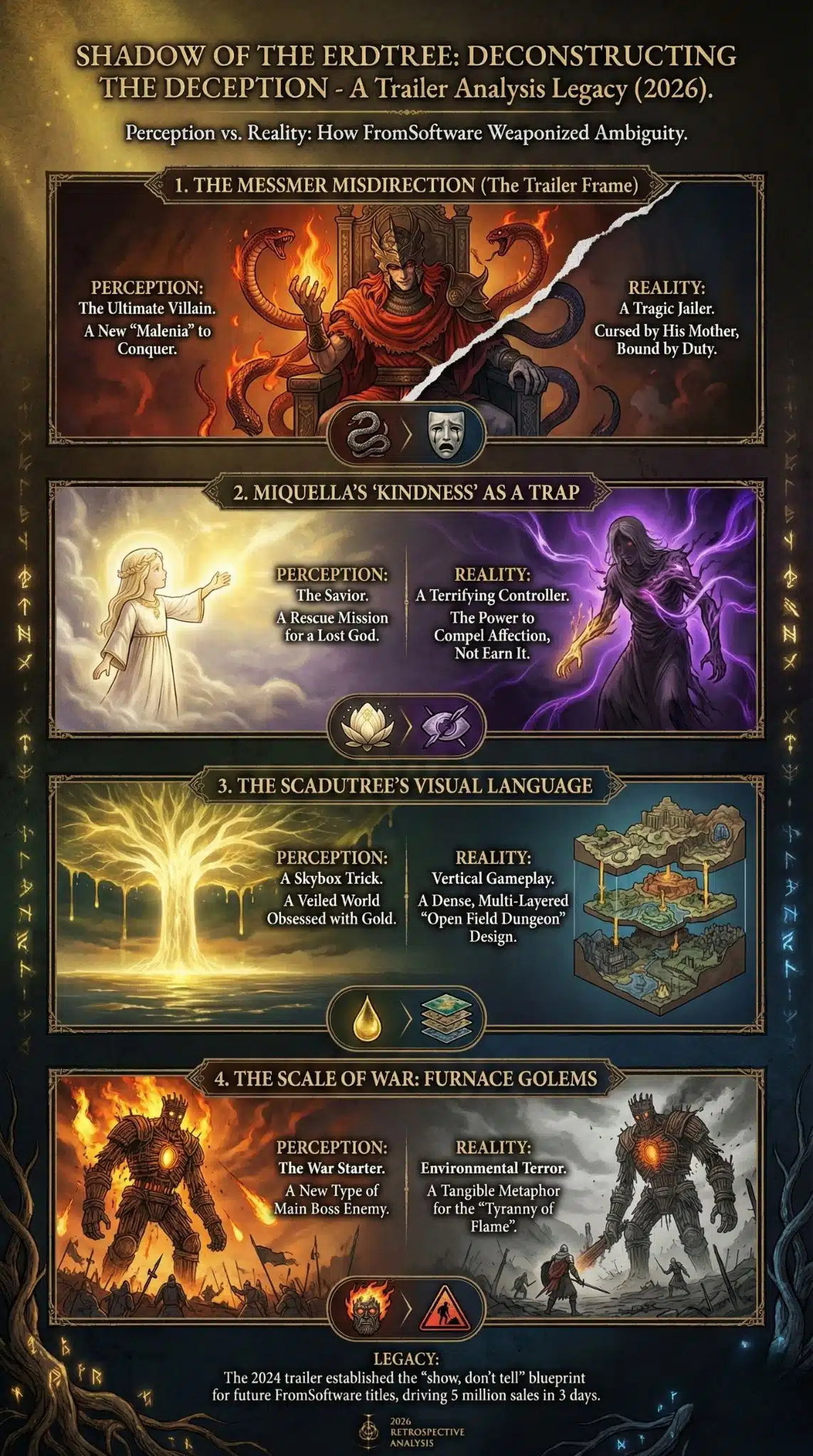
1. The Messmer Misdirection
The trailer’s most iconic frame featured Messmer the Impaler sitting on a throne, wreathed in snakes, seemingly positioning him as the “new Malenia”—an unrepentant monster.
- The Frame: Messmer holding a flame, asking, “Mother, wouldst thou truly Lordship sanction, in one so bereft of light?”
- The Analysis: The framing used low-angle shots and harsh red lighting to code him as the ultimate antagonist.
- The Reality: The trailer hid his tragic nature. Messmer was not a usurper but a loyal son acting as a jailer for his mother’s sins. The “snakes” were not just aesthetic cool-factor but visual shorthand for his accursed nature (the Abyssal Serpent), which he actively suppressed. The trailer set players up to hate a character they would eventually pity—a narrative inversion that became the DLC’s emotional core.
2. Miquella’s “Kindness” as a Trap
The final shot of the trailer showed Miquella raising his hand toward the Scadutree, bathed in ethereal white light.
- The Frame: A small, childlike figure stepping away from the camera, contrasting with the dark world.
- The Analysis: This visual reinforced the base game’s lore of “Miquella the Kind.” It suggested a rescue mission.
- The Reality: This was the trailer’s greatest lie. It concealed Miquella’s terrifying ability to compel affection. The “withered arm” seen in the trailer intro was not a sign of victimhood but the cocoon he abandoned to shed his flesh and morals. The visual language of “light” was subverted in the final game, where Miquella’s light became a tool of terrifying, absolute control.
3. The Visual Language of the Scadutree
The Scadutree (Shadow Tree) dominated the trailer’s skybox, dripping with golden resin.
- The Frame: The Erdtree acts as a “veil,” physically obscuring the sky.
- The Analysis: Technical analysis reveals this was a skybox trick to simulate the “suppression” of the land. The gold dripping wasn’t sap; it was the “Scadutree Fragments”—a new progression mechanic disguised as environmental art.
- The Reality: The trailer established the verticality of the map. Unlike the horizontal sprawl of Limgrave, the trailer’s panning shots emphasized depth and height, signaling the multi-layered map design (Ruins of Rauh vs. Abyssal Woods) that would frustrate and delight players.
4. The Scale of War: Furnace Golems
The trailer showcased massive, wicker-man-like burning giants.
- The Frame: A “Furnace Golem” waking up and raining fire.
- The Analysis: This established the “war” theme immediately.
- The Reality: These enemies served as environmental hazards rather than standard bosses. The trailer used them to convey the scale of Messmer’s purge. They were walking metaphors for the “tyranny of flame,” grounding the high-concept lore in tangible, terrifying threats.
Data & Visualization: The “Shadow” Effect
The Shadow of the Erdtree trailer didn’t just generate views; it converted engagement into historic sales figures. The following table illustrates the expansion’s impact relative to industry standards.
Elden Ring Sales & Engagement Milestones (2022–2026)
| Metric | Base Game (2022) | Shadow of the Erdtree (2024) | Nightreign Spinoff (2025) |
| Launch Sales | 12 Million (Month 1) | 5 Million (3 Days) | 2 Million (Day 1) |
| Attach Rate | N/A | ~30% (vs Base Game) | ~15% (vs Base Game) |
| Critical Reception | 96 (Metacritic) | 95 (Metacritic) | 46% (Steam – Mixed)* |
| Primary Theme | The Shattering | The Purge / Betrayal | Survival / Co-op |
Expert Perspectives: The “Miyazaki Method”
The success of the trailer and the subsequent DLC validates Hidetaka Miyazaki’s “fragmented storytelling” philosophy, but also exposes its risks.
- The “Trust” Factor: Analysts argue that the trailer worked because of the immense trust capital FromSoftware holds. “They showed us a basket of fire and a snake guy, and we bought 5 million copies in a weekend,” notes industry analyst Dr. Serkan Toto. The vagueness is a feature, not a bug.
- The Difficulty Discourse: The trailer hid the difficulty spike. Interviews from 2024 revealed Miyazaki’s intent to “crank up” the challenge, comparing the DLC to the late-game Haligtree area. In hindsight, the trailer’s focus on the Furnace Golems was a fair warning: this content was designed to punish the unprepared, a sentiment that polarized the community upon release but solidified the game’s hardcore reputation by 2026.
Future Outlook: What Comes Next in 2026?
The Shadow of the Erdtree cycle has officially closed, but its technical and narrative DNA is evident in FromSoftware’s forward-looking slate.
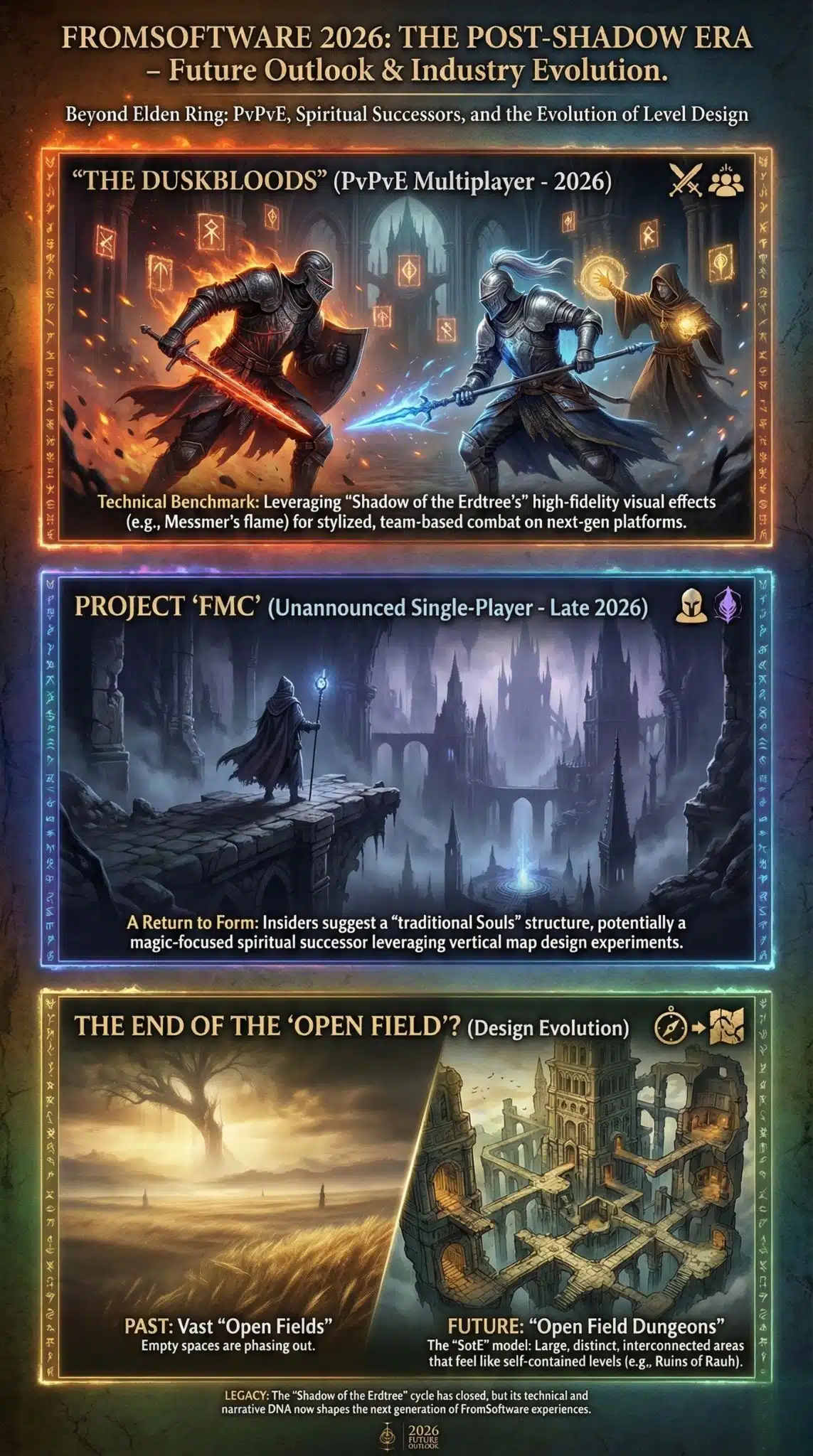
1. “The Duskbloods” (2026)
Reports from Gadgets 360 and other outlets confirm FromSoftware’s next major title, tentatively titled The Duskbloods, is a PvPvE multiplayer title targeting the “Switch 2” and other platforms. The visual fidelity seen in the SotE trailer—specifically the particle effects of Messmer’s flame—appears to be the technical benchmark for this new stylized project.
2. Project “FMC” (Late 2026)
Insiders suggest a second, unannounced project (codenamed “FMC”) is in advanced production. Given the Elden Ring engine’s maturity, analysts predict this will return to the single-player “traditional Souls” structure, potentially a spiritual successor to Bloodborne or a new magic-focused IP, leveraging the verticality experiments perfected in the Realm of Shadow.
3. The End of the “Open Field”?
The SotE map was denser and more vertical than the base game. Future titles are expected to move away from the vast “empty” open worlds toward the “Open Field Dungeon” hybrid design—large areas that feel like distinct levels—which Shadow of the Erdtree proved was the superior format.
Final Words
The Shadow of the Erdtree trailer stands as a definitive case study in narrative deception. By weaponizing ambiguity, FromSoftware didn’t just market a product; they curated a cultural event that redefined the financial viability of game expansions.
The visual misdirection surrounding Messmer and Miquella proved that in an era of leaks, genuine mystery is the ultimate currency. With over 28 million units sold ecosystem-wide by 2026, the “Elden Ring effect” has permanently shifted industry expectations. As FromSoftware pivots to The Duskbloods, the Shadow trailer remains the gold standard for how to promise a war while hiding a tragedy.