
Canada Student Visa Cap 2026 arrives as Ottawa shifts from a decade of rapid intake to managed scarcity. For South Asian applicants, it changes not only approval odds but also timelines, affordability, and the study to work to residence calculus in a housing constrained, politically sensitive Canada.
Key Takeaways
- Canada Student Visa Cap 2026 is a processing cap on study permit applications, not just a headline visa number, and it is designed to slow the temporary resident footprint.
- In 2026, Canada expects to issue up to 408,000 study permits, split between newly arriving students and in Canada extensions, which means the system is tightening while still managing a large existing base.
- The most binding constraint is provincial, because application spaces under the cap are distributed across provinces and then down to institutions.
- Financial thresholds have risen for most applicants outside Quebec, and that reshapes who can credibly apply without relying on work income to survive.
- Exemptions for certain cohorts, including eligible master’s and doctoral students at public institutions, signal a pivot toward “higher value” intake.
- For South Asia, the cap interacts with stricter integrity checks and higher refusal risk, making program choice, documentation quality, and financial clarity more decisive than ever.
From Boom To Cap: Why Canada Tightened The Student Pipeline Again?
Canada did not wake up one morning and decide to reduce international students. The cap is the result of a slow collision between three forces that used to coexist comfortably.
First, international education became a fiscal engine. Many institutions, especially in the public college system, leaned heavily on international tuition to offset domestic funding limits. In good years, that created expanded seats, new campuses, and aggressive recruitment. In bad years, it created a structural dependency that left budgets exposed to policy shifts.
Second, international students became a population policy lever. Over time, Canada’s study pathway was no longer just about education. It became linked to work permits, labour supply, and eventually permanent immigration pathways. That linkage increased demand, because the value proposition was not only a credential. It was the bundle: study rights, work rights, and a future option set.
Third, social capacity stopped scaling. Housing, local services, and community supports did not expand at the same pace as temporary resident growth in the most popular student destinations. When that mismatch becomes visible, governments tend to choose fast levers. Temporary resident policy is faster than building housing, reforming provincial funding models, or rebuilding institutional oversight.
That is the “why” behind Canada Student Visa Cap 2026. The cap is a political and administrative tool meant to buy time and restore public confidence while the system is rebuilt.
What makes 2026 different from the first round is that the cap is now being used as an instrument of composition, not only volume. Ottawa is signaling that some cohorts are preferable, not simply that fewer people are coming.
Here is the core picture that helps decode the policy intent.
| Metric | 2024 | 2025 | 2026 |
| Study Permits Issuance Target | 485,000 | 437,000 | 408,000 |
| Direction | Reset begins | Tightening continues | Managed scarcity becomes baseline |
| Implied Policy Message | “Stabilize quickly” | “Enforce and refine” | “Prioritize and rebalance” |
This is why the cap matters for South Asian applicants right now. It is not a temporary inconvenience. It is a shift in the governing philosophy of Canada’s international student system.
Another clue is how Ottawa frames the target. The cap is explicitly linked to a broader commitment to reduce the share of Canada’s temporary population to below 5% of total population by the end of 2027. In other words, student policy is now fused to macro population planning. When a policy becomes part of a macro target, it tends to last longer and it tends to become stricter before it becomes looser.
The final structural point is easy to miss: a large portion of 2026 “permits issued” are not new arrivals. Extensions for people already in Canada remain a big component. That matters because it means a tight cap can coexist with a still large student presence on the ground. Politically, that can keep the pressure on government to tighten further, since visible population strain does not vanish overnight.
Canada Student Visa Cap 2026: The Mechanics That Decide Who Gets In?
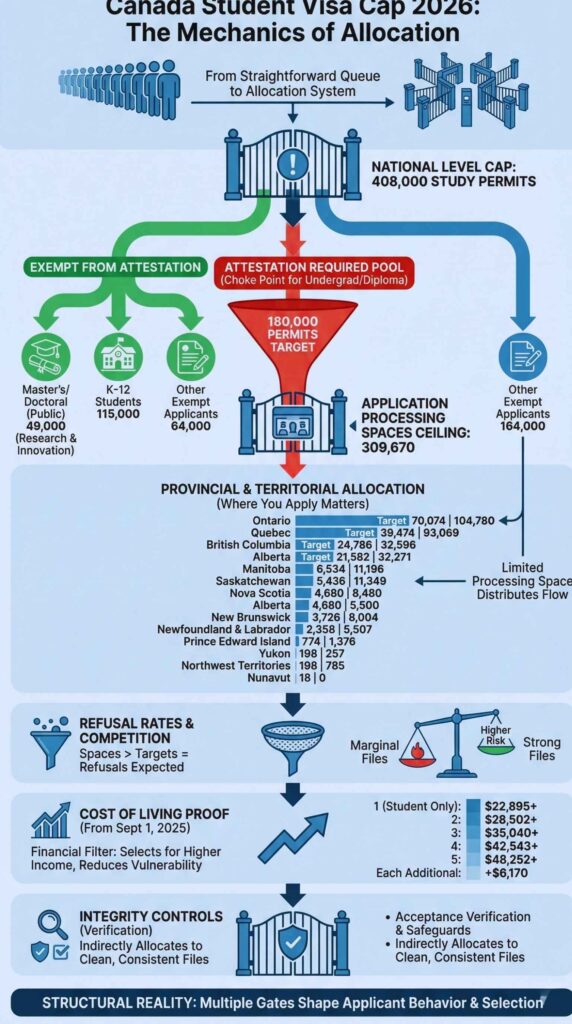
Many applicants still think of Canada’s student pathway as a straightforward queue. In the cap era, it is closer to an allocation system, where the scarce resource is not only visas but also the right to have your file processed under a provincial quota.
At the national level, Canada expects to issue up to 408,000 study permits in 2026. The headline can mislead because “408,000” sounds large. The critical detail is how that number breaks into cohorts, and how many are genuinely “new arrivals.”
| 2026 Student Cohort | Study Permits Expected To Be Issued |
| Master’s And Doctoral Students At Public Institutions (Exempt From Attestation) | 49,000 |
| K–12 Students (Exempt From Attestation) | 115,000 |
| Other Exempt Applicants | 64,000 |
| Applicants Requiring Provincial Or Territorial Attestation | 180,000 |
| Total | 408,000 |
This split matters because the cap is not a uniform blanket. It is a directional tool. When master’s and doctoral students at public institutions become exempt from the attestation requirement, it sends a signal that Canada is actively protecting pathways it associates with research, innovation, and high skill economic contribution.
For most South Asian applicants aiming at undergraduate degrees, diplomas, and college programs, the cap bites hardest inside the attestation required pool.
The second layer is even more decisive: application spaces accepted into processing for attestation required applicants. Canada’s 2026 cap provides a finite number of spaces for study permit applications that require provincial or territorial attestation. That number is 309,670 for 2026. In plain terms, even before a visa officer decides your merits, there is a ceiling on how many applications can be processed under the capped stream.
This is why the provincial layer matters more than ever. Provinces receive a finite number of spaces and then distribute them to institutions, which in turn shape applicant flows.
| Province Or Territory | 2026 Permits Target (Attestation Required Cohorts) | 2026 Application Spaces (Attestation Required) |
| Ontario | 70,074 | 104,780 |
| Quebec | 39,474 | 93,069 |
| British Columbia | 24,786 | 32,596 |
| Alberta | 21,582 | 32,271 |
| Manitoba | 6,534 | 11,196 |
| Saskatchewan | 5,436 | 11,349 |
| Nova Scotia | 4,680 | 8,480 |
| New Brunswick | 3,726 | 8,004 |
| Newfoundland And Labrador | 2,358 | 5,507 |
| Prince Edward Island | 774 | 1,376 |
| Yukon | 198 | 257 |
| Northwest Territories | 198 | 785 |
| Nunavut | 180 | 0 |
Two implications flow from this.
One, “where you apply” is now a strategy question, not only a preference question. In a capped system, a province can become congested even if the school is willing to admit you, because the province has limited processing space to distribute.
Two, refusal rates become part of the cap logic. Application spaces exceed permits targets because policymakers expect some refusals. That shifts the competitive environment. Applicants should assume that in popular streams, marginal files are less likely to survive, because the system can meet its targets without taking borderline risk.
The third mechanism that reshapes outcomes is the cost of living proof requirement, which increased for applications submitted on or after September 1, 2025, and therefore applies to the 2026 reality for most applicants outside Quebec.
| Family Size | Minimum Living Funds Required Per Year (Outside Quebec) |
| 1 (Student Only) | 22,895 |
| 2 | 28,502 |
| 3 | 35,040 |
| 4 | 42,543 |
| 5 | 48,252 |
| Each Additional Person Over 7 | +6,170 |
This is not a minor paperwork detail. It changes the selection profile of applicants in practice. A higher proof threshold does two things at once. It reduces vulnerability to exploitation, and it filters out applicants whose plan depended on immediately working to survive. Even if Canada does not say it is selecting for higher income applicants, the incentives push in that direction.
Finally, integrity controls have hardened. Acceptance verification and other safeguards are designed to prevent fraudulent admissions and misrepresentation. In the cap era, integrity controls do not only prevent fraud. They also indirectly allocate scarce processing capacity toward files that look “clean” and consistent.
That is the structural reality: Canada Student Visa Cap 2026 is an allocation system with multiple gates, and each gate changes applicant behavior.
The South Asian Pressure Point: Why This Cap Hits Harder In India, Bangladesh, Pakistan, Nepal, And Sri Lanka?
Canada’s rules are not written as country caps. Yet impact is not evenly distributed, because demand patterns differ, and the cap squeezes the high volume corridors first.
South Asian applicants face three overlapping pressures.
Concentration In The Most Constrained Streams
A large share of South Asian demand historically clustered in pathways that are now tightly managed:
- Diploma and certificate programs tied to quick labour market entry.
- Provinces with the highest demand congestion, especially Ontario.
- Recruitment ecosystems heavily mediated by agents and private consulting chains.
- Household financing models that relied on part time work and, in some cases, spousal work.
When the cap reduces processing space and raises financial proof, these pathways become harder to execute. Not impossible, but riskier.
A Harder “Credibility Test” In A Scarcity System
In an uncapped system, many applications can be approved even if the file narrative is average. In a capped system, the average file becomes less competitive because the system can meet targets while taking fewer risks.
For South Asian applicants, that “credibility test” tends to revolve around:
- Academic progression logic.
- Program relevance to prior study or work.
- Financial clarity that appears stable and traceable.
- Consistency across documents, including employment history, sponsor statements, and education timelines.
- A study plan that reads like education, not immigration first.
This is where higher refusal risk can appear in practice even without explicit country targeting. If an applicant pool is large and a subset of that pool has higher integrity concerns historically, scrutiny rises for everyone in that corridor, including genuine students.
The Household Economics Changed
The cap coincides with policies that narrow the “study as a family migration bridge” model. When spousal work rights are restricted, the economics of studying in Canada shift from “shared household earning” to “pre funded household resilience.” That is especially relevant for South Asian middle income families, where tuition may be manageable but multi year living costs without work are not.
This is why the cap is not only about approvals. It changes decision making months earlier, when families decide whether Canada remains viable, and if so, what level of program is worth it.
Key Statistics That Shape The South Asian Reality
- Total 2026 study permits expected to be issued: 408,000.
- Newly arriving students targeted in 2026: 155,000.
- Attestation required permits expected to be issued in 2026: 180,000.
- Attestation required application spaces in 2026: 309,670.
- Minimum living funds required for one applicant outside Quebec for most 2026 applications: 22,895.
These numbers matter because they tell South Asian applicants what kind of competition they are entering. The system is not closed. It is rationed.
The Behavioral Impact In South Asia
When a destination becomes rationed, student behavior changes quickly:
- More “flight to quality.” Applicants prefer universities and programs with clearer outcomes, even if costlier.
- More credential escalation. A master’s program becomes more attractive if it aligns with exemptions or perceived lower scrutiny, though it also raises cost.
- More diversification. Some applicants redirect to Australia, the UK, the US, or emerging options. Yet those alternatives also show tightening in different ways, which means diversification is not a clean escape route.
- More risk of bad advice. Scarcity increases the market for shortcuts. That is dangerous because integrity controls are stronger and refusal costs are higher, financially and psychologically.
The cap therefore does not only manage numbers. It reshapes the entire South Asia to Canada education migration market, including the quality of counseling and the pressure for “guaranteed” solutions that often are not credible.
Second Order Effects: Housing, Labour Markets, Institutions, And Politics
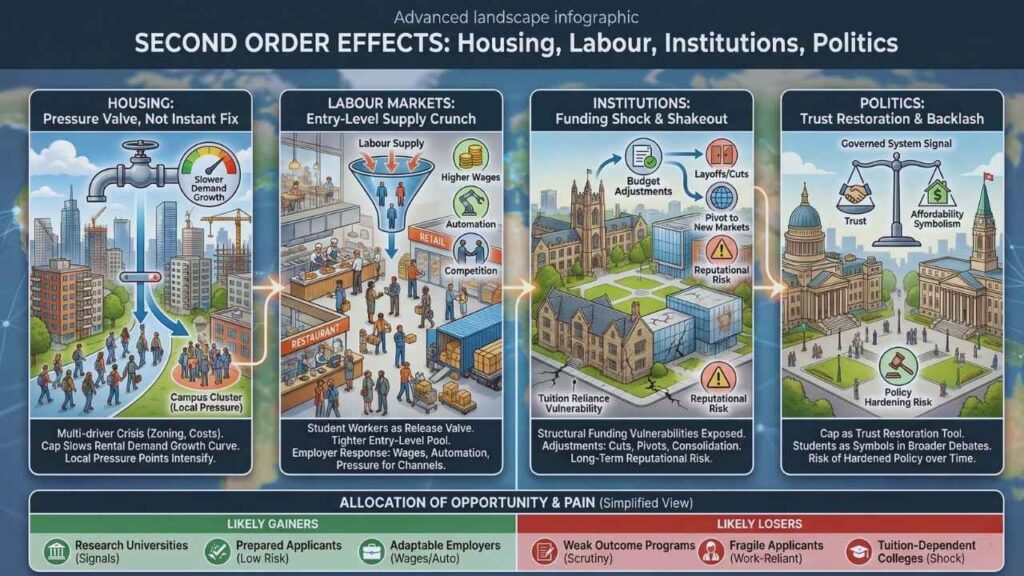
Most commentary stops at “fewer students.” The real story is the second order impacts that ripple through Canada’s housing market, labour supply, institutional budgets, and political environment. Those second order impacts are the reason the cap is likely to endure, and they are also the forces that can eventually reshape it.
Housing: Not A Single Cause, But A Real Pressure Valve
It is simplistic to blame international students for housing stress. Canada’s housing crisis has multiple drivers: underbuilding over many years, zoning restrictions, construction cost inflation, and population growth patterns.
Still, student concentration in certain cities can intensify local pressure, especially where students cluster around campuses with limited affordable rental supply. Housing politics is local, and local politics often drives national decisions.
What the cap can realistically do is slow the growth of rental demand tied to student inflows. It does not instantly reduce rents. It alters the slope of demand growth, which can matter over time, especially if combined with higher rental supply and slowing overall population growth.
Labour Markets: The Quiet Dependency
International students are not only learners. Many became an important part of the entry level labour supply in food service, retail, logistics, and personal services. In a tight labour market, that was a release valve for employers.
A cap reduces the inflow of new student workers over time. That can create labour tightening in sectors that relied on student availability, particularly in urban centres with high student density. Employers respond in predictable ways:
- Higher wages in some segments.
- More automation and scheduling efficiency.
- Higher competition for domestic workers.
- Pressure on policymakers to expand other temporary work channels.
This matters because when the economy feels labour strain, governments often adjust immigration levers again. If sectors start complaining loudly, that could become a political counterweight to the cap.
Institutions: Budget Pain And A Coming Shakeout
The cap exposes structural vulnerabilities in Canada’s post secondary funding model. Institutions that expanded rapidly on international tuition now face harsh adjustments. That shows up as:
- Staff layoffs.
- Program suspensions.
- Campus consolidations.
- A pivot toward different markets and different credentials.
- Lobbying pressure on provinces and Ottawa.
The long term risk is not only financial. It is reputational. Canada’s brand as a reliable destination depends on predictable rules and stable institutions. When programs close, staff are cut, and student supports weaken, Canada’s attractiveness suffers, which can have long lasting effects even if the cap is later relaxed.
Community Politics: Trust And Backlash
The cap is also a trust restoration tool. Policymakers are trying to show that the system is governed, not drifting. In democracies, immigration policy increasingly hinges on whether people believe it is controlled and fair.
The political risk for Canada is that international students become a symbol in broader debates about affordability and services. When that happens, governments harden policy even if the economic case for students remains strong.
A Comparative View Of Who Gains And Who Loses
| Likely Gainers In 2026 | Why | Likely Losers In 2026 | Why |
| Public universities and research intensive pathways | Preferential signals and stronger outcome narratives | Programs with weak labour market payoff | Harder to justify under credibility scrutiny |
| Applicants with clear funds and clean documentation | Scarcity rewards low risk files | Applicants relying on work to survive | Higher proof thresholds make this fragile |
| Provinces and schools that manage housing and supports well | Align with sustainability narrative | Tuition dependent colleges without buffers | Budget shock and program cuts |
| Employers able to raise wages or automate | Can adapt to fewer student workers | Small businesses reliant on student labour | Increased staffing difficulty over time |
This is not moral judgment. It is policy economics. When a cap tightens, the system reallocates opportunity and pain.
What Comes Next: Scenarios For 2026 To 2028 And How South Asian Applicants Can Respond?
Canada Student Visa Cap 2026 is best understood as the midpoint of a larger redesign. The next two years will determine whether Canada lands on a stable managed system or enters a cycle of tightening and backlash.
Below are the most plausible scenarios.
Scenario 1: Managed Stability With A Stronger Quality Filter
In this path, the cap remains but becomes more refined. Provinces distribute spaces with clearer priorities. Institutions with strong compliance and student supports gain a larger share. The attestation process becomes smoother, but more selective.
For South Asian applicants, this is the “hard but fair” world. Approvals are still possible, but the bar is higher and the margin for sloppy documentation disappears.
What this means in practice:
- Stronger advantage for applicants with academically coherent profiles.
- More weight on credible funding and traceable financial history.
- More benefit for university level and high outcome programs.
- More emphasis on showing return value and career logic.
Scenario 2: Further Tightening If Housing And Politics Stay Hot
If housing affordability remains politically explosive, or if temporary resident numbers remain visibly high in key cities, Ottawa may tighten again. Tightening can take different forms:
- Fewer application spaces.
- Narrower exemptions.
- Stricter school eligibility rules.
- Tighter work rights during study.
- Stronger restrictions on pathways associated with exploitation.
For South Asian applicants, this is the most disruptive scenario because it compresses timelines and increases uncertainty. In such an environment, applicant decisions must be earlier, more conservative, and less reliant on “rules might soften.”
Scenario 3: Partial Rebound If Institutions And Labour Pressure Push Back
If the cap triggers significant institutional instability, program collapse, or labour market complaints, Canada could recalibrate by protecting certain streams, not by returning to the old high volume model.
That could look like:
- Increased seats for graduate programs and research linked fields.
- Selective expansion for regions needing population growth.
- Enhanced recognition systems rewarding institutions that provide housing.
- Tighter enforcement against bad actors, paired with increased room for good actors.
This is the scenario where Canada remains selective but becomes more predictable, which is arguably what applicants want most.
A Practical Decision Framework For South Asian Applicants
In a capped environment, the most useful advice is not “apply more.” It is “apply better.”
Use this framework:
Program Fit
Choose a program that clearly matches your academic and professional story. A sudden pivot with weak logic looks risky in a scarcity system.
Institution Signal
Pick institutions with stable reputations, clear student supports, and transparent outcomes. In a cap era, the institution is part of your application credibility.
Financial Clarity
Meet the living funds threshold with documentation that is consistent, traceable, and stable. Avoid last minute unexplained inflows that raise questions.
Timeline Discipline
Because attestation adds a step, plan earlier. Delays can push you into bottlenecks, even with an offer letter in hand.
Integrity First
Never rely on shortcuts, fabricated statements, or questionable agents. A refusal or misrepresentation finding can carry long term consequences beyond Canada.
Why This Matters Beyond 2026?
Canada’s student pathway has been one of the most powerful mobility channels for South Asian families. It shaped not only education choices, but household investment plans, career strategies, and migration aspirations.
Canada Student Visa Cap 2026 signals that this channel is being redesigned into something more selective, more regulated, and more politically anchored to housing and services. That makes it less forgiving, but it also has the potential to become more sustainable if executed well.
The central trade off is clear: Canada is trying to protect the legitimacy of the system by reducing volume and raising standards. If the redesign succeeds, genuine students benefit from a cleaner, more trusted pathway. If it overshoots, Canada risks damaging its education brand and pushing talent elsewhere.