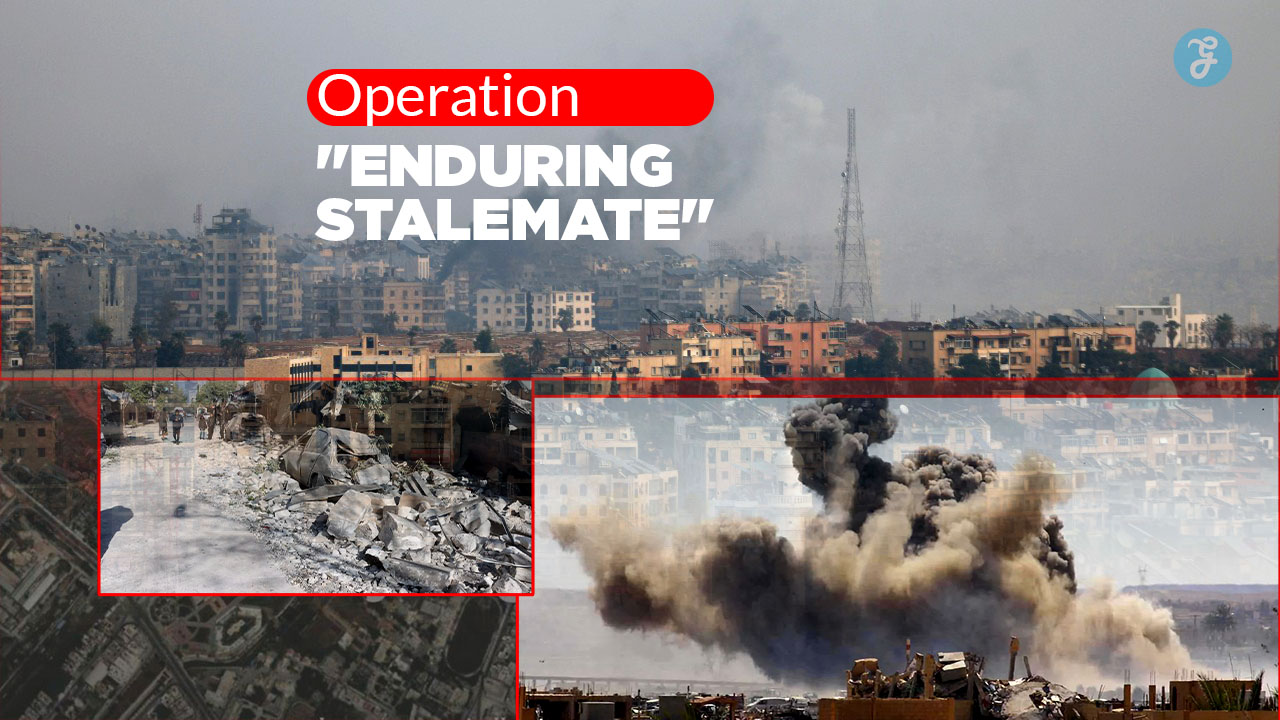
Overnight, the Pentagon confirmed a massive aerial offensive against ISIS strongholds in central Syria—the most significant American intervention since the collapse of the Assad regime in late 2024. Ostensibly a retaliation for the deadly December ambush in Palmyra, these strikes signal a grim reality: the U.S. strategy of “over-the-horizon” containment is failing as the terror group metastasizes in the chaotic vacuum of the new Syrian order.
Key Takeaways
- The Event: US CENTCOM launched “Operation Hawkeye Strike” on Jan 10-11, 2026, utilizing F-15E Strike Eagles and AC-130J Ghostriders to hit ~70 targets in the Syrian Badia.
- The Trigger: A direct response to the Dec 13, 2025, ambush in Palmyra that killed two US special operators and a local interpreter.
- The Shift: ISIS has evolved from a territorial “caliphate” to a high-mobility “digital insurgency,” exploiting the fragility of Ahmed al-Sharaa’s (formerly Abu Mohammad al-Julani) interim government.
- The Dilemma: The strikes force the Trump administration to re-engage militarily, contradicting campaign promises of withdrawal and exposing the severe limitations of relying on the SDF and the new Damascus government for security.
The Context: A “Victory” That Wasn’t
To understand why U.S. aircraft are once again lighting up the Syrian sky in January 2026, one must look back at the seismic shifts of late 2024. The fall of Bashar al-Assad on December 8, 2024, and the subsequent rise of the transitional government led by Ahmed al-Sharaa was hailed by Western policymakers as the potential end of the civil war. The “New Syria” was supposed to be a stabilizer, a chance to rebuild a fractured nation.
They were wrong. Instead of stability, the transition created a security archipelago.
The new government in Damascus is laser-focused on securing urban centers—Damascus, Aleppo, Homs—to gain international legitimacy and restart the economy. This strategic prioritization left the Badia al-Sham (Syrian Desert)—a vast, ungoverned expanse of 20,000 square miles—completely exposed. ISIS didn’t disappear when their last village fell; they simply waited in the limestone caves of the Badia, watching as Russian Wagner mercenaries withdrew and the inexperienced new Syrian Army failed to fill the void.
The strategic lethargy of 2025, characterized by a U.S. drawdown to under 800 troops and a reliance on “flexible oversight,” has now hit a hard wall. The December 2025 Palmyra ambush was not a random skirmish; it was a stress test of U.S. resolve. Operation Hawkeye Strike is the answer, but it is a tactical patch on a strategic wound.
Core Analysis: Anatomy of a Broken Strategy
1. The Failure of “Light Footprint” Containment
The U.S. approach since 2025 has been predicated on the “Economy of Force” model: minimal troops on the ground, maximum reliance on drones, signals intelligence (SIGINT), and local partners. Operation Hawkeye Strike exposes the fatal flaw in this logic. Airpower can degrade infrastructure, but it cannot root out an enemy embedded in complex desert geography without ground clearance.
The need for a “large-scale” strike package involving 20+ aircraft suggests that intelligence had identified a target set far larger than a few scattered insurgents—implying ISIS had established semi-permanent training camps right under the nose of the coalition.
The Escalation Matrix (Military Posture 2024–2026)
| Feature | 2024 (Assad Era) | 2025 (Transition Year) | Jan 2026 (Current Status) |
|---|---|---|---|
| Primary Opponent | Syrian Army / Russia | SDF / Local Militias | US Special Forces / New Syrian Army |
| ISIS Tactic | IEDs / Small Ambush | Prison Break Attempts | Coordinated Company-sized Raids |
| US Troop Levels | ~900 | < 800 (Drawdown) | Under Review (Potential Surge) |
| Avg. Monthly Attacks | ~15 | ~45 | 70+ (January projected) |
| Key Battleground | Deir ez-Zor Oil Fields | Hasakah Prisons | Palmyra-Homs Highway |
Analytical Insight: The shift from “Small Ambush” to “Company-sized Raids” indicates ISIS has re-established a command-and-control hierarchy capable of maneuvering large units, something thought destroyed in 2019.
2. The “New Syria” Governance Gap
The interim government of Ahmed al-Sharaa is proving to be a weak partner in counter-terrorism. Despite rebranding himself from a jihadist leader to a suit-wearing statesman, Al-Sharaa lacks the capacity to project power into the desert hinterlands.
- Legitimacy Crisis: The transition from HTS commander to President has not convinced the international community to fully fund reconstruction. The government is preoccupied with fending off internal coups and managing the economic crisis, leaving rural security to tribal warlords who are often coerced or bribed by ISIS.
- Operational Bandwidth: The new Syrian Army is currently deploying 60% of its elite units to the southern border to manage Druze unrest and secure the frontier with Jordan, leaving the central desert wide open.
- The Consequence: ISIS is no longer fighting a unified state; they are fighting a fractured collection of militias, allowing them to move men and materiel with impunity.
Political Stakeholders (Winners & Losers)
| Actor | Stance on US Strikes | Strategic Goal | Status |
|---|---|---|---|
| US (Trump Admin) | Reluctant Actor | Avoid “Forever War” but prevent Caliphate 2.0 | Trapped |
| Ahmed al-Sharaa | Silent Approval | Needs US to clear ISIS but can’t admit it publicly | Dependent |
| SDF (Kurds) | Supportive | Desperate for US air cover to protect oil revenue | Vulnerable |
| ISIS | Hostile | Provoke US into a ground war to boost recruitment | Resurgent |
| Russia | Observer | Watch US get bogged down; offer “mediation” later | Opportunistic |
3. The Economic Stranglehold & The SDF
ISIS is systematically targeting the economic lifelines of both the Kurdish-led Syrian Democratic Forces (SDF) and the Damascus government. By hitting oil convoys coming from the Omar field, they are depriving the SDF of revenue needed to pay their prison guards and security forces.
The SDF remains the most capable anti-ISIS force, but they are critically overstretched. They are fighting a two-front war: guarding 10,000+ ISIS prisoners in makeshift detention centers while simultaneously trying to integrate into the new Syrian federal structure. With U.S. aid tapering off in 2025, the SDF’s ability to conduct aggressive sweep operations has diminished. The recent uptick in attacks on SDF oil facilities in Deir ez-Zor (13 attacks in early 2026 alone) shows ISIS is dismantling the SDF’s economic engine.
Economic Impact of Insecurity
| Sector | Impact | Consequence |
|---|---|---|
| Oil Production | Down 40% (vs 2024) | SDF cannot pay salaries for anti-ISIS forces. |
| Transport Costs | Up 300% | Food prices in Damascus skyrocketing. |
| Reconstruction | Halted | Foreign investors (Gulf States) pulling out due to risk. |
| Illicit Revenue | High | ISIS earning est. $4M/month from extortion/smuggling. |
4. The Geopolitical Vacuum
Russia, once the guarantor of the Assad regime, is a shadow of its former self in the region. Preoccupied with its own post-Assad recalibration and the ongoing war in Ukraine, Moscow has reduced its sorties in Syria significantly. This has removed a key layer of pressure on ISIS.
Where Russian Wagner Group mercenaries once ruthlessly patrolled the desert oil fields, there is now a void. Iran, similarly, is recalibrating its influence following the regime change, leaving the U.S. as the sole external power capable of projecting force—a role Washington desperately wants to shed but cannot seem to escape.
Expert Perspectives
To understand the gravity of the situation, we must look at the differing viewpoints within the intelligence and defense communities.
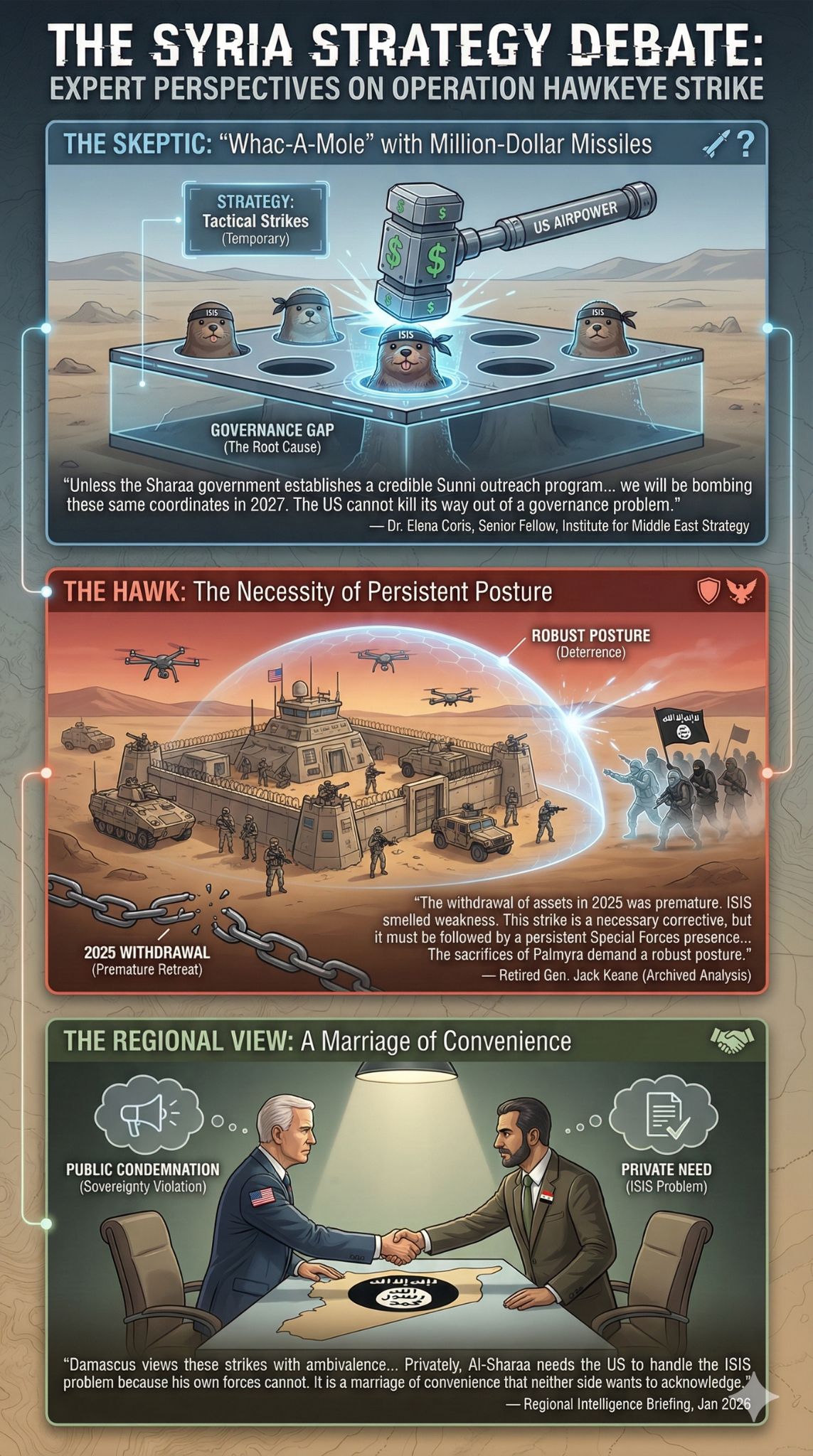
The Skeptic: “Operation Hawkeye is ‘Whac-A-Mole’ with million-dollar missiles. Unless the Sharaa government establishes a credible Sunni outreach program in the central tribes, we will be bombing these same coordinates in 2027. The US cannot kill its way out of a governance problem. The strikes may degrade immediate capabilities, but they do not address the root cause: the vacuum of governance in the Badia.” — Dr. Elena Coris, Senior Fellow at the Institute for Middle East Strategy.
The Hawk: “The withdrawal of assets in 2025 was premature. ISIS smelled weakness. This strike is a necessary corrective, but it must be followed by a persistent Special Forces presence. If we rely solely on airpower, we risk a repeat of 2014. The sacrifices of Palmyra demand a robust posture, not a retreat.” — Retired Gen. Jack Keane (Archived Analysis).
The Regional View: “Damascus views these strikes with ambivalence. Publicly, they condemn the violation of sovereignty to appease anti-American sentiment. Privately, Al-Sharaa needs the US to handle the ISIS problem because his own forces cannot. It is a marriage of convenience that neither side wants to acknowledge.” — Regional Intelligence Briefing, Jan 2026.
Future Outlook: What Comes Next?
The strikes have bought time, but they have not bought a solution. We are entering a dangerous new phase of the conflict.
- The “Forever War” Debate Returns: The Trump administration faces a binary choice: surge troops to secure the victory, or accelerate withdrawal and risk a full-blown Caliphate 2.0. Expect fierce Congressional debate over the War Powers Resolution in Q1 2026. The political appetite for a new Middle East surge is non-existent, yet the security imperative is undeniable.
- SDF Integration vs. Independence: The pressure from ISIS will force the SDF to make a hard choice—fully integrate into the Damascus army for protection (thereby losing autonomy) or demand increased US protection (which may not come). This decision will define the future map of Syria.
- The Prison Break Threat: Intelligence indicates ISIS’s next major strategic objective is a “breaking the walls” campaign to free the 10,000 fighters held in Hasakah and Al-Hol. If successful, this would instantly replenish their ranks with combat-hardened veterans, potentially overwhelming local security forces.
- Asymmetric Evolution: Expect ISIS to pivot from ambushes to urban terror in Damascus and drone warfare against US bases, attempting to raise the political cost of the American presence. They are likely to utilize commercial drones modified for combat, a tactic refined in other conflicts and now adopted by the insurgency.
Strategic Verdict: Operation Hawkeye Strike proves that while the “Caliphate” as a map-color is gone, the idea and the army remain intact. The US is no longer “containing” ISIS; it is actively fighting a second war, one that looks suspiciously like the “Enduring Stalemate” of a decade ago.