

AI-Powered Adaptive Learning is rapidly transforming the modern classroom from a static environment of standardized testing into a dynamic, personalized ecosystem. In 2026, the days of teaching to the “average” student are fading as schools embrace technology that adjusts to individual learning curves in real-time.
This shift is not merely about digitizing textbooks; it is a fundamental reimagining of how knowledge is transferred, ensuring that every student, regardless of their starting point, receives the tailored support they need to master complex concepts.
As we navigate the academic landscape of 2026, educators are finding that artificial intelligence is no longer just a futuristic concept but a daily “co-pilot” that helps close equity gaps and recover lost learning time. This comprehensive guide explores how adaptive learning works, the tangible benefits it offers to overworked teachers, and the critical challenges we must solve to ensure a fair future for all students.
Key Takeaways
- Definition: AI-powered adaptive learning uses algorithms to adjust curriculum, pace, and teaching styles in real-time for individual students.
- Teacher Role: AI acts as a “co-pilot,” automating grading and data tasks (saving ~40% of time) so teachers can focus on mentorship.
- Student Benefit: It enables mastery-based learning, allowing students to remediate gaps privately and move fast when they are ready.
- Major Risks: Data privacy, algorithmic bias, and the digital divide remain the biggest hurdles to equitable implementation.
- Future Trends: The integration of Emotional AI and Virtual Reality will create holistic, immersive learning environments that respond to human feelings as well as intellect.
What is Adaptive Learning Technology?
At its core, adaptive learning is the pedagogical practice of delivering custom learning experiences that address the unique needs of an individual through just-in-time feedback, pathways, and resources. While the concept has existed for decades, the integration of generative AI and machine learning has supercharged its capabilities.
From “One-Size-Fits-All” to “Hyper-Personalization”
In a traditional model, a teacher delivers a lesson on fractions. Some students grasp it instantly and get bored; others are lost within minutes and disengage. The class moves on regardless.
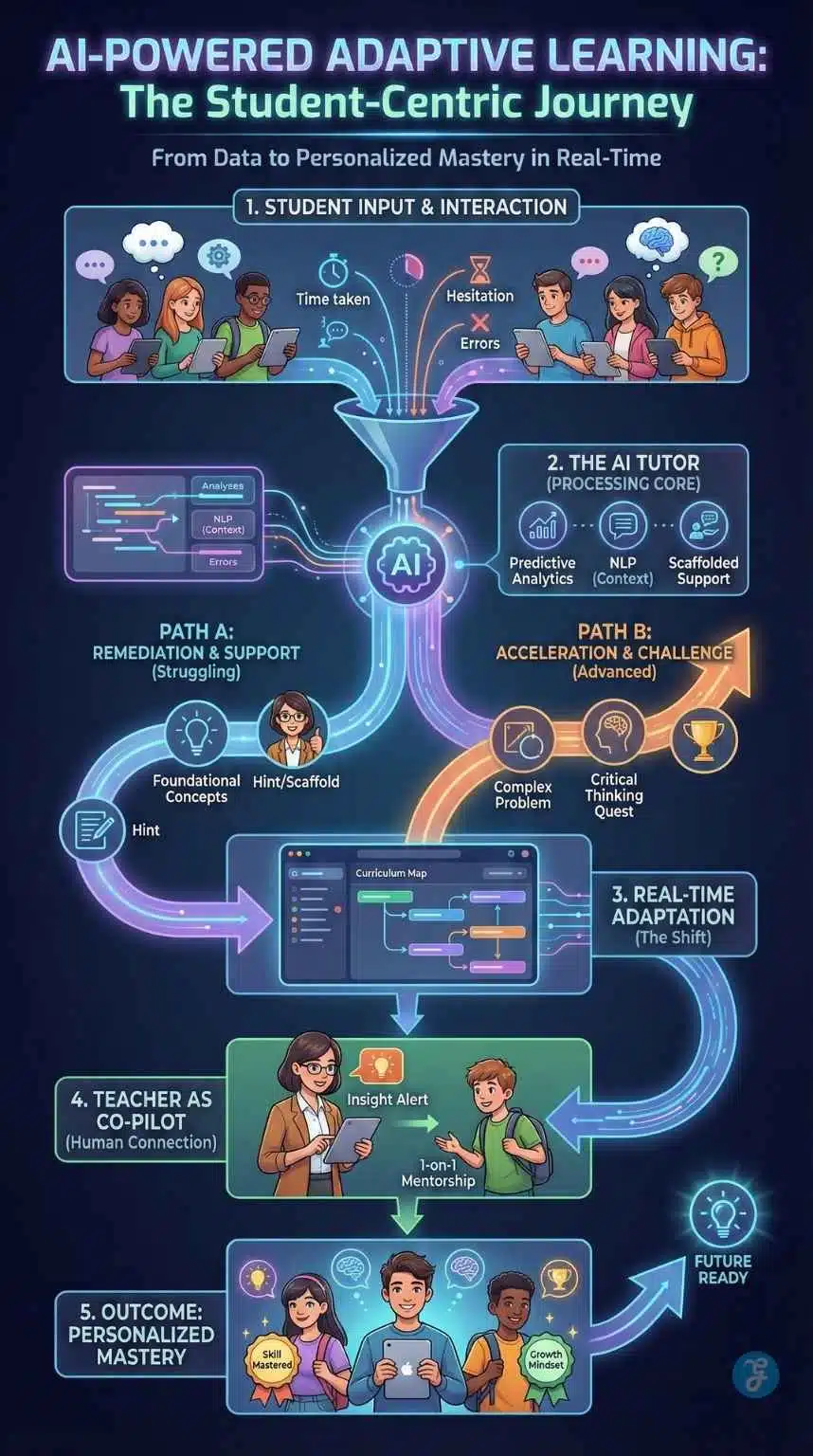
AI-powered adaptive learning changes this trajectory. It utilizes sophisticated algorithms to analyze a student’s interactions with the material. It doesn’t just score a quiz; it looks at how the student answered. Did they hesitate? did they change their answer three times? Did they rush through the reading? Based on these thousands of data points, the system alters the curriculum in real-time.
The Technology Behind the Screen: Intelligent Tutoring Systems (ITS)
Modern adaptive platforms function as Intelligent Tutoring Systems (ITS). These systems use cognitive science principles to model a learner’s psychological state.
- Predictive Analytics: The system predicts the probability of a student failing a future module based on current performance and intervenes before the failure happens.
- Natural Language Processing (NLP): In 2026, adaptive tools can now read and grade essays, not just multiple-choice questions. They can understand the intent behind a student’s written answer, identifying if a wrong answer was due to a calculation error or a fundamental misunderstanding of the concept.
- Scaffolded Support: If a student struggles, the AI doesn’t just give the answer. It provides “scaffolding”—breaking the problem into smaller steps or offering a hint—just like a human tutor would. As the student demonstrates mastery, the scaffolding fades away.
The 3 Pillars of Change: Benefits for the Ecosystem
The adoption of AI in education is driven by measurable improvements in efficiency and outcomes. Recent data from late 2024 and early 2026 highlights three primary beneficiaries: the student, the teacher, and the school administration.
1. For Students: Mastery, Agency, and Engagement
The most immediate impact of adaptive learning is the shift from “time-based” learning (sitting in a chair for 45 minutes) to “mastery-based” learning (moving on when you understand the topic).
- Closing the Remediation Gap: Post-pandemic learning loss remains a critical issue. Adaptive tools allow students to catch up on grade-level skills privately. A 10th-grade student struggling with 7th-grade math concepts can review them without the social stigma of raising their hand in class to ask a “basic” question.
- Gamification 2.0: We have moved beyond simple “badges.” New platforms use AI to determine what specifically motivates a student. For some, it is a competitive leaderboard; for others, it is a narrative-driven quest where math problems unlock the next chapter of a story.
- Immediate Feedback Loops: In traditional settings, a student might wait days for a graded paper. By then, the “teachable moment” is lost. Adaptive AI provides instant feedback, correcting misconceptions the second they occur.
2. For Teachers: The Gift of Time
Contrary to the fear that AI will replace educators, it is actually saving them from burnout. By automating administrative drudgery, AI returns approximately 40% of a teacher’s time, allowing them to focus on high-value activities like mentorship and emotional support.
Where AI Saves Teacher Time [2026 Estimates]:
| Task Category | Traditional Time Cost | AI-Assisted Time Cost | Improvement |
| Grading & Assessment | 6-10 hours/week | 1-2 hours/week | ~80% Reduction |
| Lesson Planning | 5-7 hours/week | 1-2 hours/week | ~70% Reduction |
| Data Entry & Admin | 3-4 hours/week | <1 hour/week | ~75% Reduction |
| 1-on-1 Remediation | Impossible for all students | Scalable via AI Tutors | 100% Scale |
3. For Schools: Data-Driven Equity
School districts are using predictive analytics to identify “at-risk” students months before a report card is issued. By analyzing patterns in attendance, login times, and quiz degradation, schools can deploy human counselors to intervene early, significantly reducing dropout rates.
Real-World Applications & Leading Tools [2026 Update]
The landscape of educational technology is crowded, but a few platforms have emerged as leaders by effectively utilizing AI-powered adaptive learning.
Leading Platforms
- Century Tech: This platform combines AI with neuroscience. It identifies “gaps” in knowledge and constantly refills them. If a student forgets a concept learned two weeks ago, Century Tech reintroduces it in a new context to reinforce long-term memory.
- DreamBox Learning: A pioneer in adaptive math, DreamBox adapts not just to correctness but to the strategy a student uses to solve a problem. It encourages critical thinking over rote memorization.
- Khanmigo (Khan Academy): Powered by advanced large language models (LLMs), Khanmigo acts as a Socratic tutor. Instead of giving answers, it asks guiding questions (“What do you think the next step is?”), encouraging students to think critically.
- Microsoft Reading Coach: This tool listens to students read aloud. The AI analyzes pronunciation, fluency, and reading speed, generating instant, personalized practice assignments to target specific struggle words.
The Rise of Generative Lesson Planning
A major trend in 2026 is the use of Generative AI for curriculum design. Teachers can now input a prompt like: “Create a 3-day lesson plan on the Civil War for a class with diverse reading levels, including 3 visual activities and a quiz.” The AI generates a differentiated lesson plan in seconds, which the teacher can then refine. This ensures that even “static” classroom lessons are adapted to the general profile of the students.
The AI Literacy Mandate: The ‘Meta’ Skill
As we integrate adaptive tools, a critical new subject is emerging—not just using AI to learn math or history, but learning AI Literacy itself. In 2026, simply being a “user” is no longer sufficient; students must become critical evaluators of the technology shaping their worldview.
- Solving the “Black Box” Problem: Research indicates that while students are “digital natives,” they often trust algorithmic outputs blindly. AI literacy teaches them to peek inside the “black box”—understanding that an answer from ChatGPT or an adaptive tutor is a probabilistic prediction, not an absolute truth.
- Prompt Engineering as a Core Competency: We are moving away from the “search query” mindset (keywords) to the “prompt engineering” mindset (context and iteration). Students are learning to treat AI as a debate partner rather than an answer key. For example, instead of asking, “What are the causes of WWI?” a literate student asks, “Act as a historian in 1919 and explain the causes of the war from the perspective of the losing side.”
- Ethics and Attribution: AI Literacy also covers the “rules of the road.” Schools are now implementing “AI citations,” where students must disclose which parts of an assignment were AI-generated and which were human-created, fostering a culture of transparency rather than prohibition.
While the promise of AI-powered adaptive learning is immense, its implementation is fraught with ethical and logistical hurdles. Ignoring these challenges risks creating a two-tiered education system.
1. Data Privacy and Security
To function effectively, adaptive systems require vast amounts of data, behavioral, academic, and sometimes emotional.
- The Risk: There is a genuine concern regarding who owns this data. Parents and advocates worry about “data persistence”—will a student’s struggle with reading in 3rd grade follow them on a permanent digital record that colleges or employers could see?
- The Solution: In 2026, schools are demanding “local-only” processing and strict adherence to updated privacy laws (like GDPR in Europe and updated FERPA guidelines in the US) that ensure data is anonymized and never sold to third-party advertisers.
2. Algorithmic Bias
AI models are trained on historical data, which often contains societal biases. If an algorithm is trained primarily on data from wealthy, suburban schools, it may fail to accurately assess or engage students from different cultural or linguistic backgrounds.
- Bias in Assessment: There have been instances where AI speech recognition tools struggled to understand accents or dialects, unfairly penalizing students for “incorrect” reading when they were simply speaking in their native dialect. Developers are now under immense pressure to train models on diverse, representative datasets.
3. The Infrastructure Gap (Digital Divide)
Adaptive learning relies on high-speed internet and modern devices.
- The Reality: In underfunded rural or urban districts, reliable Wi-Fi is still not guaranteed. If a student cannot access the adaptive platform at home, they lose the benefits of continuous learning. Bridging this “homework gap” is essential to preventing AI from widening the achievement gap between rich and poor students.
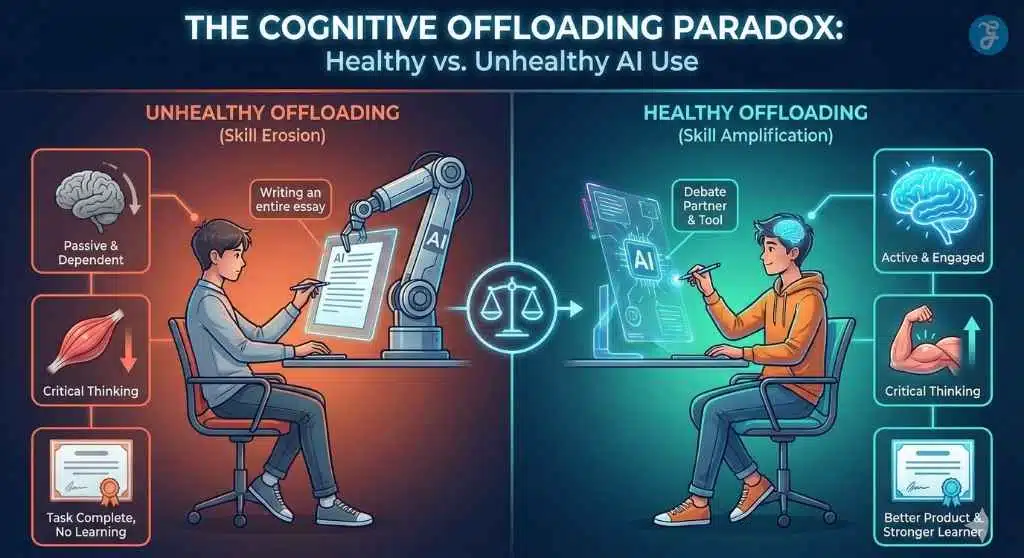
- The Cognitive Offloading Paradox Perhaps the most nuanced challenge of 2026 is “cognitive offloading”—the psychological phenomenon where we offload mental processing to external tools. While offloading has always existed (we use calculators to offload long division), AI raises the stakes.
- Healthy vs. Unhealthy Offloading: The key distinction educators are drawing is between offloading effort and offloading thinking.
- Healthy: Using AI to check grammar so the student can focus on the argument’s structure.
- Unhealthy: Using AI to generate the thesis statement itself, which bypasses the critical neural struggle required to form complex thoughts.
- The Risk of “Skill Erosion”: There is a growing body of research warning against “skill erosion” in writing and analysis. If a student never struggles through the “messy middle” of drafting an essay because an AI smooths it out instantly, they may fail to develop the resilience and critical thinking pathways that are essential for adulthood. The goal of adaptive learning must be to assist the struggle, not remove it entirely.
The Future: Emotional AI and Immersive Learning
Looking beyond 2026, the next frontier of AI-powered adaptive learning is the integration of emotion and immersion.
Emotional AI (Sentiment Analysis)
Pilot programs are currently testing systems that use computer vision (with consent) and keystroke dynamics to detect student sentiment.
- Scenario: A student is staring blankly at the screen and typing aggressively. The AI recognizes signs of “frustration” or “cognitive overload.”
- Intervention: Instead of pushing the next hard problem, the system pauses. It might suggest a 2-minute breathing exercise, switch to a gamified review activity to boost confidence, or alert the teacher that the student needs a human check-in. This moves AI from being purely academic to being holistic.
VR + AI: The Ultimate Simulation
Adaptive learning is merging with Virtual Reality (VR).
- Adaptive Simulations: Imagine a biology student performing a virtual dissection. If the student’s hand tremors or they make an incision too deep, the AI adjusts the simulation difficulty or highlights the correct path in glowing green.
- History & Empathy: In history class, AI-driven avatars in a VR simulation can interact with students, answering questions about their “lives” in the 1920s or Ancient Rome, dynamically generating dialogue based on the students’ inquiries.
The School Implementation Checklist [2026 Edition]
For administrators and lead teachers ready to move from theory to practice, use this checklist to ensure a safe and effective rollout of AI adaptive learning.
| Phase | Action Item | Success Indicator |
| 1. Audit | Check Data Sovereignty | Vendor contract explicitly states data is “local-only” and never sold/mined for ads. |
| Assess Bandwidth | Wi-Fi network can support simultaneous video-heavy AI tasks for 100% of the student body. | |
| 2. Prep | “Opt-Out” Protocol | A clear, non-punitive alternative path exists for parents who refuse AI data collection. |
| Teacher Training | Staff are trained not just on how to use the tool, but when to override its recommendations. | |
| 3. Pilot | The “10% Rule” | Start with 10% of classrooms (innovator teachers) for one semester before district-wide rollout. |
| Equity Scan | Verify that students without home internet are not disadvantaged by homework requirements. | |
| 4. Review | Cognitive Check-in | Survey students: “Do you feel you are thinking more or less when using this tool?” |
Frequently Asked Questions (FAQs)
1. Will AI replace teachers in the classroom?
No. The consensus among educators and technologists is that AI cannot replace the human connection, empathy, and mentorship that a teacher provides. Instead, AI changes the teacher’s role from “lecturer and grader” to “facilitator and mentor.” It handles the repetitive tasks, freeing the teacher to work one-on-one with students who need it most.
2. Is adaptive learning expensive to implement?
It varies. While enterprise-level platforms can be costly for districts, the market is becoming competitive. Many tools offer tiered pricing, and some (like Khan Academy’s core features) remain free. However, the “hidden” cost often lies in the infrastructure—buying tablets for every student and upgrading school Wi-Fi bandwidth.
3. How does AI handle students with special needs?
Exceptionally well. This is one of AI’s strongest use cases. Adaptive tools can instantly modify content accessibility—changing text-to-speech, increasing font size, altering color contrast for color blindness, or simplifying language complexity, without the teacher needing to create five different versions of a handout.
4. Is student data safe with these AI platforms?
It is a valid concern. Most reputable ed-tech companies use high-level encryption and comply with laws like COPPA and FERPA. However, schools must rigorously vet vendors. Parents should ask their school districts about “data retention policies”, specifically, asking if data is deleted after the student graduates.
5. Can adaptive learning work for creative subjects like Art or English?
Yes, increasingly so. While math was the first frontier, generative AI now allows for adaptive writing feedback. An AI can critique a poem’s structure or suggest deeper vocabulary for an essay. In art, AI tools can suggest techniques or historical references based on the style a student is attempting to emulate.
Final Thoughts: Empowering the Learner
The era of AI-powered adaptive learning is not about surrendering education to machines; it is about liberating human potential from the constraints of a rigid system. For too long, our education system has treated students like assembly line products, expecting them all to learn the same thing, at the same time, in the same way.
In 2026, we will finally have the tools to break that mold. By leveraging AI to handle the logistics of personalization, we free up teachers to do what they do best: inspire, encourage, and guide. As we move forward, the goal is not a classroom run by robots, but a classroom where every student feels seen, understood, and supported on their unique journey toward mastery.
Is your school ready for the AI shift? The technology is here; the next step is ensuring we use it with wisdom, equity, and empathy.





















