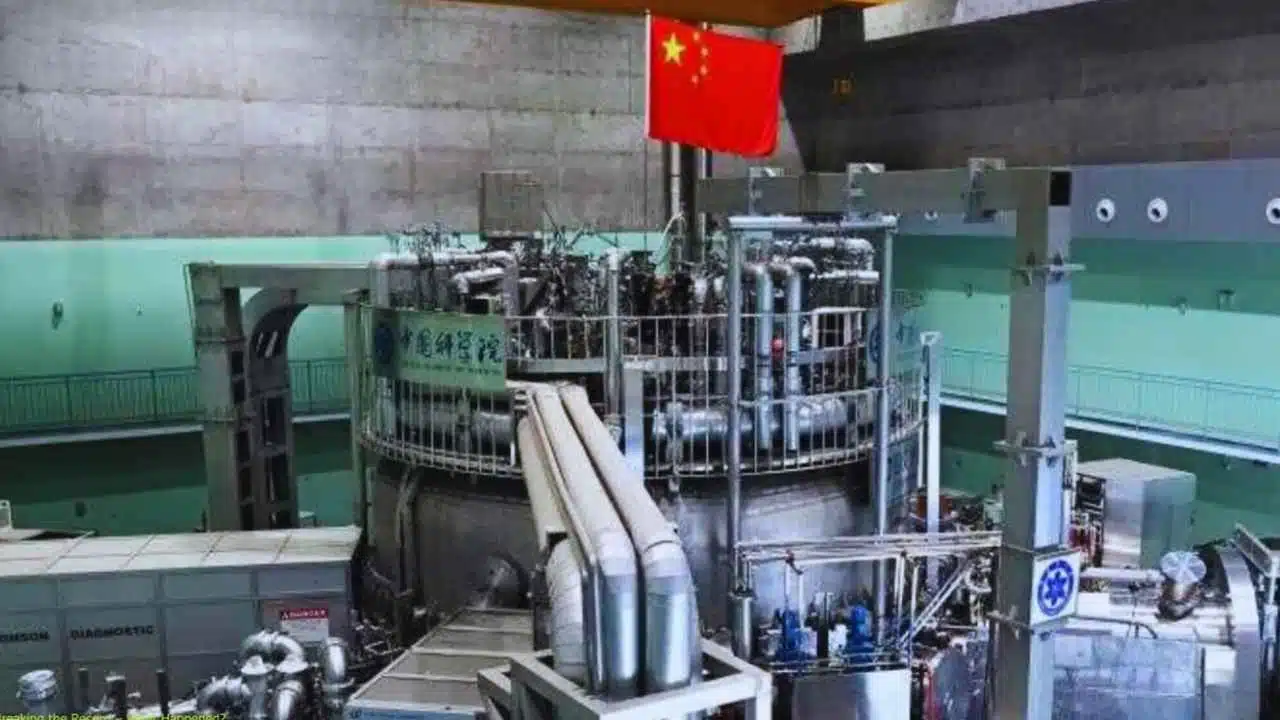
China’s EAST fusion device has run stable plasmas at 1.3 to 1.65 times a long-standing density cap, the Greenwald limit, using a startup heating method that may help future reactors reach higher power without triggering disruptions.
What Happened At EAST—and Why It Matters
Researchers working on China’s Experimental Advanced Superconducting Tokamak (EAST) report stable plasma operation at line-averaged electron densities between 1.3 and 1.65× the Greenwald density limit—a threshold that has shaped tokamak operations since the late 1980s. The result is detailed in a 2025 research preprint led by Ping Zhu and colleagues, with Ning Yan among the co-authors, and carried out with the broader EAST team.
This is significant for one simple reason: fusion power scales strongly with fuel density. Higher plasma density generally means more fusion reactions—if temperature and confinement can be maintained. But as tokamaks push density upward, they often hit disruptive instabilities and performance collapse. That “ceiling” has been widely summarized by the Greenwald limit, an empirical scaling proposed in 1988.
EAST’s new result matters because it does not rely on a brief spike. The team describes operating in a “density-free regime” consistent with a plasma–wall self-organization framework—where wall conditions and impurity radiation help stabilize the discharge at densities that typically trigger disruptions.
Breaking Down The Greenwald Limit
The Greenwald limit is an empirical relationship that links the maximum sustainable average density to the plasma current and the plasma cross-sectional area. In practice, it became a rule-of-thumb boundary: go much beyond it, and many tokamaks historically saw rising radiation losses, degraded confinement, and a higher risk of disruptions.
Fusion engineers care because commercial reactors will need to operate in regimes that are both high density and high confinement for long durations, with minimal disruptions. Any credible path to reliable operation above this density boundary improves the outlook for next-step devices.
How EAST Did It: Startup Heating And Wall Conditioning
The approach described in the EAST study combines:
- Electron Cyclotron Resonance Heating (ECRH) during the Ohmic startup phase
- Sufficiently high pre-filled neutral gas pressure
- Careful attention to plasma-facing component conditions (EAST uses tungsten-facing components in key regions)
In the reported experiments, ECRH-assisted startup and higher initial neutral density are used to influence the early plasma–wall interaction, in ways that reduce conditions that otherwise promote impurity accumulation and radiative collapse. The authors describe this as consistent with plasma–wall self-organization (PWSO) theory, which predicts that certain start-up and boundary conditions can shift the system into a higher-density operating basin—what they call a density-free regime.
In plain terms: the startup recipe appears to shape the edge and divertor environment so the plasma can accept more fuel without tipping into the instability and radiation-loss patterns typically associated with the density limit.
Key Numbers At A Glance
| Metric | Typical Reference/Expectation | EAST Reported Result | Why It Matters |
| Normal EAST operating range (reported in study) | ~0.8–1.0 × Greenwald limit | — | Baseline for comparison |
| Achieved line-averaged density | 1.0 × Greenwald limit (traditional “cap”) | 1.3–1.65 × | Higher density can raise fusion power potential |
| Method | Standard startup | ECRH-assisted Ohmic startup + higher prefill | Indicates a potentially repeatable control knob |
| Claimed regime | Density-limited basin | “Density-free regime” | Suggests a path beyond an old operational boundary |
Source: EAST density-limit study preprint.
Why Density Is So Hard In Tokamaks
Tokamaks balance a hot, charged plasma using magnetic fields. As density rises, several risk factors can increase:
- Edge cooling and higher radiation losses
- More impurities entering from plasma-facing materials
- Instability pathways that can end in disruptions
- Confinement degradation near the operational boundary
These challenges are not new, and multiple models have been proposed to explain why the density limit appears so robust across machines. Research literature has debated whether limits are driven by edge radiation physics, confinement changes, or magnetohydrodynamic stability mechanisms—often with the same outcome: density pushes the plasma toward a cliff.
The EAST work is drawing attention because it frames density control as a coupled plasma–wall system problem, where wall conditions and impurity radiation are not just “side effects” but part of the control strategy.
How This Compares With Other High-Density Advances
EAST is not the first tokamak to report operation above the Greenwald limit. But the importance here is the combination of:
- A stated mechanism to reach and sustain the regime (startup method + boundary conditions)
- A theory-linked “density-free” operating description (PWSO prediction and experimental alignment)
- A roadmap claim: potentially scalable to future burning-plasma devices
Separately, other research has demonstrated improved confinement at elevated density in specific regimes (for example, high-poloidal-beta scenarios) and coordinated studies across devices have examined how turbulence suppression can improve performance near density boundaries.
The open question—and the one fusion researchers will watch next—is whether EAST’s density method can be paired with high-confinement (H-mode) performance in a way that is compatible with reactor-grade requirements.
What’s Next: Testing Under High-Confinement Conditions
The EAST team says it plans to apply the method in high-confinement operations to see whether the same density-free behavior can be accessed in conditions closer to those needed for fusion power generation.
That matters because exceeding a density limit is only one piece of the puzzle. For practical fusion, devices must sustain:
- High temperature
- High density
- Strong energy confinement
- Long duration operation
- Acceptable wall/heat loads
- Low disruption rates
If the technique works only in restricted startup or lower-performance scenarios, it is still scientifically valuable but less transformative for reactors. If it extends into high-performance regimes, it becomes a bigger deal.
The Broader Context: ITER’s Updated Path And China’s Reactor Plans
Fusion development is increasingly shaped by a mix of national programs and international collaborations.
ITER’s Schedule Reality Check
ITER’s older public timeline often highlighted “first plasma” in 2025. ITER’s own materials still describe an updated date of December 2025 under a prior baseline schedule.
However, ITER leadership has also presented a new baseline approach that shifts emphasis from a minimal “first plasma” milestone to more complete research operations later. A July 2024 ITER press-conference summary describes a new baseline concept that envisions Start of Research Operation (SRO) in 2034, reflecting changes intended to reduce risk and improve robustness.
China’s Next-Step Reactor (CFETR)
China’s China Fusion Engineering Test Reactor (CFETR) is widely described as a bridge between ITER and a demonstration power plant, with staged goals including tens to hundreds of megawatts in earlier phases and DEMO-relevant power levels later. A peer-reviewed engineering design paper summarizes CFETR’s phased targets and mission scope.
EAST’s Momentum: The 1,066-Second High-Confinement Run
The density result arrives after EAST also reported a long-duration confinement milestone: 1,066 seconds of steady-state high-confinement plasma on January 20, 2025, described as a world record for that operating mode duration.
Long pulses matter because commercial fusion plants would need steady or near-steady operation, not just short experimental shots.
Timeline: Why These Milestones Stack Up
| Milestone | Date | What It Signaled |
| Greenwald density limit proposed | 1988 | A practical density ceiling used across tokamaks |
| EAST high-confinement long pulse | Jan 20, 2025 | 1,066-second sustained high-confinement operation |
| EAST density-limit report posted | May 5, 2025 | 1.3–1.65× Greenwald density with stability claims |
| ITER new-baseline concept outlined | July 2024 | Shift toward robust research operations timeline |
EAST’s report of stable operation at 1.3–1.65× the Greenwald limit is a meaningful scientific step because it targets a long-standing operational barrier with a repeatable control approach—ECRH-assisted startup and boundary-condition management—rather than a one-off spike.
The next, most important test is whether this higher-density path can hold under high-performance confinement conditions and remain compatible with long-pulse operation. If it does, the work strengthens the case that density ceilings in tokamaks are not fixed laws of nature—but engineering and physics constraints that can be shifted with better control of the plasma–wall system.