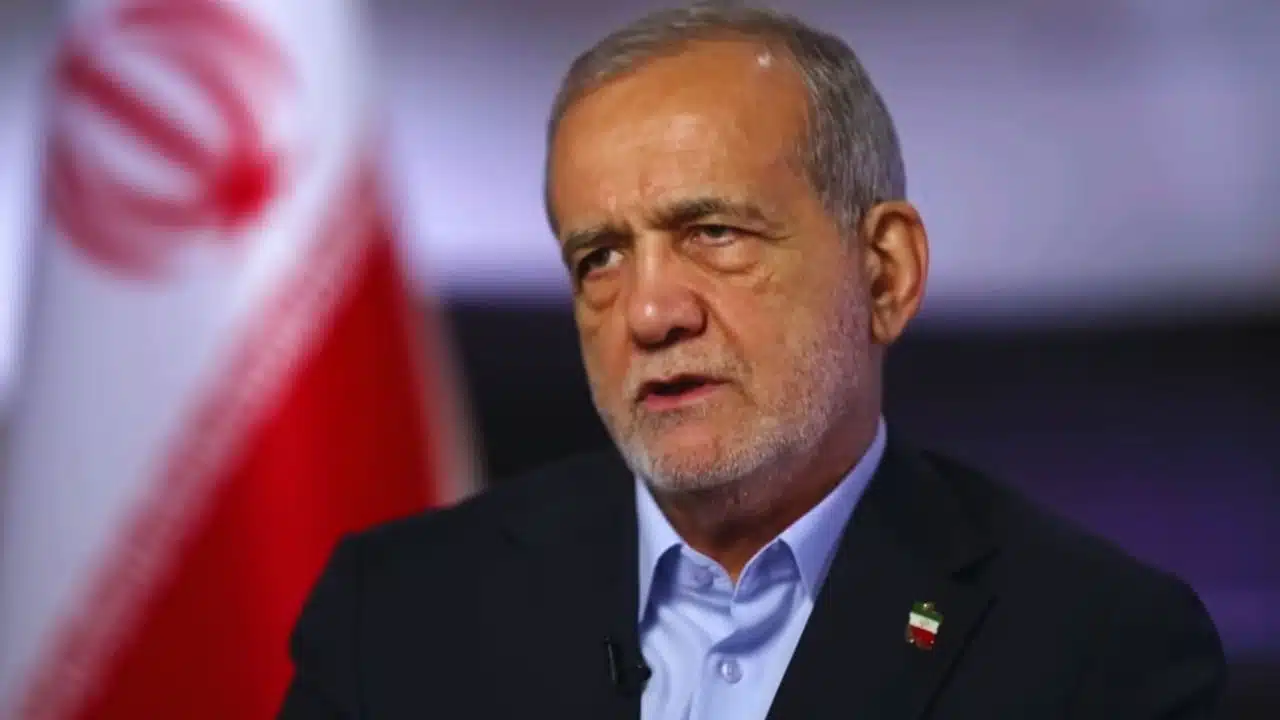
Iranian President Masoud Pezeshkian said on Saturday, December 27, 2025, Iran is in a “full-scale war” with the U.S., Israel, and Europe, as Israeli PM Benjamin Netanyahu prepares to meet President Donald Trump on Monday at Mar-a-Lago.
What Pezeshkian said—and why it matters now
Iran’s president used unusually sweeping language to describe Tehran’s standoff with Western powers, portraying the confrontation as broader and more complex than the Iran–Iraq war of the 1980s.
In the interview published on the official website associated with Supreme Leader Ayatollah Ali Khamenei, Pezeshkian framed the dispute as a coordinated campaign aimed at weakening Iran from multiple directions—through sanctions, diplomatic pressure, intelligence operations, and military threats.
His remarks land at a sensitive moment. Netanyahu is expected to use his meeting with Trump to press Israel’s assessment of the Iranian threat, including concerns about Iran’s missile production and nuclear infrastructure following the June conflict that included Israeli strikes and U.S. attacks on Iranian nuclear-related sites.
The looming Mar-a-Lago meeting: what’s expected on the agenda
Netanyahu’s planned meeting with Trump on Monday, December 29, 2025, comes as Washington and Jerusalem balance multiple files at once: Iran’s nuclear trajectory, Iran’s missile capabilities, and the political and security aftershocks of the Gaza war.
Israeli officials have recently highlighted Iran’s missile drills and warned that Iran is trying to restore capabilities damaged earlier in 2025. Tehran, for its part, has signaled it expects new pressure and is preparing for retaliation scenarios.
While neither side has publicly confirmed operational decisions, the timing of Pezeshkian’s statement suggests Tehran is trying to shape the strategic narrative ahead of high-level U.S.-Israel coordination.
Key timeline leading to this point
| Date | Event | Why it matters |
|---|---|---|
| June 13–24, 2025 | Israel–Iran conflict (“12-day war”) | Escalated direct confrontation; major casualties and infrastructure damage |
| June 22, 2025 | U.S. strikes on Iranian nuclear sites | Marked direct U.S. military involvement and disrupted diplomacy |
| Aug 28, 2025 | European “E3” move toward snapback mechanism | Set the stage for reimposed sanctions tied to the 2015 nuclear deal framework |
| Sep 17–29, 2025 | Sanctions reimposed via snapback-related steps | Increased economic and diplomatic pressure on Iran |
| Dec 22, 2025 | Iran reports missile drills across multiple cities | Heightened regional alert and signaling |
| Dec 27, 2025 | Pezeshkian: “Iran full-scale war with West” | Escalatory rhetoric ahead of Netanyahu–Trump meeting |
| Dec 29, 2025 (expected) | Netanyahu meets Trump at Mar-a-Lago | Potential decisions on deterrence, diplomacy, and military posture |
Iran’s case: sanctions, isolation, and “war on stability”
Pezeshkian argued that Iran faces a conflict that is not limited to missiles and airstrikes. He described what Tehran sees as a multi-layer pressure campaign:
- Economic constraints, including sanctions that reduce investment, restrict banking access, and complicate oil exports.
- Diplomatic isolation, especially after renewed action by European powers linked to the nuclear file.
- Security pressures, including threats of new strikes and intensified intelligence competition.
This framing is designed to support two goals at home: justify economic hardship and strengthen political unity around a security-first message. It also sends a warning abroad that Iran intends to treat economic pressure and military threats as linked parts of the same confrontation.
The nuclear issue: where things stand after the June strikes
Iran’s nuclear program remains the central driver of international tension, especially after the June conflict and subsequent disputes over monitoring and verification.
International inspectors and diplomats have repeatedly emphasized the importance of verifying Iran’s stockpiles and access to sites. Prior reporting in 2025 indicated Iran had accumulated a significant stockpile of uranium enriched to 60%, a level widely treated as close to weapons-grade in technical terms (weapons-grade is generally around 90% enrichment).
Key nuclear-and-security data points at the center of the dispute
| Issue | Latest publicly reported indicator (2025) | Why it matters |
|---|---|---|
| Enrichment level | Uranium enriched up to 60% reported in prior watchdog-related reporting | Reduces “breakout” time if further enriched |
| Monitoring | Ongoing disputes over verification and access after June conflict | Limits confidence in stockpile estimates |
| Struck sites | Fordow, Natanz, Isfahan named in reporting on June U.S. strikes | Core nodes of Iran’s enrichment and nuclear infrastructure |
| Diplomatic track | Talks and UN disputes continued through late 2025 | Indicates crisis management remains active but fragile |
Even when diplomacy continues, the central sticking point remains: Iran insists it has the right to enrich uranium, while U.S. and allied positions have increasingly pushed for tighter limits and stronger verification.
Missiles and air defenses: the other half of the escalation ladder
In recent months, Israel has increasingly emphasized Iran’s ballistic missile program as an urgent threat alongside the nuclear issue.
Iranian state-linked reporting in late December described missile drills in multiple locations. Such exercises can serve multiple purposes: routine readiness, deterrence messaging, and internal signaling that Iran is prepared to respond if attacked.
Israel’s argument, as aired in public remarks and policy coverage in 2025, is that missile production and launch capacity can create immediate regional risk—even as the nuclear issue remains the longer-horizon concern.
What we know about casualties and impact from the June war
The June 2025 conflict left a heavy toll on both sides and reshaped the region’s risk calculations.
Pezeshkian referenced the scale and complexity of the current confrontation compared with the Iran–Iraq war, but the most immediate comparison for policymakers is June’s direct Iran–Israel exchange.
Reported toll from the June 2025 Iran–Israel conflict
| Side | Reported fatalities | Notes commonly included in 2025 reporting |
|---|---|---|
| Iran | ~1,100 | Included senior commanders and nuclear-linked experts in some reporting |
| Israel | 28 | Most reported as civilians in several post-war summaries |
These figures are based on public reporting and may be revised as investigations and confirmations evolve.
Why Pezeshkian’s words may be aimed at multiple audiences
Pezeshkian’s “Iran full-scale war with West” message likely serves three audiences at once:
- Domestic public opinion: Reinforce the idea that hardships are the result of external pressure rather than governance failures.
- Regional rivals and partners: Warn that Iran is prepared to respond, potentially deterring new strikes.
- Washington and European capitals: Signal that Iran views sanctions and military threats as escalation, not negotiation leverage.
At the same time, sharp rhetoric can narrow diplomatic room. When leaders publicly frame disputes as “war,” compromises can be portrayed as surrender by opponents at home.
Final Thoughts: what to watch in the coming days
The immediate next marker is Monday’s Netanyahu–Trump meeting at Mar-a-Lago. Watch for:
- Any shift in U.S. messaging on Iran’s enrichment and verification demands.
- Signs of coordinated U.S.–Israel posture on missile deterrence and air defense.
- Tehran’s near-term signaling—through drills, deployments, or diplomatic statements—after the meeting.
- Whether European sanctions enforcement tightens further, increasing economic pressure on Iran.
For now, Pezeshkian’s statement underscores a central reality of late 2025: the Iran file is no longer just a nuclear negotiation. It is a multi-front contest spanning sanctions, regional conflict dynamics, and high-risk deterrence.