
Astronomers studying interstellar comet 3I/ATLAS have confirmed that a much-discussed radio signal linked to the object is natural, matching expected comet chemistry and behavior—not technology—after targeted observations in late 2025.
What scientists observed
3I/ATLAS—first reported to the Minor Planet Center on July 1, 2025 by the NASA-funded ATLAS survey in Chile—became only the third confirmed interstellar object ever found, based on its hyperbolic trajectory showing it came from outside the Solar System. NASA says the comet’s closest approach to Earth is about 1.8 astronomical units (about 270 million km), and it reached perihelion around Oct. 30, 2025 at about 1.4 au (about 210 million km), inside Mars’ orbit.
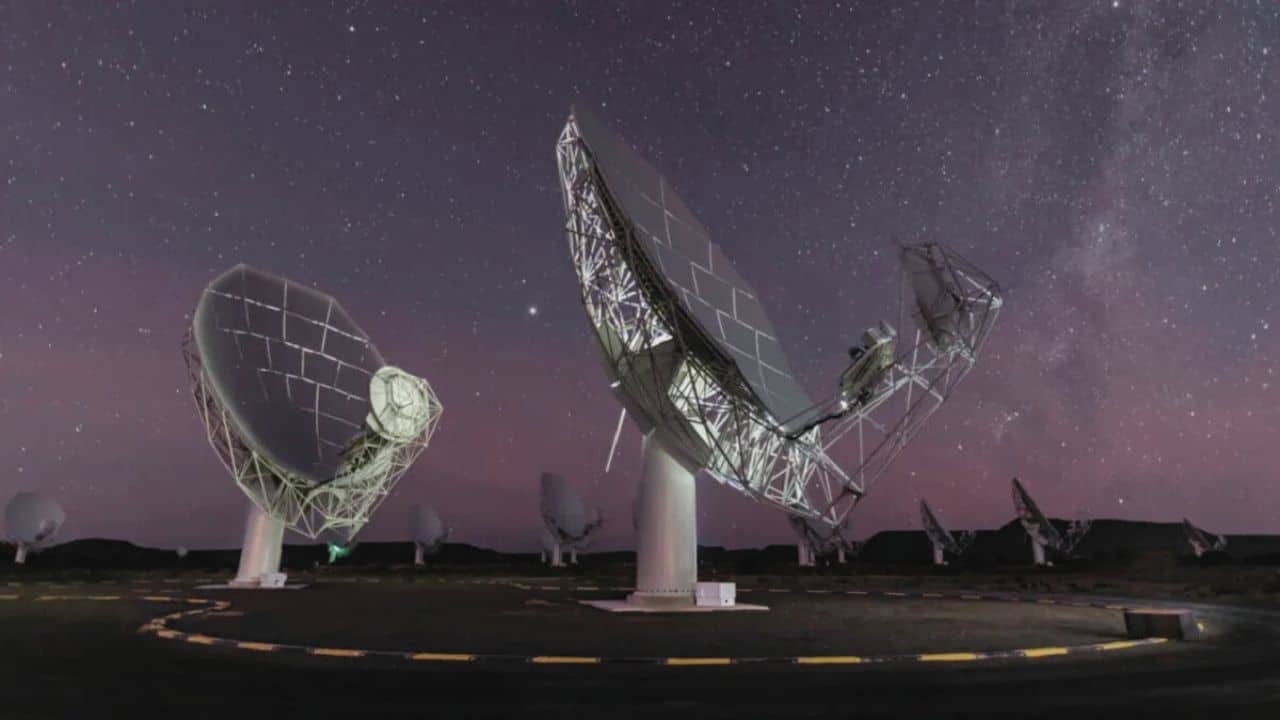
Radio observations with South Africa’s MeerKAT array detected hydroxyl (OH) signatures at well-known frequencies associated with comet activity—first in absorption (Oct. 24 and again on Nov. 4 and 6), then in emission (Nov. 11–12), matching the expected pattern as viewing geometry and solar “pumping” conditions changed. The detections occurred while the comet was still extremely far away—more than 350 million km from Earth at the time of the first OH absorption detection—helping explain why the signal was faint and challenging to measure.
Key observation timeline (radio)
| Date (2025) | Instrument | What was reported | Why it mattered |
| Sep. 20 & Sep. 28 | MeerKAT | No hydroxyl detected | Early non-detections were consistent with weak/variable OH visibility windows. |
| Oct. 24 | MeerKAT | OH absorption detected (1665/1667 MHz) | Supported an active comet coma producing OH from water-related chemistry. |
| Nov. 4 & Nov. 6 | MeerKAT | More OH absorption | Reinforced that the signal tracked the comet’s expected velocity/behavior. |
| Nov. 11–12 | MeerKAT | OH emission detected | The switch from absorption to emission matched the predicted solar-pumping pattern. |
Why the radio signal is “natural”
The confirmed signal aligns with hydroxyl (OH) spectral lines that can appear when water and related molecules in a comet’s coma are broken apart and excited by sunlight, producing radio features at specific frequencies within MeerKAT’s observing range. Researchers described how solar ultraviolet light can “pump” OH molecules into energy states that cause the lines to appear in absorption during some time windows and emission during others—exactly the behavior reported for 3I/ATLAS in late October and November.
MeerKAT teams also emphasized that the object appears relatively small by comet standards (size estimates ranging from a few hundred meters to a few kilometers) and never came especially close to the Sun, both factors that would keep any OH signal weak. NASA similarly notes that astronomers are still investigating the comet’s size, but its observed activity—an icy nucleus producing a coma—supports its classification as a comet rather than an asteroid.
What was ruled out (and how)
Alongside the standard radio astronomy analysis, MeerKAT observations were also examined with Breakthrough Listen’s “BLUSE” system, which searches for narrowband signals commonly considered a hallmark of technological transmission rather than natural astrophysics. In an analysis of the relevant dataset (including observations associated with early November), the Breakthrough Listen team reported no narrowband signals between 900 and 1670 MHz from the direction of 3I/ATLAS.
Because the comet was so distant, the same analysis translated the non-detection into an extremely low equivalent power limit—about 0.17 W—described as below the emission level of a typical cellphone, underscoring how sensitive the search was even at hundreds of millions of kilometers. In plain terms, the combined result is: natural cometary OH activity was detected, while targeted technosignature-style narrowband emission was not.
“Detected vs. not detected”
| Question | What the data showed | Practical meaning |
| Did telescopes detect radio features consistent with comet chemistry? | Yes—OH absorption and emission patterns were reported in late Oct. and Nov. | Strengthens the case that 3I/ATLAS behaves like an active comet. |
| Did the search find narrowband “technosignature-like” signals? | No narrowband signals (900–1670 MHz) localized to the comet’s direction. | No evidence in this band for an artificial transmitter. |
| How sensitive was the technosignature check? | A reported power limit of ~0.17 W at the comet’s distance. | The search could have detected extremely weak transmitters by human standards. |
Why this matters for space science
Interstellar objects are rare, brief visitors that can provide direct evidence about how icy bodies form and evolve around other stars, then get ejected into interstellar space before crossing another planetary system. NASA says 3I/ATLAS is only the third such object observed, following 2017’s ‘Oumuamua and 2019’s 2I/Borisov, making every new measurement unusually valuable for comparative studies.
The radio work adds a key piece: it supports the idea that at least some interstellar visitors behave like familiar comets, with volatile-driven activity that can be probed using spectral lines such as OH at centimeter wavelengths. It also shows how modern observing campaigns now routinely pair “what is it made of?” science with “is anything artificial present?” checks, using the same telescope time and data streams.
Final thoughts
The combined late-2025 findings tie two threads into one clearer story: the first widely discussed radio detection from this interstellar comet was real, and its detailed frequency-and-time behavior matches natural comet physics. At the same time, sensitive narrowband searches reported no technosignature-style emission in the observed band, reducing room for claims that the signal was engineered.
As 3I/ATLAS continues its passage and fades with distance, the most important next steps are continued multiwavelength studies—ground and space—aimed at measuring composition, activity levels, and how closely an extrasolar comet resembles (or differs from) comets born in our own Solar System.