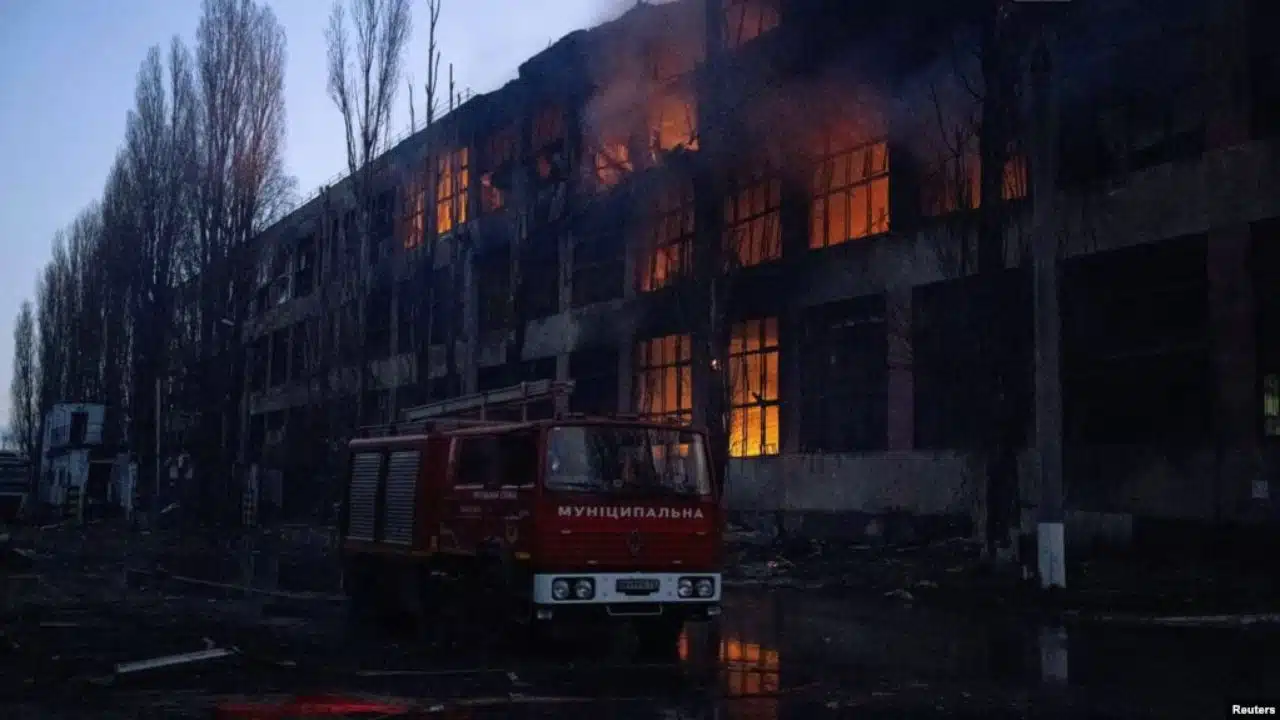
Kyiv says the Astrakhan strike targets Russia’s war-making supply chain, while negotiators in Berlin report progress but remain stuck on territory and security guarantees.
Ukraine strikes Russian gas plant after Ukrainian forces said they hit the Astrakhan gas processing plant overnight, as high-level talks in Berlin continued without a final breakthrough on the toughest issues. The twin developments underscore how battlefield escalation and diplomacy are moving in parallel, with both sides still far apart on territory and postwar security.
What happened in Russia
Ukraine’s General Staff said the Defense Forces struck the Astrakhan gas processing plant during overnight operations on Dec. 15. Ukraine described the facility as a key enterprise in Russia’s oil and gas sector and said the aim was to reduce Russia’s capacity to produce explosives.
Ukraine’s Special Operations Forces said deep strike units worked in coordination with the Unmanned Systems Forces to hit the plant, which Ukrainian reporting identified as owned by Gazprom and located in Russia’s Astrakhan region near the Caspian Sea. RBC-Ukraine reported that explosions and a large-scale fire were recorded at the site after the attack, citing Ukrainian military statements.
Why the Astrakhan plant matters
Ukrainian officials have framed the Astrakhan facility as strategically important not only for energy processing but also for inputs tied to Russia’s defense production. Ukrinform, citing Ukraine’s General Staff, said the plant can produce up to 3.5 million tonnes of sulfur annually, which Ukraine says is used in manufacturing explosives for Russia’s military-industrial complex.
The strike narrative fits a broader pattern in which Ukraine has increasingly targeted infrastructure it links to Russia’s ability to sustain the war, while Russia continues long-range attacks on Ukrainian cities and critical assets. Neither side independently verified the other’s claims about damage in the immediate aftermath, and reporting on operational impact remained limited.
Key facts at a glance
| Item | What is known (reported) |
| Target | Astrakhan gas processing plant in Astrakhan region, Russia (near the Caspian Sea). |
| Claimed attacker | Ukraine’s Defense Forces, per Ukraine’s General Staff. |
| Claimed purpose | To reduce Russia’s capacity to produce explosives, according to Ukrainian statements. |
| Reported aftermath | Explosions and a large-scale fire reported by Ukrainian-linked reporting citing military statements. |
| Strategic detail | Plant output includes sulfur; Ukraine says sulfur supports explosive manufacturing. |
Berlin talks: progress, but no endpoint
In Berlin, U.S. envoys Steve Witkoff and Jared Kushner met with Ukrainian President Volodymyr Zelenskyy and European officials as Washington pressed for a faster path to a U.S.-brokered deal. AP reported the latest round of talks concluded Monday, even as major obstacles remained—especially control of Ukraine’s eastern Donetsk region, much of which is occupied by Russian forces.
U.S. officials briefed reporters that Moscow has indicated it is open to Ukraine joining the European Union as part of a potential peace deal, while also saying the U.S. is prepared to provide unspecified security guarantees—though the offer won’t be on the table forever. Global News reported that U.S. officials described narrowing differences on security guarantees and said the peace plan discussions were broadly advanced, but the territorial issue remained central.
Zelenskyy has said Ukraine could drop its NATO bid if the U.S. and other Western nations provide security guarantees similar to those NATO members receive, while also emphasizing that any assurances must be legally binding and backed by the U.S. Congress. At the same time, both AP and Global News reported Ukraine continues to reject proposals that would require ceding territory, while Russia wants Ukraine to withdraw forces from the part of Donetsk still under Kyiv’s control as a condition for peace.
What negotiators are stuck on
| Issue | Ukraine’s stated position | Russia’s stated/reported demand | What the U.S./Europe discussed in Berlin |
| Territory (Donetsk/Donbas) | Ukraine rejects ceding territory pushed by the U.S., per reporting. | Putin wants Ukraine to withdraw from Donetsk areas still controlled by Ukraine, per AP/Global News reporting. | U.S. officials said differences narrowed in some areas, but territory remains unresolved. |
| NATO | Zelenskyy has expressed readiness to drop NATO bid if NATO-like security guarantees are provided. | The Kremlin has demanded Ukraine renounce NATO ambitions as part of any settlement, per AP/Global News reporting. | Talks focused heavily on security guarantees described as Article 5-like in reporting. |
| Security guarantees | Zelenskyy says guarantees must be legally binding and supported by Congress. | Russia has said it will not accept NATO troops based on Ukrainian soil, per Global News reporting. | European leaders referenced robust security guarantees, including a European-led multinational force supported by the U.S., per Global News reporting. |
| EU membership | Ukraine seeks closer Western integration and has pursued EU integration. | U.S. officials said Russia is open to Ukraine joining the EU, calling it a major concession. | U.S. officials highlighted EU openness as a notable point in briefings. |
Fighting continues as diplomacy drags
While negotiators worked in Berlin, drone strikes continued on both sides. AP reported Russia launched 153 drones at Ukraine overnight Sunday into Monday, and Ukraine’s Air Force said 133 were neutralized while 17 hit targets.
On the Russian side, AP reported Russia’s Defense Ministry said forces destroyed 130 Ukrainian drones overnight and that 18 drones were shot down over Moscow, prompting temporary flight halts at Domodedovo and Zhukovsky airports as safety measures. Against this backdrop, the reported Astrakhan strike reinforced the message that Kyiv is maintaining long-range pressure even as peace talks remain unresolved on core demands.
Timeline of key developments
| Date (2025) | Event |
| Dec. 14–15 | Berlin talks involving Zelenskyy, U.S. envoys Witkoff and Kushner, and European officials; discussions focused on security guarantees and territory. |
| Night of Dec. 15 | Ukraine says it struck the Astrakhan gas processing plant to reduce Russia’s capacity to produce explosives. |
| Dec. 15 | AP reports the Berlin talks concluded Monday without resolving major obstacles, especially Donetsk territory and security arrangements. |
What happens next
Global News reported additional talks were expected after Berlin, with U.S. officials signaling the process would continue as the sides try to finalize an arrangement on guarantees and other unresolved points. But as long as territory, security guarantees, and force posture remain contested—and as long-range strikes continue—any diplomatic momentum in Berlin is likely to remain fragile and vulnerable to escalation.