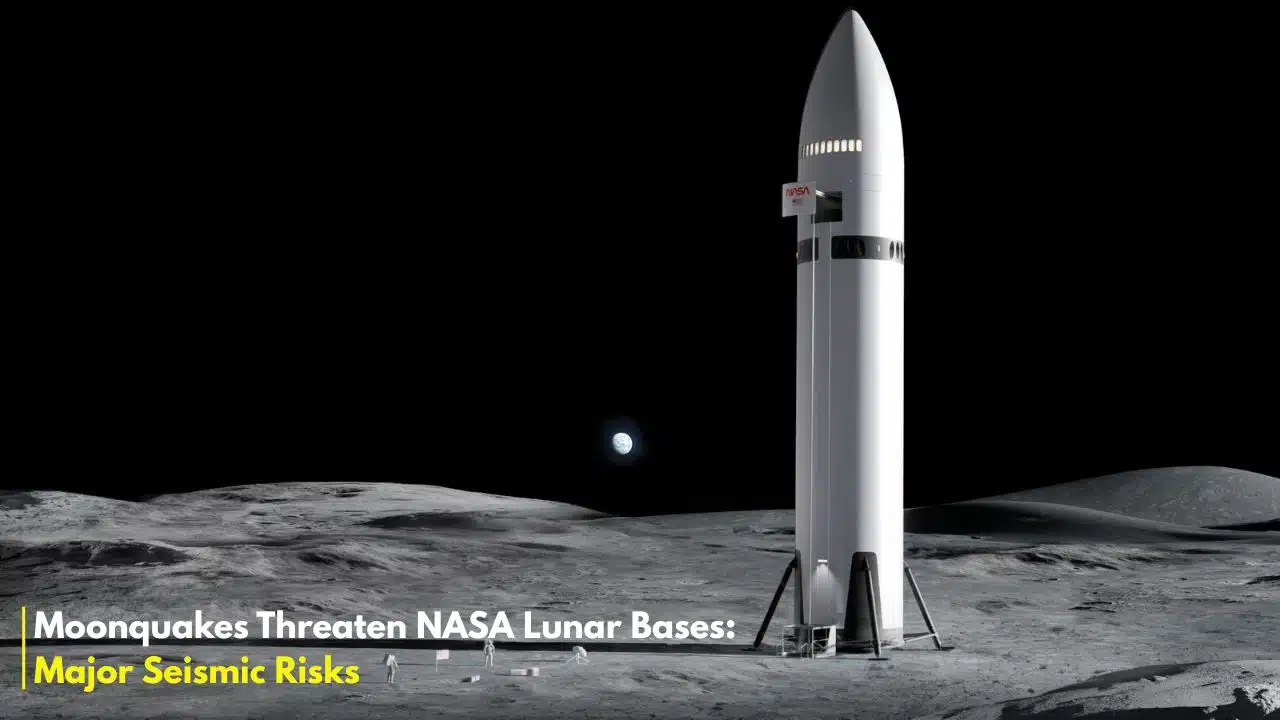
NASA’s ambitious Artemis program aims to establish a sustained human presence on the Moon, but new research reveals a hidden hazard: moonquakes. These lunar seismic events, once thought rare and mild, are now understood to pose a significant threat to long-term lunar infrastructure, including habitats, landers, and scientific outposts. With Artemis missions set to return astronauts to the Moon within the next few years, scientists are urging planners to factor in the risk of moonquakes when selecting and designing future lunar bases.
The Hidden Danger Beneath the Lunar Surface
Moonquakes, or seismic events on the Moon, were first detected during the Apollo missions in the late 1960s and early 1970s. While Apollo astronauts experienced only minor tremors, recent studies suggest that moonquakes could be more frequent and impactful than previously believed. Researchers have found that the Moon’s surface is crisscrossed by young thrust faults, such as the Lee-Lincoln fault near the Apollo 17 landing site, which may still be seismically active today. These faults are the result of the Moon’s ongoing contraction as its interior cools, a process that generates stress and, occasionally, moonquakes.
A new study published in Science Advances analyzed geological evidence from the Apollo 17 site, including boulder trails and landslides, to reconstruct the Moon’s seismic history. The researchers concluded that moonquakes, rather than meteoroid impacts, were the primary force behind much of the shifting terrain in the Taurus-Littrow valley. This discovery has major implications for the safety of future lunar missions, as infrastructure built near active faults could be at risk from repeated ground shaking.
Assessing the Risk for Long-Term Lunar Outposts
The statistical likelihood of a damaging moonquake near an active fault is low on any given day—about 1 in 20 million—but the risk increases significantly over longer durations. For a short mission like Apollo 17, the odds of encountering a hazardous event were negligible. However, for a permanent base or decade-long mission, the cumulative risk rises to about 1 in 5,500, making it a factor that cannot be ignored in mission planning.
Scientists warn that the risk is particularly relevant for taller structures and newer spacecraft, such as the Starship Human Landing System, which may be more vulnerable to ground acceleration caused by moonquakes close to an active fault. Unlike Earth, the Moon lacks a comprehensive network of seismic sensors, so researchers must rely on indirect evidence—such as boulder falls and landslides—to estimate the strength and frequency of past quakes.
Implications for Artemis Base Camp and Future Lunar Missions
NASA’s Artemis Base Camp is planned for the lunar south pole, a region that offers near-continuous sunlight and access to water ice. However, new research shows that the south polar region is also home to a group of faults that could pose seismic hazards for future missions. Engineers and architects stress the importance of site selection, recommending that habitats and critical infrastructure be located as far as possible from known active faults.
Modern lunar architecture must incorporate seismic protection systems, much like those used on Earth in earthquake-prone regions. Structural engineers suggest that terrestrial civil engineering experience should be applied to accelerate the development of lunar infrastructure and building systems. As NASA prepares to deploy advanced seismometers during future Artemis missions, better data on lunar seismic activity will help refine risk assessments and improve the safety of permanent lunar outposts.
Types of Moonquakes and Their Effects
Moonquakes come in several forms, each with different causes and effects. Shallow moonquakes, triggered by tectonic activity along thrust faults, are the most energetic and pose the greatest threat to infrastructure. Deep moonquakes, caused by tidal forces from Earth, are less likely to affect surface structures. Thermal moonquakes, which occur as the lunar surface heats and cools during the lunar day, are generally mild but can still cause minor vibrations in equipment and habitats.
Recent reanalysis of Apollo-era seismic data has revealed that shallow moonquakes are much more common than previously thought, with tens of thousands of previously unrecognized events identified in the historical record. This suggests that the Moon’s seismic environment is more dynamic than earlier models indicated, further underscoring the need for robust seismic hazard assessments in future mission planning.
Preparing for the Lunar Frontier
As NASA and its international partners prepare to establish a permanent human presence on the Moon, the threat of moonquakes adds a new layer of complexity to mission planning. Site selection, structural design, and risk management strategies must all take into account the possibility of seismic activity. The Artemis program’s success will depend not only on technological innovation but also on a thorough understanding of the lunar environment and its hazards.
Future missions are expected to deploy more advanced seismometers, providing real-time data on lunar seismic activity and enabling more accurate risk assessments. These instruments will be critical for monitoring active faults and ensuring the safety of astronauts and infrastructure on the lunar surface.
The Road Ahead
The discovery of ongoing moonquake activity is a reminder that the Moon, while seemingly serene, is a dynamic and geologically active world. As humanity prepares to return to the lunar frontier, the lessons learned from Apollo and new research on lunar seismicity will be essential for building safe, resilient, and sustainable lunar bases. The Artemis program’s vision of a permanent human presence on the Moon is within reach, but it will require careful planning, innovative engineering, and a deep respect for the challenges posed by the lunar environment.
In the coming years, as new seismometers are deployed and more data is gathered, our understanding of moonquakes and their risks will continue to evolve. For now, the message from scientists is clear: when it comes to building on the Moon, location matters—and avoiding active faults is the safest bet for the future of lunar exploration.