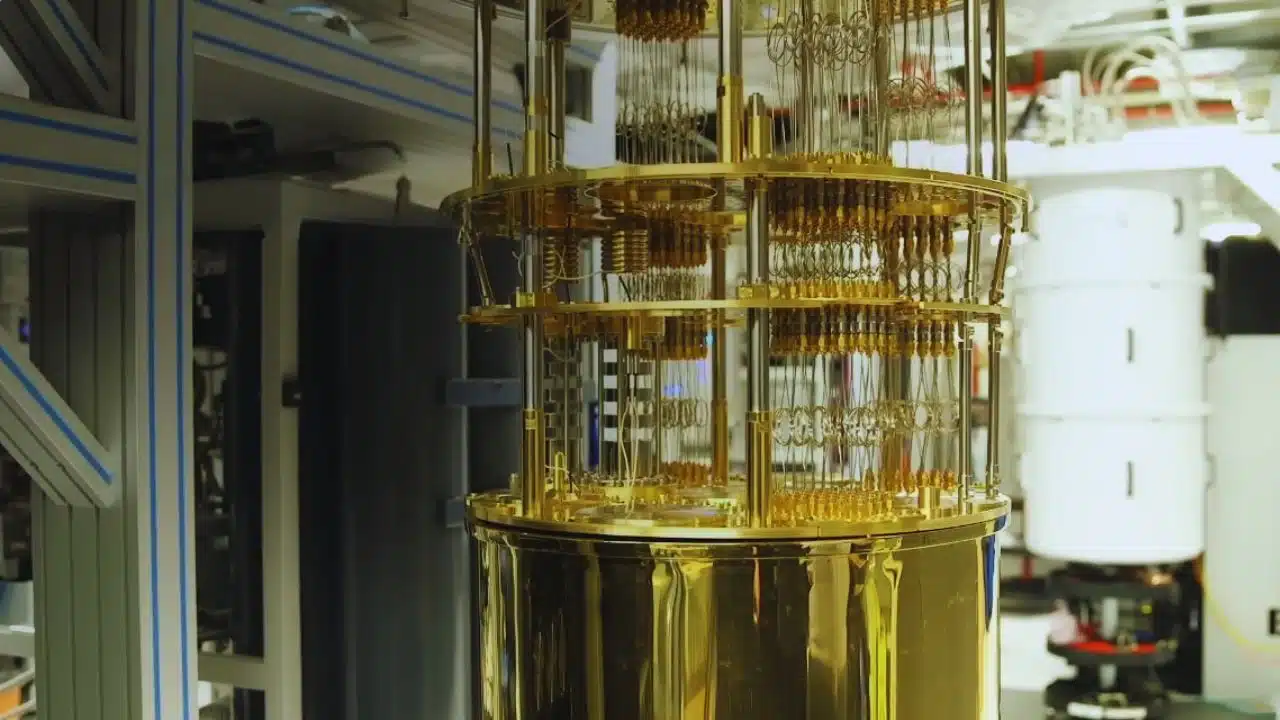
A pioneering research team at the Jülich Supercomputing Center in Germany, in collaboration with NVIDIA experts, has reached a groundbreaking milestone in quantum computing simulation. For the very first time, a universal quantum computer composed of 50 qubits has been fully simulated. This achievement was realized on JUPITER, Europe’s first exascale supercomputer, which was officially inaugurated at Forschungszentrum Jülich in September 2025.
This record surpasses the previous world benchmark of simulating 48 qubits, which was themselves established by the Jülich team back in 2022 using Japan’s K computer. The new achievement clearly demonstrates the extraordinary computational power of the JUPITER supercomputer, opening up significant new possibilities for the development and testing of complex quantum algorithms. The research findings have been made publicly accessible through a detailed study published on the arXiv preprint server.
Why Quantum Simulations Are Crucial?
Simulating quantum computers on classical hardware plays a key role in advancing quantum technologies. Such simulations enable researchers to validate experimental results and test innovative quantum algorithms well before powerful quantum machines become commercially available or practically usable. Important algorithms under exploration include the Variational Quantum Eigensolver (VQE), widely used for modeling molecules and materials at quantum levels, as well as the Quantum Approximate Optimization Algorithm (QAOA), valuable for solving complex optimization problems in sectors like logistics, financial modeling, and artificial intelligence.
The Computational Challenge of Quantum Simulation
Replicating the behavior of a quantum computer on classical systems is an immense technical challenge due to the exponential growth of quantum states as qubits increase. Each additional qubit doubles the computational and memory requirements. For perspective, while about 30 qubits can be simulated on a powerful laptop, scaling up to 50 qubits necessitates an extraordinary amount of memory—around 2 petabytes or roughly two million gigabytes. Such capacity is only provided by the world’s most advanced supercomputers, with JUPITER standing at the forefront.
The simulation involves precisely mimicking the quantum physics underpinning a true quantum processor. Each quantum gate operation influences more than 2 quadrillion complex numerical values, all of which must be precisely synchronized across thousands of computing nodes. This extreme scale is what made previous attempts at simulating 50 qubits nearly impossible until now.
Innovative Technologies Driving the Breakthrough
Several key technical innovations enabled this simulation breakthrough:
- Hybrid CPU-GPU Memory Architecture: JUPITER is built with NVIDIA GH200 Superchips, which tightly integrate CPUs and GPUs with high-bandwidth interconnects. This allows data exceeding GPU memory limits to be temporarily stored in CPU memory without significant performance loss, effectively doubling usable memory capacity.
- Advanced Simulator Software (JUQCS-50): The team developed JUQCS-50, an enhanced version of their existing quantum computer simulation software. It intelligently manages quantum operations across the hybrid memory system, ensuring low-latency, high-fidelity simulation even when data must be offloaded between CPU and GPU.
- Memory Compression and Communication Optimization: A novel byte-encoding compression method was employed to reduce memory requirements eightfold. Additionally, a dynamic on-the-fly network traffic optimizer minimizes data transfer overhead between the more than 16,000 GH200 superchips in operation.
Combining these advances resulted in an 11.4-fold increase in simulation speed compared to the previous 48-qubit simulations, while maintaining high fidelity and accuracy. This level of performance marks a significant leap forward in large-scale quantum circuit simulation efficiency.
Implications for Quantum Research and Beyond
The JUQCS-50 simulator will be made available through JUNIQ—the Jülich Unified Infrastructure for Quantum Computing—providing external researchers and industry partners with access to this powerful tool. This platform enables exploration of new quantum algorithms beyond the reach of today’s quantum processors, helping to accelerate innovation in quantum computing.
Moreover, JUQCS-50 will serve as a benchmark for next-generation supercomputers, shaping the design and development of future computing infrastructure optimized for quantum research demands.
This simulation milestone was realized within the framework of the JUPITER Research and Early Access Program (JUREAP), a collaborative effort involving hardware engineers and quantum scientists. The partnership between Jülich experts and NVIDIA was essential to co-designing both hardware and software during JUPITER’s construction phase, maximizing the system’s potential.
Europe’s Strategic Investment in Exascale and Quantum Computing
JUPITER represents a major step forward in Europe’s commitment to leading edge computing technologies. As the continent’s first exascale supercomputer, JUPITER combines unprecedented computational power with cutting-edge quantum simulation capabilities. It supports a broad range of scientific domains, from nuclear physics and materials science to climate modeling and computational engineering.
By achieving this record in quantum simulation, JUPITER sets a new global standard and underlines the synergy between classical exascale computing and quantum technology research. This integration is expected to drive breakthroughs across science, industry, and technology sectors, reinforcing Europe’s strategic position in the future global computing landscape.
The information is collected from Phys.org and arXiv.