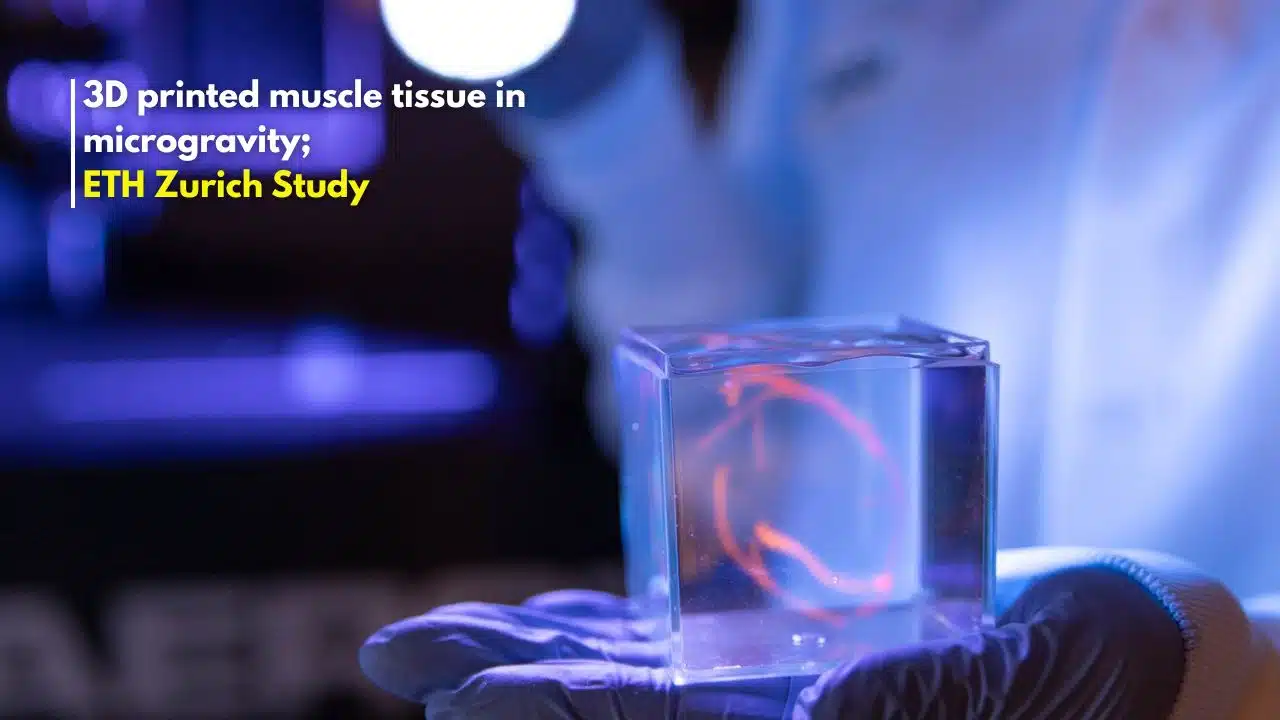
In a breakthrough that blurs the line between science fiction and next-generation medicine, researchers at ETH Zurich have successfully 3D printed muscle tissue in microgravity. This milestone, achieved during a series of parabolic flights, overcomes a fundamental barrier to creating complex human tissues and brings the goal of manufacturing transplantable organs in space one giant leap closer to reality.
The Swiss team’s success, announced in early November 2025 and detailed in the journal Advanced Science (ETH Zurich, Nov 10, 2025), is the latest and perhaps most telling achievement in a rapidly accelerating field. This is not a theoretical exercise; it is a vital proof of concept.
This new research joins a flurry of recent, tangible progress in low-Earth orbit. U.S.-based company Redwire Space has already successfully bioprinted a human knee meniscus and, more recently, cardiac (heart) tissue aboard the International Space Station (ISS) (Redwire, Sep 7, 2023). In parallel, an experiment from the Wake Forest Institute for Regenerative Medicine, launched in August 2025, is currently studying the growth of 3D-printed liver tissue on the station (ISS National Lab, Aug 20, 2025).
A new space race is underway—not for the Moon or Mars, but to build a biological “factory” in orbit. The prize is the “holy grail” of regenerative medicine: the ability to manufacture fully functional human organs from scratch, solving a medical crisis that costs thousands of lives a year.
The ‘Gravity Problem’: Why Bioprinting on Earth Falls Short
For decades, the promise of 3D bioprinting—using a patient’s own cells in a ‘bio-ink’ to print a new organ—has been tantalizingly out of reach. The reason is deceptively simple: gravity.
On Earth, bioprinting a simple, rigid structure like a piece of bone or cartilage is possible. But soft, complex organs like a heart, liver, or muscle are a different story. These tissues are intricate, jelly-like structures, defined by delicate networks of blood vessels, fibers, and nerves.
When scientists try to print these structures on Earth, they immediately run into a problem:
- Structural Collapse: The bio-ink, a hydrogel suspension of living cells, is too soft. The delicate, layered structure slumps and collapses under its own weight before it can mature and fuse.
- Uneven Settling: Gravity causes the heavier cells within the bio-ink to settle unevenly, ruining the microscopic precision required for the tissue to function.
- The Scaffold Dilemma: To compensate, terrestrial bioprinting must use a “scaffold,” or artificial support structure, to hold the tissue’s shape. But this scaffold is an impurity. It can impede cell-to-cell communication, block the growth of blood vessels, and cause immune reactions in the patient.
Microgravity solves all three problems. In the weightlessness of orbit, a 3D-printed heart, a bundle of muscle fibers, or a lobe of a liver can be extruded into open space. It holds its shape perfectly, allowing the cells to mature, bond, and form natural, “scaffold-free” tissues in a way that is physically impossible on the ground.
As Michael Roberts, chief scientific officer of the ISS National Laboratory, explained, “In the absence of gravity, you can print three-dimensional structures—tissues that more closely resemble the actual structures here on Earth
A ‘Vomit Comet’ Breakthrough: ETH Zurich’s G-FLight
This is the problem the ETH Zurich team, led by researcher Parth Chansoria, set out to solve. Their challenge was to prove that complex muscle tissue—defined by its long, aligned fibers—could be printed without gravity.
Printing Muscle in Seconds
To test their theory, the team developed a novel, gravity-independent printer called G-FLight (Gravity-independent Filamented Light). This portable system uses a special light-curing bio-resin loaded with living muscle-forming cells.
They didn’t go to the ISS. Instead, they took their experiment on a series of “vomit comet” parabolic flights, which provide short bursts of true weightlessness. During the 30 parabolic cycles, each offering about 20-22 seconds of microgravity, the G-FLight printer whirred to life, building muscle constructs layer by layer in mid-air.
‘Similar Cell Viability’: The Results
The results were a stunning success. The researchers found that the tissue printed in microgravity had “similar cell viability and a similar number of muscle fibers” when compared to identical tissue printed in normal gravity on the ground (ETH Zurich, Nov 10, 2025).
This is a critical finding. It proves that the printing process itself is not harmful to the cells and, more importantly, that the resulting tissue is structurally sound and biologically realistic. The microgravity-printed muscle fibers were precisely aligned, mimicking the structure of natural human muscle.
“Our system… can produce biomimetic muscle constructs in seconds,” says Parth Chansoria, who led the study (3Dnatives, Nov 11, 2025). “This system is also not affected by gravity, where the tissues printed in zero gravity… mimic the properties of those printed in Earth’s gravity, enabling a predictability of tissue properties.”
The ETH team’s next goal is to take G-Flight beyond the “vomit comet” and into orbit, to fabricate more complex tissues aboard the ISS.
From Simulation to Orbit: The New Space-Based Organ Factory
While the ETH study provides a critical proof-of-concept for muscle, other organizations are already running a full-scale factory operation on the ISS. The leader in this commercial field is Redwire Space.
Redwire’s In-Orbit Success: The Knee and Heart
Redwire’s BioFabrication Facility (BFF) is a permanent, industrial 3D bioprinter installed on the International Space Station. It has been producing tissue for several years, with groundbreaking, verified results.
- Human Knee Meniscus (2023): In September 2023, Redwire announced it had successfully printed the first human knee meniscus (a complex C-shaped piece of cartilage) in orbit. The tissue was cultured for 14 days on the ISS and then returned to Earth for analysis. “Demonstrating the ability to successfully print complex tissue such as this meniscus is a major leap forward,” said Redwire Executive Vice President John Vellinger
- Human Heart Tissue (2024): In April 2024, Redwire announced an even bigger milestone: the successful bioprinting of live human heart tissue. The goal is not to print a full heart yet, but to create “heart patches” that can be used to repair tissue damaged by cardiovascular disease, the number one cause of death in the U.S.
Wake Forest’s Liver Mission (2025)
The field is not a monopoly. In August 2025, a SpaceX resupply mission carried a payload from the Wake Forest Institute for Regenerative Medicine (WFIRM). Their experiment: sending 3D-printed liver tissue constructs to the ISS.
Their goal is slightly different but equally important. They are not just printing in space, but studying how microgravity affects the development and maturation of tissue. The liver is a highly complex, vascularized organ, and the WFIRM team hopes to understand how to grow the intricate networks of blood vessels that are essential for any organ to survive (ISS National Lab, Aug 20, 2025).
The ‘Holy Grail’: A Solution to the Organ Crisis
This convergence of academic and commercial research is aimed at one of the most pressing problems in modern medicine: the organ shortage.
In the United States alone, over 100,000 people are on the national transplant waitlist. Seventeen of them die each day waiting for an organ (HRSA, Oct 2025).
The vision is to end this wait. A patient would provide a small sample of their own cells (like skin or blood). These cells would be reprogrammed into stem cells, which can become any cell type. Those stem cells would be mixed into a bio-ink, flown to an orbital manufacturing facility, and used to print a genetically identical organ—a heart, a liver, a kidney—that would not be rejected by the patient’s body.
These “space-grown” organs would be flown back to Earth for transplantation.
While the full, transplantable organ is still years away, the path is now clear. The first steps are tissue patches (like Redwire’s cardiac tissue) to treat heart failure. The next are non-complex tissues like cartilage (the meniscus). From there, the challenge will be printing the highly-vascularized organs like the liver and kidney.
The ETH Zurich team’s success in printing muscle tissue is a vital new piece of that puzzle. It confirms that another key tissue type is viable for microgravity manufacturing. What was once the realm of “Star Trek” is now a well-funded, multinational industrial and scientific objective.