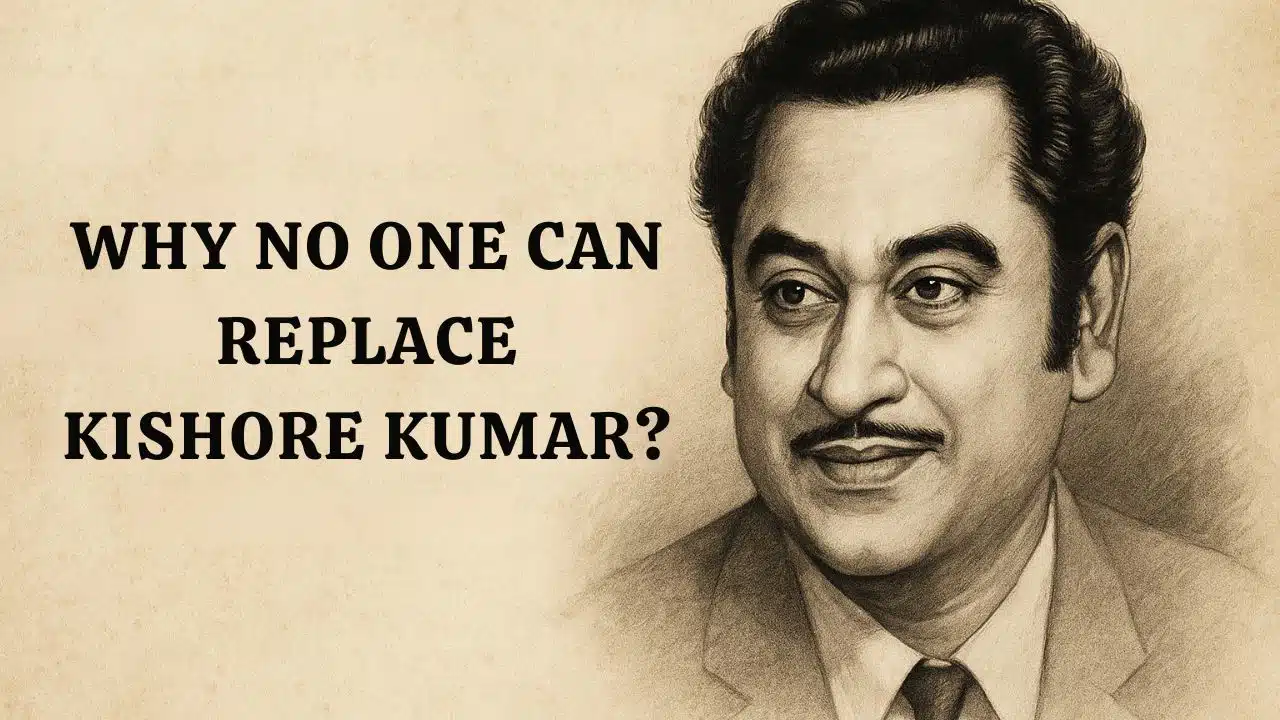
More than three decades after his passing on 13 October 1987, Kishore Kumar continues to dominate playlists, radio waves, and YouTube recommendations. His songs still echo at weddings, road trips, and lonely midnights—bridging generations that never even saw him on screen.
Kishore wasn’t just a playback singer; he was an emotion translated into sound. In an industry that has seen countless talented vocalists come and go, his presence remains unmatched. His death left a silence that technology, training, and even artificial intelligence have yet to fill.
So, why has no one ever replaced Kishore Kumar? The answer lies in the unrepeatable combination of voice, emotion, authenticity, and rebellion that defined both the man and his music.
The Unmistakable Voice: Emotion Beyond Technique
Every great singer has skill. Kishore Kumar had soul.
His baritone voice carried an emotional texture that went far beyond technical perfection. Whether it was the playfulness of “Ek Chatur Naar,” the romance of “Roop Tera Mastana,” or the melancholy of “Kuch To Log Kahenge,” Kishore infused each note with lived experience.
Unlike his contemporaries, he wasn’t classically trained—he learned by listening, experimenting, and absorbing the world around him. His voice could rise, crack, laugh, or ache—yet always sound honest.
He was the first to blur the line between playback and performance. When Rajesh Khanna smiled onscreen, Kishore’s voice smiled with him. When Amitabh Bachchan raged, the baritone thundered. His singing wasn’t background music—it was the actor’s inner voice.
Modern singers often hit every note flawlessly, but few make listeners feel. Kishore Kumar’s gift was his imperfection—every breath, pause, or laugh made his songs human. That emotional realism is irreplaceable.
Beyond the Singer: The Multitalented Maverick
Kishore Kumar wasn’t confined to a studio microphone. He was an actor, composer, director, producer, writer, and humorist—a one-man creative powerhouse.
He starred in more than 80 films, including timeless classics like “Chalti Ka Naam Gaadi” (1958), “Half Ticket” (1962), and “Padosan” (1968). His screen presence reflected the same spontaneous energy that powered his songs—natural, unpredictable, and captivating.
As a filmmaker, he directed “Door Gagan Ki Chhaon Mein” (1964), a poignant father-son drama that revealed his philosophical depth. It showed a quieter, introspective side of Kishore that audiences rarely saw.
His eccentricity became legendary. He talked to trees, avoided crowds, and even charged double if a producer said hello to him in person. Beneath the eccentric surface, however, was a man fiercely protective of his creative freedom—an attribute that defines true artists across eras.
The Chemistry of Legends: When Kishore Met the Burmans
Bollywood’s golden soundscape was shaped by one of its most iconic collaborations—Kishore Kumar and the Burmans, father and son.
S.D. Burman, a master composer, recognized Kishore’s potential in the 1950s when most studios preferred classical voices like Mohammed Rafi. The result was songs like “Jeevan Ke Safar Mein” and “Phoolon Ke Rang Se”—fresh”, lively, and emotionally textured.
Later, R.D. Burman redefined that partnership for a new generation. Together they created magic in tracks like
-
“Yeh Shaam Mastani” (Kati Patang, 1971)
-
“O Mere Dil Ke Chain” (Mere Jeevan Saathi, 1972)
-
“Chingari Koi Bhadke” (Amar Prem, 1972)
-
“Khaike Paan Banaraswala” (Don, 1978)
Their synergy was revolutionary—R.D.’s innovative soundscapes met Kishore’s intuitive emotion. They built the soundtrack of the 1970s, an era where melody met modernity.
No other duo managed to fuse rhythm, rebellion, and romance quite like them. While technology today replicates sound, it cannot recreate chemistry born from instinctive understanding—and that’s what made their partnership immortal.
The Voice of the Everyman: Why His Songs Still Speak to Us
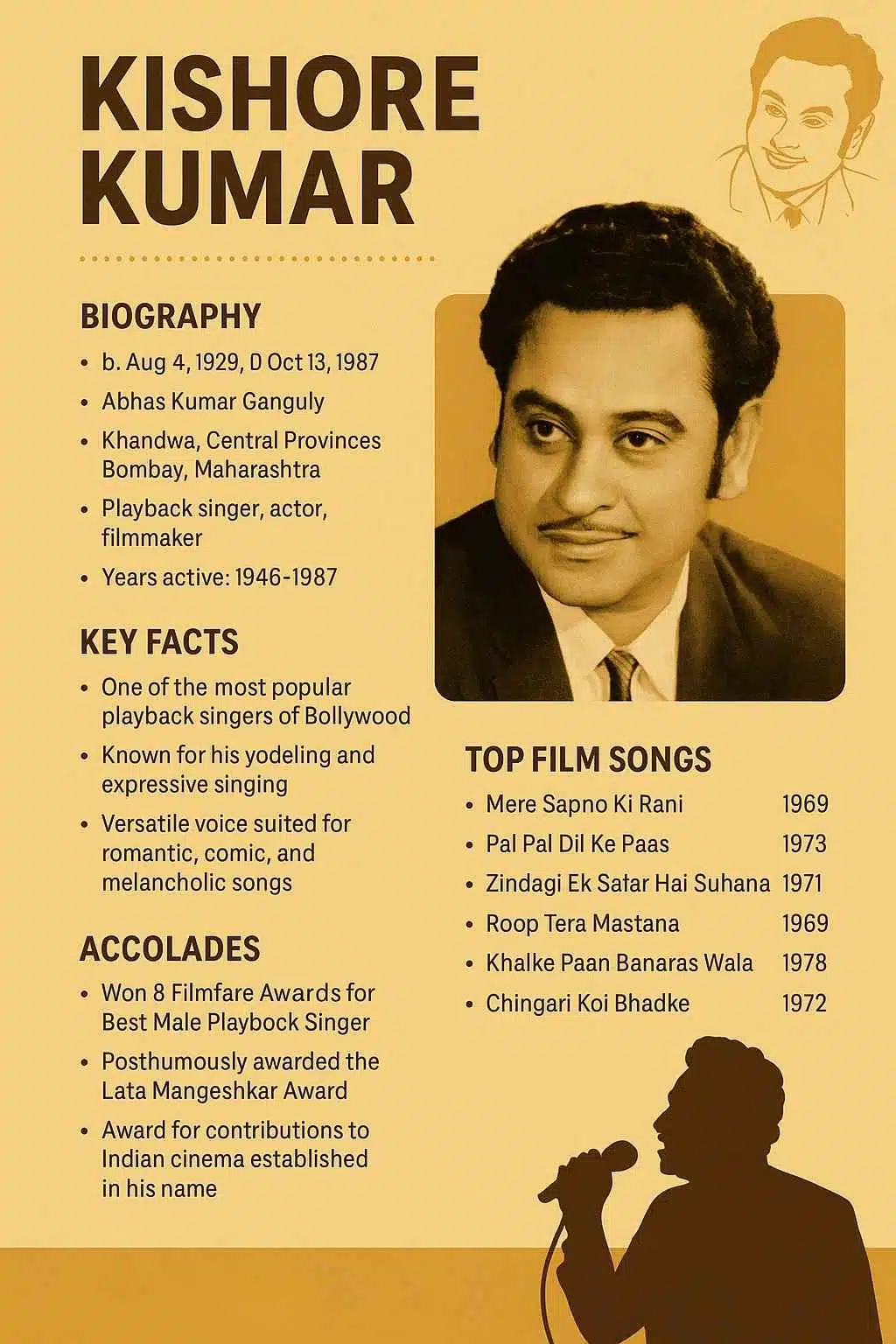
Kishore Kumar was never the polished crooner of elite society—he was the voice of the common man, singing of dreams, heartbreaks, and everyday chaos.
In “Zindagi Ek Safar Hai Suhana,” he celebrated life’s uncertainty. In “Chingari Koi Bhadke,” he mourned love’s fragility. In “Mere Sapno Ki Rani,” he embodied youthful optimism.
Every generation finds its reflection in his catalogue because his songs captured emotions universal and timeless—joy, loss, nostalgia, and rebellion.
Spotify’s India reports show that Kishore Kumar remains one of the most streamed vintage artists, decades after his death. YouTube tributes rack up millions of views every year, with comments from listeners born long after he left us.
That’s because Kishore’s voice wasn’t designed for an era—it was designed for human experience itself.
The Rebel Spirit: Authenticity Over Approval
Kishore Kumar’s creative philosophy was simple—never fake emotion.
He famously refused to lip-sync during performances, saying that music couldn’t be acted; it had to be felt. He often clashed with producers over artificial situations or hurried recording schedules.
During the Emergency in the mid-1970s, he was unofficially blacklisted for refusing to sing at a government event—a decision few dared to take.
He wasn’t chasing fame or awards. He was chasing truth—in voice, tone, and emotion. His unpredictability wasn’t arrogance; it was artistic integrity.
In an industry increasingly shaped by commercial formulas and auto-tuned perfection, Kishore’s defiance reminds us that real art breathes through imperfection and conviction.
The Afterlife of a Legend: Kishore in the Digital Age
Technology has transformed how we listen to music—from vinyl to cassettes, from CDs to Spotify. Yet Kishore Kumar’s voice thrives across every format.
-
On YouTube, remastered versions of “Pal Pal Dil Ke Paas” and “Dil Kya Kare” continue to trend.
-
On Spotify, he ranks among the top five most-streamed vintage Indian artists globally.
-
His songs feature in international playlists like “Bollywood Forever” and “Legends of India.”
Modern singers—Arijit Singh, Sonu Nigam, Shaan—frequently cite him as their emotional compass. Tribute concerts, biopics, and cover albums continue to keep his memory alive.
Interestingly, even AI-generated Kishore covers have gone viral—yet listeners quickly sense the difference. Machines can mimic pitch, but not pathos. Kishore Kumar remains, even in 2025, the benchmark for what human emotion in music sounds like.
Why No One Can Replace Kishore Kumar
The reason is deceptively simple—he wasn’t trying to be anyone else.
Kishore Kumar’s greatness lies not only in what he sang but also in how he lived. His songs embodied freedom—creative, emotional, and human.
Modern playback singers may surpass him in range, training, or production quality. But what they can’t replicate is his emotional spontaneity—that magical unpredictability that turned every song into a story.
He bridged laughter and longing in a single verse. He made music an act of truth, not just performance. He represented the era when art was instinct, not algorithm.
That’s why every new voice, no matter how brilliant, eventually ends up compared to him. Kishore Kumar isn’t a benchmark to surpass—he’s a standard of authenticity that continues to define Indian music.
Takeaways
Kishore Kumar’s voice is more than nostalgia—it’s heritage in motion. It travels through generations not as a relic, but as a living companion.
He proved that true music doesn’t age; it simply adapts to new hearts. His laughter, his melancholy, and his magic remain woven into the cultural DNA of South Asia.
In an industry obsessed with hits and hashtags, Kishore Kumar’s legacy reminds us of one eternal truth: voices fade, but emotions echo forever.
Every time “Zindagi Ek Safar Hai Suhana” plays, India hums along—not to remember the past, but to feel alive in the present.
That is why no one—and perhaps no one ever will—replace Kishore Kumar.