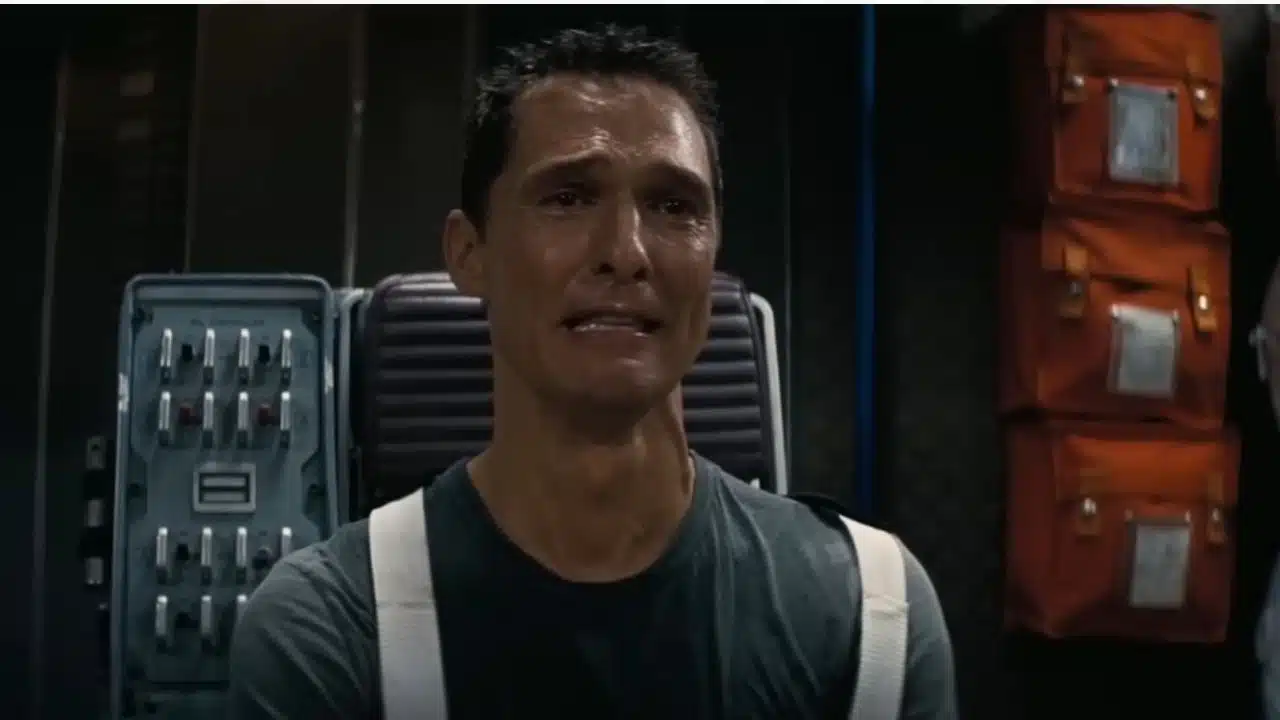
Academy Award–winning actor Matthew McConaughey has revisited one of the most unforgettable moments in his career — the heart-wrenching crying scene from Christopher Nolan’s 2014 sci-fi epic Interstellar. In a recent career retrospective interview with Vanity Fair, the actor revealed new behind-the-scenes details about how the sequence was filmed, how he prepared for it, and why it was captured in just a single take that made it into the final cut.
The scene in question remains one of the most emotional beats in the film. McConaughey’s character, astronaut Joseph Cooper, sits aboard the Endurance spacecraft after returning from a mission on a water planet that experiences extreme time dilation — where one hour on the planet equals seven years on Earth. By the time Cooper and his crew escape, they have lost 23 years of Earth time. Watching archived video messages from his children, he breaks down in tears as he realizes he has missed their entire childhoods and most of their adult lives.
This devastating moment has become a hallmark of Interstellar and a defining point in McConaughey’s career — both as a raw emotional performance and as a viral internet meme that continues to circulate nearly a decade after the film’s release.
Preparing for the Scene
McConaughey explained that the powerful reaction did not come from elaborate acting exercises or multiple rehearsals. Instead, the timing of the shoot allowed him to approach the moment in a natural, almost instinctive way.
“It was the very first scene we shot,” McConaughey revealed. “I had gotten really good rest that weekend. I had a humble, good couple of days with my family. And I walked in with this fresh, relaxed state of mind.”
The actor also shared that he handed Christopher Nolan a handwritten note before cameras rolled. On it, he had written the words “See you first” — a small but symbolic reminder that the performance would be about raw discovery and not mechanical acting.
When Nolan suggested rehearsing the playback of the tapes, McConaughey stopped him, insisting they roll cameras immediately. “I went, ‘Ah, ah — don’t rehearse it,’” he recalled. “All of a sudden, cameras were on, and we played the tape. That first take you see in the film — that’s the only one we did.”
Why the First Take Was Everything
The decision to use only one take wasn’t accidental. McConaughey explained that he has long believed in the authenticity of a first reaction.
“I’ve learned that I like to just do the first take,” he said. “Because everything after take one is acting. We can polish or improve technical things later, but if you’re relaxed and simply reacting, that first take carries a truth you can’t fake again.”
In the case of Interstellar, that truth came through in the form of pure, unfiltered grief. Watching his character’s grown children — played later in the film by Jessica Chastain and Casey Affleck — hit McConaughey at a personal level. As a father himself, he admitted the thought of losing decades with his own children immediately triggered an overwhelming sense of dread.
“What if one day you go to work, and then you’re gone for ten years?” he asked rhetorically. “That’s what I thought about. And when I saw those messages from the characters who were now adults, I just reacted. I didn’t have to push it. It was already there.”
Christopher Nolan’s Approach
Christopher Nolan is known for preferring practical effects and in-camera realism over heavy CGI. This philosophy extended into his approach with actors. For the video messages, Nolan had them played back in real time on set so McConaughey could react authentically, rather than performing to a blank screen or imagined prompt.
By creating the environment as realistically as possible, Nolan ensured the actor’s performance was not only convincing for the audience but also emotionally genuine for McConaughey. Film scholars and critics have since praised the choice as a prime example of Nolan’s grounded approach to science fiction, where human emotions are treated with the same importance as cosmic spectacle.
The Scene’s Legacy: Cinema and Internet Culture
The crying scene has lived well beyond Interstellar’s original 2014 release. It has become a widely shared reaction meme, often used online to dramatize everything from disappointing sports results to fictional tragedies in fan communities.
While McConaughey acknowledged the “memery” of the moment, he emphasized that the authenticity of the first take was what gave it staying power. “That’s just me relaxing, and then what happened, happened,” he reflected.
The scene has since been ranked among the most memorable emotional breakdowns in modern cinema and continues to be referenced in discussions of Nolan’s greatest works. Critics from outlets like The Guardian and IndieWire have noted how the scene bridges big-picture sci-fi themes (like relativity and time dilation) with deeply personal stakes that resonate universally with audiences.
Why It Still Resonates
More than a decade later, McConaughey’s performance underscores why Interstellar is considered not only a technical triumph but also a deeply human story. The fusion of scientific imagination with raw human vulnerability is what gives the movie its enduring legacy.
For McConaughey, the one-take crying scene stands as a reminder of the power of authenticity in acting:
“I didn’t want to know what was coming. I wanted to be surprised in the moment. That’s all about relaxing. And when you’re relaxed, what happens, happens.”
That philosophy gave audiences one of the most iconic moments of his career — a performance etched into cinema history, internet culture, and the collective memory of anyone who has ever pondered the weight of lost time.
The Information is Collected from IMDb and Gizmodo.