
Does your online store feel like a slow turtle on a racetrack? When pages hang, shoppers bail. That frustration slams your sales and brand. I’ll show you the top Hosting Features To Look For In An E-commerce Website.
By 2027, online shops will rake in 41 percent of all retail. That surge demands a fast, secure site. In this post, we cover SSD drives, global edge servers, SSL certificates, scalable cloud hosting grids, and 24/7 live chat.
Each tip helps you pick a host that boosts speed, uptime, and trust. Read on.
Key Takeaways
- By 2027, online shops will make 41% of all retail sales. You need fast hosting with SSD drives. Hostinger’s Cloud Startup plan gives you 100 GB NVMe storage that loads pages in under two seconds.
- A global CDN like Cloudflare caches content near buyers and cuts delays by up to 50%. It also shields your site from DDoS attacks and helps you rank higher on Google.
- Hostinger’s cloud plan promises 99.9% uptime with redundant servers and load balancers. Auto-scaling spins up CPU, RAM, and storage when traffic spikes so your store never stalls.
- Free unlimited SSL certificates plus PCI compliance (12 security rules) encrypt customer card data and boost shopper trust. HTTPS sites score better in Google PageSpeed and Analytics.
- You get 24/7 live chat, phone, and ticket support to fix SSL issues, stop DDoS floods, and resolve payment bugs in minutes.
High Performance and Speed

NVMe SSD drives fire up pages in a blink, so your shoppers never tap their watches. Cloudflare edge servers stash content near buyers around the globe and serve it almost instantly.
Importance of SSD Storage for fast loading times
SSD drives slash page load times for online stores. Hostinger’s Cloud Startup plan gives you 100 GB NVMe storage, a big boost over spinning disks. Ecommerce hosting with SSD tech feeds assets faster, so shoppers stick around.
Google PageSpeed and Google Analytics both flag slow sites, and fast sites often climb search engine ranks.
SSD storage speeds up database queries and image loads. Cloud hosting plans with NVMe handle spikes without sweat. You can push files via SFTP or secure shell in record time. Data centers filled with SSD arrays serve content faster than shared hosting or VPS options.
Online stores often see sales jump when pages pop up in under two seconds.
Use of a Content Delivery Network (CDN) for global accessibility
Fast page delivery keeps shoppers happy. Hostinger’s Cloud Startup cloud hosting plan packs a content delivery network (CDN) for global reach. Edge caching stores images, code, and other files near browsers around the world.
This trick cuts page load speed down, boosting search engine rankings and user joy. A prime tool like a content distribution service can cut delay by up to 50 percent. Managed hosting providers and ecommerce platforms need this to serve buyers fast.
DNS records steer users to the closest server. A real service, an edge caching platform, offers DDoS protection and fights cyber-attacks. This mix shields your web application and speeds checkout flows.
Reliable Uptime
A 99.9% uptime pledge keeps your shop running around the clock. Backup servers team up with uptime monitoring tools to catch glitches before they hit your pages.
Guaranteed uptime percentages (e.g., 99.9%)
Hostinger’s cloud hosting plans carry a 99.9 percent uptime guarantee. This figure sets the bar for ecommerce hosting, and it beats most shared hosting deals. High uptime stops site outages that cost sales.
Stores rely on CDNs and stable connections to serve pages fast.
IT teams use uptime monitors and performance tools. They fight DDoS attacks on online stores.
Redundant servers for consistent availability
Redundant servers mirror your site on extra machines in data centers around the world. Think of these nodes like spare tires, ready to roll if one fails. This measure stops single failures from crashing an e-commerce site.
Many ecommerce hosting plans promise at least 99.9% uptime based on real metrics. You can pick VPS hosting or dedicated services with this setup.
Load balancers and mirror clusters spread traffic across machines. Cloudflare’s balancer keeps shoppers on a healthy node. Amazon Elastic Compute Cloud servers spin up when visits surge.
This auto-scaling setup handles payment processing and inventory management without a pause.
Robust Security Features
A solid SSL certificate and DDoS protection serve as your store’s bodyguards, fending off bad traffic and shady spies. A top host meets PCI compliance, locks down firewall ports, and scans logs for odd traffic so you stop an attack in its tracks.
SSL Certificates for secure transactions
SSL certificates encrypt customer data and secure all online transactions in your online store. Browsers show a padlock icon when a site uses secure sockets layer tech, so shoppers know their credit card info stays secret.
Compliance with the payment card industry data security standard (PCI compliance) needs SSL for safe payment processing on any ecommerce platform. Web hosting firms often bundle SSL support with automatic backups, ddos protection, and a content delivery network (CDN) for full ecommerce hosting peace of mind.
Hostinger adds free unlimited ssl certificates to each ecommerce hosting plan, with no setup fees. Shared hosting, cloud hosting, managed woocommerce hosting, or saas hosting all get instant HTTPS from a free certificate authority or a managed certificate service.
The OpenSSL library runs in the background to sign keys. Cloudflare shields the padlock sign, and helps stop many ddos attacks. Google ranks HTTPS sites higher, so search engines reward secure servers.
PCI Compliance for handling payment data
PCI compliance controls how ecommerce hosting platforms treat card details. These rules, set by Visa, Mastercard, and others, aim to stop breaches. The standard lists 12 steps, like encrypting data in motion and at rest.
A network scanner and an intrusion detection system catch weak spots. Providers must run vulnerability scans before they go live.
Select a pci compliant plan that pairs a managed ssl certificate with encryption across all pages. This hosting solution isolates card info in a locked segment and runs daily vulnerability scans.
A software-as-a-service model may handle payment processing on your behalf. This setup cuts risks and shields you from fines that can reach up to $100,000 per month for noncompliance.
Firewall protection and regular security audits
Cyber thieves scan ecommerce hosting setups for weak points. You need strong shields and regular security audits.
- Firewalls create a barrier between your ecommerce hosting server and malicious bots, using packet filters on the network gateway.
- Application firewall checks every HTTP request; it spots scripts designed to hijack payment processing or inventory management on your ecommerce website.
- Threat monitoring services scan log files for odd entries; they alert your technical support team when someone slips in hidden exploit code.
- Scheduled security audits review databases and server code; they recommend patches and enforce PCI compliance rules for safe transactions.
- Hostinger layers on network flood prevention and malware guard; this duo protects an online retail site from traffic overloads and hidden threats.
Scalability and Flexibility
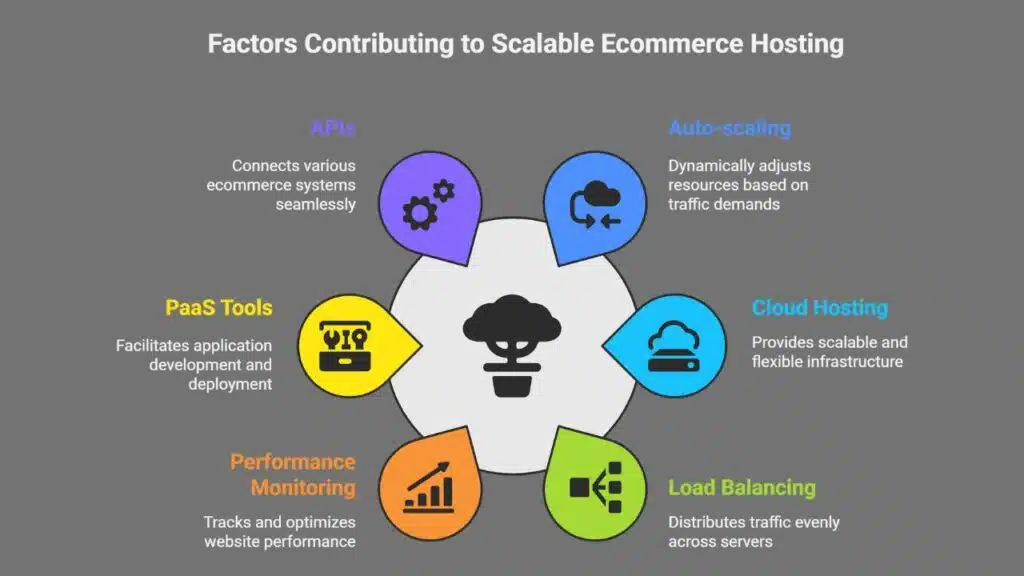
Auto-scaling on a cloud-hosted IaaS plan kicks in, it spins up capacity when traffic spikes swarm your store. You roll out provisioning scripts, watch performance metrics, and surf the surge with ease.
Auto-scaling capabilities to handle traffic spikes
Your store can ride traffic waves without crashing. A cloud auto scaling service adds server resources as visits spike during Black Friday sales. It taps into extra CPU, RAM, and storage in seconds.
This quick boost helps you keep page load speed low and customers happy.
Peak holiday surges will not slow down your ecommerce website. A load balancer splits incoming requests across new nodes on demand. Large brands often pick cloud hosting for scalable resources and multi-site growth.
This model beats the limits of shared hosting or vps hosting, letting your ecommerce site grow.
Room for growth as your business expands
Small ecommerce hosting setups start with VPS hosting at 10 GB storage. Cloud hosting scales storage and bandwidth fast, it covers 90 to 180 GB per month for flash sales. It spins up extra CPU and RAM on demand.
It uses PaaS and infrastructure as code tools. Application performance monitoring spots slow pages early.
Hostinger’s Cloud Startup plan hosts up to 100 sites, it helps you add stores on the fly. You can launch new brands or test promos. Managed woocommerce hosting keeps SSL certificates, CDN, and firewall shields in place.
APIs connect shopping carts to inventory, payments, and shipping. You skip downtime, you sell more.
Comprehensive Customer Support
We staff chat, phone, and ticket channels around the clock, so you never race the clock alone. Our team stops phishing, thwarts DDoS attacks, and patches that SSL certificate in minutes.
24/7 support availability
Hostinger offers 24/7 expert assistance with all cloud hosting plans. You can call, email, or use instant messaging any time. Shoppers count on fast answers to payment processing, SSL certificate issues, and inventory management.
This support stands out for any ecommerce hosting setup that scales up under traffic spikes. You should test response times before you pick a hosting provider. Reliable technical support cuts downtime and stops malicious software melee.
Good help can block ddos attacks and phishing attempts on your online store.
Multiple support channels like live chat and phone
Your ecommerce hosting plan needs fast help. A hosting provider gives you options by offering live chat or phone. You face a ddos attack, and a chat message might fix it fast. You spot a payment processing bug.
A quick call can sort it out.
Hostinger makes support easy with live chat and email contact around the clock. You test each channel to note response times before you pick shared hosting, cloud hosting or managed woocommerce hosting.
Always check your provider’s phone line too. Agents can guide you through file transfer protocol issues or application programming interface setup.
Takeaways
We picked the five hosting specs that make stores soar. Cloud hosting, solid state drives, and a content delivery network keep pages quick.
SSL certificates and PCI checks encrypt and guard card data. Auto-scaling servers absorb sudden visitor waves.
Built-in DDoS shields block traffic floods. Tech teams answer calls or chat at odd hours. These specs help shops load fast, shield data, and grow with ease.
FAQs
1. What hosting type should I pick for my e-commerce platform?
Choose shared web hosting to start. It is cheap and easy. When you grow, you can move to VPS hosting or cloud hosting. High performance hosting or dedicated hosting works for big shops.
2. How do CDN and content delivery networks help my site?
A CDN cuts load times by sending images and files from servers near your customers. It boosts page load speed and keeps your site fast under heavy traffic.
3. Why are PCI compliance and SSL certificates important?
PCI compliance means you follow rules for safe payment processing. SSL certificates encrypts data and guards credit card info on the internet.
4. What role do automatic backups and technical support play?
Automatic backups save your inventory management files, order information, and email messages. Solid technical support fixes server-side glitches and fights ddos attacks.
5. Should I use managed WooCommerce hosting or SaaS hosting?
Managed WooCommerce hosting makes your WordPress shop quick to set up. SaaS hosting, or software as a service, gives you tools without server chores. You can also try PaaS or infrastructure as a service for more control.
6. How can my hosting provider scale with my online store needs?
A good hosting provider lets you add storage space or upgrade to a dedicated server. You can scale up with VPS hosting, cloud hosting, or a managed hosting plan as your sales climb.