
We are living a technological revolution that future generations will likely view as one of the most transformative in history, i.e., the rise of artificial intelligence (AI) and machine learning (ML).
Machine Learning solutions enable businesses to extract deeper insights from their data, uncover patterns humans might miss, and deliver more personalized, efficient, and scalable experiences.
From Netflix predicting your next favorite show to Facebook recognizing faces in photos, ML has the power to unlock business value. It empowers organizations with smarter decision-making, optimized operations, and new revenue streams.
The numbers speak volumes. The global machine learning market is valued at USD 35.32 billion in 2024. The market is expected to grow from USD 47.99 billion in 2025 to USD 309.68 billion by 2032, exhibiting a CAGR of 30.5% during the forecast period.
In this blog, we’ll explore how your business can harness ML’s potential to drive value, and AI-adoption strategies that drive tangible and productive results.
What Does ‘Unlocking Business Value’ Mean for Machine Learning Models?
When we talk about business value in the realm of machine learning, it’s important to note that it’s not just about financial gains or the technical complexity of your models.
Actual business value lies in how effectively a model performs and the extent to which it addresses the needs of your customers. A poorly performing model that fails to deliver meaningful outcomes for your customers offers little value, regardless of how advanced it may appear.
For example, imagine you’re the CEO of a start-up bank that has implemented a machine learning model to evaluate new customer applications using Know Your Customer (KYC) and anti-money laundering (AML) guidelines.
The model shouldn’t only return a simple “YES” or “NO” response. To truly support decision-making, it must provide reliable, actionable insights that add context to each outcome.
This is what deriving business value from machine learning means. When your models empower both you and your customers with clarity and confidence, you foster trust and strengthen your brand’s reputation.
Top 5 Best Practices to Maximize Business Value with Machine Learning
Developing ML business models that offer the desired value to you and your customers is easier said than done.
However, as a machine learning services company, we’ve identified five practices that can establish a strong foundation for your ML venture.
1. Start with a Well-Defined Business Problem
A common mistake organizations make when commencing their machine learning (ML) initiatives is beginning with their existing data or technological capabilities rather than an articulated business challenge.
While it might seem logical to start with the richest datasets, especially since sophisticated ML models thrive on abundant, high-quality data, this approach often leads to solutions in search of a problem.
The reality is that most business challenges don’t require high-level data to solve effectively. Successful ML projects tend to emerge from aligning technical efforts with specific organizational needs.
When projects are initiated without this clarity, companies frequently end up with complex models that fail to address immediate issues, delivering little to no business value.
By focusing on defining the problem you want to solve, you set the stage for creating ML solutions that drive tangible outcomes for both your organization and your customers.
2. Create a Strong Data Ecosystem
Despite living in a data-driven era, many organizations still don’t value their data assets. They often view them as a burden until a crisis such as a data breach forces them to reconsider.
Treating data as an afterthought limits your ability to extract meaningful insights and apply ML effectively. As ML experts, we firmly believe that establishing a robust data ecosystem is critical.
This involves developing infrastructure and practices that facilitate seamless data collection, management, integration, and access throughout your organization. Without this, valuable information remains siloed, underutilized, or poorly governed, trapped in a data “void.”
A well-constructed data ecosystem democratizes access to high-quality, well-governed data, empowering teams to make informed decisions. Ultimately, it creates the groundwork necessary to fully realize the potential of your ML models and maximize the value of your data assets.
3. Rethink Your Approach to Talent Acquisition
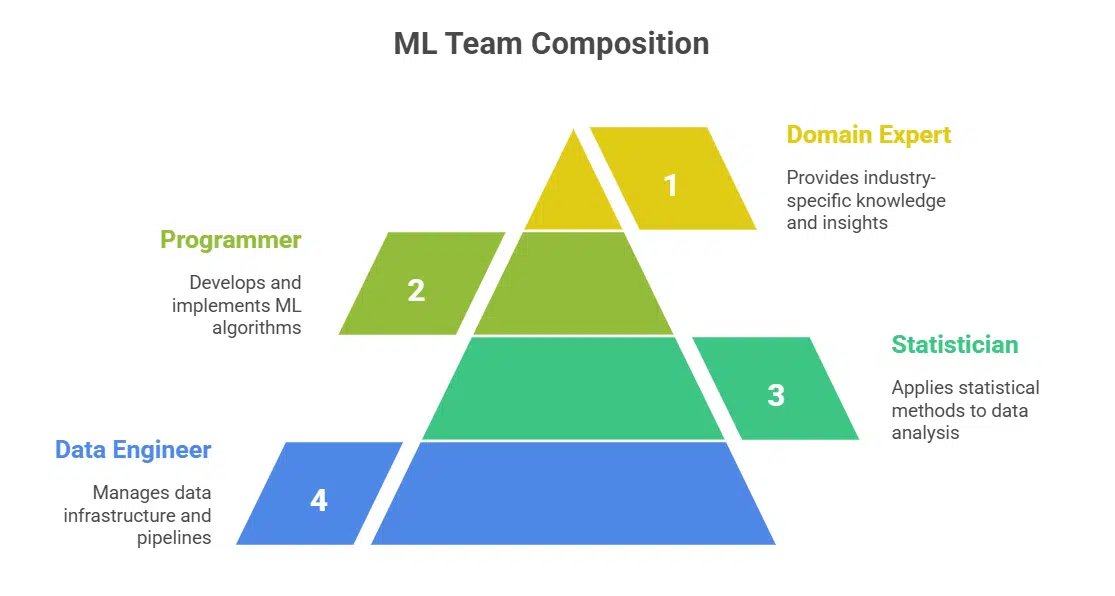
Hiring machine learning experts often comes with unrealistic expectations. Business leaders sometimes seek “unicorn” candidates i.e. data scientists with PhDs, world-class programming skills, deep analytical expertise, and strong business acumen.
These individuals exist but are exceedingly rare, and building an entire team of such talent is impractical. Instead, consider ML development as a team sport. Essentially, your team should have a skilled data engineer, a statistician, a programmer, and a knowledgeable domain expert.
A team with these experts can achieve far more collectively than any single individual claiming expertise across all these disciplines. This approach not only broadens the talent pool but also fosters collaboration.
It ensures that ML projects benefit from diverse perspectives and specialized expertise at every stage of development.
4. Run Pilot Tests for Your ML Model
Many organizations hesitate to pilot their ML models, believing they need to perfect every detail before deployment. This often leads to “pilot purgatory”, a state where functional models sit idle, unused, and untested in real-world conditions.
Launching test pilots early, even with basic models, is essential. Pilots act as a low-risk “try-before-you-buy” opportunity. It helps teams evaluate performance in operational environments, uncover potential challenges, and refine models iteratively before committing to full-scale deployment.
To run effective pilots, ensure you:
- Clearly define the desired business outcome.
- Choose an appropriate testing methodology.
- Anticipate roadblocks and prepare to adjust quickly.
- Recognize the distinction between testing and production readiness.
This proactive approach accelerates learning, minimizes waste, and positions your ML models for smoother adoption and greater impact.
5. Be Ready to Pivot When Necessary
Even with the best planning, ML projects often encounter roadblocks that challenge initial assumptions. Organizations sometimes cling to original business cases, adjusting goals to fit the model’s limitations instead of addressing the root issue.
This can erode the model’s business value and waste valuable resources. A more effective strategy is embracing flexibility. Be prepared to adapt, whether that means sourcing new data, revising business processes, or even rethinking your model’s design.
ML solutions are not static; they are dynamic tools that evolve alongside your organization’s needs and challenges. By cultivating a mindset of iteration and resilience, businesses can unlock far more value from ML initiatives, ensuring they remain aligned with real-world demands and deliver desired impact.
Conclusion
Machine learning holds immense promise for organizations ready to harness its power, but success doesn’t happen by chance. Unlocking actual business value requires more than just technical expertise; it demands a thoughtful, holistic approach.
Starting with a clearly defined business problem ensures that your models address real challenges, rather than just processing data for its own sake. Building a robust data ecosystem creates the foundation for seamless integration and informed decision-making.
Assembling cross-functional teams promotes collaboration and avoids unrealistic talent expectations, while running early test pilots helps fine-tune models in real-world environments.
Ultimately, staying agile and willing to pivot ensures that your initiatives remain aligned with evolving needs and maintain long-term relevance. The path to impactful ML adoption starts with a thorough plan and strategic execution.
At Maruti Techlabs, we have worked on numerous AI and ML projects, delivering value to our clients across various sectors, including healthcare, insurance, banking, and others.
Explore our Artificial Intelligence Consulting Services to drive innovation and measurable value. Connect with us today and see the magic unfold.