


Margin Trading Facility (MTF) is the facility through which investors buy stocks by paying only a margin amount and taking the remaining amount as a loan from brokers. This facility is regulated by the Securities and Exchange Board of India (SEBI), and it’s available for approved stocks to be traded through the broker’s margin trading list.
One of the important constituents of cost in MTF is the interest on borrowed funds, which is termed the MTF interest rate. This interest has an immediate bearing on the overall cost of any trade and plays a significant role in personal financial planning, particularly for frequent leveraged trade participants.
What is MTF?
MTF is a facility offered by stockbrokers through which clients can get stocks by buying the required amount with a margin. The purchased shares will serve as collateral for the broker to finance the remaining value of the trade. The investor subsequently pays the borrowed sum along with daily interest based on a valuation for the amount of time the position remains open.
Understanding MTF Interest Rate
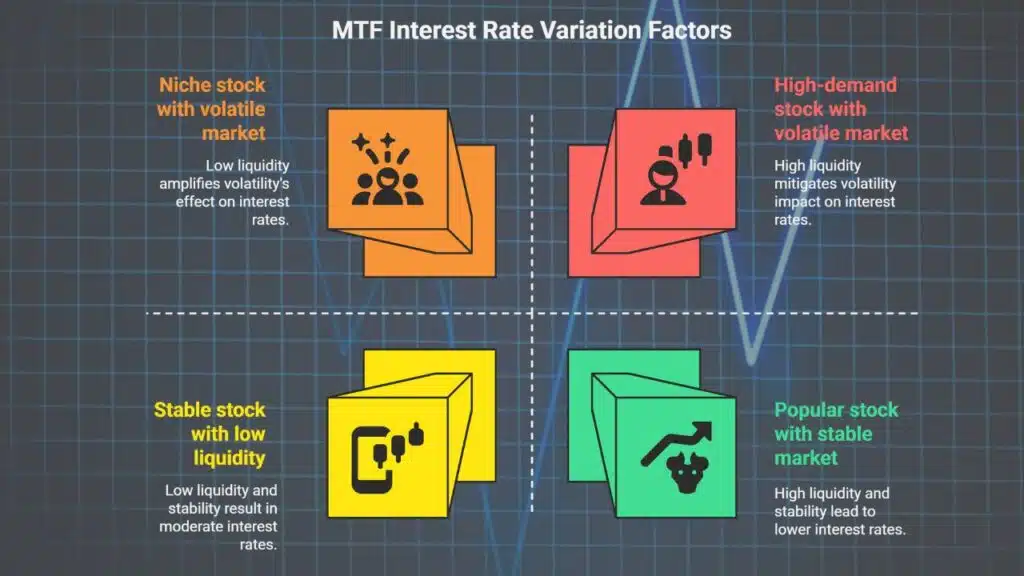
The MTF interest rate applies as a charge on the proportion of the participating trader’s trade that was borrowed overnight and, regarding comparison with conventional bank deposits, incurred on a day-to-day basis until the closure or squaring off of such position. It is normally quoted as an annual percentage but applied proportionally for each day’s holding of an open trade.
Different brokers have different MTF interest rates. This variation is attributed to factors such as prevailing market conditions, liquidity for a particular stock, and the policy of the brokerage firm.
Impact of MTF Interest Rate on Financial Planning
Like all borrowing, margin trading impacts the investor’s financial commitments and portfolio management. Here is how MTF interest rates affect financial planning:
1. Trade Duration Decisions
As the cost of holding on to trades for longer durations is usually higher, traders are prompted to plan a shorter trade cycle or an immediate exit after the target levels are achieved without leaving the position hanging.
2. Leverage Management
Interest costs increase with increased leverage. Investors often go for lower leverage ratios when the interest rate is high to minimize cash outflows and protect the capital.
3. Budgeting for Interest Expenses
Including expected interest charges in trade informs a realistic expectation of profit or loss. It also contributes to keeping personal finances disciplined within the overall cash flow.
4. Evaluating Stock Selection
The trade would also depend on the stock selected, as those with price movements would have different interest costs compared to those with steadier price movements or quicker tradability. This would then determine how much cumulative interest over time the trader is trying to control.
5. Portfolio Rebalancing
The interest accrued during a day on the MTF trades becomes cumulative over several days and affects the net returns of the portfolio tracked. This enables the investor to reallocate investments, switch to lower-risk investments, or exit margin trades in response to changing interest expenses.
Takeaways
The MTF Interest rates are highly significant concerning costs in the total value of margin-based trades. It also highly influences one’s investment decision. By taking into consideration interest charges and the timing of a trade use as well as the level of leverage used, traders can have an efficient handling of MTF.
























