The U.S. Olympic and Paralympic Committee (USOPC) has issued a major policy change that bans transgender women from competing in women’s events. The update, posted quietly on the USOPC website and confirmed through a letter sent to national sport governing bodies, cites compliance with a federal executive order signed by former President Donald Trump in February titled “Keeping Men Out of Women’s Sports.”
According to the USOPC, the change was made as part of its Athlete Safety Policy and applies to all national sports federations under its umbrella—including swimming, athletics, and other Olympic sports.
Citing Federal Obligation: Why the Change Was Made
USOPC President Gene Sykes and CEO Sarah Hirshland explained in a joint letter that, as a federally chartered organization, the committee is required to align with federal directives. This includes Trump’s executive order, which threatens to cut off federal funding to organizations that allow transgender women to compete in female categories.
“We have an obligation to comply with federal expectations,” the letter stated.
“Our revised policy emphasizes the importance of ensuring fair and safe competition environments for women.”
All Sports Federations Required to Update Policies
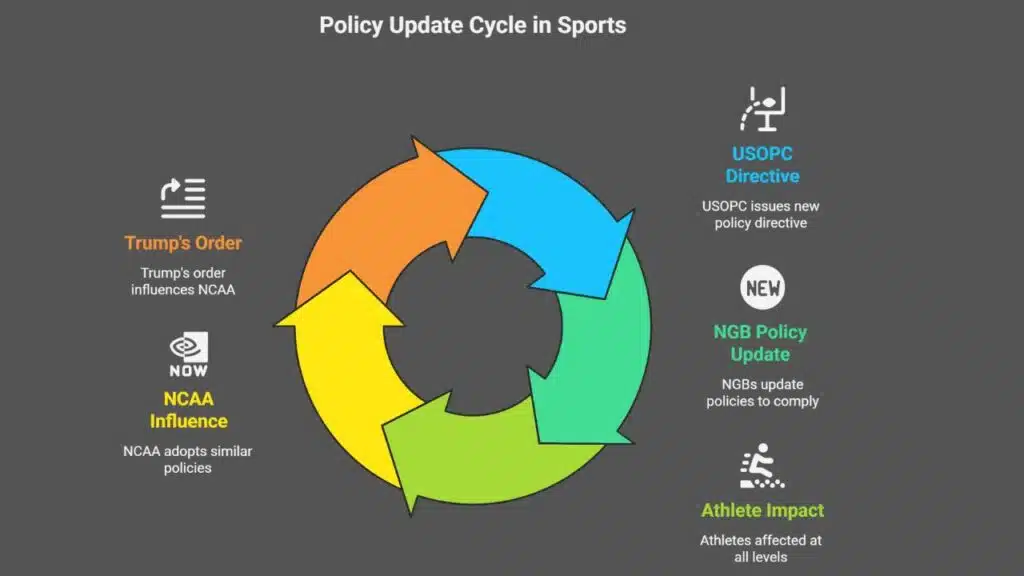
All National Governing Bodies (NGBs) have been instructed to update their policies to match the USOPC’s new directive. This affects athletes at every level under the Olympic pipeline, from national competitions to international representation.
The policy is in line with recent moves by other sports bodies—most notably the NCAA, which earlier this year announced a similar change. The NCAA now only allows athletes assigned female at birth to compete in women’s sports, a shift that followed closely after Trump’s executive order.
Trump’s Executive Order and Political Background
The policy shift is directly tied to Trump’s executive order, which characterizes the inclusion of transgender women in women’s sports as a threat to “fairness.” The order states that organizations allowing transgender athlete participation risk losing federal funds and recognition.
The issue has become a high-profile cultural and political battleground, with over two dozen U.S. states enacting laws to ban transgender girls and women from certain sports competitions. Advocates for these laws argue that athletic fairness is at stake, while critics say these measures are discriminatory and target a very small group of athletes.
How This Fits into Global Sports Policy
While this new USOPC stance marks a strict approach in the U.S., internationally the situation is more nuanced. The International Olympic Committee (IOC), under new president Kirsty Coventry, has allowed each sport’s governing body to set its own rules regarding transgender participation.
Several international sports federations have already responded with more restrictive policies:
- World Aquatics (Swimming): Bars athletes who experienced male puberty from competing in women’s events.
- World Athletics (Track and Field): Enforces similar restrictions.
- UCI (Cycling): Recently implemented a policy that restricts transgender women from elite female competition.
- FIFA (Soccer): Is currently reviewing its guidelines and may implement testosterone-based eligibility standards.
What’s Next for the Los Angeles 2028 Olympics?
With the Los Angeles 2028 Summer Games on the horizon, the issue of transgender eligibility could become a flashpoint for global debate. Trump has stated publicly that he wants the IOC to adopt a uniform ban across all sports, calling the issue “absolutely ridiculous.”
The IOC has so far resisted a one-size-fits-all policy, choosing instead to leave the decision-making to each sport’s federation. However, with mounting pressure from political figures, sports administrators, and advocacy groups on both sides, it remains to be seen how policies will evolve before the 2028 Games.
Broader Impact on Transgender Athletes
This sweeping change by the USOPC significantly limits options for transgender women looking to compete at the national and Olympic levels. While proponents argue the decision protects fairness for cisgender women, critics—such as LGBTQ+ advocacy organizations and civil rights groups—call it discriminatory and scientifically unfounded.
Legal challenges are expected, as similar state-level bans have been contested in federal courts. Organizations such as the American Civil Liberties Union (ACLU) and Human Rights Campaign (HRC) have argued that such policies violate Title IX, the U.S. law that prohibits sex-based discrimination in federally funded education programs and activities.
The U.S. Olympic Committee’s new transgender policy marks a pivotal moment in the ongoing national and international debate over gender identity and fairness in sports. With political pressure, legal battles, and the 2028 Olympics ahead, this issue will likely remain in the spotlight—and continue to shape the future of athletic competition.
The Information is Collected from NPR and ESPN.