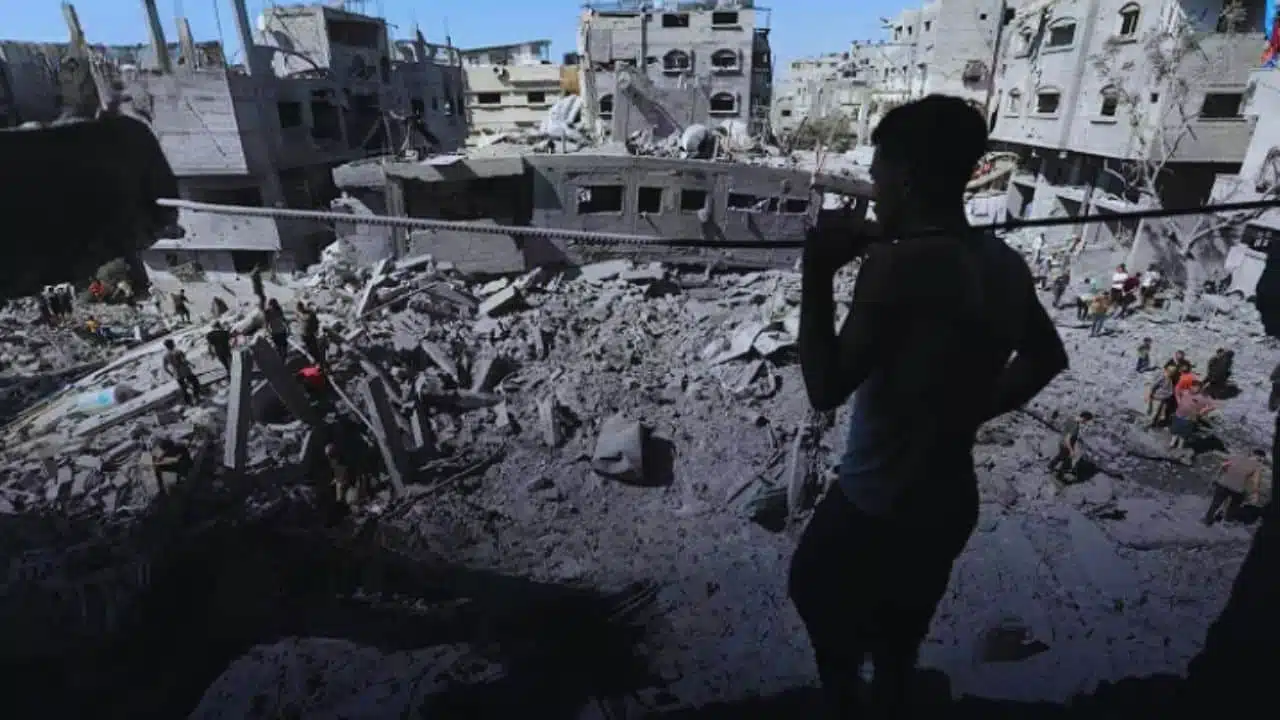
In a rare show of unity, twenty-five nations spanning Europe, North America, Oceania, and Asia have jointly called for an immediate and unconditional end to the war in Gaza. The coordinated diplomatic statement, released Monday, directly criticizes Israel’s handling of the ongoing conflict and its restrictions on humanitarian aid entering Gaza. The foreign ministers of these countries argue that the situation on the ground has reached catastrophic levels, with the civilian population enduring worsening conditions of starvation, displacement, and violence.
These nations collectively emphasized the urgency of halting military operations and allowing international aid agencies full and secure access to Gaza. They expressed concern that Israel’s current approach to aid delivery is contributing to regional instability and deepening the humanitarian disaster inside the besieged enclave. The joint message highlighted that the denial of vital assistance not only threatens civilian lives but may also constitute violations of international humanitarian law, which obligates all parties in conflict to protect civilians and ensure basic humanitarian standards.
Humanitarian Collapse and Food Crisis Spark Global Outcry
The appeal from these 25 countries comes amid alarming developments on the ground in Gaza. Over recent weeks, food insecurity has escalated to crisis levels, with multiple aid organizations reporting widespread malnutrition, particularly among children and vulnerable populations. The United Nations and agencies such as the World Food Programme have repeatedly warned that the volume of aid permitted to enter Gaza is far below the required threshold to sustain the population, especially as infrastructure has been destroyed and supply chains disrupted.
The situation reached a tragic point on Sunday when at least 81 Palestinians were reported killed and another 150 wounded during a chaotic attempt to access food supplies. The incident occurred near the Zikim border area, one of the limited points along the Gaza-Israel frontier where aid might be distributed. The Gaza Health Ministry, operated by Hamas, stated that the casualties resulted from Israeli military action targeting crowds of people who had gathered in desperation. Most of those affected were reportedly unarmed civilians seeking food for their families.
Israeli military officials acknowledged that troops had used live fire near groups of civilians, claiming the action was taken in response to a perceived threat to soldiers. However, the Israeli Defense Forces did not release specifics about what constituted the threat or provide direct evidence to support the claim. A preliminary IDF internal review questioned the death toll reported by Palestinian authorities but admitted a review of the incident was still ongoing. Human rights monitors have called for independent investigations to verify the facts and assess whether disproportionate force was used against civilians.
Growing Casualties Among Civilians Seeking Aid
According to the United Nations, this incident is not isolated. Over 875 Palestinians have been killed while trying to obtain food aid in recent weeks, either during airstrikes, shelling, or through altercations at aid distribution points. This alarming trend points to the growing desperation within Gaza, where more than half the population is now believed to be food-insecure, with some regions experiencing famine-like conditions. Many civilians are risking their lives daily in hopes of securing bread, water, or medicine.
The joint statement released by the 25 nations specifically cited the rising civilian death toll related to food access, calling the situation horrifying and unacceptable. They stressed the need for immediate action to prevent further deaths and insisted that humanitarian agencies be allowed to operate without obstruction, with international observers monitoring the aid flow.
List of Nations Demanding Action
The following countries signed the statement: Australia, Austria, Belgium, Canada, Denmark, Estonia, Finland, France, Iceland, Ireland, Italy, Japan, Latvia, Lithuania, Luxembourg, the Netherlands, New Zealand, Norway, Poland, Portugal, Slovenia, Spain, Sweden, Switzerland, and the United Kingdom. This diverse coalition represents longstanding allies of both Israel and the Palestinian people, underscoring the gravity of the concerns raised.
The foreign ministers of these nations jointly urged the Israeli government to remove all barriers to humanitarian access and fully cooperate with United Nations agencies and independent NGOs working in Gaza. They emphasized that humanitarian operations must be conducted safely and effectively, without interference or threat of violence, and that the principles of neutrality and protection of civilians should be strictly upheld.
Israel Responds with Rejection and Accusations
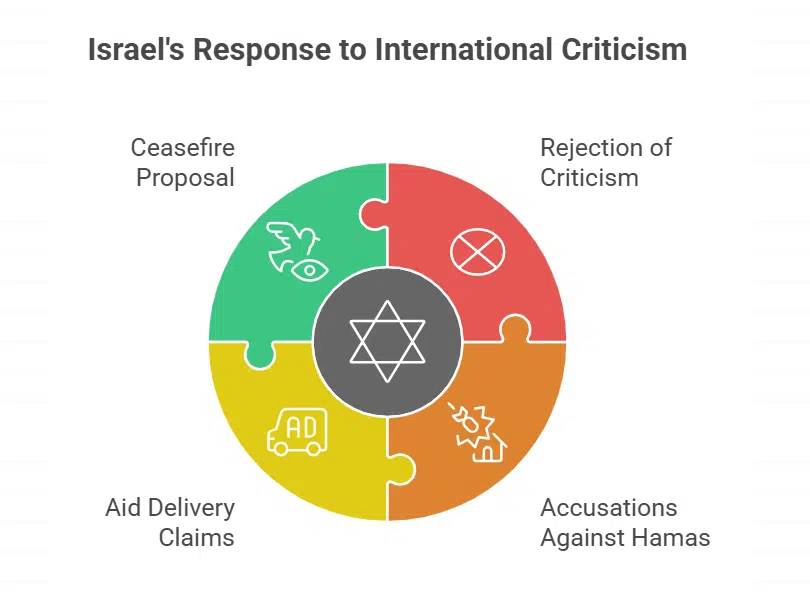
The Israeli government, through its Ministry of Foreign Affairs, promptly dismissed the statement. A senior spokesperson, Oren Marmorstein, criticized the 25 countries for what Israel described as a one-sided and unrealistic portrayal of the conflict. Israel accused the signatories of ignoring the role of Hamas, which it holds solely responsible for the war’s continuation and for obstructing efforts to reach a ceasefire agreement.
Israeli officials maintain that aid deliveries into Gaza are being facilitated and that the government is working with international partners to coordinate logistics. However, multiple humanitarian groups have contradicted these claims, stating that only a fraction of required supplies are being allowed in. They report that trucks are often delayed or denied entry, and security procedures are excessively restrictive.
The Israeli government further argued that a ceasefire proposal is currently on the table and has been communicated through international mediators. According to Israel, Hamas continues to reject the terms and is thereby prolonging the conflict and the suffering of civilians on both sides. Israel’s position is that any criticism should be directed primarily at Hamas leadership, which it claims instigated the war and has shown unwillingness to compromise.
U.S. Ambassador Defends Israel, Attacks Statement
Amid the diplomatic fallout, former Arkansas governor and current U.S. Ambassador to Israel, Mike Huckabee, condemned the 25-nation statement in a strongly worded social media post. He accused the countries involved of unfairly blaming Israel while overlooking what he characterized as Hamas’s repeated rejection of peace initiatives. Huckabee asserted that the humanitarian crisis is being exploited to tarnish Israel’s reputation and deflect responsibility from Hamas, which he claims has refused every ceasefire and hostage exchange proposal presented so far.
Huckabee’s comments reflect a broader divide between U.S. conservative circles and the increasingly critical tone of European and global partners toward Israel’s actions in Gaza. While the Biden administration has also expressed concern over the humanitarian toll, it has not endorsed the international call for an immediate ceasefire in the same terms as the 25-nation statement.
Hostage Crisis Remains Unresolved
A central component of the ongoing diplomatic negotiations is the continued captivity of Israeli hostages by Hamas. Since October 7, 2023, when Hamas launched a surprise attack into southern Israel, dozens of Israeli citizens and foreign nationals have been held hostage in Gaza. Negotiators from the United States, Qatar, and Egypt have been involved in weeks of talks to broker a prisoner exchange and ceasefire deal, but a final agreement remains elusive.
The joint statement released Monday reiterates international condemnation of Hamas for refusing to release hostages unconditionally. The ministers of the 25 nations insist that an immediate ceasefire, negotiated in good faith by all parties, is the most promising path to ensuring the safe return of hostages and ending the war.
United Nations Warns of Humanitarian Collapse
United Nations Secretary-General António Guterres issued a separate statement echoing the dire concerns of the 25 countries. He emphasized that the humanitarian system in Gaza is at risk of total collapse, with basic services such as water, sanitation, and healthcare barely functioning. Guterres condemned all forms of violence, including attacks on civilians attempting to collect food, and demanded that all warring parties prioritize the protection of noncombatants.
According to UN reports, most of Gaza’s population is now displaced, with hundreds of thousands living in makeshift shelters or in overcrowded facilities without electricity or clean water. Hospitals are overwhelmed, medical supplies are exhausted, and infectious diseases are spreading rapidly due to unsanitary conditions and the lack of fuel to power treatment centers.
International Community Pushes for Political Resolution
Beyond the immediate crisis, the joint statement urged all parties and the broader international community to support a political pathway to peace. The 25 signatory countries expressed full backing for mediation efforts by the United States, Egypt, and Qatar. They stressed that only a negotiated solution—one that addresses both Israeli security concerns and Palestinian rights—can prevent future cycles of violence.
The ministers emphasized their willingness to take further diplomatic and political actions to pressure the warring parties into agreeing to a ceasefire. They concluded by reaffirming their commitment to supporting long-term peace and security for both Israelis and Palestinians, including the possibility of expanded peacekeeping or post-conflict reconstruction efforts if a durable ceasefire is achieved.
Pope Leo XIV Adds Voice to Ceasefire Appeals
In a separate but aligned development, Pope Leo XIV renewed his call for an immediate ceasefire during his weekly public address from Castel Gandolfo, his summer residence. The Pope described the war as an unacceptable tragedy and called on all nations to work toward a peaceful and just resolution that prioritizes human dignity, compassion, and reconciliation. His comments, carried by global news agencies, added a moral and spiritual dimension to the international chorus demanding an end to hostilities.
Escalating Death Toll Spurs Diplomatic Unity
The war in Gaza, now several months old, has taken an immense toll on civilians, especially within Gaza itself. The latest developments—including the deaths of over 80 Palestinians trying to access food—have amplified calls for an immediate ceasefire and full-scale humanitarian relief. The joint statement by 25 nations, combined with appeals from the United Nations and the Vatican, reflect mounting global impatience with the current state of the conflict and an urgent desire for political resolution.
As negotiations continue behind closed doors, the world watches closely to see whether this growing international pressure can bring an end to one of the most devastating conflicts of the modern era.