
If you think that only your developers should care about code quality, think again. Sloppy code irritates engineers and quietly chips away at customer satisfaction, velocity and, eventually, your bottom line.
At its core, code quality refers to how readable, maintainable and reliable a codebase is. It is often judged by standards such as consistency, test coverage, performance and how easy it is for other developers to understand or extend. While it’s tempting to treat this as internal housekeeping and an ‘engineering thing,’ the ripple effects extend far beyond the development team.
Poor code slows feature releases. It creates bugs that users will notice before you do. It increases infrastructure costs and makes onboarding new engineers a slow-motion nightmare. Clean, efficient code, on the other hand, becomes a silent engine for innovation. It reduces technical debt, cuts debugging time and enables you to pivot more quickly when the market shifts.
It’s not just a question of polish – it’s a question of competitiveness.
What’s coming next? We’ll explain exactly how code quality influences business outcomes such as customer retention, scaling speed and investor confidence. If you’re involved in making tech decisions or funding them, this is one blind spot you can’t afford.
Join us as we explore the connection between good code and smart business.
The Real-World Impact of Code Quality on Business Outcomes
Lower Technical Debt Means Faster Innovation
Technical debt isn’t just an engineering problem; it also hinders growth. When your team is constantly patching brittle code, they’re not developing new features. They’re firefighting. In a competitive market, speed means survival.
High-quality code is modular, well-documented and testable, meaning your developers can add or change functionality without causing a cascade of errors.
Companies that neglect this often find themselves paralysed by their own infrastructure. Just ask anyone who has tried to refactor a legacy monolith built a decade ago with no version control, scattered documentation and no automated tests. Some of the biggest tech slowdowns, think of Twitter’s earlier outages or airline booking systems freezing under pressure, can be traced back to poor maintainability and fragile code.
When code is clean, teams can iterate faster. They conduct more A/B tests. They can push updates without a week of regression testing. And when they work with a smart QA testing services company, the velocity-to-reliability ratio increases significantly.
Code Quality Drives Product Stability and Customer Trust
Users don’t care how elegant your backend architecture is until something goes wrong. Then they care a lot.
Every bug, crash or delay chips away at your reputation. According to PwC, 32% of customers say they would stop dealing with a brand after just one negative experience, even if they love the company. For platforms handling sensitive data or transactions, such as fintech and healthtech, that figure is even higher.
High code quality directly reduces production incidents. It’s the difference between being alerted by your QA testing services company during staging and waking up to a social media firestorm because your checkout flow stopped working at midnight.
Stable code also makes it easier to track and resolve edge-case bugs, handle exceptions proactively, and prevent data corruption. Uptime becomes the norm, not a goal.
And that matters. Because reliability builds trust. Once lost, trust is expensive to rebuild.
Strategic Benefits of Prioritizing Code Quality
Reduced Maintenance Costs and Operational Risks
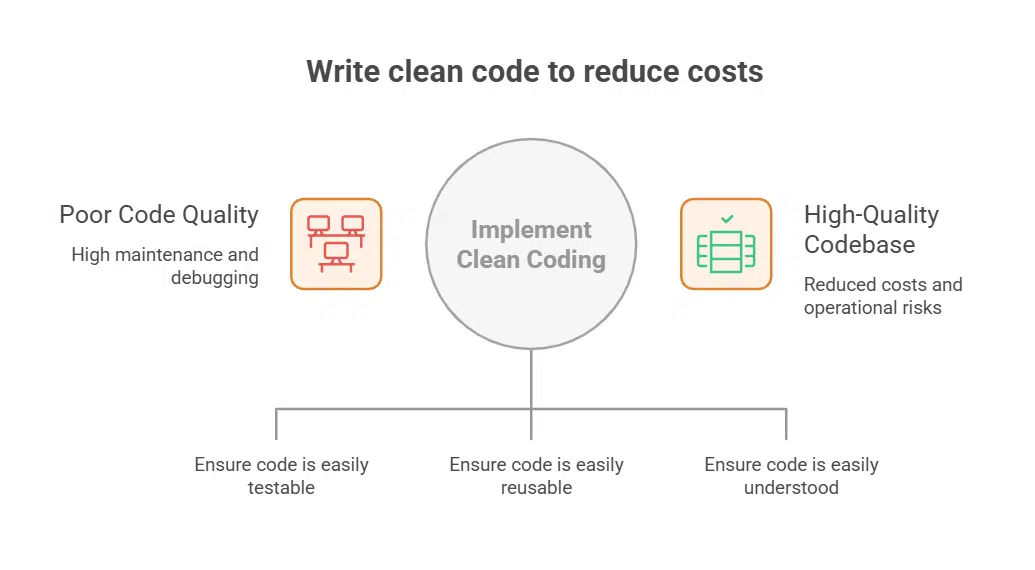
Rushed code today becomes a liability tomorrow. Poor-quality code often requires more developer hours just to maintain it, for example, debugging, applying hotfixes and rewriting messy logic that wasn’t built to last. Over time, the cumulative cost of this maintenance work far exceeds the initial effort required to write clean, testable code.
According to a study by Stripe and Harris Poll, developers spend over 17 hours a week dealing with ‘bad code’ and technical debt. That equates to nearly $85 billion in lost productivity globally each year. Now imagine what your team could achieve with half that time back.
High-quality code also minimises operational risks. It’s easier to secure, simpler to audit and more reliable under pressure. Whether you’re preparing for a compliance review or scaling your infrastructure to handle peak traffic, clean code makes the process less chaotic and more reliable. There’s less guesswork and fewer hidden pitfalls.
For companies in regulated sectors – finance, healthcare or insurance, this isn’t just a bonus. It’s essential for business survival. Maintaining audit trails, ensuring traceability and isolating risk become much easier when the codebase is clear, modular and well documented.
Attracting and Retaining Top Engineering Talent
To be blunt, no talented engineer wants to wade through messy code every day.
Clean code isn’t just good engineering; it’s a signal. It shows candidates that your organisation prioritises long-term quality, craftsmanship and developer experience. It shows them that their time won’t be wasted unravelling three-layer hacks buried in business-critical logic.
Developers often talk. Word spreads fast. Companies known for messy code and a firefighting culture struggle to retain senior engineers. Meanwhile, companies that treat code quality as a cultural pillar build teams that stay longer, deliver more, and attract other top-tier talent.
Think of it like this: would a top chef work in a kitchen where the knives are dull, the pans are sticky and the recipe cards are smudged? Probably not. Engineers are no different.
Investing in code quality makes your company a place where great people want to work. It reflects your business’s standards, attention to detail, and respect for the team doing the work. And that’s a major advantage when it comes to hiring.
Conclusion
Code quality is not just about cleaner syntax or fewer bugs; it is a business decision with long-term consequences. Throughout this article, the message has been clear: quality code increases velocity, builds trust, improves efficiency and helps to retain talent. It reduces maintenance costs, mitigates risk and ensures your product remains stable under pressure. These are not concerns that sit solely on a developer’s desk.
If you run a company that depends on software, and, let’s be honest, most do – you can’t afford to treat code quality as an afterthought. It deserves the same strategic focus as financial planning or customer acquisition.
The most resilient businesses treat code as an asset, not a liability. This involves budgeting for quality, providing teams with proper QA testing services and setting up workflows that enable engineers to consistently produce clean code.
So here’s the real question: Is your business gaining momentum or merely patching leaks?