The digital landscape is evolving rapidly, and Web3 is at the forefront of this transformation. Unlike traditional web development, which relies on centralized servers and databases, Web3 embraces decentralization, blockchain technology, and smart contracts to create a more secure, transparent, and user-centric internet.
If you’re looking to break into this revolutionary field, understanding the essential skills you need to become a Web3 developer is crucial.
With the rise of blockchain applications, decentralized finance (DeFi), and non-fungible tokens (NFTs), companies are actively seeking skilled Web3 developers. This guide explores the seven key skills necessary to thrive in this ecosystem, covering blockchain fundamentals, smart contract programming, decentralized applications (dApps), security, and more.
Whether you’re a beginner or an experienced developer looking to transition into Web3, this article will provide you with a structured learning path and valuable insights into the Web3 industry.
Why Web3 Development Skills Are in High Demand
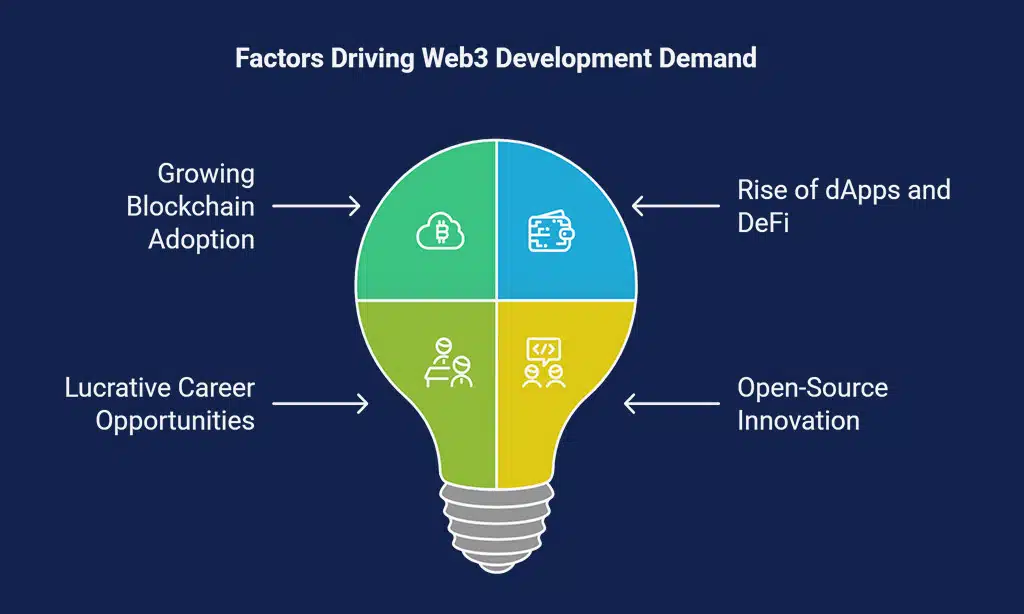
The Web3 ecosystem is rapidly expanding, and companies worldwide are investing in decentralized solutions. Here’s why skills you need to become a Web3 developer are more in demand than ever:
- Growing Blockchain Adoption: Companies across industries are integrating blockchain to enhance security, transparency, and efficiency.
- Rise of dApps and DeFi: Decentralized applications (dApps) and decentralized finance (DeFi) projects have revolutionized industries such as finance, gaming, and supply chain management.
- Lucrative Career Opportunities: Web3 developers command high salaries, with job roles spanning blockchain development, smart contract engineering, and security analysis.
- Open-Source Innovation: Web3 is built on open-source principles, enabling developers to contribute, innovate, and collaborate globally.
| Key Web3 Career Statistics (2024) | Data |
| Average Salary of Web3 Developers | $120,000 – $250,000 |
| Demand Increase (Year-over-Year) | 395% |
| Top Industries Hiring | Finance, Gaming, Supply Chain |
| Popular Blockchain Networks | Ethereum, Solana, Polkadot |
Essential Skills to Become a Web3 Developer
Mastering Web3 development requires a diverse skill set that spans blockchain technology, smart contracts, cryptography, and decentralized applications. These skills will empower you to build secure, scalable, and innovative solutions in the Web3 ecosystem. Below, we explore the essential skills you need to become a Web3 developer and how they contribute to the decentralized future.
1. Proficiency in Blockchain Technology
Becoming proficient in blockchain technology is the first step towards excelling in Web3 development. This skill is crucial because blockchain serves as the foundation for decentralized applications and smart contracts. A Web3 developer must understand how blockchain networks operate, how transactions are validated, and the role of consensus mechanisms in ensuring security and trust within the system. Understanding blockchain technology is the foundation of Web3 development. Here’s what you need to master:
Key Concepts:
- Blockchain Basics: How decentralized networks work, including nodes, miners, and validators.
- Consensus Mechanisms: Proof of Work (PoW) vs. Proof of Stake (PoS) and their impact on network security.
- Different Blockchain Networks: Ethereum, Solana, Binance Smart Chain, and Layer 2 solutions like Polygon.
Comparison of Blockchain Networks:
| Blockchain | Consensus Mechanism | Use Case |
| Ethereum | Proof of Stake | Smart Contracts, DeFi |
| Solana | Proof of History | High-Speed Transactions |
| Binance Smart Chain | Delegated PoS | Low-Cost Transactions |
| Polkadot | Nominated PoS | Interoperability |
Resources to Learn:
- Ethereum Documentation
- Bitcoin Whitepaper
2. Smart Contract Development
Smart contracts are self-executing programs running on a blockchain. These contracts automate transactions and remove the need for intermediaries, making them a cornerstone of decentralized applications. Learning smart contract development is one of the most important skills you need to become a Web3 developer, as it enables you to build secure and efficient blockchain-based solutions. Mastering this skill is crucial for building dApps.
Languages for Smart Contract Development:
| Language | Use Case | Notable Blockchains |
| Solidity | Ethereum-based smart contracts | Ethereum, Polygon, Binance Smart Chain |
| Rust | High-performance smart contracts | Solana, Near Protocol |
| Vyper | Alternative to Solidity with stricter security | Ethereum |
Best Practices:
- Security First: Avoid vulnerabilities like reentrancy attacks and overflow issues.
- Use Frameworks: Hardhat, Truffle, and Foundry for smart contract testing and deployment.
- Gas Optimization: Write efficient contracts to reduce transaction costs.
Example Case Study:
In 2021, a DeFi protocol lost over $30M due to a smart contract vulnerability. The issue? A reentrancy attack that allowed repeated withdrawals before the contract updated balances. Ensuring robust security practices is critical.
Resources:
- Solidity Docs
- Smart Contract Best Practices
3. Knowledge of Decentralized Finance (DeFi) and dApps
Decentralized Finance (DeFi) and decentralized applications (dApps) are revolutionizing the financial industry by eliminating intermediaries and empowering users with direct control over their assets. Understanding DeFi protocols and dApp development is one of the critical skills you need to become a Web3 developer, as it allows you to build decentralized solutions that enhance transparency, security, and efficiency in financial transactions.
Web3 developers must understand DeFi protocols and dApp development to build innovative blockchain applications.
Core Concepts:
- Liquidity Pools: How decentralized exchanges like Uniswap and PancakeSwap function.
- Yield Farming & Staking: How users earn rewards by locking up tokens.
- NFTs and Tokenization: The role of ERC-721 and ERC-1155 tokens in digital ownership.
Top DeFi Platforms to Explore:
| Platform | Use Case |
| Uniswap | Decentralized Exchange (DEX) |
| Aave | Lending & Borrowing |
| Compound | Interest-Earning Protocol |
| MakerDAO | Stablecoin (DAI) Issuance |
4. Web3 Programming Languages and Frameworks
To build robust decentralized applications, developers need proficiency in both frontend and backend Web3 technologies. Choosing the right programming language and framework is essential for efficient interaction with blockchain networks. Learning these technologies is a fundamental part of the skills you need to become a Web3 developer, as they enable seamless integration of smart contracts with user interfaces.
A strong programming background is necessary to integrate blockchain with frontend and backend applications.
Key Languages & Frameworks:
| Technology | Usage |
| JavaScript & TypeScript | Frontend & Backend Web3 Integration |
| Web3.js & Ethers.js | Blockchain API Interactions |
| Hardhat & Truffle | Smart Contract Development & Testing |
5. Cryptography and Security Fundamentals
With the rise of decentralized applications, security is a top priority in Web3 development. Ensuring the integrity and safety of blockchain transactions is one of the fundamental skills you need to become a Web3 developer. Without proper cryptographic security, blockchain networks and smart contracts become vulnerable to attacks, leading to significant financial and data losses.
Security is a top priority in Web3 development due to frequent hacks and vulnerabilities.
Core Cryptographic Concepts:
- Public & Private Keys: Essential for digital signatures and wallet security.
- Hashing Algorithms: SHA-256, Keccak-256 for blockchain integrity.
- Common Vulnerabilities: Reentrancy, integer overflow, and phishing attacks.
Tools for Security Audits:
| Tool | Use Case |
| MythX | Smart Contract Security Analysis |
| OpenZeppelin | Secure Smart Contract Libraries |
| Slither | Static Analysis for Solidity |
6. Understanding Tokenomics and NFTs
A key component of Web3 development is understanding tokenomics and NFTs, as they shape the financial models of decentralized ecosystems. Without a well-designed token economy, projects may struggle with sustainability and user adoption. Learning about tokenomics is one of the essential skills you need to become a Web3 developer, ensuring that you can design efficient economic incentives and governance models.
Tokenomics is a crucial aspect of Web3 projects, as it defines the economic structure behind cryptocurrencies and NFTs.
Core Concepts:
- Token Supply & Distribution: How tokens are issued, allocated, and controlled.
- NFTs (Non-Fungible Tokens): Their role in gaming, digital art, and virtual real estate.
- Governance Tokens: Powering decentralized autonomous organizations (DAOs).
Comparison of Token Standards:
| Token Standard | Use Case |
| ERC-20 | Fungible tokens for cryptocurrencies |
| ERC-721 | Unique NFTs for digital assets |
| ERC-1155 | Multi-token standard for efficiency |
7. Frontend and Backend Web3 Integration
Developing a complete Web3 application requires expertise in both frontend and backend integration. A seamless user experience depends on how well the frontend communicates with blockchain networks, while the backend supports data storage, authentication, and smart contract interactions. Mastering this balance is one of the essential skills you need to become a Web3 developer, ensuring efficient and user-friendly decentralized applications.
To build functional dApps, developers must integrate blockchain with user-friendly interfaces.
Frontend Stack for Web3:
- React.js & Next.js: Popular frameworks for building dApp UIs.
- Wallet Integration: MetaMask, WalletConnect APIs for user authentication.
- Storage Solutions: IPFS, Arweave for decentralized file storage.
Backend Tools:
- The Graph: Query blockchain data efficiently.
- Moralis: API for seamless Web3 interactions.
Comparison of Web3 Development Tools:
| Tool | Use Case |
| The Graph | Indexing blockchain data |
| Moralis | Backend infrastructure for dApps |
| IPFS | Decentralized file storage |
Takeaways
Web3 development offers exciting opportunities for developers willing to embrace blockchain technology and decentralized applications. By mastering the skills you need to become a Web3 developer, you can build innovative solutions, contribute to the future of the internet, and secure lucrative career opportunities.
Start learning today and be part of the decentralized revolution!