
Web hosting has undergone a massive transformation over the years, from shared hosting and dedicated servers to cloud-based solutions.
Today, businesses and developers seek more efficient, scalable, and cost-effective ways to manage their websites and applications. Why Serverless Computing is the Future of Web Hosting is a crucial topic that addresses these evolving demands.
Serverless computing eliminates the need for server management, offering a pay-as-you-go model where resources automatically scale based on demand. As businesses look for high-performance hosting solutions with minimal overhead, serverless computing emerges as a game-changer.
This article explores why serverless computing is revolutionizing web hosting, its benefits, challenges, use cases, and future trends.
What is Serverless Computing?
Serverless computing is a cloud-based execution model where cloud providers manage the infrastructure, allowing developers to focus solely on writing and deploying code. Unlike traditional hosting, where users provision and maintain servers, serverless computing dynamically allocates resources based on real-time demand.
Key components of the serverless model:
- Function as a Service (FaaS): Runs individual functions in response to events.
- Backend as a Service (BaaS): Provides managed backend services like databases, authentication, and APIs.
How Serverless Computing Works
Serverless computing operates on an event-driven architecture where code execution is triggered by specific events such as HTTP requests, database modifications, or file uploads. The cloud provider automatically provisions resources, runs the code, and scales it up or down based on demand.
Example Workflow:
- A user submits a form on a website.
- The request triggers a function to validate the data and store it in a database.
- The serverless function executes the process in milliseconds without the need for a continuously running server.
- Once executed, the function scales down, reducing costs and improving efficiency.
Key Benefits of Serverless Computing for Web Hosting
As technology evolves, businesses seek more efficient, scalable, and cost-effective hosting solutions. Why Serverless Computing is the Future of Web Hosting is evident when considering the numerous advantages it offers over traditional hosting methods. From cost savings to enhanced security and performance, serverless computing is reshaping how web applications are deployed and maintained.
1. Cost-Efficiency and Resource Optimization
One of the biggest advantages of serverless computing is its cost efficiency. Traditional hosting requires businesses to pay for pre-allocated server capacity, even if they don’t use it fully. Serverless computing, on the other hand, follows a pay-as-you-go model, where costs are based on actual compute time.
Cost advantages:
- No upfront server provisioning costs.
- Charges only for executed functions.
- No idle server costs.
2. Scalability and Performance Enhancement

Scalability is a critical factor in web hosting. Serverless computing provides automatic scaling based on traffic load. Unlike traditional hosting, where businesses must manually scale their servers, serverless platforms handle this dynamically.
Performance benefits:
- Instant resource allocation during traffic spikes.
- Optimized load balancing.
- Improved response times with minimal latency.
3. Security and Maintenance Advantages
With traditional hosting, security and maintenance responsibilities fall on the business or developer. Serverless computing offloads these tasks to the cloud provider.
Security enhancements:
- Automated patching and updates to mitigate vulnerabilities.
- Built-in security compliance and monitoring.
- Isolated function execution for enhanced protection.
4. Developer Productivity and Innovation
Serverless computing allows developers to focus on writing code rather than managing infrastructure. This accelerates deployment, innovation, and overall efficiency.
Developer advantages:
- Shorter development cycles.
- Easy integration with APIs and third-party services.
- Support for multiple programming languages.
Challenges and Considerations in Serverless Computing
As businesses and developers increasingly adopt modern hosting solutions, it is crucial to understand the potential challenges associated with this technology. Why Serverless Computing is the Future of Web Hosting also involves recognizing its limitations and finding ways to mitigate them effectively.
1. Cold Start Issues and Latency Concerns
A common challenge in serverless computing is the cold start issue, where functions experience latency during the first execution after a period of inactivity.
Solutions:
- Keeping frequently used functions warm.
- Using provisioned concurrency to reduce delays.
2. Vendor Lock-in and Platform Dependency
Since serverless platforms like AWS Lambda, Google Cloud Functions, and Azure Functions have unique configurations, businesses may face vendor lock-in when switching providers.
Best practices to avoid lock-in:
- Using open-source serverless frameworks.
- Designing code to be provider-agnostic.
3. Limited Execution Time and Resource Constraints
Most serverless providers impose time limits on function execution, which may not be suitable for long-running applications.
Workarounds:
- Breaking down tasks into smaller functions.
- Using hybrid approaches with dedicated resources.
Comparing Serverless with Traditional Web Hosting
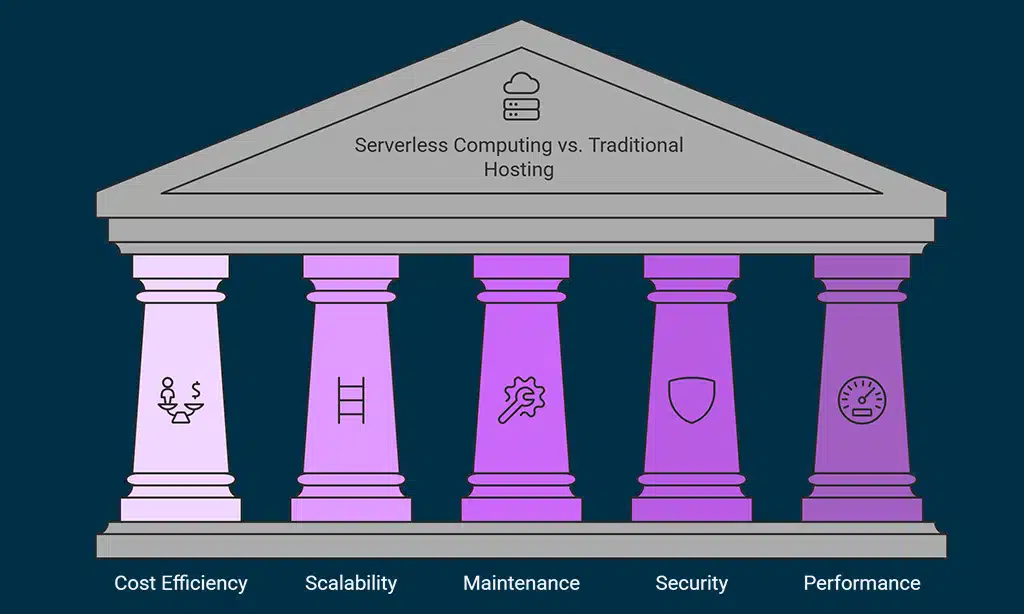
As businesses explore hosting solutions, understanding the differences between serverless computing and traditional hosting is crucial. Why Serverless Computing is the Future of Web Hosting becomes clearer when comparing scalability, cost, maintenance, and performance. The following table highlights key distinctions between the two approaches.
| Feature | Serverless Computing | Traditional Hosting |
| Cost | Pay-as-you-go | Fixed monthly fee |
| Scalability | Automatic scaling | Manual scaling |
| Maintenance | Managed by provider | User-managed |
| Security | Automated | Requires manual updates |
| Performance | Optimized for bursts | Limited by server capacity |
Use Cases: When to Choose Serverless Computing
As web hosting evolves, businesses need to assess when serverless computing is the right choice. Why Serverless Computing is the Future of Web Hosting is evident in various scenarios where flexibility, scalability, and cost efficiency matter the most.
1. Best Applications for Serverless Hosting
- Dynamic websites with variable traffic.
- API-driven applications.
- Event-driven microservices.
- IoT and real-time data processing.
2. When Traditional Hosting Might Be Better
- High-performance applications with consistent workloads.
- Applications requiring dedicated resources.
- Legacy systems that are not cloud-compatible.
Future Trends in Serverless Computing for Web Hosting
As serverless computing gains momentum, emerging trends are shaping its future. Why Serverless Computing is the Future of Web Hosting is further reinforced by advancements in AI, edge computing, and multi-cloud strategies. These innovations promise greater efficiency, security, and scalability for web applications.
1. AI and Machine Learning Integration
Serverless computing is being integrated with AI and machine learning for real-time analytics and automation.
Example: AI-driven chatbots running on serverless infrastructure.
2. Edge Computing and Serverless Convergence
Serverless and edge computing are merging to deliver low-latency applications by running functions closer to users.
Example: Content delivery networks (CDNs) leveraging serverless for faster website performance.
3. The Rise of Multi-Cloud and Hybrid Deployments
Businesses are adopting multi-cloud and hybrid serverless deployments to reduce vendor lock-in and improve resilience.
Example: Running serverless functions across AWS, Google Cloud, and Azure simultaneously.
Wrap Up
Why Serverless Computing is the Future of Web Hosting is clear when considering its scalability, cost efficiency, security, and development speed. As technology advances, serverless computing will continue to shape the future of web hosting by reducing infrastructure complexity and enhancing performance.
Businesses looking to optimize their hosting strategy should explore serverless solutions for their web applications. While challenges exist, the benefits far outweigh the drawbacks, making serverless computing the go-to option for modern web hosting needs.