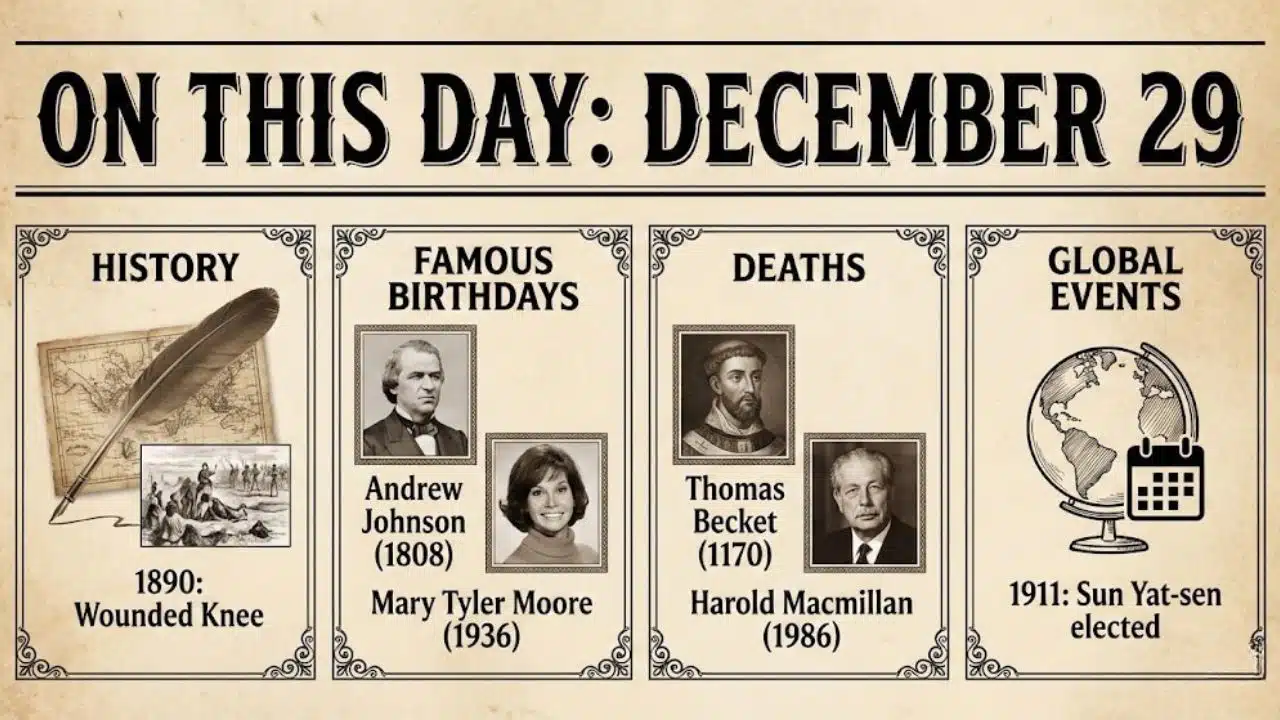
December 29 stands as a monumental date in the annals of global history—a day where the pendulum of human experience swings violently between triumph and tragedy. It is a day that witnessed the dawn of modern democracy in China and the crushing blow to Indigenous sovereignty in America. In the cultural sphere, it marks the birth of the man who gave Bangladesh its visual identity and the death of the athlete who defined “The Beautiful Game” for the world.
From the fog-laden streets of London during the Blitz to the celebratory crowds in Dhaka marking a new era of infrastructure, December 29 is not just a date on the calendar; it is a repository of lessons on resilience, governance, and artistic immortality. This comprehensive report delves deep into the events, lives, and legacies that define this day.
The Bangalee Sphere
The “Bangalee Sphere” on December 29 offers a profound look into the intellectual and political maturation of the region. It is a day that honors the creators who defined the Bengali identity and the leaders who shaped its political destiny.
Historical Events & Milestones
- 1914: The Birth of the Shilpacharya (Zainul Abedin)Perhaps the most culturally significant event for Bangladesh on this date is the birth of Zainul Abedin in Kishoreganj. Known as the Shilpacharya (Great Teacher of the Arts), Abedin is not merely a painter; he is the founding father of Bangladeshi modern art. His harrowing sketches of the Bengal Famine of 1943 did what thousands of words could not—they exposed the brutal reality of colonial negligence and human suffering to the world.
-
Significance Today: Abedin was instrumental in establishing the Institute of Fine Arts at the University of Dhaka. His legacy ensures that art in Bangladesh is not just aesthetic but a medium of social protest and documentation.
-
- 1971: The First Step Toward Justice (Intellectual Inquiry)On December 29, 1971, just 13 days after Bangladesh achieved victory, the newborn nation took its first major step toward accountability. A seven-member inquiry committee was formed to investigate the systematic genocide of intellectuals by the Pakistan Army and their local collaborators, the Al-Badr and Al-Shams forces. The committee was headed by the legendary filmmaker and writer Zahir Raihan.
-
Tragic Context: This appointment was one of Raihan’s final contributions to his country. He would disappear exactly one month later, on January 30, 1972, while searching for his missing brother, adding a layer of personal tragedy to this national endeavor.
-
- 2008: A Political LandslideThe 9th General Election of Bangladesh was held on this day, marking a pivotal return to democracy after two years of a military-backed caretaker government. The Grand Alliance, led by Sheikh Hasina and the Awami League, secured a historic landslide victory.
-
Significance Today: This election fundamentally altered the trajectory of Bangladeshi politics, initiating a consecutive 15-year rule that saw massive infrastructural development alongside intense political debate.
-
- 2022: The Metro Era BeginsWhile the official inauguration took place a day earlier, December 29, 2022, marked the first day the Dhaka Metro Rail (MRT Line 6) was opened to the general public.
-
Impact: For a city infamous for its traffic, this was a moment of liberation. It symbolized Bangladesh’s entry into the club of nations with modern, electrified urban mass transit systems.
-
- 1844: Birth of Womesh Chandra BonnerjeeIn the broader Indian context, this day saw the birth of Womesh Chandra Bonnerjee, the first president of the Indian National Congress.
-
Significance: His leadership in the late 19th century laid the organizational groundwork for the Indian independence movement, creating the platform that Gandhi and Nehru would later utilize.
-
Cultural & Festivals
-
Death of Hakim Ajmal Khan (1927): A titan of the Indian subcontinent, Khan was a physician who revitalized Unani medicine and a founder of the Jamia Millia Islamia university. His death on this day marked the end of an era for traditional medicine and educational reform in British India.
-
Literary Legacy: The day also remembers the Kannada poet Kuvempu (born 1904), the first Kannada writer to be decorated with the Jnanpith Award. His contributions to the “Non-Bangalee” Indian literary canon are immense, emphasizing universal humanism.
International Observances & Holidays
Focus: Sovereignty, Arts, and Reflection.
- Constitution Day (Ireland):On December 29, 1937, the adoption of a new constitution officially replaced the Irish Free State with a new, fully sovereign state called “Ireland” (or Éire). This was a definitive break from British dominion status, asserting an identity that was independent, republican, and distinct.
- Independence Day (Mongolia):Mongolia celebrates its liberation from the Qing Dynasty on this day in 1911. The enthronement of the Bogd Khan marked the restoration of Mongolian statehood after centuries of foreign rule.
- International Cello Day:This unofficial holiday honors the birth of Pablo Casals (born 1876). It is a day for classical music lovers worldwide to appreciate the deep, resonant tones of the cello, an instrument often described as the closest to the human voice.
- Tick Tock Day:As the year winds down, “Tick Tock Day” serves as a gentle reminder that only two days remain in the Gregorian calendar. It encourages people to complete unfinished business—whether it’s filing taxes, reconciling with a friend, or finishing a book—before the New Year rings in.
Global History
Focus: The Struggle for Rights, Imperial Shifts, and Modern Tragedy.
United States: The Tragedy of Wounded Knee
-
1890: The Wounded Knee Massacre remains one of the darkest stains on American history. On the frozen plains of the Pine Ridge Reservation in South Dakota, the U.S. 7th Cavalry Regiment opened fire on a group of Lakota people who were in the process of surrendering.
-
The Toll: Nearly 300 Lakota were killed, including unarmed women and children.
-
Significance: It is cited as the closing engagement of the American Frontier Wars. Today, it stands as a powerful symbol of the systemic destruction of Native American culture and life.
-
-
1845: Texas was officially admitted as the 28th state of the Union. This annexation was a major trigger for the Mexican-American War and played a crucial role in the expansionist “Manifest Destiny” ideology of the 19th century.
China: The End of Dynasties
-
1911: In a watershed moment for Asian democracy, Dr. Sun Yat-sen was elected as the first Provisional President of the Republic of China by provincial representatives in Nanjing.
-
Significance: This event signaled the definitive end of over 2,000 years of imperial rule and the collapse of the Qing Dynasty, paving the way for the modern Chinese state.
-
United Kingdom: Murder and Fire
-
1170: The cathedral floor turned red when Thomas Becket, the Archbishop of Canterbury, was assassinated by four knights of King Henry II. Becket had refused to let the state encroach on church liberties.
-
Legacy: His death transformed him into an instant martyr. Canterbury Cathedral became one of Europe’s most significant pilgrimage sites, eventually inspiring Geoffrey Chaucer’s literary masterpiece, The Canterbury Tales.
-
-
1940: During World War II, London faced “The Second Great Fire.” The German Luftwaffe dropped over 24,000 incendiary bombs, causing a firestorm that devastated the City of London.
Europe: The Velvet Revolution’s Triumph
-
1989: The year of revolutions ended on a high note in Czechoslovakia. Václav Havel, a dissident playwright who had been imprisoned by the communist regime, was elected President.
-
Significance: This was the crowning moment of the “Velvet Revolution,” proving that peaceful, non-violent protest could dismantle totalitarian regimes.
-
Rest of World
-
1996 (Guatemala): The Guatemalan government and leftist rebels signed a peace accord, ending a grueling 36-year civil war that had claimed over 200,000 lives, mostly Indigenous Mayans.
-
1998 (Cambodia): Leaders of the Khmer Rouge publicly apologized for the genocide of the 1970s that killed nearly two million people. While many viewed the apology as insufficient, it was a necessary step in the nation’s healing process.
Notable Births & Deaths (Global)
Famous Births
| Name | Year | Nationality | Significance |
| Zainul Abedin | 1914 | Bangladeshi | The “Shilpacharya”; founding father of Bangladeshi modern art. |
| Andrew Johnson | 1808 | American | 17th U.S. President; the first president to be impeached. |
| Mary Tyler Moore | 1936 | American | Actress who revolutionized female roles on TV (The Mary Tyler Moore Show). |
| Jude Law | 1972 | British | Award-winning actor known for The Talented Mr. Ripley and Sherlock Holmes. |
| Pablo Casals | 1876 | Spanish | Cellist and conductor; awarded the U.N. Peace Medal. |
| Rajesh Khanna | 1942 | Indian | The “First Superstar” of Indian cinema; an icon of romantic films. |
Famous Deaths
| Name | Year | Nationality | Cause/Legacy |
| Pelé | 2022 | Brazilian | Died of colon cancer. The only 3-time World Cup winner; widely considered the greatest footballer ever. |
| Vivienne Westwood | 2022 | British | Natural causes. Fashion designer who brought punk and new wave into the mainstream. |
| Thomas Becket | 1170 | English | Assassinated. Archbishop and Saint; a symbol of religious resistance against the state. |
| Harold Macmillan | 1986 | British | Natural causes. Prime Minister who presided over the decolonization of the British Empire. |
| Pierre Cardin | 2020 | French | Natural causes. Visionary fashion designer known for Space Age styles. |
“Did You Know?” Trivia
-
The “Mad Monk’s” Long Night: The assassination of the mystic Grigori Rasputin is the stuff of legend. While he died in the early hours of December 30, the plot began late on the night of December 29, 1916. His killers poisoned him with cyanide, shot him three times, and finally threw him into a freezing river—and autopsy reports suggested he may have still been alive when he hit the water.
-
Bowling’s Hidden History: While bowling dates back to ancient Egypt, the modern standardization of the bowling ball remains murky. Folklore claims that on this day in 1862, the bowling ball was invented (or significantly patented) in the U.S., evolving from wooden designs with two finger holes to the three-hole rubber/synthetic balls we use today.
-
A Miraculous Survival: During the “Second Great Fire of London” on this night in 1940, over 1,500 fires were burning simultaneously. The famous photograph of St. Paul’s Cathedral rising through the smoke became an instant symbol of survival, but few know that a bomb actually struck the cathedral—it just failed to detonate.
Quote of the Day
“Success is no accident. It is hard work, perseverance, learning, studying, sacrifice and most of all, love of what you are doing or learning to do.”
— Pelé (Passed away on this day, 2022).
“I want to make art that speaks to the people, for the people. Art is not for the elite alone; it is the language of the soil.”
— Zainul Abedin (Born on this day, 1914).
Takeaways
December 29 serves as a powerful mirror to the human condition, reflecting our capacity for both profound creation and devastating destruction. It is a day that demands we look at the canvas of history with a wide lens—appreciating the strokes of genius in Zainul Abedin’s sketches and the musical mastery of Pablo Casals, while never turning a blind eye to the scars left by the Wounded Knee Massacre or the London Blitz.
From the bustling metro stations of Dhaka to the quiet reverence of Canterbury Cathedral, this date connects disparate worlds. It reminds us that while empires like the Qing Dynasty may fall and political tides in Bangladesh or Europe may shift, the legacies of art, justice, and resilience remain constant. As we mark the birth of new democracies and bid farewell to legends like Pelé, we are reminded that history is not static; it is being written every day by the choices we make.