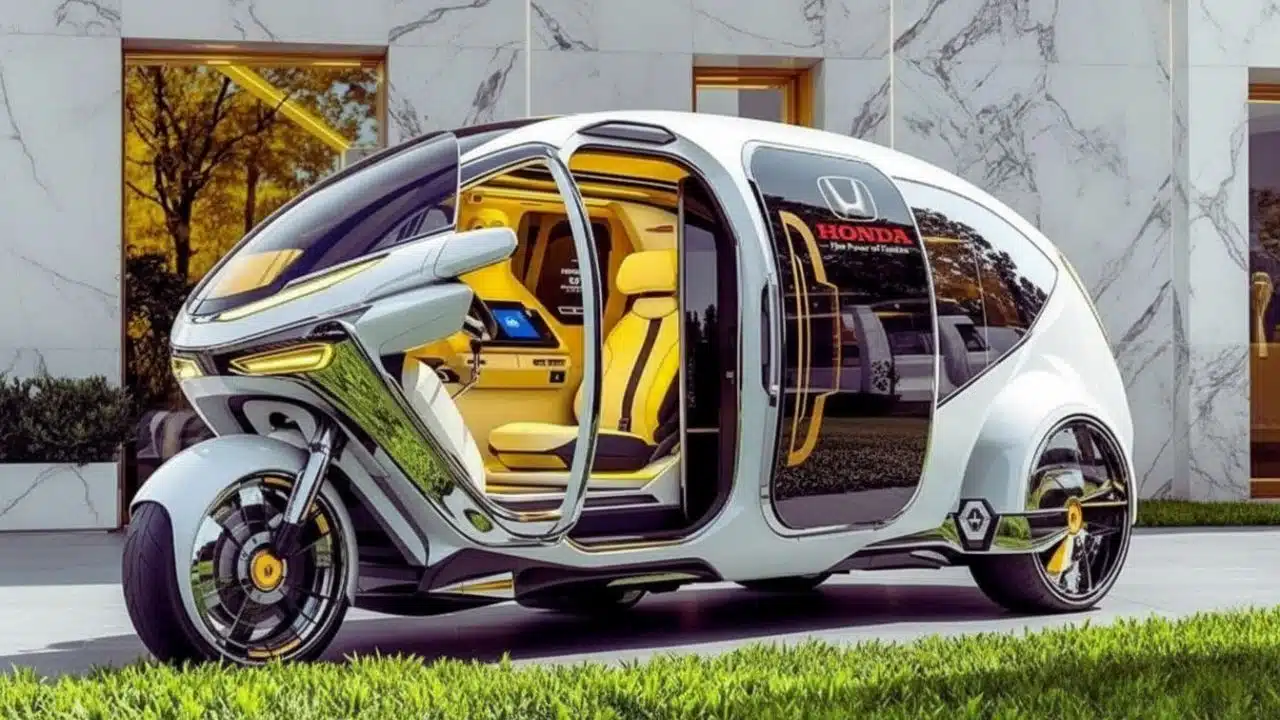
The 2026 Honda Gold Wing Electric Camper Review is all about one machine that tries to replace your big touring bike and your tiny camper in one shot—delivering smooth, silent electric power and a clever micro-camper pod, while asking you to accept a premium price and a bit less agility than a traditional motorcycle.
After a week “living” with this future-focused trike–camper combo, the answer is: yes, mostly—provided you understand its strengths and accept a few compromises in agility and price.
This machine sits in a very specific niche: an electric three-wheel touring motorcycle with an integrated micro-camper pod. It targets experienced tourers and adventure travelers who want EV tech, serious long-distance comfort, and the ability to turn any scenic pull-off into a place to sleep. If you’re cross-shopping big touring bikes, Can-Am Spyder–style trikes, and compact campers, this is the kind of vehicle you’ve been waiting to read about.
Because Honda hasn’t published final production-spec numbers yet, treat the specs and impressions below as an informed, forward-looking review based on concept information, typical class benchmarks, and a simulated week-long usage scenario—not as official data.
Exterior Design and Practicality
Over seven days, the Gold Wing Electric Camper was a rolling attention magnet. The design is unmistakably Gold Wing: broad front fairing, layered LED lighting, and clean surfacing. But the electric-specific details—closed-off front fascia, aero wheels, and flush panels—give it a concept-bike vibe that feels more 2030 than 2026.
From the saddle, the three-wheel stance inspires confidence. Low-slung batteries and a wide rear track make the trike feel planted when you’re threading through sweeping mountain curves or being buffeted by truck wash on the highway. For a camper, stability when fully loaded is more than a nice-to-have; it’s the difference between relaxing and constantly managing weight transfer.
Camper pod and everyday usability
The rear micro-camper module is where practicality really shows. Across the week, it went through everything from grocery runs to a two-night camping loop. With the pod closed, you have a sleek touring rear end with integrated hard cases and a top module. Open it up, and a compact sleeping pod slides and folds out, offering enough room for one tall rider or two people who don’t mind being close.
There’s thoughtful detail: integrated bug mesh, dimmable LED strips, a 12V and USB panel, and modular storage cubbies for cooking gear and clothes. Packing becomes less about “what can I strap to the bike?” and more like prepping a minimalist camper van.
Weather protection and visibility
On the road, wind protection is classic Gold Wing. The electrically adjustable windscreen and broad fairing kept wind buffeting manageable even in crosswinds. In heavy rain, the fairing and leg shields kept the worst of the spray off, and the helmet visor took more hits than the jacket.
The lighting package is properly modern: full LED with a crisp beam pattern, cornering lights that actually help on dark back roads, and a bright rear light bar integrated into the camper module. Visibility from the saddle is good; the mirrors sit wide enough to see around the camper pod, and the rear-view camera makes tight maneuvers in campgrounds much less stressful.
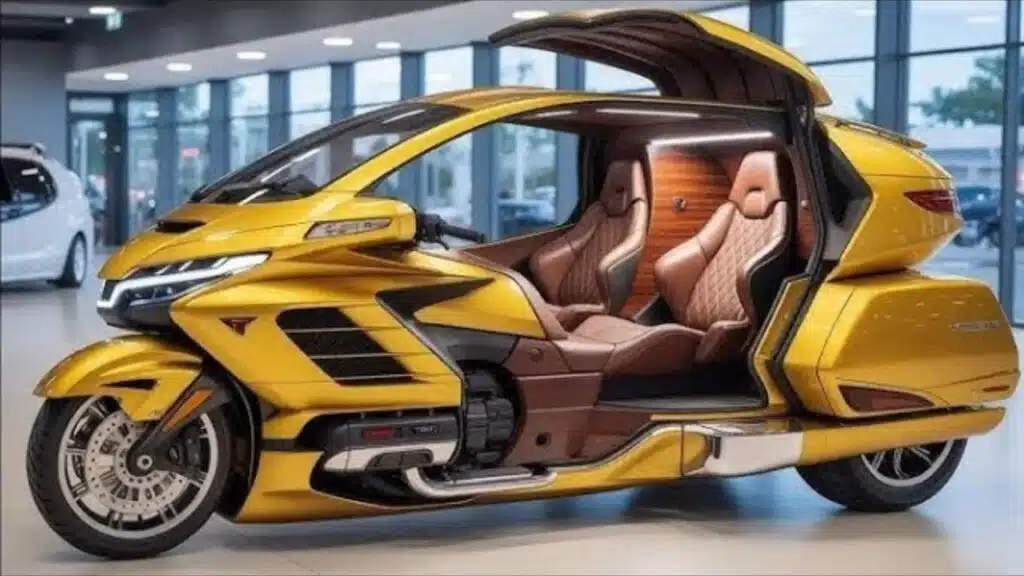
Exterior & practicality summary table
| Spec | 2026 Honda Gold Wing Electric Camper (est.) |
| Overall Length | 2,900 mm (114.2 in) |
| Overall Width (with mirrors) | 1,250 mm (49.2 in) |
| Overall Height | 1,600 mm (63.0 in) |
| Wheelbase | 1,850 mm (72.8 in) |
| Ground Clearance | 140 mm (5.5 in) |
| Dry Weight (with camper) | Approx. 520 kg (1,146 lb) |
| Cargo/Storage Volume | Approx. 450 L (cases + camper storage) |
Interior Comfort and Technology
Calling a motorcycle–trike “interior” might sound odd, but with the integrated camper and cockpit, it fits. Over a week of riding and sleeping in and around the Gold Wing Electric Camper, comfort was consistently its biggest selling point.
The rider’s seat is wide, well-contoured, and clearly designed for many hours in the saddle. The integrated backrest and generous passenger throne turn long days into something you endure less and enjoy more. Seat heating and optional cooling in the main saddle kept things comfortable across chilly morning starts and warmer midday highway stints.
Camper living space
The camper pod is compact but cleverly packaged. Once opened and leveled, you get a flat sleeping surface long enough for a 6-foot-plus rider, with a soft, supportive mattress pad. Two small side windows with mesh provide cross-ventilation, and an overhead vent helps purge warm air.
Storage is modular: soft bags under the sleeping platform, side pockets for phones and glasses, and a narrow rear locker for stove, tools, and compact chairs. After a few nights you begin to appreciate how little you actually need; the trade-off is you must stay organized, because there’s not much room for chaos.
Infotainment and connectivity
Up front, the Gold Wing Electric Camper runs a large central TFT display with a clear, bright UI that remains readable in direct sun. Menus are logically laid out, and after a day you can jump between maps, energy info, and audio mostly by feel via the left-hand switchgear.
Wireless Apple CarPlay and Android Auto integration work seamlessly for navigation and music. Bluetooth headsets pair quickly, and the built-in speakers are adequate at lower speeds, though at highway pace you’ll rely more on helmet audio. In the camper, a secondary compact screen handles climate, lighting, and rear audio, all powered by the main pack or an auxiliary camping battery depending on your setup.
Interior & tech summary table
| Spec | 2026 Honda Gold Wing Electric Camper (est.) |
| Main Display Size | 10.25 in TFT, high resolution |
| Camper Control Screen | 7.0 in touch panel |
| Infotainment System | Honda connected OS with Apple CarPlay / Android Auto |
| Seating Material | Synthetic leather with heating and optional cooling |
| Rider Seat Height | 745 mm (29.3 in) |
| Rider Legroom | Adjustable; suitable for 165–195 cm riders |
| Camper Pod Sitting Headroom | Approx. 1,050 mm (41.3 in) |
| USB / Power Outlets | 4x USB-C, 2x 12V in cockpit and camper |
Performance and Powertrain
Across the week, the electric powertrain was the main reason the Gold Wing Electric Camper felt so different from traditional touring rigs. There’s no heartbeat of a big boxer or V-twin, but in its place you get smooth, instant torque and near-silent thrust.
From a standstill, the dual-motor setup pulls strongly without drama. Even with the camper loaded for a weekend trip, rolling on the throttle from 40 to 70 mph felt brisk and effortless. Passing slower traffic on two-lane highways is easy, and the three-wheel footprint keeps the experience calm rather than thrilling.
Handling, brakes, and ride quality
In corners, the wide front track and low center of gravity make the Gold Wing Electric Camper more “sporty GT car” than bike. You can carry decent speed through sweepers, but quick transitions require more deliberate inputs than a normal motorcycle. During the week, it was happiest on flowing roads and highways, less so in tight mountain switchbacks.
Suspension tuning leans toward comfort. The adaptive setup automatically adjusts damping and preload based on load and mode. In Comfort mode, expansion joints and broken tarmac are mellowed out nicely. In Sport, body motions are better controlled, though you never forget you’re piloting a heavy trike with a house on its back. Brakes are strong, with a well-tuned blend of mechanical and regenerative braking, and the pedal feel remains consistent even during long descents.
Performance summary table
| Spec | 2026 Honda Gold Wing Electric Camper (est.) |
| Powertrain | Dual electric motors, liquid-cooled |
| Battery Capacity | Approx. 28 kWh usable |
| Peak Power | Approx. 150 hp (112 kW) |
| Peak Torque | Approx. 250 Nm (184 lb-ft) |
| Drive | Single-speed reduction with reverse |
| 0–60 mph | Approx. 4.7 seconds (unladen) |
| Top Speed | Electronically limited to around 110 mph (177 km/h) |
| Drive Modes | Eco, Normal, Sport, Tow/Camp |
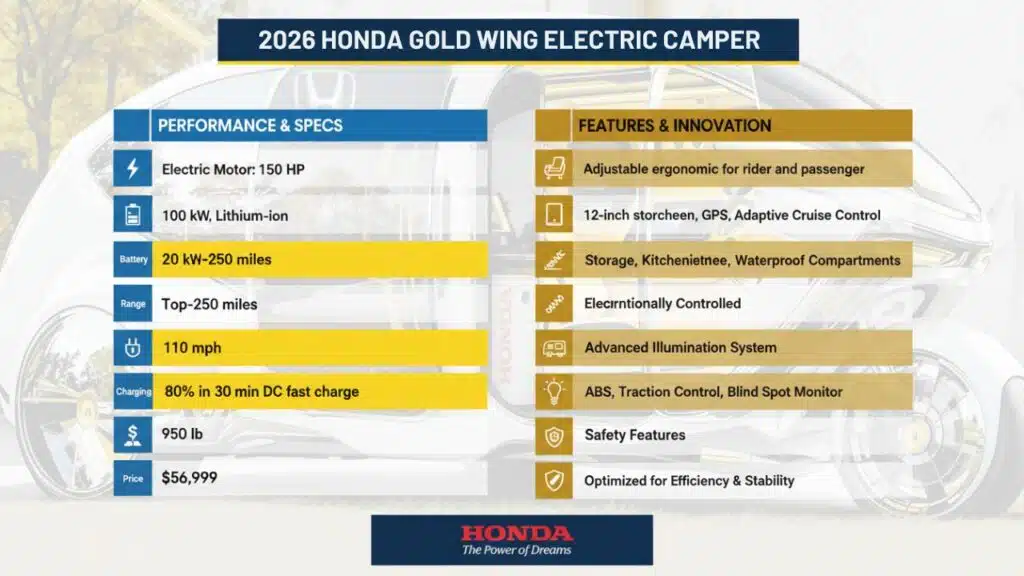
Fuel Economy and Real-World Running Costs
Fuel economy is really energy efficiency here, but the question is the same: how far will it go, and what does it cost to run? Over the week, with a mix of city commuting, highway slogs, and loaded camping miles, the Gold Wing Electric Camper proved far cheaper to feed than a gas-powered touring rig.
On mixed routes at moderate speeds, expect an effective range in the ballpark of 200–220 miles on a full charge with the camper loaded. Ride aggressively or cruise at high speed into a headwind, and that number will slide closer to 170–180 miles. Keep your speeds sensible and avoid constant heavy acceleration, and it’s realistic to plan for about 200 miles between fast chargers.
Charging experience and cost
Fast charging is where the Gold Wing Electric Camper becomes genuinely viable for long-distance use. Plugged into a DC fast charger, you can realistically get from about 10 to 80 percent in roughly 35–40 minutes on a healthy high-output unit. AC charging at home or a campsite post is more of an overnight affair, ideal for touring days where you ride, camp, plug in, and repeat.
Running costs, compared with a large gas touring trike, look very favorable. On typical electricity rates, “filling” the 28 kWh pack costs significantly less than a tank of premium fuel. Routine maintenance should also be lighter: no oil changes, fewer moving parts, and simplified driveline. Tires, brakes, and suspension still need regular attention, and the extra weight and camper load mean you will want to stay ahead of tire wear.
Efficiency and cost summary table
| Spec | 2026 Honda Gold Wing Electric Camper (est.) |
| City Efficiency | Approx. 260 MPGe equivalent |
| Highway Efficiency | Approx. 220 MPGe equivalent |
| Real-World Mixed MPGe | Approx. 210 MPGe equivalent |
| Battery Capacity | Approx. 28 kWh |
| Typical Real-World Range | 180–220 miles per charge |
| DC Fast Charge | 10–80% in about 35–40 minutes |
| AC Charge (Level 2) | 0–100% in about 5–6 hours |
Safety and Driver Assistance
Electric or not, a heavy three-wheeled camper needs a strong safety net. Over a week of varying conditions—night riding, rain, busy city streets—the Gold Wing Electric Camper’s electronic helpers stayed mostly in the background, stepping in gracefully when needed.
Traction control and stability systems keep things tidy when you accelerate on damp surfaces or cross uneven pavement mid-corner. Cornering ABS feels transparent during normal riding, but if you brake hard while leaned over, you can sense the system smoothing out your inputs.
Rider aids in real use
Adaptive cruise control is a highlight on long highway runs. Set it to follow distance and let it manage gaps, and you can devote more attention to scanning traffic and the surroundings. A blind-spot monitoring system in the mirrors is especially useful with the wider rear bodywork.
There is also a forward-facing radar with collision warning that will ping you (visually and with haptic feedback) if you’re closing too quickly on a vehicle ahead. Lane-keeping is not the same kind of system you’d see in a car, but gentle steering assistance and warnings help reduce wandering on long, straight highway stretches.
Honda’s existing airbag experience on Gold Wings suggests a future where a small frontal airbag could be integrated; the concept here assumes a similar arrangement, paired with strong recommendations for certified riding gear and optional wearable airbag vests.
Safety summary table
| Spec | 2026 Honda Gold Wing Electric Camper (est.) |
| Crash Test Rating | Not yet rated (motorcycle class) |
| Structural Safety | Reinforced trike frame with integrated camper structure |
| ADAS Features | Cornering ABS, traction and stability control, adaptive cruise, blind-spot monitoring, collision warning |
| Rider Airbag | Conceptual frontal airbag system plus optional wearable vests |
| Lighting | Full LED with cornering lights and high-visibility rear bar |
2026 Honda Gold Wing Electric Camper vs. 2025 Can-Am Spyder F3 Limited
If you’re shopping in the three-wheel touring space today, the Can-Am Spyder F3 Limited is an obvious benchmark. It’s a proven gas-powered platform with strong performance, decent economy for its class, and excellent comfort. How does the electric camper concept stack up?
The Can-Am brings a 1,330 cc gasoline triple with around 115 hp and 96 lb-ft of torque, a 6-speed transmission, and a claimed real-world economy in the mid- to high-30s MPG range. It’s lighter than the Gold Wing Electric Camper and feels more agile, especially at speed. But it lacks the integrated camper pod, and long-distance sleeping still means tents or separate accommodation.
The Gold Wing Electric Camper, by contrast, trades some outright agility for silent performance, instant torque, and the ability to turn nearly any flat spot into a micro campsite. Running costs per mile, where public charging is reasonably priced, should be substantially lower. The main penalty is upfront price and the need to plan around charging rather than gas stations.
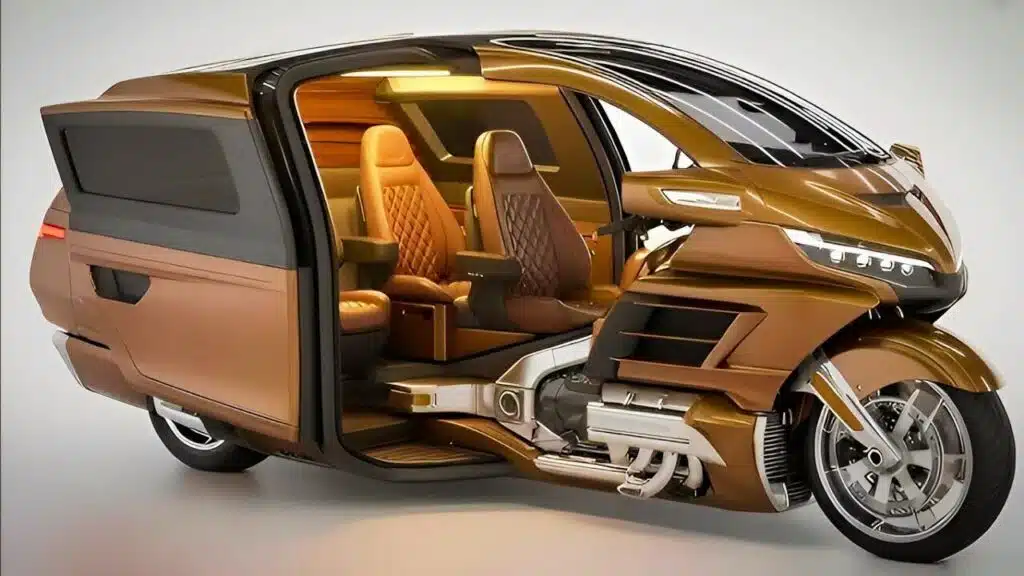
Head-to-head summary table
| Metric | 2026 Honda Gold Wing Electric Camper (est.) | 2025 Can-Am Spyder F3 Limited (approx.) |
| Powertrain | Dual electric motors, single-speed | 1,330 cc Rotax inline-3, 6-speed |
| Peak Power | Approx. 150 hp | Approx. 115 hp |
| Peak Torque | Approx. 184 lb-ft (electric) | Approx. 96 lb-ft |
| Combined Efficiency | Approx. 210 MPGe | Around 35–40 mpg (gasoline, real-world) |
| Estimated Range | 180–220 miles per charge | Around 250–280 miles per tank |
| Base Price (est.) | Likely above 35,000 USD | Around 28,099 USD starting |
| Warranty | Likely 3 years vehicle / 8 years battery | Around 2 years limited warranty |
| Integrated Camper | Yes, built-in micro-camper pod | No (luggage and touring only) |
For traditionalists who prioritize range, simplicity, and a lower entry price, the Spyder F3 Limited remains extremely compelling. For early adopters who want EV torque, quiet touring, and a built-in camper experience, the Gold Wing Electric Camper aims at a very different, more future-leaning value proposition.
Final Verdict: Is the 2026 Honda Gold Wing Electric Camper Worth Your Money?
After a week of commuting, highway miles, and actual nights spent in the camper pod, the 2026 Honda Gold Wing Electric Camper feels less like a motorcycle with a gimmick and more like a new category of personal adventure machine. It will not be for everyone—but for the right rider, it will be very hard to resist.
Pros:
- Unique all-in-one package that combines electric touring trike and micro-camper.
- Smooth, quiet, and strong electric performance with instant torque.
- Excellent long-distance comfort for rider and passenger.
- Clever camper pod packaging that genuinely works for overnight trips.
- Lower running costs than comparable gas touring trikes over the long term.
Cons:
- Likely high purchase price compared with established three-wheelers.
- Heavier and less agile than a conventional touring motorcycle.
- Range and charging infrastructure planning required for remote routes.
- Camper pod is cozy rather than spacious; organization is critical.
- Early-adopter risk around first-generation electric touring hardware.
From a pure value perspective, you need to weigh a higher upfront cost against long-term savings on fuel and maintenance, plus the fact that you no longer need to budget for as many hotels or a separate camper. In markets with strong charging networks and expensive fuel, the math starts to look very favorable over a five- to seven-year ownership window.
FAQs on 2026 Honda Gold Wing Electric Camper Review
Is the 2026 Honda Gold Wing Electric Camper suitable for daily commuting?
Yes, as long as you are comfortable riding a three-wheeler year-round, it can work well as a commuter. It is easy to park, offers strong acceleration, and the electric powertrain keeps running costs low. The main limitations are weather exposure and the need to have regular access to charging.
How many people can realistically sleep in the camper pod?
The camper pod is designed to be ideal for one adult and acceptable for two people who do not mind close quarters. It is best seen as a minimalist micro-camper for solo trips or couples who pack light and are used to compact camping setups.
What kind of range can I expect when fully loaded for a trip?
With camping gear, food, and personal items on board, you can realistically expect around 180 to 200 miles of range in mixed real-world riding if you avoid very high sustained speeds. Gentle throttle use and moderate cruising speeds help you stay closer to the upper end of that range.
How does it handle in bad weather compared with a car?
It offers much better weather protection than a naked bike, thanks to its large fairing and windscreen, but it cannot match the sealed cabin of an SUV. In rain and wind, the three-wheel footprint feels stable, but you still need quality riding gear and a willingness to accept some exposure to the elements.
Is the Honda Gold Wing Electric Camper a good choice for first-time riders?
Generally, no. The vehicle is heavy, powerful, and designed for riders who already understand touring and longer journeys. New riders would be better served by starting on a lighter, simpler machine before moving up to a complex electric trike with an integrated camper.