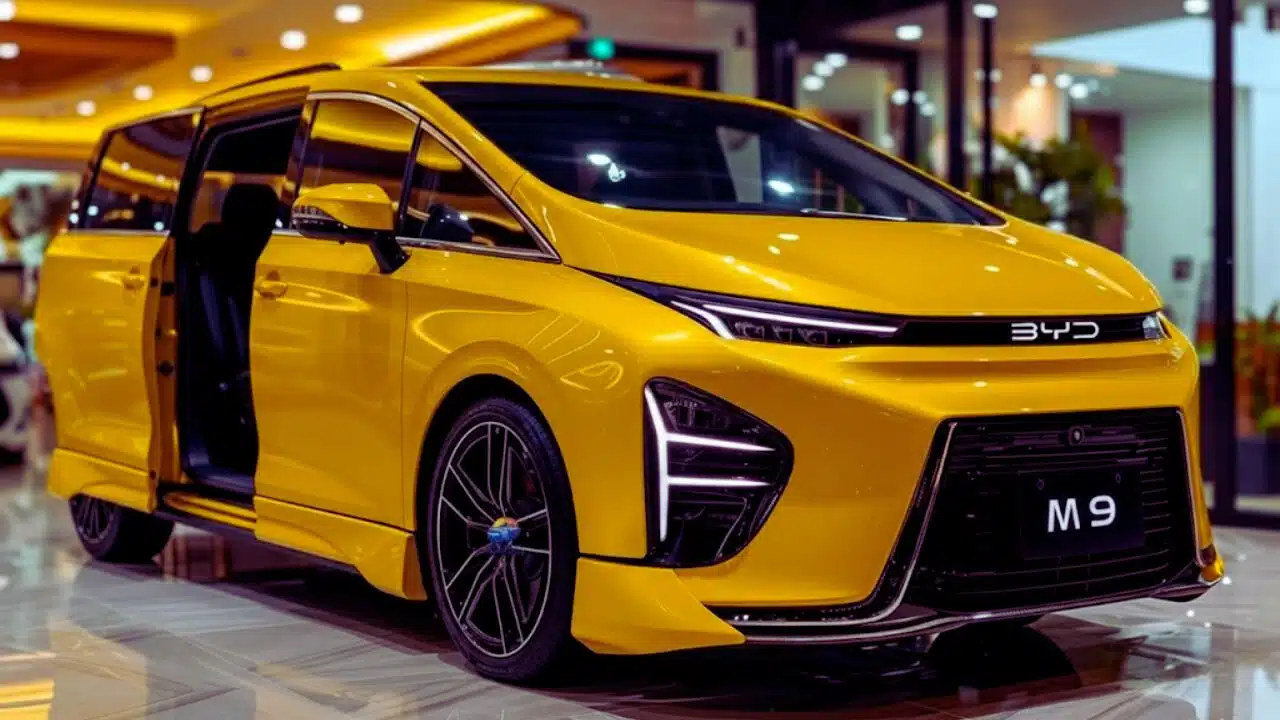
If you want a seven-seat people-mover that feels business-class inside while sipping fuel like a compact hatchback, the 2026 BYD M9 is one of the most compelling MPV buys right now—provided you can live without sports-car dynamics.
The 2026 BYD M9 (sold as “Xia” in China) is a mid-to-large plug-in hybrid MPV aimed squarely at family buyers, airport–hotel shuttles, and executive fleets that need real three-row comfort without luxury-brand pricing. In this 2026 BYD M9 Review: Price, Range, Features & Full Specifications Review, we’ll treat it like a week-long road test: school runs, highway hauls, airport pickups, and a couple of late-night drives.
Exterior Design and Practicality
Road presence and styling
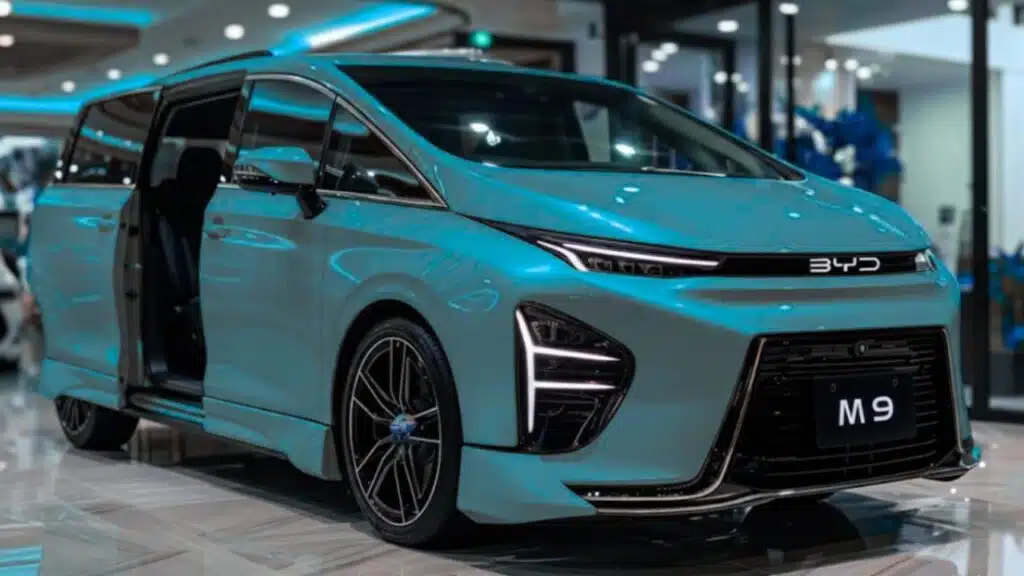
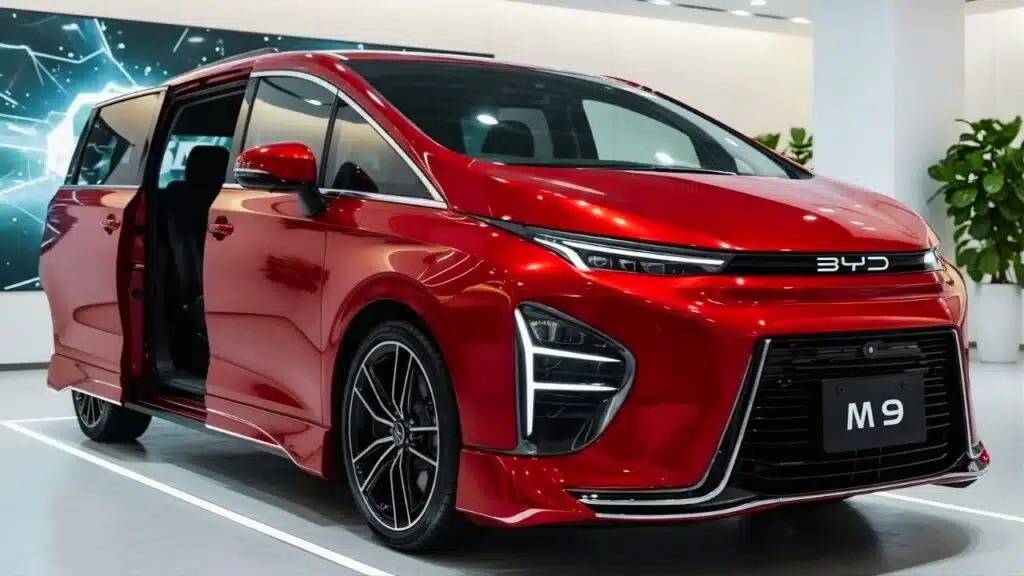
The M9 leans into BYD’s bold modern design language, with a huge textured grille, full-width light bar, and intricate taillights that make it instantly recognizable in traffic. It reads more like a clean, upscale shuttle than a flashy luxury van.
The tall nose, sliding side doors, and squared-off tail all shout practicality, while subtle chrome and two-tone paint options give it just enough premium flair to feel at home in hotel forecourts or business parks.
From a usability standpoint, the powered dual sliding doors, relatively low step-in height, and big glass area make daily family use easy—kids can climb in, grandparents don’t have to strain, and visibility from the driver’s seat is better than in many large SUVs.
Parking, visibility and real-life size
On paper it’s big: roughly 5,145 mm long, 1,970 mm wide, and 1,805 mm tall, with a 3,045 mm wheelbase. Think Toyota Alphard / Kia Carnival footprint rather than compact SUV. In tight city streets that means you rely heavily on the surround-view cameras and parking sensors, but the light steering and large mirrors keep it manageable once you’re used to the dimensions.
The squared body also pays dividends in internal space and cargo usability: the roof doesn’t slope aggressively, so rear passengers get a proper ceiling above them, and luggage isn’t fighting a tapering hatch.
Cargo space and everyday practicality
With all three rows up, you get a genuinely usable boot—enough for a few large suitcases or a proper weekly grocery run. Fold the third row down and it turns into a cavernous van-like space, easily swallowing bikes, flat-pack furniture, or multiple prams.
The electric folding third row is a big quality-of-life win: instead of wrestling with heavy seatbacks, you tap a button and the floor flattens itself, which matters when you’re doing it multiple times across a busy week.
Exterior & Practicality: Key Specs
| Item | 2026 BYD M9 (Xia, China spec) |
| Length | ~5,145 mm |
| Width | ~1,970 mm |
| Height | ~1,805 mm |
| Wheelbase | ~3,045 mm |
| Ground clearance | ~140 mm (estimate) |
| Trunk volume (3-row) | Large, usable boot space |
| Max cargo volume | Over 2,000 L (3rd row folded) |
| Doors | Dual power sliding rear doors |
Interior Comfort and Technology
Seating and long-distance comfort
The cabin is laid out 2+2+3, with a huge emphasis on the second row. Higher trims get captain’s chairs with heating, ventilation, massage, extendable leg rests, and fold-out tables—very much business-class airline seating for a family MPV.
For a week of mixed driving, these are the seats people will fight over. On highway runs they recline comfortably; in city traffic the armrests, soft padding, and individual controls keep fatigue low.
Third row space is better than average for the class: adults can sit back there without feeling punished, especially for short to medium trips, thanks to the long wheelbase and upright roofline.
Noise isolation is a strong point. Wind and road noise are well suppressed, and the hybrid system keeps engine revs low most of the time. At city speeds the car often glides along in near-silence on electric power alone.
Materials and perceived quality
Material quality sits in the “approaching premium” zone. You get soft-touch plastics on most touchpoints, synthetic leather or higher-grade upholstery depending on trim, tasteful metallic or wood-effect trim, and generally tight panel gaps.
The overall ambience feels closer to a mid-level German MPV or SUV than to a budget people mover. It doesn’t quite hit limousine-level luxury, but it comfortably beats many mainstream rivals on perceived quality and design flair.
Infotainment, screens, and connectivity
Front and centre is BYD’s familiar large touchscreen (around 15.6 inches) running the latest DiLink system, flanked by a digital instrument cluster and, on some trims, a separate passenger display.
Top trims also add a huge AR head-up display and a roof-mounted rear entertainment screen, turning the M9 into a rolling cinema for kids on long journeys.
Daily usability highlights include:
- A snappy, app-like infotainment interface with over-the-air updates.
- A capable voice assistant that can adjust navigation, climate, and media in natural language.
- Wireless phone charging and plenty of USB ports for all three rows.
- Available premium audio with a multi-speaker surround setup for those who care about sound quality.
For a week of family use, that combination means easy device charging, rear entertainment for kids, and a genuinely modern cockpit experience that doesn’t feel like an afterthought.

Interior & Tech: Key Specs
| Item | 2026 BYD M9 (higher trims unless noted) |
| Seating layout | 2+2+3, seven seats |
| Front screens | Digital cluster + large central screen |
| Passenger screen | Available on select trims |
| Rear entertainment | Roof-mounted screen on top trims |
| Infotainment OS | BYD DiLink with OTA updates |
| Seat features | Heat, ventilation, massage (front/2nd, trim-dependent) |
| Ambient lighting | Multi-color ambient lighting available |
| Head/legroom | Generous in all three rows |
Performance and Powertrain
Power, drivetrain and character
Under the skin, the M9 uses BYD’s fifth-generation DM-i plug-in hybrid system: a 1.5-litre turbocharged petrol engine paired with a strong electric motor, for a combined output in the 270 hp ballpark. Power goes to the front wheels via an e-CVT.
On paper it won’t scare performance sedans, but for a family MPV it’s more than adequate. 0–100 km/h sits in the low-to-mid 8-second range depending on trim—perfectly fine for on-ramps and overtakes when fully loaded.
In everyday use, most low-speed work is handled by the electric motor, giving very smooth, near-silent launches from traffic lights and in stop-go city conditions. When you push harder or run low on battery, the petrol engine steps in without much drama.
Ride, handling, and refinement
The M9’s chassis is tuned very clearly for comfort. It uses a modern suspension layout with available adaptive dampers on higher trims, prioritizing bump absorption over outright body control.
Across a week of mixed use, the pattern is consistent:
- Soft, compliant ride that flattens speed bumps and rough surfaces.
- Noticeable but well-controlled body roll in tighter bends.
- Light steering that makes parking easy but doesn’t offer much feel at higher speeds.
Regenerative braking is set up for smoothness rather than aggressive one-pedal driving. It feels natural if you’re coming from a conventional hybrid, but EV enthusiasts might wish for a stronger regen mode.
Performance: Key Specs
| Item | 2026 BYD M9 (all trims) |
| Engine type | 1.5 L turbo petrol (PHEV system) |
| Combined power | ~270 hp |
| Transmission | e-CVT (single-speed hybrid) |
| 0–100 km/h | ~8.1–8.5 s |
| Drive type | Front-wheel drive only |
| Character | Smooth, comfort-biased, not sporty |
Fuel Economy and Real-World Running Costs
Official efficiency and range
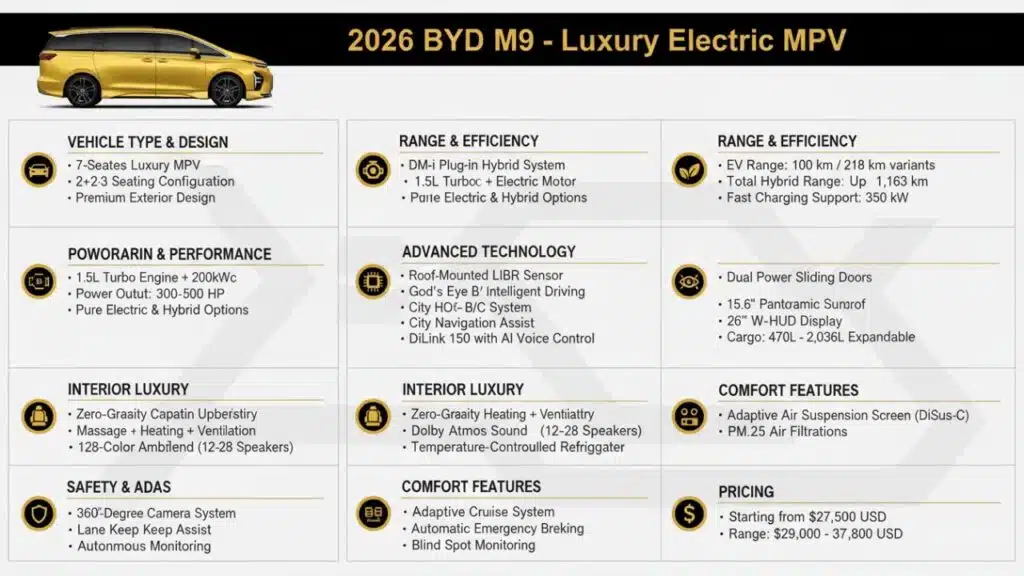
One of the biggest headlines for the 2026 BYD M9 is its electric range. Long-range trims offer up to about 218 km of pure electric range on local test cycles, thanks to a bigger BYD Blade battery pack. Standard-range versions still deliver around 100 km of EV driving.
Combined petrol-plus-electric range can exceed 1,100 km in the best-case configuration. That’s ideal if you do a couple of longer business trips or out-of-city family visits in a week and don’t want to see a fuel station often.
Hybrid fuel consumption is rated in the high 4s to around 5.0 L/100 km on test cycles—exceptionally efficient for such a large seven-seater.
Real-world consumption
In real life, owners and early testers typically see numbers in the mid-5s to low-6s L/100 km in mixed use when using the plug regularly. If you ignore the plug and drive it like a regular hybrid, consumption understandably creeps up, but it’s still far better than a conventional petrol MPV.
Translated into a typical week:
- Daily 40–60 km school/office runs can be done mostly on electric power if you charge at home or work.
- A 300–400 km highway trip will lean more on the engine, but overall fuel use will still undercut most V6 or turbo-petrol vans.
Fuel grade, servicing and long-term costs
The engine is tuned for regular unleaded fuel in its home market, which helps keep running costs realistic. Because the electric motor handles a lot of low-speed work, the engine spends much of its life in a relatively relaxed state, which should also help long-term durability.
Service intervals and pricing will vary by market, but BYD typically offers competitive packages and extended warranties, including strong battery coverage on its plug-in and EV models. That lowers the risk for buyers nervous about first- or second-generation electrified platforms.
Economy & Running Costs: Summary
| Item | 2026 BYD M9 (long-range trims) |
| Hybrid fuel consumption | ~4.9–5.0 L/100 km (official) |
| Real-world mixed (est.) | ~5.5–6.2 L/100 km |
| Pure EV range | ~100 km or ~218 km (trim-dependent) |
| Combined range | 1,000+ km possible |
| Fuel tank capacity | Around 50 L |
| Recommended fuel | Regular unleaded |
Safety and Driver Assistance
Structural safety and airbags
The M9 rides on a modern body structure with a high proportion of high-strength steel and multiple airbags, including front, side, curtain, and, on higher trims, additional central airbags. That puts it squarely in line with current best practice for large family vehicles.
Formal crash-test scores will depend on local testing (C-NCAP, Euro NCAP, etc.) as exports grow, but on paper the hardware is bang up to date.
ADAS: from highway assist to “God’s Eye”
Earlier Xia/M9 variants launched with BYD’s DiPilot suite (adaptive cruise, lane keeping, automatic emergency braking and more). For 2026, top trims add LiDAR and a more advanced “God’s Eye” system with enhanced navigation assist and smarter automated parking.
In week-long, real-life use:
- Adaptive cruise control and lane-centring work well on highways but can feel conservative in tighter curves or dense traffic.
- 360-degree cameras and blind-spot monitoring are extremely helpful in tight car parks and multi-lane junctions, especially given the M9’s footprint.
- Automated parking is accurate enough to use in tricky spots, though most owners will probably rely on it only occasionally.
Safety & ADAS: Key Specs
| Item | 2026 BYD M9 |
| Airbag count | Up to 10 (trim-dependent) |
| ADAS level | L2+ highway and city assist |
| Core ADAS features | ACC, lane-keeping/centering, AEB, blind-spot monitoring, traffic sign recognition, auto parking |
| Sensor suite | Cameras, radar, ultrasonic, plus LiDAR on top trims |
| Warranty (vehicle, typical) | Around 6 yrs / 150,000 km in home market |
| Battery warranty | Long-term coverage / lifetime (first owner, market-dependent) |
2026 BYD M9 vs. Zeekr 009
To understand where the M9 sits, it helps to compare it to one of the most talked-about Chinese MPVs: the Zeekr 009, a pure-electric luxury van.
Value and positioning
In China, the 2026 M9 slots into the mid-200,000 yuan band, with top trims creeping under 270,000 yuan. That’s roughly equivalent to a well-specified mainstream minivan or SUV from Japanese or Korean brands.
The Zeekr 009, by contrast, starts around half a million yuan and can go substantially higher depending on spec. In other words, it’s roughly twice the price of an M9 and clearly aims at the full-luxury EV buyer who might otherwise be considering a Mercedes, Lexus or Volvo EM90.
So the M9 is very much “smart premium”: lots of tech, lots of comfort, but priced for families and fleet buyers rather than exclusively for the chauffeur-driven elite.
Performance and range
- BYD M9: Plug-in hybrid, front-wheel drive, around 270 hp, 0–100 km/h in the low-to-mid 8s, with up to ~218 km of EV range and over 1,100 km combined.
- Zeekr 009: Dual-motor, all-wheel drive, roughly 400 kW plus, 0–100 km/h in the mid-4s, with huge battery-only range but total range limited by charging opportunities.
The Zeekr is clearly the performance monster and the better choice for those committed to pure electric. The M9 counters with easier long-distance flexibility and lower purchase price.
Comfort, tech and ownership
Both vehicles pack multi-screen cabins, rear entertainment, and premium materials. The Zeekr edges ahead on ultimate luxury—think first-class seats, more exotic trim options, and flagship-level audio systems.
The M9 doesn’t quite reach that level, but it gets surprisingly close for far less money, especially in higher trims with massage seats and the full screen suite.
Warranty-wise, both brands offer strong coverage on vehicle and battery, but details will vary a lot between markets. In general, the M9’s combination of low running costs and competitive pricing gives it a strong value argument; the Zeekr’s pitch is more about “no compromise” luxury EV motoring.
2026 BYD M9 vs Key Competitor (Zeekr 009)
| Metric | 2026 BYD M9 (PHEV) | Zeekr 009 (EV) |
| Approx. price | Mid-200,000s yuan | ~500,000+ yuan |
| Horsepower (approx) | ~270 hp combined | ~536 hp (dual-motor) |
| Fuel/energy type | Petrol + battery (PHEV) | Pure battery electric |
| EV / combined range | Up to ~218 km / 1,100+ km | 700+ km EV (battery only) |
| Warranty (typical) | Strong vehicle + battery | Strong vehicle + battery |
Final Verdict: Is the 2026 BYD M9 Worth Your Money?
Pros
- Very strong efficiency for a large seven-seat MPV, with long electric range and huge combined range.
- Exceptionally comfortable second row with near business-class seating and a genuinely usable third row.
- Huge, flexible cargo area with easily folding third-row seats.
- Modern infotainment with big screens, strong connectivity, and available premium audio.
- Comprehensive ADAS suite with available LiDAR and advanced navigation assist on top trims.
- Aggressive pricing versus many hybrid MPV rivals and far cheaper than full-luxury EV vans.
- Competitive vehicle and battery warranties that reduce long-term risk.
Cons
- No pure-EV version for buyers who want to avoid petrol entirely.
- Front-wheel drive only; no AWD option for harsher climates or steep, slippery terrain.
- Handling is soft and comfort-biased; keen drivers will find it lazy in corners.
- Big footprint can make tight city parking stressful despite cameras and sensors.
- Brand and dealer network are still maturing in some export markets, which may affect resale and support.
Value assessment
In its home market, the M9 sits below expensive luxury MPVs but offers comfort, tech, and efficiency that frequently punch above its price. In export markets, early pricing suggests a premium over basic minivans but a clear discount versus full-fat luxury vans and many European plug-in SUVs.
Given what you get—genuine three-row comfort, near-luxury cabin, long electric commuting range, and very low running costs—the pricing is hard to argue with. You’re paying mainstream money for a package that often outguns established brands on tech and efficiency.
Who should buy the 2026 BYD M9?
The 2026 BYD M9 makes the most sense if:
- You run a family or executive shuttle where passengers spend more time in the second and third rows than up front.
- Your weekly pattern combines urban commuting (where EV mode shines) with occasional longer highway trips.
- You want luxury-leaning comfort and tech but don’t want to pay Zeekr 009 or Lexus LM money.
- You’re comfortable buying from a fast-growing brand and have a BYD dealer within sensible reach.
You should probably look elsewhere if:
- You want sharp handling, rear- or all-wheel drive, or genuinely sporty performance.
- You must have a pure EV with no combustion engine.
- You live in a region where BYD has little or no dealer and service presence.
Verdict: As a practical, tech-rich, and extremely efficient family or business MPV, the 2026 BYD M9 is absolutely worth considering. It doesn’t chase outright luxury or sports-sedan performance; instead, it nails the everyday realities of moving people and cargo comfortably, cheaply, and with very modern tech. If that matches your use case, it’s one of the standout people-movers to watch for 2026.
FAQs on 2026 BYD M9 Review
Is the 2026 BYD M9 a full electric vehicle?
No. The 2026 BYD M9 is a plug-in hybrid (PHEV), not a pure EV. It combines a 1.5-litre turbo petrol engine with an electric motor and battery pack, allowing you to drive significant distances on electric power alone and then rely on petrol for longer trips.
What is the price of the 2026 BYD M9?
Exact pricing depends on market and trim, but in its home market the M9 is positioned as a “smart premium” MPV. That means it costs far less than a Lexus LM or Zeekr 009, and lands closer to well-equipped mainstream minivans and SUVs, while still delivering a very rich feature set.
How far can the BYD M9 go on electric power alone?
The BYD M9 offers two main EV ranges depending on trim: a standard battery with around 100 km of pure electric range and a long-range version with roughly 200+ km of EV driving under local test cycles. Real-world figures will vary with speed, climate, and load, but both versions can comfortably handle daily commuting in EV mode if you charge regularly.
How many seats does the BYD M9 have?
The M9 is primarily offered as a seven-seater MPV with a 2+2+3 layout. You get individual captain’s chairs in the second row (often with heating, ventilation and massage on higher trims) and a three-seat bench in the third row that adults can actually use for real journeys.
How does the BYD M9 perform compared to luxury MPVs like the Lexus LM or Zeekr 009?
The M9 cannot match the ultimate lounge-like luxury of the Lexus LM’s four-seat configuration or the explosive acceleration of the Zeekr 009. However, it delivers similar real-world space, very strong efficiency and competitive comfort at a fraction of the price, which makes it a far better value proposition for most families and fleet buyers.
Is the BYD M9 safe and does it have ADAS features?
Yes. The M9 uses a modern, high-strength body structure and multiple airbags, and comes with a full suite of driver-assistance tech, including adaptive cruise control, lane-keeping assist, automatic emergency braking, and 360-degree cameras. Higher trims add even more advanced systems, such as LiDAR-supported navigation assist and upgraded automated parking.