Blockchain is no longer just about Bitcoin. It now powers real products in payments, trading, supply chains, gaming, digital identity, creator tools, and enterprise data workflows.
That matters for your career because adoption doesn’t create only one type of job. As organizations build, ship, and secure blockchain products, they need developers, auditors, security engineers, product leaders, analysts, designers, marketers, legal experts, and operators.
This guide focuses on blockchain career paths that have strong long-term demand potential. You’ll learn what blockchain is, how to choose a path that fits your strengths, and what each role actually does day to day.
What is Blockchain Technology?
Blockchain is a decentralized digital ledger used to record data in a way that is transparent and difficult to tamper with. Instead of storing records in one central database, it distributes records across a network of computers that follow shared rules.
Data is grouped into blocks, and each block connects to the previous one, forming a chain. Once information is confirmed and added, changing it becomes extremely hard without the network rejecting the change.
The practical advantage is verifiable trust. The system reduces reliance on a single institution to validate records, which is why blockchain is used for digital assets, smart contracts, and shared data workflows.
Why Blockchain Career Paths Growing?
Blockchain growth is being driven by real-world use cases, not only speculation. Payments and settlement, tokenized assets, and on-chain identity experiments are pulling more companies into the ecosystem.
The second driver is infrastructure maturity. Wallets, custody, developer frameworks, analytics platforms, and compliance tooling are getting more professional, which creates hiring across multiple departments.
The third driver is risk management. Hacks, fraud, and regulatory uncertainty raise the stakes, which increases demand for security, auditing, legal, and compliance roles.
How to Choose a Blockchain Career Path
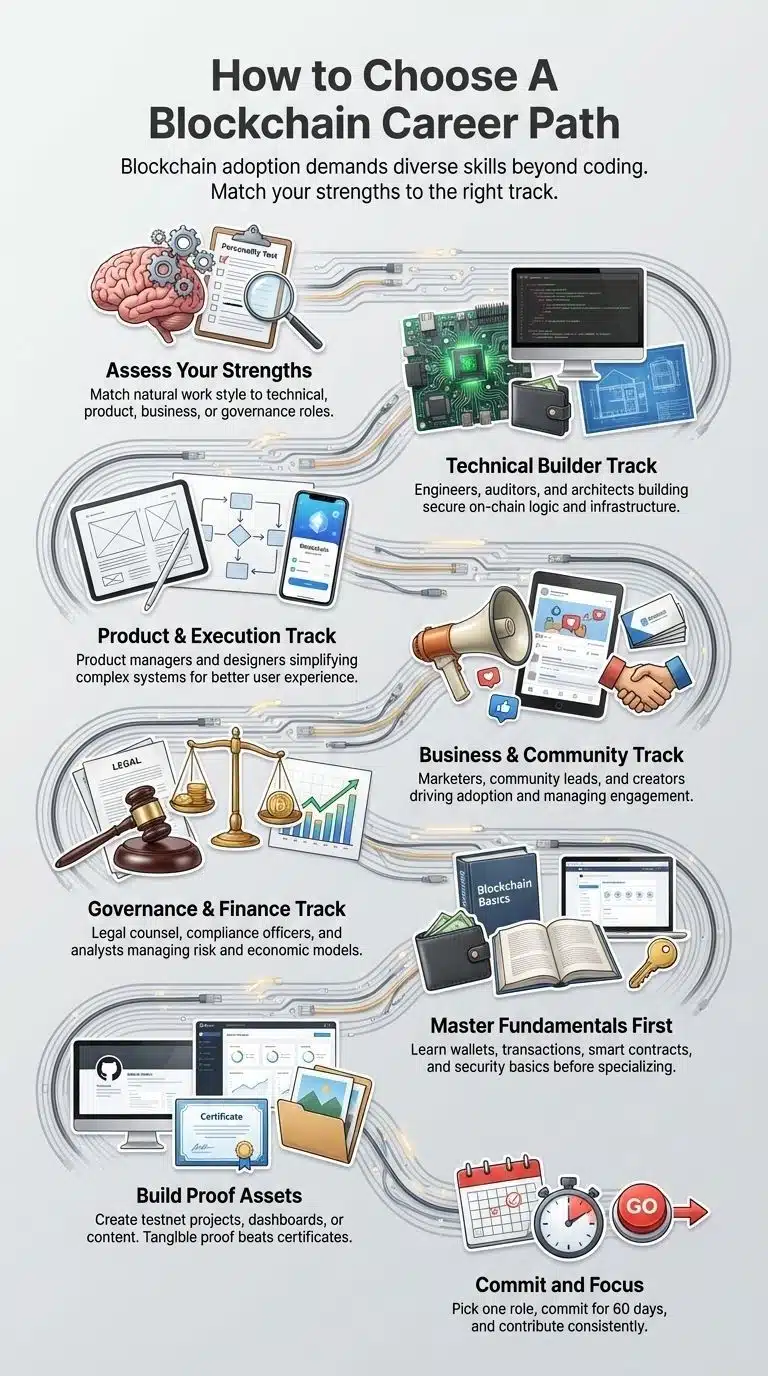
Start with your strengths and your preferred work style. You’ll move faster if you pick a path that matches how you naturally think and collaborate.
Ask yourself these questions:
- Do you prefer technical work or non-technical work?
- Do you enjoy finance and markets, or product design and user experience?
- Do you like research and analysis, or building communities and partnerships?
- Do you want a startup environment, a large company, or independent work?
Then match yourself to a track:
- Technical builder track: developer, auditor, security, architect, integration
- Product and execution track: product manager, project manager, designer
- Business and community track: growth, community, partnerships, content
- Governance and finance track: compliance, legal, tax, tokenomics, analysis
To reduce overwhelm, learn the basics once, then specialize. Most people fail because they try to learn everything at the same time.
Core Skills To Learn First (For Every Track)
Before you specialize, build baseline literacy. This helps you communicate with teams and avoid costly mistakes.
Start with these essentials:
- Wallets, private keys, seed phrases, and basic security habits
- Transactions, confirmations, and what “finality” means in practice
- Tokens vs. coins, and how stablecoins differ from volatile assets
- Smart contracts and why bugs can be permanent
- Basic terminology: DeFi, NFTs, Layer 1, Layer 2, bridges, oracles
Once those fundamentals feel normal, pick one role and build proof. Proof is how you get interviews faster than “I’m learning.”
1. Blockchain Developer
Blockchain developers build smart contracts and core application logic that run on-chain. They create the rules that govern transfers, lending, swaps, staking, membership access, and many other workflows.
This role is in demand because every blockchain product needs contract logic, tooling, and integration. It also pays well because mistakes can be expensive and public.
If you want the fastest hiring signal, ship a small, working testnet project and document it well. Employers love proof more than certificates.
Key things you do:
- Build and test smart contracts
- Write secure on-chain logic and handle edge cases.
- Integrate contracts with front-end and back-end systems.
- Maintain upgrades and handle deployment safely.
| Aspect | Details |
| Typical Background | Software engineering, CS, full-stack development |
| Key Skills | Solidity or Rust, smart contract testing, security basics |
| Common Tools | Foundry/Hardhat, ethers/web3 libraries, explorers |
| Employers | Web3 startups, DeFi teams, and infrastructure companies |
| Growth Driver | More dApps, tokenization, and on-chain payments |
2. Smart Contract Auditor
Auditors review smart contracts to find vulnerabilities before attackers exploit them. Auditing matters because many contracts manage valuable assets and operate openly on public networks.
This path is highly respected because it protects users and protocols. It can also be a strong, independent consulting career once you build credibility.
Auditing is not just reading code. It’s threat modeling, adversarial thinking, and writing clear reports that teams can act on quickly.
Key things you do:
- Review contracts for known vulnerability patterns
- Validate assumptions, permissions, and upgrade safety.
- Test exploit scenarios and recommend fixes.
- Write a professional audit report and follow-up guidance.
| Aspect | Details |
| Typical Background | Blockchain dev with security focus |
| Key Skills | Code review, threat modeling, exploit thinking |
| Common Tools | Static analyzers, test frameworks, fuzzing tools |
| Employers | Audit firms, DeFi protocols, security teams |
| Growth Driver | High-value contracts and ongoing attack pressure |
3. Web3 Front-End Engineer
Web3 front-end engineers build the interface users interact with. They connect wallets, handle signing flows, display transaction states, and make complex systems feel simple.
Good UX is one of the biggest adoption barriers in Web3. That makes front-end specialists more important as products move beyond early adopters.
This role suits developers who like user experience, interaction design, and product polish.
Key things you do:
- Build wallet connection and signing flows
- Display balances, positions, and on-chain activity clearly
- Handle transaction failures and status messaging well.
- Improve usability and reduce user mistakes.
| Aspect | Details |
| Typical Background | Front-end or full-stack engineering |
| Key Skills | React, TypeScript, wallet integration, UX awareness |
| Common Tools | Next.js, wagmi/ethers, index |
| Employers | dApps, wallets, NFT platforms, Web3 games |
| Growth Driver | Better UX and mainstream adoption |
4. Blockchain Architect
Architects design the overall system and decide what belongs on-chain and what stays off-chain. They also plan scaling, security boundaries, and integration with legacy systems.
This is usually a senior role because the consequences of design mistakes are costly. Architects need both technical depth and business clarity.
This path fits people who enjoy system design, tradeoffs, and long-term planning.
Key things you do:
- Choose chains, L2s, and architecture patterns
- Design contract structure, upgrade strategy, and security boundaries
- Plan integrations with databases, APIs, and identity systems.
- Document architecture and guide multiple teams
| Aspect | Details |
| Typical Background | Senior engineer, solutions architect |
| Key Skills | System design, scaling, security, integration planning |
| Common Tools | Architecture docs, threat models, performance plans |
| Employers | Enterprises, consultancies, large Web3 projects |
| Growth Driver | Complex adoption and large deployments |
5. DeFi Product Manager
DeFi product managers lead products like lending, exchanges, derivatives, and yield tools. They balance growth, safety, and user needs in a high-risk environment. DeFi products need careful parameter choices and strong risk thinking. Incentives can drive growth, but they can also attract exploitative behavior if poorly designed.
This role fits people who understand finance and enjoy product strategy.
Key things you do:
- Define product roadmap and feature priorities
- Work with risk teams on parameters and guardrails.
- Run user research and improve onboarding and retention.
- Coordinate launches, governance proposals, and communication.
| Aspect | Details |
| Typical Background | Product, fintech, trading, or operations |
| Key Skills | DeFi mechanics, user research, roadmap planning |
| Common Tools | Analytics dashboards, governance tooling, and docs |
| Employers | DeFi protocols, wallets, Web3 fintechs |
| Growth Driver | Expansion of on-chain financial products |
6. Tokenomics Designer
Tokenomics designers build the economic model behind a token. They define supply rules, incentives, fees, governance rights, and sustainability mechanisms. This role is critical because token design can make or break a project. Good tokenomics rewards real usage and discourages short-term exploitation.
This path fits people who like economics, modeling, and incentive design.
Key things you do:
- Design supply schedules and distribution plans
- Create incentives for users, builders, and validators.
- Model sustainability and prevent exploitation loops
- Align governance and utility with long-term value.
| Aspect | Details |
| Typical Background | Economics, finance, data analysis |
| Key Skills | Modeling, incentive design, and on-chain metrics literacy |
| Common Tools | Spreadsheets, simulations, dashboards, research docs |
| Employers | Protocols, games, DeFi teams, launch platforms |
| Growth Driver | Need for sustainable token models |
7. On-Chain Data Analyst
On-chain analysts turn public blockchain data into actionable insight. They track flows, user behavior, protocol revenue, risk signals, and market patterns. The work is powerful because blockchain is transparent, but it is also tricky because raw data can be misleading without context.
This role fits people who like analytics and storytelling with data.
Key things you do:
- Build dashboards for protocol or exchange metrics
- Analyze cohort behavior and retention patterns.
- Track whale movements and risk indicators.
- Support product, trading, or governance decisions
| Aspect | Details |
| Typical Background | Data analysis, statistics, and sometimes trading |
| Key Skills | SQL, basic scripting, dashboards, interpretation |
| Common Tools | Dune, Flipside, Python/SQL stacks, explorers |
| Employers | Funds, exchanges, analytics firms, protocols |
| Growth Driver | Demand for transparent market and user insights |
8. Compliance And Regulatory Specialist
Compliance specialists help crypto and Web3 companies follow rules like KYC, AML, sanctions screening, reporting, and licensing. They reduce legal and operational risk while supporting growth.
This role matters most in exchanges, custodians, stablecoin firms, and tokenization platforms. It is also becoming more relevant for serious DeFi teams building with institutional users in mind.
This path fits people who like policy, risk frameworks, and operational controls.
Key things you do:
- Build compliance processes and internal controls
- Coordinate KYC/AML operations and risk scoring.
- Monitor regulation changes and update procedures.
- Work with legal, product, and leadership teams
| Aspect | Details |
| Typical Background | Compliance, law, banking, and financial regulation |
| Key Skills | Risk assessment, policy writing, AML/KYC knowledge |
| Common Tools | Compliance platforms, case management tools |
| Employers | Exchanges, custodians, fintechs, banks |
| Growth Driver | Clearer rules and stronger enforcement |
9. Blockchain Legal Counsel
Legal counsel supports token offerings, contracts, governance, disputes, IP, and cross-border operations. They help teams avoid costly missteps and structure products responsibly.
This role typically requires a law degree and qualifications. But tech literacy is the differentiator that makes a lawyer truly valuable in this space.
This path fits lawyers who enjoy emerging tech and financial innovation.
Key things you do:
- Advise on token structure and legal classification risk
- Draft and review contracts and partnership agreements
- Support governance frameworks and dispute handling.
- Coordinate across jurisdictions and regulators.
| Aspect | Details |
| Typical Background | Qualified lawyer with relevant experience |
| Key Skills | Securities concepts, contract law, tech literacy |
| Common Tools | Legal research, compliance coordination, policy docs |
| Employers | Law firms, exchanges, protocols, enterprises |
| Growth Driver | Complex deals and enforcement risk |
10. Blockchain Security Engineer
Security engineers protect systems beyond contracts alone. They focus on key management, infrastructure security, monitoring, incident response, and secure deployment practices.
This role grows because attackers target value. As adoption increases, security budgets and security hiring tend to increase, too. This path fits people who like defensive engineering and threat thinking.
Key things you do:
- Build monitoring for suspicious activity and attacks
- Improve key management and secure operational practices.
- Harden infrastructure and deployment pipelines.
- Lead incident response and postmortems
| Aspect | Details |
| Typical Background | Cybersecurity, DevOps, cryptography basics |
| Key Skills | Threat modeling, monitoring, and secure engineering |
| Common Tools | SIEM/logging, alerting, infra-as-code, security tooling |
| Employers | Protocol teams, infrastructure providers, custodians |
| Growth Driver | High-value targets and ongoing exploit activity |
11. Web3 UX And Product Designer
Designers make blockchain experiences understandable and safe. They design onboarding flows, wallet interactions, transaction confirmations, and recovery flows. This role matters because user confusion is still a major barrier. Mistakes can be costly, so designers must prioritize clarity and warnings.
This path fits people who love user research and simplifying complex systems.
Key things you do:
- Design safer signing and transaction confirmation flows
- Build onboarding journeys that reduce user drop-off.
- Improve dashboard readability and error handling.
- Run usability testing with real users.
| Aspect | Details |
| Typical Background | UX/UI design, product design |
| Key Skills | User flows, prototyping, Web3 patterns, microcopy |
| Common Tools | Figma, user testing tools, design systems |
| Employers | Wallets, dApps, exchanges, Web3 games |
| Growth Driver | Need to hide complexity for mainstream adoption |
12. Community Manager And DAO Community Lead
Community managers build trust and momentum. They manage channels, events, education, moderation, and feedback loops. DAOs lead deeper into governance. They coordinate proposals, working groups, voting processes, and stakeholder communication.
This role fits people who are organized, patient, and good at conflict management.
Key things you do:
- Moderate communities and set communication standards
- Organize events, calls, and contributor workflows.
- Gather feedback and route it to product teams.
- Support governance proposals and execution.
| Aspect | Details |
| Typical Background | Community, support, marketing, content |
| Key Skills | Communication, moderation, education, coordination |
| Common Tools | Discord/Telegram, governance tools, docs, event platforms |
| Employers | Protocols, DAOs, NFT brands, Web3 games |
| Growth Driver | Community-led growth and DAO structures |
13. Web3 Content Creator and Educator
People want clear explanations, not hype. Educators and creators produce tutorials, documentation, blogs, newsletters, and video content. This path can be in-house, freelance, or independent. The key is trust: accuracy, clarity, and consistent publishing.
This role fits writers, teachers, journalists, and creators who like turning complexity into simple guidance.
Key things you do:
- Write explainers, guides, and technical docs
- Produce educational videos or courses.
- Translate product updates into user-friendly content.
- Build a recognizable voice and audience.
| Aspect | Details |
| Typical Background | Writing, journalism, teaching, video |
| Key Skills | Research, clarity, storytelling, consistency |
| Common Tools | CMS tools, video editors, and documentation platforms |
| Employers | Web3 companies, media brands, and education platforms |
| Growth Driver | Need for trustworthy education and onboarding |
14. Blockchain Project Manager
Project managers keep cross-functional teams aligned. They track timelines, dependencies, risk, and communication across engineering, design, security, legal, and marketing.
Blockchain projects often add unique milestones like audits, governance votes, and multi-chain coordination. That makes strong project management valuable.
This path fits people who love structure and execution.
Key things you do:
- Build timelines that include audits and security checks
- Coordinate teams across technical and non-technical functions.
- Reduce launch risk with clear checklists and runbooks.
- Keep stakeholders informed and aligned.
| Aspect | Details |
| Typical Background | Project management, operations, product support |
| Key Skills | Planning, coordination, risk tracking, Web3 literacy |
| Common Tools | Jira/Asana, docs, launch checklists, comms calendars |
| Employers | Protocols, enterprises, agencies, consultancies |
| Growth Driver | Larger and more complex Web3 deployments |
15. NFT Strategist And Platform Lead
NFT strategy has matured beyond quick drops. Strategists now focus on long-term ecosystems like memberships, tickets, loyalty, in-game assets, and creator monetization.
This role blends brand strategy, product thinking, and community understanding. It requires creativity and discipline, especially in volatile markets. This path fits marketers and creative strategists.
Key things you do:
- Design NFT utility and long-term engagement strategy
- Coordinate creators, partnerships, and platform operations.
- Build storytelling and community plans.
- Measure retention and avoid hype-only cycles.
| Aspect | Details |
| Typical Background | Marketing, creative industries, brand strategy |
| Key Skills | Storytelling, community engagement, and NFT standards basics |
| Common Tools | Community tools, CRM, campaign analytics, marketplaces |
| Employers | Brands, media, games, NFT platforms |
| Growth Driver | Shift toward utility and long-term engagement |
16. Integration Engineer And API Engineer
Integration engineers connect traditional systems to blockchain rails. They build APIs and middleware that allow apps to read on-chain data, submit transactions, and handle confirmations reliably.
This role is vital for enterprise adoption because most businesses won’t rebuild everything from scratch. They need connectors that work with existing tools.
This path fits back-end developers who enjoy reliability engineering.
Key things you do:
- Build APIs that interact with nodes and indexers
- Handle retries, confirmations, and error states cleanly.
- Connect identity, payments, and databases to on-chain workflows.
- Maintain service reliability and observability.
| Aspect | Details |
| Typical Background | Back-end engineering, integration engineering |
| Key Skills | APIs, auth, data mapping, basic blockchain mechanics |
| Common Tools | Node providers, indexers, queues, monitoring stacks |
| Employers | Enterprises, fintechs, infrastructure providers |
| Growth Driver | Tokenization and enterprise integration needs |
17. Crypto Tax And Accounting Specialist
Taxes and accounting for digital assets can be complicated. Trades, staking rewards, airdrops, DeFi yields, and cross-chain activity create messy records.
Specialists help individuals and companies generate accurate reports and maintain clean financial statements. As adoption grows, demand for this expertise grows too.
This path fits accountants and tax professionals who like complex datasets.
Key things you do:
- Reconcile transactions across exchanges and wallets
- Classify taxable events and generate compliant reports.
- Support treasury management for token holdings
- Help companies handle audits and disclosures.
| Aspect | Details |
| Typical Background | Accounting, tax advisory, and finance operations |
| Key Skills | Reporting tools, data cleanup, and regional tax rules |
| Common Tools | Crypto accounting software, spreadsheets, reconciliation tools |
| Employers | Accounting firms, exchanges, and large token holders |
| Growth Driver | More adoption and tighter reporting expectations |
18. Protocol Researcher
Researchers explore scaling, privacy, consensus, cryptography, and economic models. They help design the next generation of blockchain infrastructure, including L2 systems and privacy-focused tech.
Research roles often require strong math or computer science depth, but not always. Some research roles focus on applied experimentation and technical writing. This path fits people who love deep problem-solving and publishing ideas clearly.
Key things you do:
- Study protocol improvements and propose new designs
- Run experiments and write technical papers or specs.
- Collaborate with engineering teams on implementation.
- Evaluate tradeoffs in security, scalability, and decentralization.
| Aspect | Details |
| Typical Background | CS, cryptography, economics, or related research |
| Key Skills | Research methods, writing, experimentation, analysis |
| Common Tools | Papers/specs, prototypes, testnets, simulations |
| Employers | Protocol foundations, labs, universities, R&D teams |
| Growth Driver | Need for scalability, privacy, and security innovation |
19. Web3 Growth Marketer
Growth marketers drive adoption and retention. They build campaigns, run experiments, analyze funnels, and collaborate with community and product teams to improve traction.
In Web3, growth often includes partnerships, referral systems, ambassador programs, and culture-aware messaging. The best growth marketers focus on real user value, not empty hype.
This path fits people who love experimentation and measurement.
Key things you do:
- Run growth experiments and measure conversion
- Build referral and retention programs.
- Use on-chain and off-chain analytics to learn what works.
- Coordinate launches with community and content teams.
| Aspect | Details |
| Typical Background | Growth marketing, performance, brand |
| Key Skills | Funnels, analytics, A/B testing, Web3 culture literacy |
| Common Tools | Analytics platforms, CRMs, attribution tools, dashboards |
| Employers | Wallets, exchanges, games, DeFi teams |
| Growth Driver | Competition and need for real user traction |
20. Blockchain Consultant And Strategy Advisor
Consultants help organizations decide where blockchain fits and where it doesn’t. They design pilots, evaluate vendors, map requirements, and guide adoption programs.
This role is in demand because many organizations are curious but lack internal expertise. Advisors translate technical concepts into business outcomes and risk frameworks.
This path fits people with a strategy background and strong communication skills.
Key things you do:
- Identify use cases and assess feasibility
- Run workshops and stakeholder alignment sessions.
- Evaluate vendors and architecture options.
- Build roadmaps and ROI/risk analysis.
| Aspect | Details |
| Typical Background | Consulting, strategy, sector expertise |
| Key Skills | Use case design, ROI analysis, stakeholder management |
| Common Tools | Frameworks, workshop plans, roadmaps, comparison matrices |
| Employers | Consultancies, enterprises, public sector programs |
| Growth Driver | Broad interest with limited internal expertise |
Pros and Cons of Blockchain Career Paths
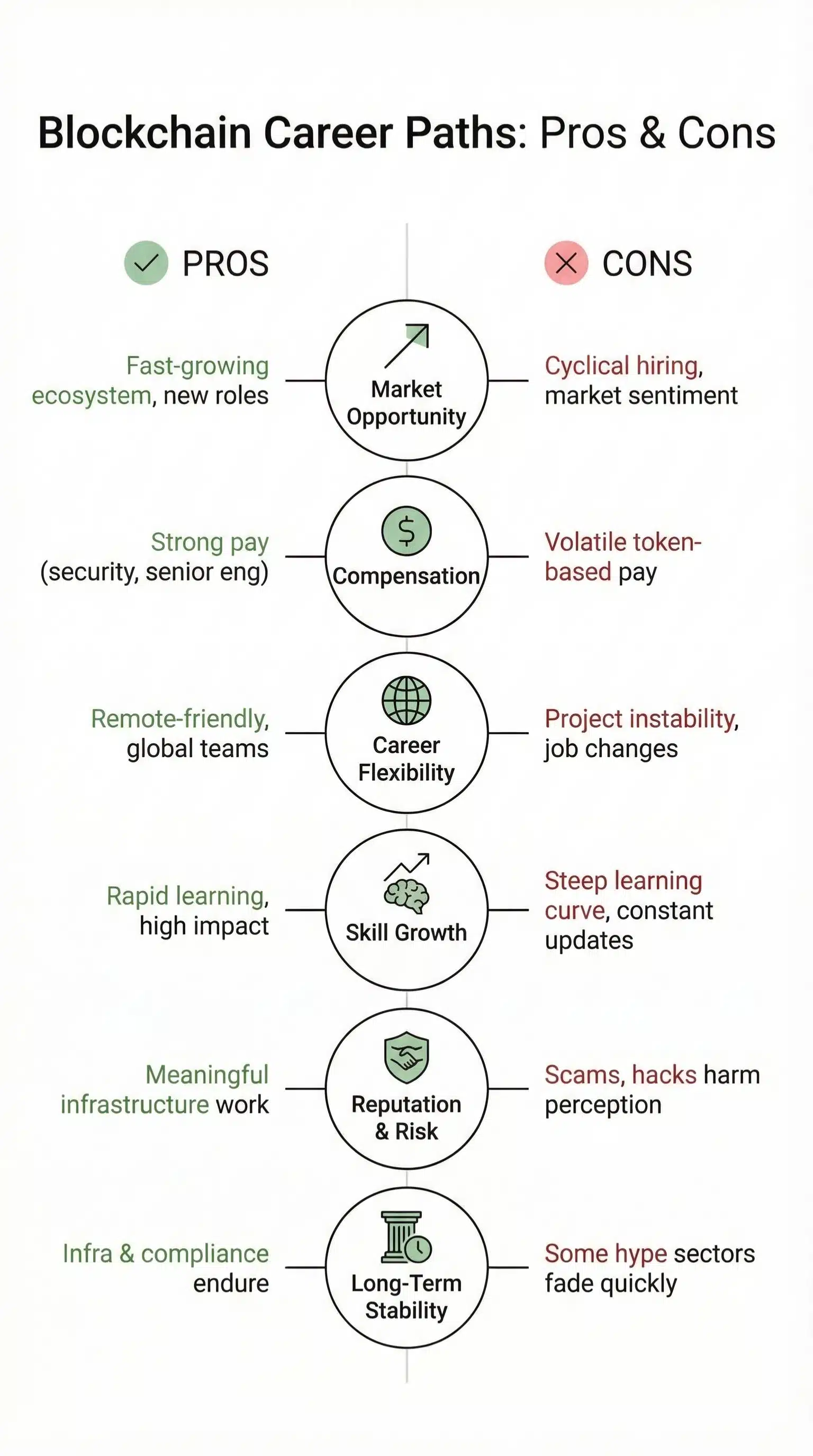
Blockchain can be a strong long-term move, but it comes with tradeoffs. Use this table to evaluate whether the opportunity fits your risk tolerance and learning style.
| Aspect | Pros | Cons |
| Market Opportunity | Fast-growing ecosystem with many new roles | Cyclical hiring tied to market sentiment |
| Compensation | Strong pay in security, auditing, and senior engineering | Volatile token-based compensation at some firms |
| Career Flexibility | Remote-friendly and global teams are common | Project instability can force job changes |
| Skill Growth | Rapid learning and high-impact work | Steep learning curve and constant updates |
| Reputation And Risk | Chance to work on meaningful infrastructure | Scams, hacks, and bad actors can harm perception |
| Long-Term Stability | Infrastructure, compliance, and security roles endure | Some consumer hype sectors can fade quickly |
How to Get Started in Blockchain Career Paths
You don’t need to learn everything to become employable. You need fundamentals plus proof in one role.
Use this simple plan:
- Learn wallet basics and security habits first
- Pick one role from the 20 and commit to it for 30–60 days.
- Build one proof asset that matches that role.
- Share your proof publicly with clear documentation.
- Join one community and contribute consistently.
Here are proof ideas by track:
- Developer: a small testnet dApp + tests + clear README
- Auditor/security: a vulnerability write-up or bug bounty submission
- Data analyst: a dashboard and a weekly insight thread/report
- Product/UX: a redesign case study with better signing flows
- Compliance/legal/tax: a practical checklist or explainer series
- Community/growth/content: a playbook, campaign plan, or education series
Small proof beats big plans. Hiring teams want to see that you can finish and explain real work.
Final Thoughts on Blockchain Career Paths
Blockchain is moving beyond a single use case into a broader technology stack that supports payments, ownership, automation, and shared records. That expansion is why blockchain career paths are growing across engineering, security, product, compliance, analytics, and community roles.
The fastest way to win is focus. Pick one path, build one proof asset, and contribute consistently where real teams can see your work.
If you approach the space with strong fundamentals, healthy skepticism, and continuous learning, blockchain can become a high-growth career move with global opportunities.