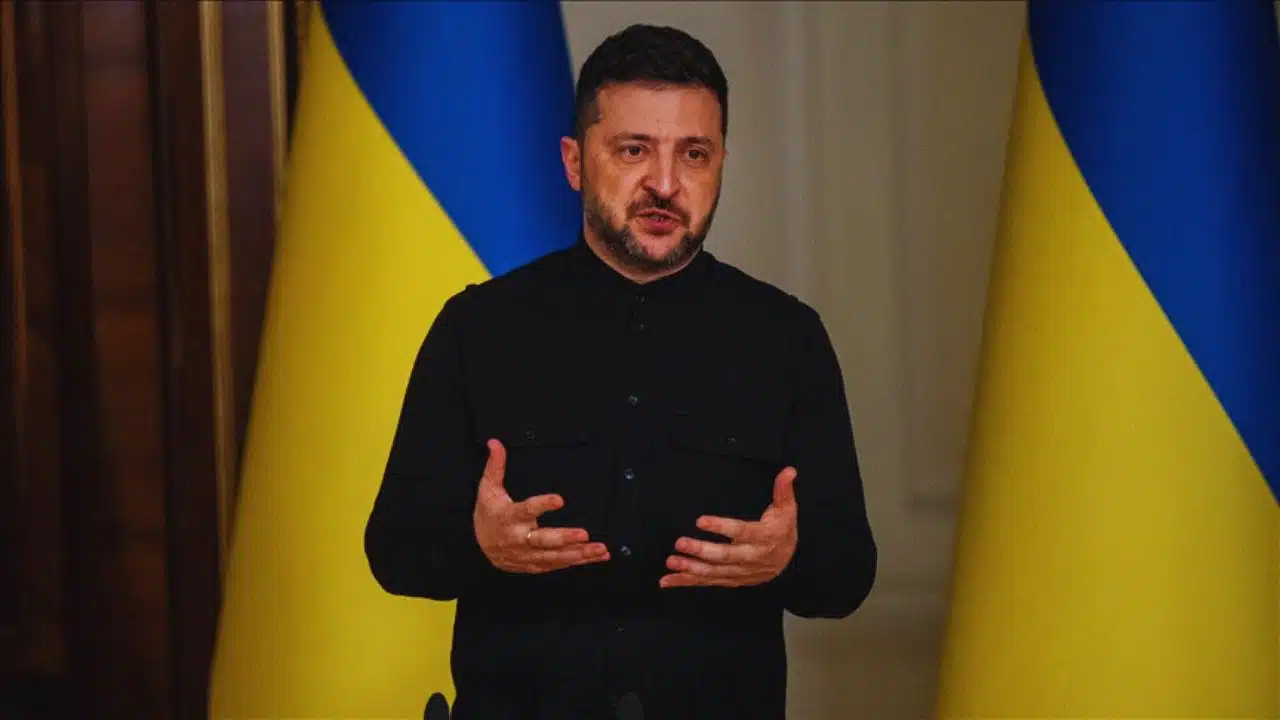
Ukrainian President Volodymyr Zelenskyy says he is ready to organize national elections within 60–90 days if Western partners provide security guarantees and parliament updates wartime election laws.
Zelenskyy’s 90-day election offer
Ukrainian President Volodymyr Zelenskyy has offered to hold national elections within 90 days, saying his government could organize a vote in 60–90 days if the United States and European partners ensure security across the country. He made the remarks in early December during briefings with journalists and in appeals to lawmakers from his Servant of the People party.
Zelenskyy stressed that he is personally ready to run in such elections but insisted that a vote can only happen if Ukrainians can cast ballots safely despite ongoing Russian missile and drone attacks. He also asked parliament to prepare draft amendments that would allow elections to be held under martial law, which currently blocks any national vote.
Conditions: security, law, and funding
According to Zelenskyy, two main conditions must be met before any wartime elections can take place: security guarantees and a clear legal framework. He has publicly appealed to Washington and European capitals to help provide air defense, protection for polling stations, and support for international observers during the campaign and voting period.
Beyond security, Ukraine’s election laws would need to be amended because they currently prohibit national elections while martial law is in effect. Lawmakers are now being urged by the president to draft changes that would define how to run elections during wartime, including rules for campaigning, voter registration, and counting ballots in areas under constant threat of attack.
Financial support is another factor. Before the full-scale invasion, Ukrainian officials estimated that organizing nationwide elections during war could require tens of millions of euros in extra funding from partners, to cover security, logistics, and voting arrangements for refugees abroad. With much of Ukraine’s budget now directed to defense and reconstruction, Kyiv is again signaling that foreign assistance would be needed to make any 60–90 day election plan realistic.
Martial law and delayed elections
Ukraine has been under martial law since Russia launched its full-scale invasion on 24 February 2022. Under Ukrainian legislation on the legal regime of martial law, presidential, parliamentary, and local elections are barred while the emergency regime remains in force, and the mandates of the president and parliament are automatically extended.
A presidential election had been scheduled for March or April 2024, but it did not take place because martial law was repeatedly extended. Parliamentary elections, originally expected in October 2023, were also postponed for the same reason. The Verkhovna Rada has since prolonged martial law multiple times, with one extension in April 2025 pushing the regime at least into August to maintain mobilization and frontline stability.
In March 2025, lawmakers went further and passed a resolution affirming that national elections could not be held while martial law continues, formally extending Zelenskyy’s mandate until the emergency is lifted. That document was framed as a rebuttal to foreign criticism of Ukraine’s democratic credentials and as a legal guarantee that state institutions would remain legitimate during the war. Zelenskyy’s new 90-day offer now appears to open the door to revisiting that stance, at least if parliament agrees to amend the laws that currently block a vote.
Planned vs postponed national votes in Ukraine
| Election type | Originally scheduled date | Current status / reason for delay |
| Presidential | March–April 2024 | Postponed due to martial law and ongoing full-scale invasion |
| Parliamentary (Rada) | October 2023 | Postponed under martial law; mandates extended automatically |
| Local elections | October 2025 (planned) | Not held; martial law and security risks across regions |
Pressure from Trump, Russia, and Western partners
Zelenskyy’s latest remarks come after months of rising international pressure over the absence of elections since the war began. US President Donald Trump has repeatedly argued that Ukraine should hold elections despite the conflict, at one point calling Zelenskyy a “dictator” and claiming that Kyiv was using the war to avoid a vote. These comments have fueled political debate both inside Ukraine and among its Western supporters.
Russian President Vladimir Putin, meanwhile, has tried to question Zelenskyy’s legitimacy by pointing to the expired electoral calendar and claiming Ukraine is no longer a democracy. Moscow has used this narrative to argue against negotiations and to justify its refusal to sign a comprehensive peace agreement. Some Western officials worry that if Ukraine waits too long to renew its mandate at the ballot box, such narratives could gain traction among undecided audiences in Europe, the Global South, and the United States.
At the same time, EU representatives have cautioned that free and fair elections are only possible when circumstances allow voters, candidates, and observers to operate safely. European officials have stressed that Ukraine’s democracy should not be judged solely by whether it votes during active war, but also by how it protects civil liberties and constitutional order under extreme conditions. Zelenskyy’s new offer appears aimed at balancing these competing pressures: addressing concerns about democratic legitimacy while insisting that partners share responsibility for the risks of a wartime vote.
Risks of voting during wartime
Security remains the biggest obstacle to elections in Ukraine while Russian forces continue to target cities, infrastructure, and government buildings with missiles and drones. Polling stations, campaign rallies, and queues of voters would present obvious targets, and there is no guarantee that Russia would refrain from strikes on election day or during the campaign. Analysts warn that any mass-casualty attack linked to voting could damage public trust not only in the election but also in the authorities who decided to hold it.
Logistics pose another serious challenge. Millions of Ukrainians have been displaced internally, and several million more are registered as refugees abroad, mainly in EU countries. Organizing a credible vote would require updated voter lists, secure ways to cast ballots from foreign countries, and solutions for citizens living in or near Russian-occupied territories. Experts note that redrawing electoral districts, building temporary polling places, and training staff could take many months beyond the 60–90 day window Zelenskyy mentioned.
There are also concerns about political competition and media access during wartime. Martial law gives the government broad powers over information space and public gatherings, which could make it harder for opposition parties to campaign freely or for media outlets to cover candidates equally. Supporters of waiting argue that elections held under these constraints could be contested or viewed as less legitimate, even if they are technically legal.
What comes next for Ukraine’s democracy
Zelenskyy’s offer to hold elections within 90 days now puts the focus on Ukraine’s parliament and Western partners. Lawmakers will have to decide whether to amend legislation to permit voting under martial law and to design detailed rules for a wartime campaign. In parallel, Kyiv will be asking the US and Europe not only for weapons and financial support, but also for a concrete plan to secure polling sites, transport ballots, and protect election officials.
Diplomats and analysts note that any election timeline will depend heavily on the trajectory of the war and on whether current ceasefire or peace talks produce at least a partial reduction in hostilities. If large-scale Russian attacks continue, it may be politically and practically impossible to meet the 60–90 day target, even with foreign support. Still, by publicly stating his readiness to go to the polls and inviting both parliament and Western partners to help enable a vote, Zelenskyy is signaling that Ukraine’s leadership wants to keep a path open toward renewing its democratic mandate, even before the war fully ends.