
A worker dies every 96 minutes in the United States. The year 2022 alone saw almost 5,500 fatal work injuries. These alarming numbers show why safety technology has become vital for today’s businesses. Companies that use these technologies see remarkable results. VR training reduces workplace accidents by 30%, while AI-powered risk management cuts losses by the same percentage.
The way companies handle safety has transformed completely. Workers have embraced new safety technologies, with 83% showing active support. Evidence-based strategies help businesses cut workplace injuries by up to 30%. Companies that use IoT technologies to manage physical environments see their employee satisfaction rise by 20%. Health-tracking wearables will grow into a $60 billion market by 2026. These devices are changing how businesses protect their workers’ well-being.
This detailed guide looks at the most effective workplace safety technologies available now. You’ll learn about their real-life effects and practical ways to create safer workplaces for 2025 and beyond.
Current State of Workplace Safety Technology
Incorporating advanced technology into workplace safety strategies is crucial for addressing potential threats and ensuring a secure environment. As companies strive to protect their employees, implementing a comprehensive workplace violence prevention program Forth Worth can be a vital step. This program not only focuses on immediate safety measures but also emphasizes long-term strategies to mitigate risks. By integrating cutting-edge solutions, businesses can foster a culture of safety and awareness, empowering employees to recognize and respond to potential hazards effectively. Such proactive measures are essential in creating a resilient workplace that prioritizes the well-being of its workforce, ultimately enhancing productivity and morale.
The workplace safety technology market has reached USD 14.64 billion in 2024, and experts project it to grow to USD 15.98 billion by 2025.
Key Statistics and Trends in 2024-2025
Both employers and employees now face greater workplace risks in every category. Fatigue stands out as the biggest problem, with 81% of employees and 78% of employers listing it as their most likely risk. On top of that, workplace violence incidents have grown substantially, and employer concern levels jumped from 57% to 66%.
Most Effective Safety Technologies
The most meaningful safety technologies currently in use include:
- Risk management software (38% adoption rate)
- Proximity sensors (31% implementation)
- Wearable safety devices (17% current usage)
- AI-powered monitoring systems (20% deployment)
- Drone technology (20% utilization)
Manufacturing and warehousing industries lead in technology adoption, with construction sites using an average of 5.7 different safety technologies. These solutions help prevent common workplace hazards through up-to-the-minute data analysis and early warning systems.
Implementation Success Rates
Companies using safety technologies see major improvements. One manufacturer cut workers’ compensation costs by 60% between 2021-2023. The core team’s buy-in and proper training play crucial roles in success, as companies report they can reduce 85% of safety incidents with proper technology deployment. More importantly, 83% of employees say they’re willing to try new safety technologies at work.
ROI of Safety Technology Investments
Research shows safety technology investments in workplaces pay off well. Companies see a Return on Prevention (ROP) ratio of 2.2. Each dollar invested in safety technology brings back USD 2.20 in benefits.
Cost-Benefit Analysis Framework
The evaluation framework for safety technology investments includes both direct and indirect benefits. Companies save money directly by reducing workplace accidents and indirectly through better productivity and employee retention. The three biggest cost areas for companies using safety technologies are safety technology support (USD 251 per employee), investment costs (USD 241 per employee), and organizational costs (USD 235 per employee).
Success Metrics and KPIs
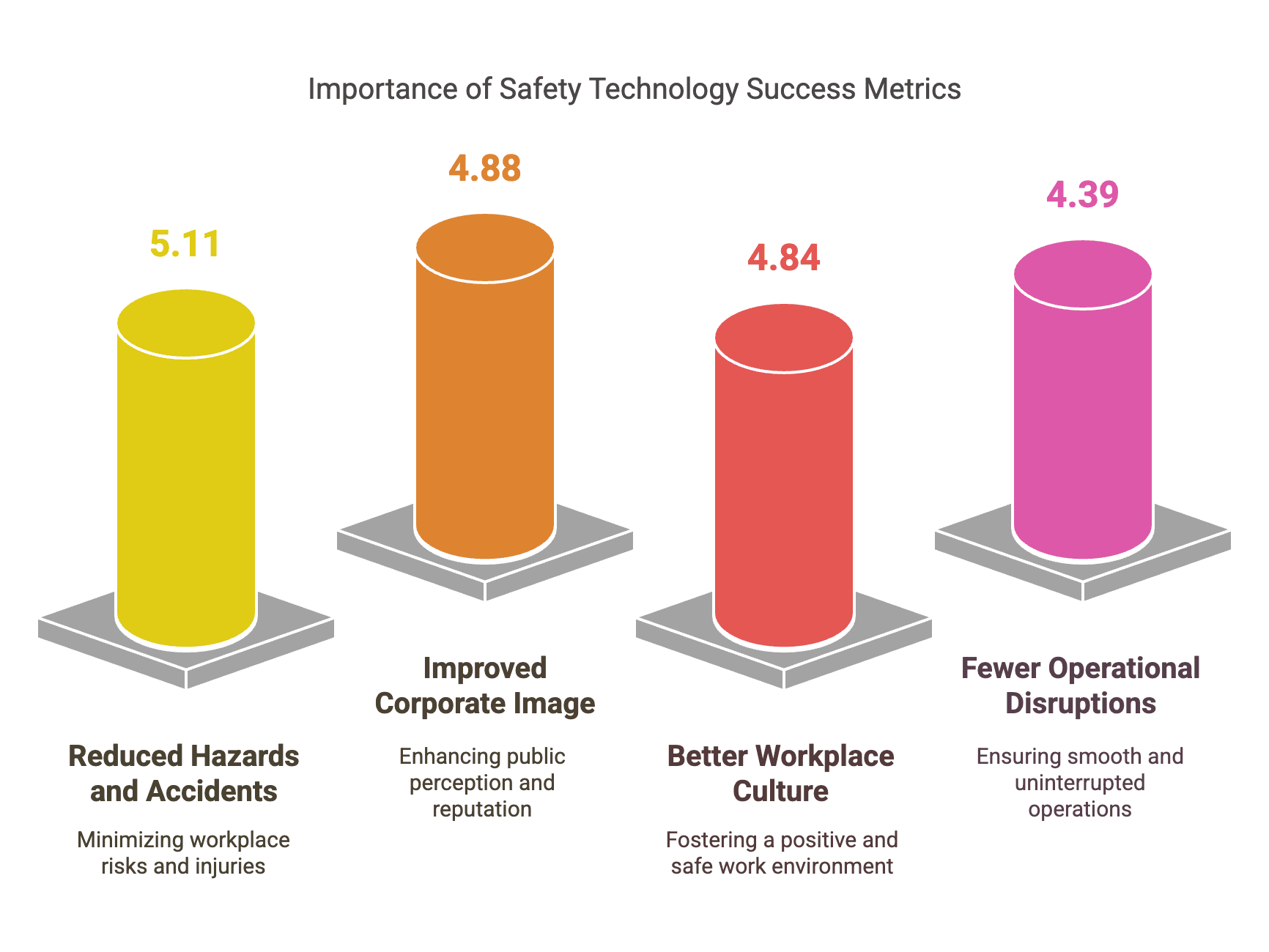
These key metrics measure how well safety technology works:
- Reduced hazards and workplace accidents (rated 5.11 out of 6 in importance)
- Improved corporate image (rated 4.88 out of 6)
- Better workplace culture (rated 4.84 out of 6)
- Fewer operational disruptions (rated 4.39 out of 6)
Companies now look beyond just reducing incidents. They track proactive indicators like hazard identification rates and controlled high-energy hazards.
Case Studies from Industry Leaders
Manufacturing companies using detailed safety technologies show impressive results. One company saved USD 506 per employee by preventing disruptions. The average total benefit reached USD 2,645 per employee yearly, with USD 561 coming from motivated employees and USD 563 from a better corporate image.
Large companies see more value in safety technology investments than smaller ones. These results show the clear financial benefits of workplace safety technology investments. About 75% of companies say extra investments either maintain or lower their long-term operational costs.
Technology Integration Strategies
Organizations that take a well-laid-out approach to preparation and integration succeed in implementing workplace safety technology. Research shows companies achieve 82% higher adoption rates with systematic implementation processes.
Assessing Organizational Readiness
Safety technology adoption follows five distinct phases in organizations:
- Observing: Passive exploration of safety technology applications
- Experimenting: Evaluating specific safety use cases
- Adopting: Investing in safety technology development
- Integrating: Actively seeking technology value maximization
- Transforming: Driving safety innovations
Companies that get a full picture before implementation face 59% fewer integration challenges. The successful adoption depends on evaluating current systems, employee’s technical proficiency, and available resources.
Employee Training and Adoption
Employee buy-in is the life-blood of successful safety technology implementation. Companies achieve the best results when they communicate openly about data usage and explain safety benefits clearly. Research shows organizations focusing on education and transparency see 82% higher employee acceptance rates.
Successful training programs combine hands-on workshops, user-friendly activities, and regular feedback sessions. Companies using phased training approaches see 40% higher participation levels.
System Integration Best Practices
Pilot programs play a crucial role in safety technology integration. Companies that run original pilot tests report 30% fewer implementation issues. The most effective approaches include:
Small-scale implementations help identify potential hurdles, ensure proper fit across worker groups, and establish dedicated support channels. Organizations achieve 71% higher success rates in long-term adoption when they maintain regular check-ins and collect continuous feedback during integration.
Future-Proofing Safety Technology Investments
Strategic planning drives long-term sustainability and growth in safety technology investments. The U.S. Government’s National Standards Strategy highlights that sustained coordination between public and private sectors is vital to future safety technology success.
Scalability Considerations
Organizations must assess their technology investments based on three main factors. The first factor relates to expanding across multiple facilities without increasing costs per worker. The second focuses on blending with existing systems, since 48% of employers say their current equipment meets their needs. The third involves customization options to address specific workplace hazards.
Emerging Technologies on the Horizon
The next wave of state-of-the-art safety solutions has:
- Smart helmets incorporating physiological and environmental sensors
- Advanced exoskeletons providing customized physical support
- AI-powered predictive analytics for up-to-the-minute hazard detection
- Extended reality systems for improved safety training
Early adopters of these emerging technologies report a 95% reduction in overhead lift high-risk postures and an 86% decrease in forklift safety incidents.
Long-term Implementation Roadmap
A detailed implementation strategy must tackle multiple dimensions at once. The roadmap focuses on boosting coordination across federal agencies, with USD 750 million allocated in 2024 for safety initiatives. Organizations should develop three key areas:
Pre-standardization research and development sustains U.S. technical leadership. Communication and information sharing between public and private sectors needs expansion, as 49% of employers worry about data privacy. Educational programs require strengthening to develop standards-ready workforce capabilities.
Long-term implementation success depends on sustained funding and involvement from government and private sector stakeholders. Organizations that maintain regular coordination with technology providers see 71% higher success rates in sustained adoption.
Takeaways
Workplace safety technology is at a vital turning point today. The data and results prove it works. Companies that use these technologies see better results – from 2.2 Return on Prevention ratio to 60% fewer workers’ compensation costs.
The next wave of workplace protection includes smart helmets, AI-powered analytics, and advanced exoskeletons. These technologies create safer environments and bring financial benefits when implemented properly. Research shows how robotics and automation prevent common workplace injuries, especially when you have repetitive strain issues like carpal tunnel syndrome. According to ConsumerShield, carpal tunnel syndrome often develops due to repetitive tasks like typing or using machinery, causing pain, numbness, and reduced dexterity. Workers’ compensation can help cover medical expenses and lost wages, with average settlements for carpal tunnel claims reaching approximately $34,987. Technologies that minimize repetitive strain could significantly reduce the prevalence of such injuries, improving worker well-being and productivity.
The success depends on three elements: a full picture of organizational readiness, detailed employee training, and long-term planning. Companies that follow well-laid-out implementation processes get 82% higher adoption rates. Regular coordination with technology providers leads to 71% better sustained adoption.
The future of workplace safety technology looks promising through 2025 and beyond. Public and private sector investments keep driving innovation forward. Companies can build safer workplaces and see substantial returns on safety investments through proper evaluation and implementation of these economical solutions.