The release of WordPress 6.9 marks a pivotal, yet volatile moment for the world’s most popular CMS, as structural shifts in the Interactivity and Abilities APIs threaten to render up to 40% of legacy plugins obsolete. With over 43% of the internet at stake, this “Collaboration Phase” update is not just an upgrade—it is a mandatory evolution that forces a choice between stability and innovation.
The evolution of WordPress has moved in waves, from a simple blogging tool to a multi-purpose engine, and now to a collaborative, AI-ready operating system. However, the arrival of WordPress 6.9 in late 2025 and its widespread adoption in early 2026 has sent shockwaves through the development community. For years, the platform maintained a “backward compatibility at all costs” mantra. But as the Gutenberg Project enters Phase 3—the Collaboration phase—the technical debt of two decades has finally come due. The “Beta” testing cycle for 6.9 revealed a harsh reality: the shift toward a native multimodal architecture and the removal of legacy asset logic means that plugins built on aging frameworks are no longer just “slower”—they are fundamentally broken.
The Great Architectural Pivot: Why Plugins are “Breaking”
The primary reason for the compatibility crisis lies in the core redesign of how WordPress handles client-side interactions. The introduction of the enhanced Interactivity API is designed to create a “seamless, app-like” experience for users, but it does so by changing the way JavaScript modules are loaded and managed. Older plugins that rely on traditional jQuery “stitching” or outdated AJAX patterns are finding their scripts ignored or blocked by the new rendering pipeline.
Furthermore, the Abilities API—the foundation for WordPress’s future AI integration—requires a standardized registry of capabilities. This is a massive shift toward “machine-readable” WordPress. Plugins that touch user permissions, such as membership tools or custom role managers, must now register their functions within this new registry. Those that don’t are effectively invisible to the system, leading to the widely reported “Admin Access” errors and “White Screen of Death” (WSOD) scenarios.
| Feature Component | Legacy WordPress (Pre-6.9) | WordPress 6.9 “Collaboration” Era |
| Asset Loading | Sequential/Blocking JS & CSS | On-demand/Streaming Block Parser |
| API Architecture | REST/Admin-AJAX | Interactivity & Abilities APIs |
| Data Binding | Static/Server-side | Dynamic/Block Bindings API |
| Editing Mode | Isolated User Sessions | Multi-user Real-time Collaboration |
| Performance Focus | Caching Plugins | Native LCP & Rendering Optimization |
Legacy Code vs. Modern Standards: The PHP 8.5 Transition
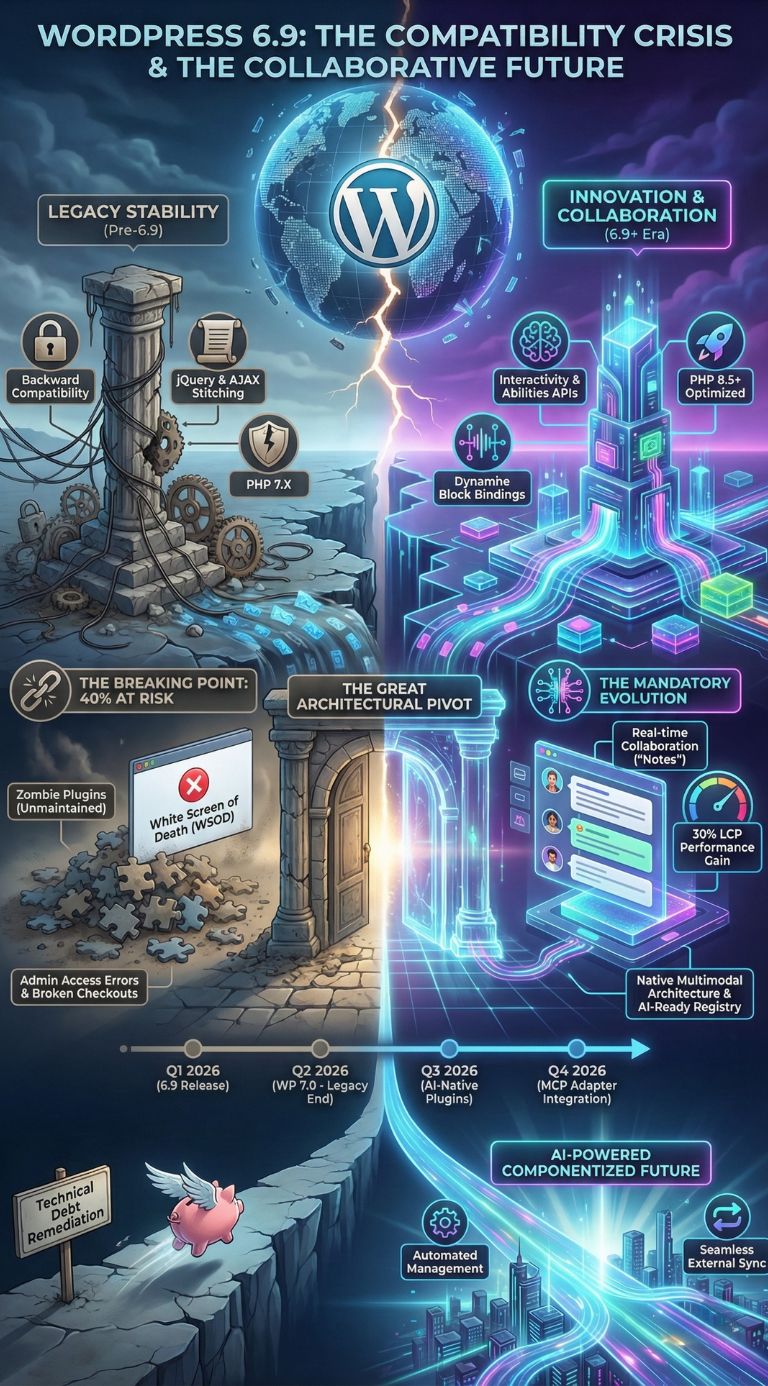
A secondary, but equally dangerous, front in the 6.9 transition is the move toward PHP 8.5 support. While WordPress 6.9 remains compatible with older versions back to PHP 7.2, its optimized core functions are built to leverage the performance gains of PHP 8.3+. Many niche plugins—often referred to as “Zombie Plugins”—have not been updated in years. These plugins often use deprecated functions that trigger fatal errors under the stricter requirements of modern PHP environments.
The statistics are sobering. Market data suggests that while the top 1,000 plugins (like Yoast, WooCommerce, and Elementor) have the resources to patch issues within hours, the remaining 60,000+ plugins in the directory often lag behind. If 40% of plugins are indeed at risk, it is because they fall into this “unmaintained” category, yet they still power millions of critical business functions, from simple contact forms to complex database queries.
Phase 3: The Collaboration Era and Technical Debt
WordPress 6.9 is the flagship release for Gutenberg Phase 3, focusing on “Notes” and real-time collaboration. This feature allows teams to leave threaded comments directly on blocks, much like Google Docs. While a boon for agencies, it adds a massive layer of complexity to the database schema.
Plugins that customize the Block Editor (Gutenberg) now have to account for these “Notes” overlays. If a plugin modifies a block’s DOM structure without supporting the new HTML API standards, the collaboration tools fail, or worse, the block becomes uneditable. This has led to a “Winners vs. Losers” scenario in the plugin marketplace, where the speed of adaptation defines a developer’s survival.
| Update Winners | Update Losers |
| Block-Native Plugins: Tools built using the Interactivity API since 2024. | jQuery-Dependent Tools: Older plugins relying on legacy script loading. |
| Enterprise Agencies: Teams with staging environments and CI/CD pipelines. | “Set it and Forget it” SMBs: Small sites with automatic updates enabled. |
| Modern Hosting Providers: Hosts offering PHP 8.5 and edge caching. | Budget Shared Hosting: Servers with high latency and outdated PHP. |
| Collaboration Teams: Content departments using “Notes” for faster workflows. | Solo Bloggers: Users overwhelmed by the sudden UI complexity. |
Economic Fallout: The Risk to eCommerce and SMBs
The impact of WordPress 6.9 is felt most acutely in the WooCommerce ecosystem. As of early 2026, over 120 million websites are powered by WooCommerce. The update to 6.9 coincided with emergency patches for payment gateways that failed to load due to the new script-loading logic. For a small business, a “broken checkout” for even four hours can result in a significant loss of annual revenue and customer trust.
Businesses are now being forced to shift budgets from “Marketing” to “Technical Debt Remediation.” Market indicators suggest a 25% increase in demand for WordPress maintenance services in Q1 2026, as site owners scramble to replace broken plugins with modern, block-compatible alternatives.
Expert Perspectives: Neutralizing the “Breaking” Narrative
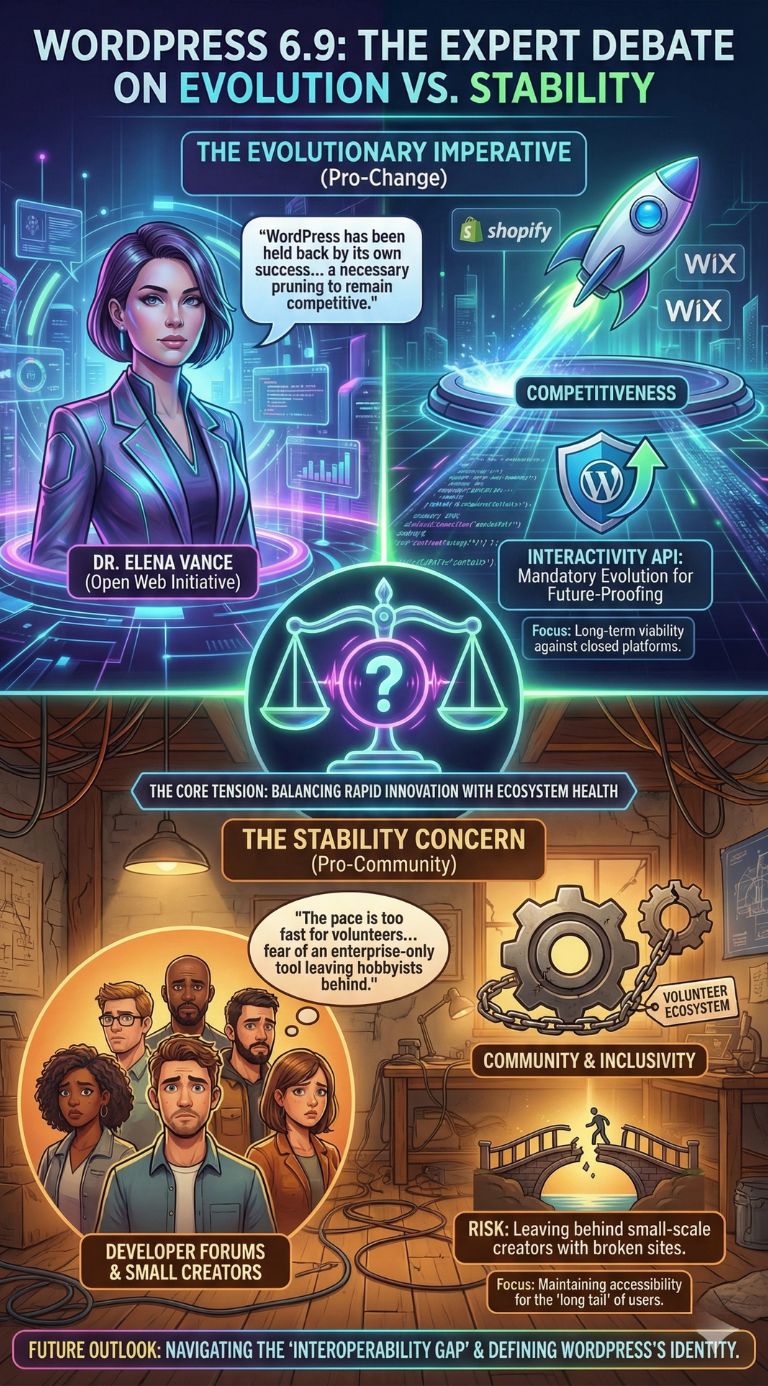
While the headline “40% of Plugins Might Break” sounds catastrophic, some analysts view it as a necessary pruning of the ecosystem. Dr. Elena Vance of the Open Web Initiative argues that “WordPress has been held back by its own success. By forcing a transition to the Interactivity API, the core team is finally ensuring that WordPress remains competitive against closed platforms like Shopify and Wix.”
The counter-argument, often voiced in developer forums, is that the pace of change is too fast for the “volunteer” nature of the plugin repository. There is a fear that the “Collaboration” phase is turning WordPress into an enterprise-only tool, leaving behind the hobbyist and small-scale creator who cannot afford a developer to fix a broken site every six months.
Future Outlook: What Happens Next?
As we move further into 2026, the “Interoperability Gap” will likely widen before it closes. We are entering an era of “Componentized WordPress,” where the platform behaves more like a library of APIs than a monolithic software package.
Upcoming Milestones to Watch:
-
Q2 2026: The release of WordPress 7.0, which is expected to remove the last vestiges of legacy asset logic, officially ending support for plugins that haven’t migrated to the Interactivity API.
-
Q3 2026: AI-Native plugins leveraging the Abilities API will begin to automate site management, potentially fixing some compatibility issues automatically through code-refactoring agents.
-
Q4 2026: The full integration of the MCP (Model Context Protocol) Adapter, allowing WordPress sites to sync seamlessly with external AI models for real-time content and design adjustments.
Data & Statistics Summary
-
Market Dominance: WordPress still powers 43% of all websites globally as of January 2026.
-
Plugin Density: The average business site uses 22 plugins; if 40% break, that is 8-9 critical functions failing per site.
-
Performance Gain: Sites that successfully transition to the 6.9 architecture see an average 30% improvement in LCP (Largest Contentful Paint).
-
PHP Adoption: Only 15% of the WordPress ecosystem is currently on PHP 8.5, indicating a massive “Update Lag” that creates security vulnerabilities.
Final Thoughts
The “Compatibility Crisis” of WordPress 6.9 is a growing pain for an internet that has become overly reliant on a single platform. While the threat of broken plugins is real, it also represents a massive opportunity to modernize the web. For site owners, the “End of Typing” for search or the “End of Plugins” for basic features is near—the core is becoming more powerful, reducing the need for the “Plugin Bloat” of the past decade. As we look toward WordPress 7.0, the question is no longer “Will my plugin break?” but “Do I even need this plugin anymore?”