Renewable energy is widely seen as a crucial tool in the fight against climate change, but will renewable energy stop global warming?
As the world grapples with rising temperatures and extreme weather events, the transition to clean energy sources like solar, wind, and hydropower offers hope for reducing greenhouse gas emissions and mitigating the impacts of climate change.
However, the relationship between renewable energy adoption and global temperature trends is complex, requiring a nuanced understanding of both the potential and limitations of clean power.
The Promise of Renewable Energy in Combating Climate Change
Renewable energy sources have emerged as a beacon of hope in addressing the climate crisis. Unlike fossil fuels, renewables produce little to no greenhouse gas emissions during operation, making them a cleaner alternative for power generation. The International Renewable Energy Agency (IRENA) estimates that doubling the global share of renewable energy in the energy mix could reduce greenhouse gas emissions by up to 70% by 2050.
The potential impact of renewable energy on climate change mitigation is significant:
- Solar and wind power can reduce CO2 emissions when replacing fossil fuel-based energy systems
- Renewable energy systems generally have a smaller carbon footprint over their entire lifecycle compared to fossil fuels
- Widespread adoption of renewable energy technologies could cut U.S. power sector emissions by 80% by 2050
Current State of Renewable Energy Adoption
The transition to renewable energy sources has gained momentum in recent years:
- In 2022, renewable energy sources made up 28.1% of global electricity production.
- Global renewable energy capacity increased by 507 GW in 2023, almost 50% higher than in 2022.
- Solar PV alone accounted for three-quarters of renewable capacity additions worldwide in 2023.
This growth in renewable energy adoption is driven by several factors:
- Declining costs of renewable technologies, especially solar and wind
- Supportive government policies and incentives
- Increasing public awareness and demand for clean energy solutions
The Impact of Renewable Energy on Greenhouse Gas Emissions
While renewable energy adoption is increasing, its impact on global greenhouse gas emissions is still evolving:
- In 2022, renewable energy supply from solar, wind, hydro, geothermal, and ocean sources rose by close to 8%.
- This increase allowed non-bioenergy renewables to achieve their second-highest share growth in history.
- However, the overall impact on global emissions remains limited due to continued fossil fuel use in other sectors
To better understand the potential impact of renewable energy on emissions, consider the following data:
| Country | CO2 Emissions Reduction per 1% Increase in Renewable Energy Consumption |
| China | 341 million tons |
| India | 76 million tons |
| South Africa | 10 million tons |
| United States | 131 million tons |
| Germany | 14 million tons |
| Italy | 10 million tons |
| United Kingdom | 21 million tons |
| Mexico | 25.99 million tons |
| Japan | 40.16 million tons |
This data demonstrates that increased renewable energy consumption can lead to significant reductions in CO2 emissions across various countries.
Challenges in Relying Solely on Renewable Energy to Stop Global Warming
While renewable energy plays a crucial role in mitigating climate change, several challenges prevent it from being a standalone solution to global warming:
Intermittency and Storage Issues
Renewable energy sources like solar and wind are variable, depending on weather conditions and time of day. This intermittency poses challenges for grid stability and reliability. Energy storage technologies are improving but still need further development to fully address this issue.
Infrastructure and Grid Adaptation
Transitioning to a renewable energy-dominated grid requires significant infrastructure upgrades and adaptations. This includes:
- Long-distance transmission lines to connect renewable energy sources to population centers
- Smart grid technologies to manage variable energy inputs
- Distributed energy systems to enhance grid resilience
Economic and Political Barriers
Despite falling costs, renewable energy still faces economic and political challenges:
- Existing investments in fossil fuel infrastructure
- Lobbying efforts by traditional energy industries
- Varying levels of government support and policy consistency across regions
Sector-Specific Challenges
While renewable electricity generation is progressing, other sectors like transportation, industry, and heating still heavily rely on fossil fuels. Electrification of these sectors is necessary but presents additional challenges.
The Broader Picture: Renewable Energy as Part of a Comprehensive Climate Strategy
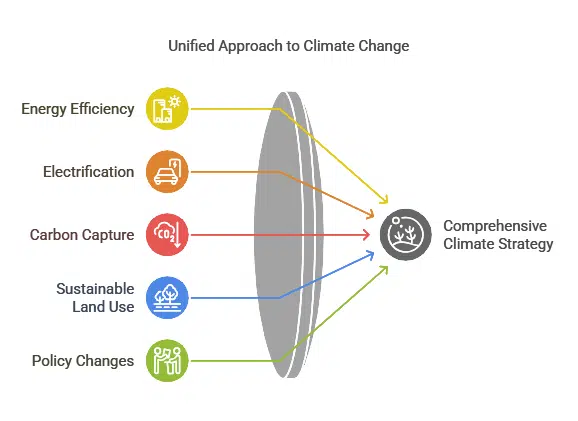
To effectively address global warming, renewable energy must be part of a more comprehensive climate strategy that includes:
- Energy Efficiency: Reducing overall energy demand through improved efficiency in buildings, industry, and transportation.
- Electrification: Transitioning more sectors to electricity-based systems powered by renewable sources.
- Carbon Capture and Storage: Developing technologies to remove CO2 from the atmosphere or capture it at emission sources.
- Sustainable Land Use: Implementing practices that enhance natural carbon sinks like forests and soils.
- Policy and Behavioral Changes: Enacting regulations and encouraging lifestyle changes that support low-carbon choices.
Future Projections and Milestones
The International Energy Agency (IEA) projects several key milestones for renewable energy in the coming years:
- 2024: Solar PV and wind generation together surpass hydropower generation
- 2025: Renewables-based electricity generation overtakes coal-fired
- 2026: Wind and solar power generation both surpasses nuclear
- 2027: Solar PV electricity generation surpasses wind
- 2029: Solar PV electricity generation surpasses hydropower and becomes largest renewable power source
- 2030: Wind-based generation surpasses hydropower
By 2030, renewable energy sources are expected to account for 46% of global electricity generation, with wind and solar PV together making up 30%.
The Role of Renewable Energy in the Fight Against Global Warming
While renewable energy alone cannot stop global warming, it is a critical component in the fight against climate change. The rapid growth of renewable energy capacity, particularly in solar and wind power, offers significant potential for reducing greenhouse gas emissions and mitigating the impacts of global warming.
However, to truly address the climate crisis, a multi-faceted approach is necessary. This includes:
- Continued investment in renewable energy technologies and infrastructure
- Development of energy storage solutions to address intermittency issues
- Implementation of comprehensive climate policies that support the transition to clean energy
- Addressing emissions in hard-to-decarbonize sectors like industry and transportation
- Promoting energy efficiency and conservation measures
As we move forward, the role of renewable energy in combating climate change will likely grow even more significant. While it may not single-handedly stop global warming, renewable energy remains one of our most powerful tools in creating a sustainable, low-carbon future.
Takeaways
while renewable energy alone cannot stop global warming, it is a critical component in the fight against climate change. The rapid growth of renewable energy capacity, particularly in solar and wind power, offers significant potential for reducing greenhouse gas emissions and mitigating the impacts of global warming.
However, to truly address the question “will renewable energy stop global warming?” A multi-faceted approach is necessary, combining renewable energy adoption with other strategies to create a sustainable, low-carbon future.