In many European homes, the real holiday “click” happens on December 24. Families gather earlier, streets feel more alive after dark, and the most meaningful meal often lands before midnight. Christmas Eve traditions in Europe turn the 24th into the emotional center, while the 25th becomes slower, softer, and built for leftovers and long visits.
This isn’t just about one night being more fun. It’s about how Europeans learned to celebrate the end of waiting, the arrival of light in winter, and the comfort of doing the most important things together.
The 24th Wins Because It Has a Built-In Story Arc
December 24 carries both preparation and payoff, which makes it memorable. People spend the day traveling, cooking, decorating, and finishing errands. Then the evening becomes a clear “beginning,” marked by candles, a first toast, a first bite, or a shared quiet moment.
That arc feels satisfying because it creates a before and after. When the meal begins, the waiting ends. Christmas Day often becomes the calm follow-through, not the night you have to “make magical.”
If you want a quick way to understand any household, ask this: what moment counts as “the start”? In many places, the answer lives on the 24th.
The Hidden Drivers Behind the 24th
Three forces quietly shaped the European calendar: the culture of waiting, the pull of midnight, and the mood of winter darkness. Even families who do not practice religion still live inside the structure that those forces created.
The result is a holiday that often peaks at night. Lights look better, people feel cozier, and the whole world seems to slow down in the evening. The 24th offers the perfect stage.
Waiting Is Part of the Tradition
In many European cultures, the holiday is not only Christmas itself. It is the build-up, the anticipation, and the feeling of “almost there.” That build-up makes the first real celebration moment feel bigger.
When a family treats the day as preparation, the evening becomes a reward. You taste it in how carefully people set the table and how they protect the mood. The night feels earned.
Midnight Creates a Natural Threshold
Midnight acts like a finish line and a doorway at the same time. Families gather before it, share rituals, and then watch the calendar flip together. That shared transition makes the holiday feel communal.
Even when gifts happen earlier or later, midnight still adds weight. It’s why many Christmas Eve dinners feel slightly more ceremonial than a normal family meal.
Winter Darkness Makes Light the Main Symbol
December evenings are long across Europe. When darkness arrives early, people lean into light as comfort and meaning. Markets glow, churches glow, windows glow, and tables glow.
That’s why so many traditions focus on candles and warm indoor scenes. The season practically begs for an evening centerpiece.
A Quick Orientation Map of Europe’s Christmas Timing
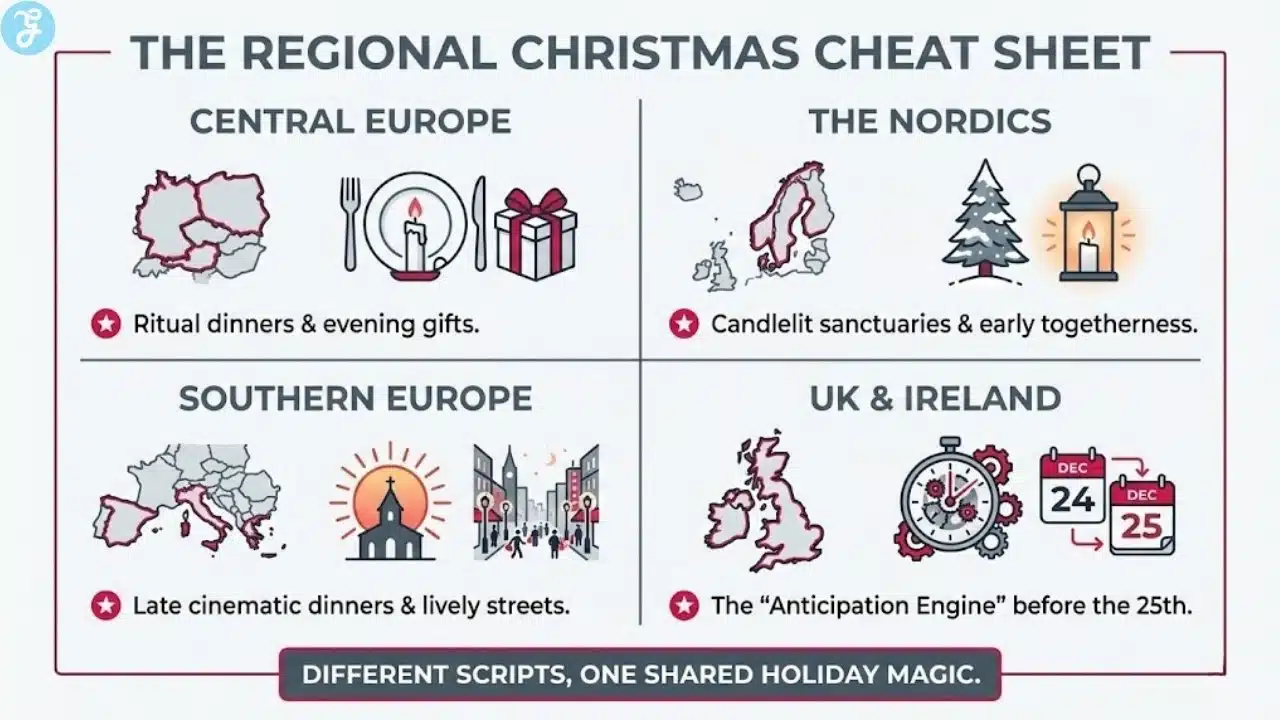
Europe isn’t one script. It’s a set of patterns that repeat with local accents. Use this table as a cheat sheet, not a strict rulebook.
| Region | December 24 Often Centers On | December 25 Often Centers On |
|---|---|---|
| Central Europe | Ritual dinner, symbolic moments, gifts in many homes | Quiet visits, walks, second meals |
| Nordics | Cozy evening, candles, often gifts | Calm family day, slow routines |
| Southern Europe | Late dinners, strong atmosphere, church for some | Big lunches, extended family time |
| UK & Ireland | Prep night, anticipation, church for some | Main meal and many gift moments |
The key question is simple: which day holds the main family ritual? That is usually the day people remember most.
How Christmas Eve traditions in Europe Became the Main Event
Christmas Eve took the lead because it solved two problems at once. It created a meaningful “start” after weeks of waiting, and it gathered family into one shared moment before schedules scattered them again.
Over time, households built repeatable rituals around the night: a specific dinner, a candle moment, a church service, a gift exchange, or a walk through decorated streets. Once children grow up expecting that rhythm, the culture locks it in.
You can modernize the menu, skip church, or blend traditions across backgrounds, and the 24th can still stay central. The timing itself carries meaning.
Central Europe: When Dinner Feels Like a Ceremony
In many Central European homes, Christmas Eve dinner is not casual. Families often treat it as the holiday’s most intentional event. The table can carry symbols, the start time can matter, and the pacing can feel slower than usual.
The mood tends to be home-focused and story-friendly. People talk about family history, old holidays, and dishes tied to memory. The 25th then becomes gentler because the big ritual already happened.
Poland: The First-Star Feeling and a Table With Meaning
Polish Christmas Eve is often built around anticipation. Many families wait for the first star before beginning dinner, which turns the start into a shared countdown. That small detail can make the meal feel like a doorway you walk through together.
Wigilia dinners frequently include multiple meatless dishes, and many families keep symbolic touches like an extra place setting for an unexpected guest. People may share a thin wafer and exchange wishes, which sets an emotional tone before anyone eats.
The structure is the secret. The evening feels like a complete holiday on its own, not just the night before the “real” day.
Czechia and Slovakia: Icon Foods and Gifts That Arrive Early
In Czech and Slovak traditions, the evening often carries the main family energy. Households frequently anchor dinner with specific holiday foods, and many families exchange gifts on the 24th. Gift timing alone can move the emotional peak to the night.
These countries also highlight a common European pattern: keep the home as the stage. Families build cozy routines around familiar films, desserts, and unhurried time together.
The result is a 24th that feels finished and satisfying. Christmas Day becomes calm because the magic already landed.
Hungary and Nearby Traditions: The Home Transformation Effect
In some households, the 24th is when the home visibly transforms. Families might decorate the tree that day, light candles, and treat dinner as the moment the house becomes “Christmas.” That creates a powerful before and after, even without rigid rules.
Some families attend church; others keep the night fully home-centered. Either way, the evening often carries a sense of respect and tenderness.
This is where you see the deeper logic: the 24th matters because it concentrates family attention into one protected window.
German-Speaking Europe: Public Glow, Private Ritual
Germany, Austria, and Switzerland often combine public holiday atmosphere with private family ritual. Markets, lights, and seasonal stalls bring people out into the evening. Then families return home and switch into a quieter, more intimate mode.
That contrast makes Christmas Eve feel complete. You get the communal glow outside, then the emotional center inside.
Germany: Heiligabend and the Power of Earlier Gifts
Many German families treat the 24th as the key family evening, often including gift exchanges that happen on Christmas Eve. When gifts arrive at night, children don’t go to bed “waiting for tomorrow.” The big moment already happened.
Dinner style can vary widely, from simple, familiar dishes to more elaborate meals. The important part is not culinary complexity. It’s the ritual pacing and the protected family time.
Heiligabend often feels balanced: warm, structured, and designed to keep the evening peaceful.
Austria: Similar Timing, Distinct Seasonal Flavor
Austria shares many patterns with Germany but often emphasizes regional sweets and holiday foods that feel uniquely local. Many families gather on the 24th, enjoy a special meal, exchange gifts, and attend church if that’s part of their practice.
In many towns, the 24th night can feel surprisingly quiet outside. The holiday moves indoors, which reinforces the idea that the night belongs to family.
Austria shows how a shared European structure can still feel culturally specific through food and pacing.
Switzerland: A Mosaic That Still Leans Toward the Evening
Switzerland varies by language region and household tradition. Still, many families treat Christmas Eve as a significant gathering night, whether gifts happen on the 24th or the 25th.
Shared-table meals are common in some households because they encourage slow conversation. That format fits the Christmas Eve mood: less rushing, more presence.
Switzerland’s version often feels calm and restrained, which makes the evening feel intimate rather than loud.
The Nordics: Candlelight, Cozy Rules, and Early Togetherness
Nordic Christmas often leans into warmth and ritual because winter demands it. Darkness arrives early, and the home becomes a sanctuary. Many families treat the 24th as the main celebration because it fits the season’s emotional needs.
You’ll notice a strong preference for protected family time. People dress nicely, set the table carefully, and keep the evening home-centered.
Sweden: The 24th as the Centerpiece for Many Families
In Sweden, many families treat Christmas Eve as the main celebration day. The evening often includes a festive meal and gift exchanges, and households tend to follow familiar rhythms year after year.
Consistency is part of the comfort. When a culture repeats a ritual, it becomes a shared language. The 24th holds that language in Sweden.
Christmas Day then feels quieter, built for rest and low-pressure togetherness.
Norway and Denmark: Formal-Cozy Dinners and Candle Rituals
Norway and Denmark often combine a respectful tone with a relaxed vibe. Families gather, light candles, and treat dinner as a special event without making it feel stiff.
The evening tends to stay close to home. That home focus helps the 24th feel like the true heart of the holiday.
The 25th becomes a slow continuation, not an attempt to top the night before.
Finland: Reflection Adds Depth to the Evening
Finland often brings a reflective layer to the season. Some families include candle visits to honor loved ones, which can make the evening feel both tender and grounded.
At home, families lean into warmth, calm meals, and time together. The night can feel less about spectacle and more about meaning.
Finland is a reminder that the 24th matters not only because it’s exciting. It matters because it holds emotion in a quiet way.
Southern Europe: Late Dinners, Strong Atmosphere, and Long Family Time
Southern Europe often celebrates later into the night. Streets can feel lively, meals can run long, and church services can shape timing for families who attend. Christmas Eve can feel like the most cinematic night because the public atmosphere peaks after dark.
At the same time, Christmas Day often becomes a major lunch day in many places. That means the season spreads its weight across both dates, but the 24th still carries a unique mood.
Italy: La Vigilia and the Night That Feels Like a Movie
Many Italian households treat Christmas Eve as a distinct event with its own food identity. In some traditions, families favor fish or seafood on the 24th, then shift to richer meat dishes on the 25th.
Late timing matters. When dinner runs later and the streets glow, the evening feels like the real holiday moment. Even families who skip church often keep the night rhythm.
Italy also varies by region, which is part of the charm. The structure stays recognizable even when the menu changes.
Spain: A Long Dinner Night Inside a Longer Season
Spain often makes Christmas Eve a major family dinner night that can stretch late. The 24th feels emotionally significant because it gathers family in a warm, social setting while the city lights and public décor peak outside.
In many places, the broader season includes multiple important celebration days. That spreads pressure out and lets Christmas Eve focus on togetherness.
The result is a 24th that feels big, even when Christmas Day remains important too.
Portugal: Home-Centered Warmth and Seasonal Food Identity
Portugal often emphasizes a meaningful family meal that makes the house feel like the holiday’s center. Many households treat the 24th as an intimate gathering night, then expand celebrations on the 25th.
Seasonal foods and sweets often carry strong tradition signals. Even modern households keep key dishes because they feel like cultural anchors.
Portugal’s Christmas Eve energy is often calm, warm, and designed for conversation.
France: Réveillon Culture and the Art of the Late Meal
France is known for long holiday meals, and many families embrace a late celebration that can make the 24th feel like the main event. Multi-course dinners and special desserts can turn the night into a true occasion.
Even in simpler households, the idea of eating late and treating the meal as an experience gives the evening weight. When the meal takes time, the night becomes the memory.
France shows how timing alone can elevate the 24th. A late celebration naturally makes Christmas Eve feel bigger.
UK and Ireland: Christmas Day Often Leads, But the 24th Builds the Spell
In the UK and Ireland, many households place the biggest meal and major gift moments on Christmas Day. Still, Christmas Eve plays an important role as the anticipation engine.
The 24th often includes travel, last wrapping, final cooking prep, and church for those who attend. It’s the night the house becomes “Christmas-ready,” and that readiness is a ritual of its own.
Even when the 25th is the headline, the 24th still matters because it carries the transition from normal life into holiday life.
What Actually Happens on December 24, Step by Step
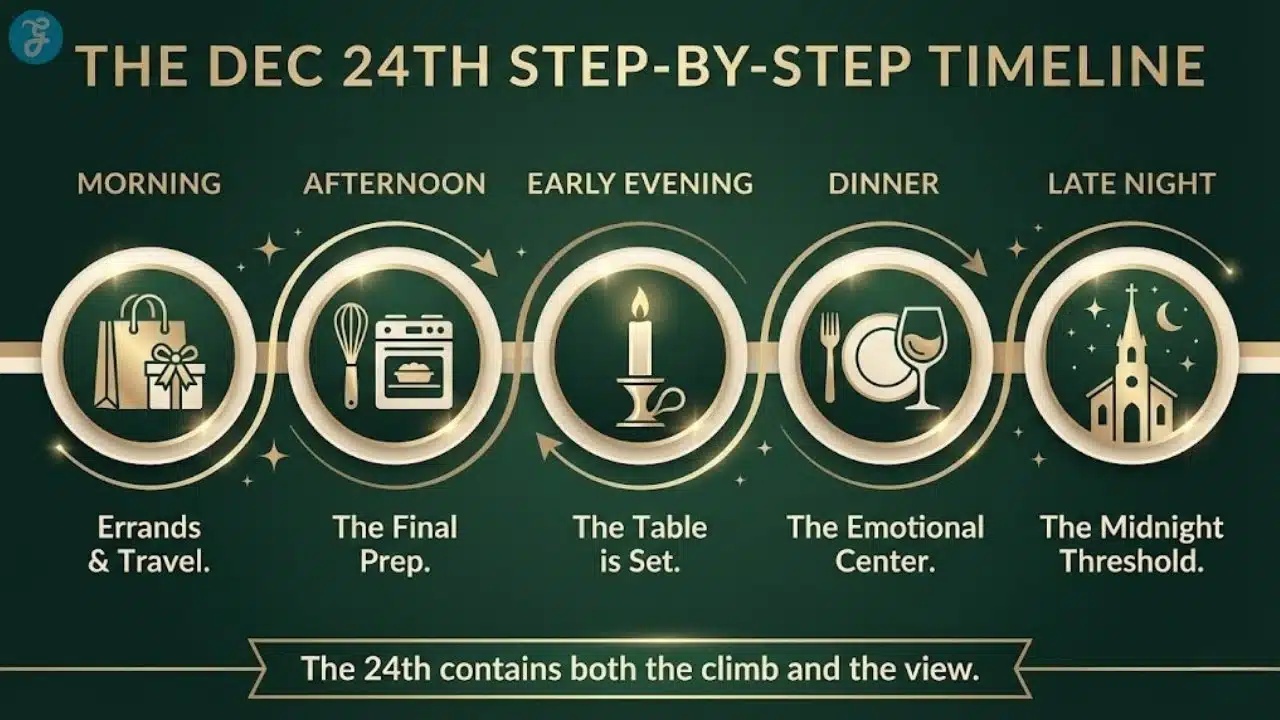
If you want to picture the 24th in practical terms, think of it as a sequence. The exact details vary, but the shape repeats across Europe.
| Time Window | What People Often Do | Why It Matters |
|---|---|---|
| Morning | Errands, travel, early prep | Clears stress before evening |
| Afternoon | Cooking, baking, decorating, markets | Builds anticipation |
| Early evening | Family gathers, table is set, candles appear | Signals “we’re here now” |
| Dinner | Ritual meal, toasts, symbolic moments | Main emotional center |
| After dinner | Desserts, gifts, music, church in some places | Extends warmth |
| Late night | Midnight service or slow wind-down | Shared threshold into the 25th |
This structure is why the 24th feels like a complete holiday in itself. It contains both the climb and the view.
Food Signals: The Dishes That Say “Now It’s Christmas”
Food is the loudest cultural marker because it returns every year and carries memory. Many traditions use contrast to create meaning: simpler or meatless Christmas Eve meals, then richer Christmas Day feasts.
Here’s a useful way to think about recurring patterns without turning it into a recipe encyclopedia.
| Christmas Eve Pattern | What It Communicates | Common Where |
|---|---|---|
| Fish or meatless emphasis | Preparation, tradition, restraint | Parts of Central Europe, Italy, Portugal |
| Icon dish that appears yearly | Identity and continuity | Poland, Czechia, Slovakia, Germany |
| Late multi-course meal | Celebration as an event | France, parts of Spain and Italy |
| Simple dinner + strong rituals | Ritual over menu complexity | Many German-speaking and Nordic homes |
Even when families modernize, they usually keep one “signal dish.” That dish acts like a seasonal password: one taste and the holiday arrives.
Gift Timing: The Fastest Way to Predict Which Day Feels Bigger
Gift timing changes the emotional calendar more than almost anything else. When gifts happen on the evening of the 24th, the night becomes the climax. When gifts happen on the morning of the 25th, Christmas Eve becomes suspenseful.
Here’s the simple psychological difference: gifts on the 24th compress excitement into one evening. Gifts on the 25th stretch excitement across two days.
| Gift Moment | How the 24th Feels | How the 25th Feels |
|---|---|---|
| Gifts on Dec 24 evening | Peak celebration night | Calmer, restful day |
| Gifts on Dec 25 morning | Anticipation and build-up | Main “big moment” day |
| Mixed (some on 24th, some later) | Warm evening plus extended season | Multiple peaks, less pressure |
This is why the same country can feel different by household. One change in gift timing can reshape the entire mood.
If You’re Visiting Europe for Christmas Eve, Do This
You don’t need perfect cultural knowledge. You need good timing, respect for the evening, and a willingness to follow the household’s pace.
Quick etiquette that almost always lands well
-
Arrive on time, or a little early if invited for dinner
-
Dress slightly nicer than usual unless the host says casual
-
Bring a small host gift (sweets, flowers, wine, seasonal treats)
-
Let the host lead rituals (toasts, candles, prayers, start times)
-
Keep conversation light and warm, especially during the meal
Topics that usually stay safe
-
Food memories and seasonal dishes
-
Local holiday markets and decorations
-
Family traditions and how they started
-
Comfort films, music, and winter rituals
-
Travel stories that are funny, not braggy
Topics that often blow up the mood
-
Political arguments and culture-war headlines
-
Personal life interrogation (money, weight, relationships)
-
Old family conflicts dressed up as “jokes”
-
Competitive gift comparisons
If you’re invited to a Christmas Eve dinner, treat it as meaningful. In many households, it’s the most intimate holiday invitation of the whole season.
Why the 24th Keeps Winning, Even as Europe Modernizes
Modern life changes how people cook, travel, and gather. Still, the 24th remains strong because it solves emotional needs that don’t change. People want a moment that marks the end of waiting and the start of warmth.
The 24th also stays practical. Families can gather for the main ritual, then use the 25th for slower visits, travel, and rest. That balance keeps the season full without making it exhausting.
Most importantly, the 24th holds the strongest atmosphere. Darkness, lights, and candlelit rooms make the evening feel like the holiday’s natural stage.
The Night Europe Makes Christmas
The easiest way to understand the continent is to stop asking which day is “more correct” and start asking which day holds the main ritual. Some places peak on the 25th, but in many homes the emotional center lives on the 24th because it contains the threshold moment.
That is why Christmas Eve traditions in Europe feel so powerful. They turn one winter evening into a shared signal: we’re together, the waiting is over, and the light is here.
When you see the holiday as a story arc, the calendar makes sense. The 24th is the climax in many cultures, and the 25th is the calm ending you get to enjoy without rushing.
FAQs on Christmas Eve Traditions in Europe
Why do so many Europeans treat Christmas Eve as more important than Christmas Day?
Many cultures built the holiday around preparation and a clear “start” moment, often tied to evening rituals and late-night services. The 24th contains both the buildup and the payoff, which makes it feel like the emotional center. The 25th often becomes calmer because the main ritual already happened.
Do all European countries celebrate mainly on December 24?
No. In the UK and Ireland, Christmas Day often holds the biggest meal and the main gift-opening. In many Central European and Nordic households, Christmas Eve is the key family gathering and often the gift night.
Why is fish common on Christmas Eve in some places?
Some traditions treat Christmas Eve as a preparation day with simpler or meatless meals, followed by richer foods on Christmas Day. Families may keep the pattern for cultural reasons even if they don’t follow religious rules strictly. Fish also became a familiar seasonal choice in many coastal and Catholic-influenced regions.
When do Europeans open gifts, on the 24th or the 25th?
It depends on the country and the household. Many families in parts of Central Europe and the Nordics exchange gifts on Christmas Eve, while others wait for Christmas morning. Some households split gifts across multiple days to spread the season out.
Is Christmas Day quieter in countries where Christmas Eve is the main event?
Often, yes. When the biggest ritual happens on the 24th, the 25th becomes a relaxed day for visits, walks, and leftovers. Families still celebrate, but they do it with less pressure and more open time.
Are there European communities that celebrate Christmas on different dates?
Yes. Some Orthodox Christian communities celebrate Christmas in January due to different calendar traditions. Within Europe, dates and practices can vary by faith, region, and family background.