Gen Z’s buying decisions are no longer shaped by traditional advertising, linear search behavior, or celebrity endorsements. Instead, they unfold inside a complex digital ecosystem where two forces dominate the path to purchase: influencers and algorithms. As TikTok, Instagram, and YouTube reinvent how young consumers discover, evaluate, and shop for products, the line between organic influence and algorithmic persuasion becomes increasingly blurred.
In today’s attention economy, the question is no longer whether Gen Z trusts influencers or relies on algorithm-driven recommendations—it’s how these two forces interact to shape desire, identity, and purchasing behavior in real time. From micro-creators driving niche trends to AI engines determining what surfaces in the feed, buying decisions for this generation emerge through a blend of human storytelling and machine-curated discovery.
But the truth is, the real power structure behind Gen Z consumer behavior—and the debate between influencers vs algorithms is more intertwined than anyone wants to admit.
Gen Z, the Algorithm-Native Consumer
There is a reason the debate over who shapes Gen Z buying decisions has become so sharp. This is the first cohort to grow up with smartphones, social feeds, and algorithmic recommendations as the default way to navigate the world, not as an add-on.
For Gen Z, there is rarely a blank page. There is always a “For You” page.
Surveys show this generation increasingly skips traditional search and goes straight to TikTok or Instagram when they want to discover products, restaurants, or places. One recent analysis found that almost 40% of 18–24-year-olds in some markets now turn to TikTok or Instagram instead of Google Maps or Search when looking for a place to eat, with Instagram and TikTok also leading for product discovery.
Gurkha Technology
At the same time, Gen Z’s economic influence is no longer hypothetical. Estimates suggest they already command hundreds of billions of dollars in spending power in the US alone, with a global impact projected in the trillions by 2030.
From Search Boxes to Infinite Feeds
Older consumers still think in terms of typing queries into a search engine and scanning lists of links. Gen Z’s habits are different. They scroll visual feeds tuned by algorithms that learn from every like, pause, and swipe.
Research on TikTok’s recommendation algorithm shows how signals such as watch time, like ratios, comments, save, and trending audio shape what appears next.
The more a user engages with a type of content—beauty tips, tech gadgets, “affordable hauls”—the more intensively the system serves it back, reinforcing preferences and pushing discovery.
When 43% of Gen Z say they prefer to browse products on TikTok instead of traditional search engines, that is not just a quirky statistic. It is a sign that the store window has moved inside the feed.
A Trillion-dollar Demographic Raised on Recommendations
This generation’s consumer behavior is therefore shaped by two intertwined forces:
- Influencers and creators who provide the human face, the narrative, and the perceived authenticity.
- Algorithms, which decide which faces and stories get seen in the first place.
Studies repeatedly find that social content heavily shapes Gen Z shopping habits. One recent report notes that Gen Z’s purchasing decisions are deeply rooted in social media content, peer recommendations, and interactive experiences.
So the question “Who is shaping Gen Z’s buying decisions—influencers or algorithms?” is really a question about which of these forces has more leverage in this new attention economy.
The Case for Influencers: People Still Sell to People
For all the power of recommendation engines, commerce is still ultimately relational. People still buy from people, or at least from people they feel they know.
Trust, Relatability, and The New Word-of-mouth
A recurring pattern in the research is simple: Gen Z trusts influencers. In one widely cited study, 68% of Gen Z consumers said they trust influencers more than traditional celebrities.
Another survey found that 58% of Gen Z had made a purchase based on a recommendation from a social media influencer or creator.
Academic work supports this, linking influencers to:
- Higher brand awareness
- Stronger purchase intentions
- More favorable brand attitudes across categories, from fashion to tourism.
Influencers function as scaled-up word-of-mouth. They compress product discovery, social proof and storytelling into a single, shareable post.
For Gen Z, the influencer is often:
- Close in age
- Sharing similar frustrations and aspirations
- Speaking in informal, unpolished language
- Demonstrating products in real-world settings
That relatability feeds the sense that recommendations are “from someone like me”, not from a faceless brand.
Micro- and Niche Creators as Conversion Engines
A significant nuance is who counts as an influencer. The numbers tell us that micro-influencers (smaller accounts with tightly defined audiences) can be more persuasive than big names.
One 2025 data set indicates Gen Z is over three times more likely to trust a product recommendation from a micro-influencer than from a traditional celebrity (69% vs 22%).
This aligns with campaign experience: niche creators often deliver higher engagement and better conversion because they speak to specific subcultures—K-beauty enthusiasts, sustainable fashion fans, productivity-obsessed students—rather than broadcasting generic lifestyle content.
In other words, credibility scales down even as message reach scales up through the feed.
AI and Virtual Influencers Blur the Line Further
The picture becomes more complex with the rise of AI influencers. Synthetic personas like Lil Miquela collaborate with global brands and attract millions of followers. Surveys suggest that nearly 46% of Gen Z consumers are open to, or even prefer, brands partnering with AI influencers over traditional celebrities.
This blurs the distinction between “human” influence and algorithmic mediation. The persona may look like a creator, but the way it operates is much closer to a software product—scripted, optimized, endlessly A/B tested.
Yet the underlying logic is the same: influence works because followers feel a sense of continuity and connection, even when both are heavily engineered.
The Invisible Hand of Algorithms
If influencers are the visible faces of persuasion, algorithms are the invisible stage managers.
How Recommendation Systems Script the Feed
Recommendation systems—from TikTok and Instagram to YouTube and Snapchat—are built to maximize attention and engagement. They predict the next piece of content most likely to keep a user scrolling based on past behavior and patterns learned across millions of profiles.
Several developments matter for Gen Z buying decisions:
- Content is atomized. A product demo, a restaurant review, or a skincare routine is just another short video in an infinite sequence.
- Relevance is dynamic. The algorithm constantly adjusts, prioritizing content that performs well for similar users.
- Commercial and non-commercial content mix seamlessly. Organic posts, ads, influencer content, and user reviews all coexist in the same feed, often indistinguishable at a glance.
The result is a shopping environment where many decisions happen without a conscious “I am now researching a product” moment.
When the “For You” Page Becomes the Storefront
The storefront is now the “For You” page.
Studies highlight how social feeds increasingly replace more deliberate research. For restaurant discovery, a 2025 survey found that 73% of Gen Z and millennials had visited a place based on a social media review in just the previous three months, with almost half using social platforms as their primary discovery tool—ahead of Yelp or Google.
A similar pattern holds for food and groceries: 72% of Gen Z say they get meal inspiration from social media, and 42% report buying ingredients directly because of content they saw online.
Add TikTok product browsing and Instagram “shop the look” features, and algorithms start to feel less like background infrastructure and more like active merchandisers, deciding what appears at eye level and what stays in the warehouse.
Personalization, Impulse, and the Dopamine Loop
These systems are not neutral. They are optimized for:
- Personalization – tailoring content to each user’s micro-interests
- Engagement – privileging what sparks comments, shares, and watch time
- Recency and trends – amplifying what is already taking off
That triad has clear consequences.
On one hand, it creates serendipitous discovery: a small creator doing honest, low-budget reviews can suddenly go viral. On the other hand, it can reinforce impulse purchasing, especially when combined with discount codes, limited-time offers, and frictionless in-app checkout.
Research into Gen Z decision-making more broadly finds that younger consumers are unusually comfortable relying on “vibes” and intuition in major life choices, with social media content acting as a key influence.
That same “vibes over spreadsheets” mindset can make a well-timed, well-targeted recommendation especially powerful.
Influencers vs Algorithms: A False Contest?
Framed as a duel—influencers vs algorithms—the debate misses something fundamental. One rarely operates without the other.
Algorithms Pick the Winners; Influencers Hold Attention
In practice, algorithms decide who gets the stage, while influencers decide what happens once the spotlight is on.
Most Gen Z creators will never be seen by a particular user unless the recommendation system judges them relevant. Once they are surfaced, however, research shows that influencers can strongly shape brand perceptions, purchase intentions, and loyalty, especially when their content is perceived as authentic and value-aligned.
Seen this way:
- Algorithms are gatekeepers and amplifiers
- Influencers are narrators and persuaders
Neither works in isolation. A brilliant creator whose content never makes it into a feed has little impact. An algorithm surfacing bland or untrustworthy content will be scrolled past.
Feedback Loops: Trends, FOMO, and Social Proof
Short-form platforms are built on feedback loops. A creator posts a video. The algorithm tests it with a small audience. If the metrics spike—watch time, shares, saves—it pushes the video to larger segments. The content becomes a trend, spawning remixes and reactions.
Gen Z, highly attuned to social proof and trend cycles, often responds to this momentum with rapid adoption: a skincare routine, a new beverage, a budget airline route.
In this loop:
- Influencer charisma drives those first bursts of engagement.
- Algorithmic amplification turns early performance into wide visibility.
- Peer replication (friends, classmates, micro-communities) normalizes the behavior.
The resulting “everyone is talking about this” feeling can be more persuasive than any traditional ad.
When Even Influencers are at the Mercy of the Machine
Influencers themselves know they are constrained by feeds they do not control. Many talk openly about “pleasing the algorithm”: adjusting posting times, video length, hooks, and thumbnail styles to stay visible.
This dependence has two implications for Gen Z consumer behavior:
- Influencers may skew towards products and formats that perform well in the feed, not necessarily what is most useful.
- Creators who stop fitting the platform’s evolving priorities may quietly disappear from users’ daily media diet, even if followers still like them.
The “versus” framing, therefore, misleads. Gen Z buying decisions are shaped inside an ecosystem where human and machine influences are fused.
What Really Shapes Gen Z’s Buying Decisions?
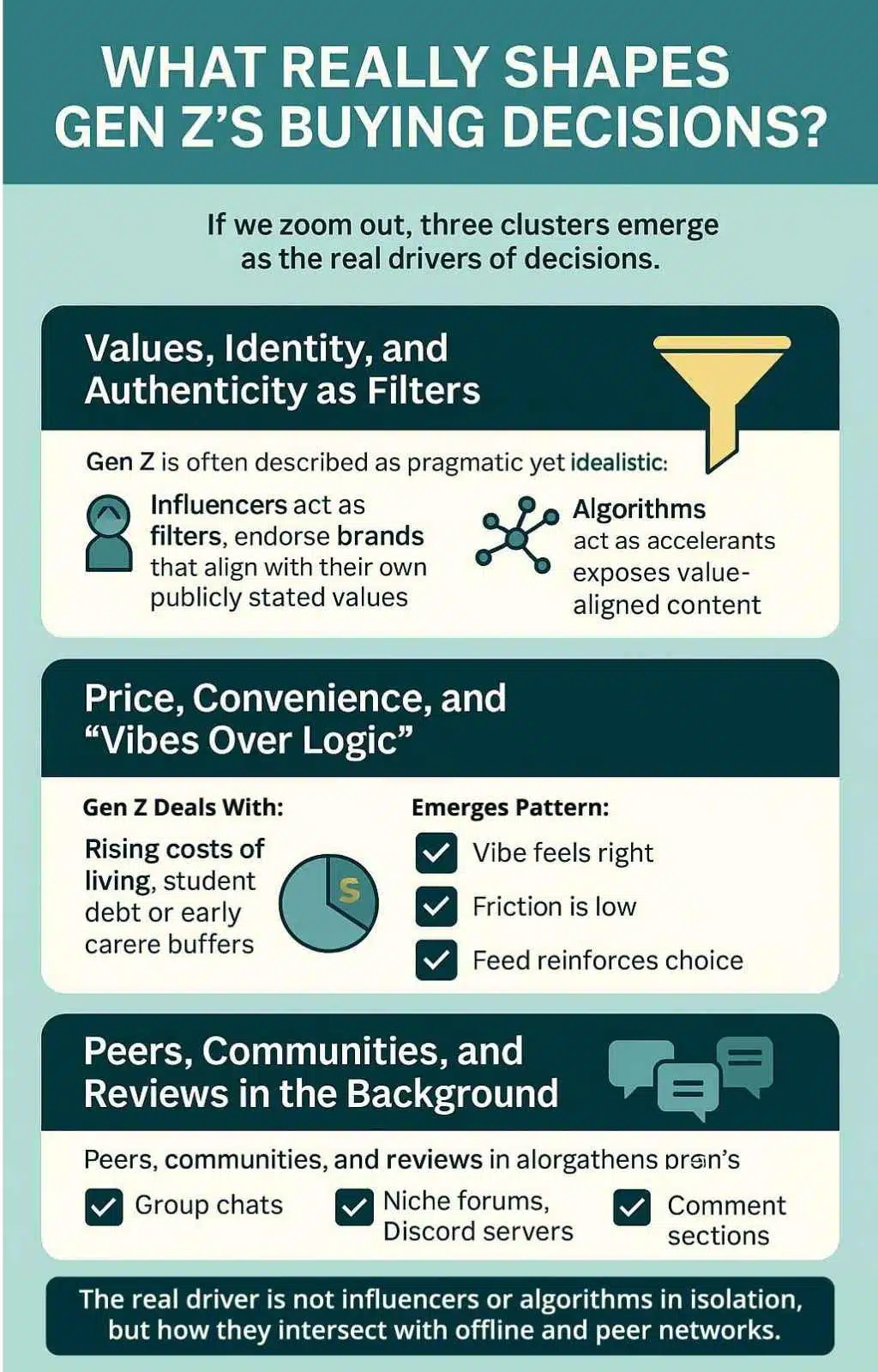
If we zoom out, three clusters emerge as the real drivers of decisions.

Values, Identity, and Authenticity as Filters
Gen Z is often described as pragmatic yet idealistic: price-sensitive, but also strongly motivated by social and environmental values. Research into their social media behavior notes that concerns around sustainability, inclusivity, and ethics increasingly influence which brands they follow and buy from.
In this context:
- Influencers act as filters: they endorse brands that align with their own publicly stated values, signaling to followers that a product fits within a particular identity.
- Algorithms act as accelerants: they expose more of that value-aligned content to users whose past behavior suggests they care about similar issues.
For a Gen Z consumer trying to live out a specific identity—eco-conscious, tech-forward, budget-savvy—both the creator’s stance and the feed’s curation matter.
Price, Convenience, and “Vibes Over Logic”
Values matter, but they do not erase practical constraints. Gen Z often deals with:
- Rising costs of living
- Student debt or early-career income volatility
- Limited savings buffers
Discount codes, bundled offers, and “dupes” culture, therefore, have real weight. Social media research notes the power of promotions shared by influencers, especially when frictionless checkout is integrated into the platform.
At the same time, surveys about how younger adults make decisions show a high reliance on gut feeling, intuition, and the general “vibe” of a choice—even for significant life decisions.
Combine those elements and a pattern emerges:
- If the vibe feels right (creator seems authentic, aesthetic matches identity)
- And the friction is low (one-click purchase, clear price, visible discount)
- Also, the feed keeps reinforcing the choice with similar content
Then the path from impression to purchase can be very short.
Peers, Communities, and Reviews in the Background
There is a third layer that quietly competes with both influencers and algorithms: peers and communities.
Gen Z uses:
- Group chats
- Niche forums, Discord servers, or Reddit-style spaces
- Comment sections that function as informal review hubs
Studies comparing generations suggest that Gen Z still relies heavily on recommendations from friends and peers, even as social media content shapes the initial shortlist.
In practice, a typical journey might look like this:
- A product appears in the feed via a creator video.
- The algorithm shows similar content from multiple accounts.
- The user checks comments, DMs a friend, or searches quick reviews.
- A mix of influences—not one single source—tips the decision.
So the real driver is not influencers or algorithms in isolation, but how they intersect with offline and peer networks.
What Brands Should Actually Do
For marketers, the practical question is not “Who wins?” but “How do we work with both?”
Design for the Influencer–algorithm Partnership
Effective strategies treat influencers and algorithms as interdependent:
- Creator selection: Prioritize micro-influencers whose audiences overlap with your target segments and whose content style already performs well on the relevant platform. Data consistently shows they have a disproportionate impact on Gen Z trust and conversions.
- Format discipline: Build briefs around platform-native formats—short vertical video, strong first three seconds, clear narrative tension—so that content has a fair chance with the recommendation engine.
- Iterative testing: Treat every campaign as a sequence of experiments. Adjust hooks, lengths, and CTAs based on early performance signals rather than fixed assumptions.
The aim is not to “beat the algorithm”, but to align with it without losing authenticity.
A Practical Playbook for Campaigns That Travel in the Feed
A workable playbook for Gen Z buying decisions might include:
1. Full-funnel creator mix
- Use smaller creators for deep product demos and niche communities.
- Use larger or more aspirational accounts for cultural relevance and reach.
2. Content designed for search and social discovery
- Incorporate keywords Gen Z actually uses (e.g., “gift ideas under $50”, “starter skincare routine”) into captions and on-screen text so content is discoverable both via social search and traditional engines.
3. Native social commerce
- Where possible, integrate in-platform shops, pinned product links, and promo codes so the path from awareness to purchase is compressed.
4. Proof points beyond the creator
- Encourage customers to post their own content, reviews, and before-and-after stories. Algorithms favor engagement; real-user posts provide durable social proof.
5. Measurement beyond vanity metrics
- Track not only likes and views, but also saves, shares, click-throughs, and repeat purchases. Those metrics align more closely with long-term brand impact.
These tactics position brands where influencers and algorithms meet, rather than forcing a choice between them.
Ethics, Transparency, and the Coming Regulatory Lens
As algorithms and influencers become more central to Gen Z consumer behavior, regulators and audiences are asking harder questions:
- Are ads and sponsored content clearly labeled?
- Are recommendation systems amplifying unhealthy products or unrealistic lifestyles?
- How are data and behavioral signals being used to target young users?
Several jurisdictions are already tightening rules on influencer disclosure and algorithmic transparency, especially when minors are involved. That trend is likely to continue.
For brands, this is not just a compliance issue. Gen Z tends to punish what it sees as dishonest or manipulative behavior and reward brands that treat it as partners rather than targets.
A credible strategy, therefore, builds ethics into the creative brief: clear labeling, realistic claims, and a willingness to explain how recommendations and personalization work.
Conclusion: The New Power Triangle
So, who is shaping Gen Z’s buying decisions—Influencers or algorithms?
The evidence points to a more nuanced answer:
- Algorithms decide what gets seen, structuring the digital environment in which choices are made.
- Influencers translate products into stories and identities, supplying the human context that builds trust.
- Peers and communities quietly arbitrate in the background, validating or vetoing what the feed suggests.
The real risk is not that one side “wins”, but that the interaction between both becomes opaque. When commercial messages are woven seamlessly into personalized feeds, the line between discovery and persuasion can blur.
Gen Z is not naive about this. They understand that feeds are curated and that creators often earn from recommendations. Yet their daily decisions—from where to eat to what to wear—are still shaped in powerful ways by a system where people and code co-author desire.
For brands and policymakers, the task now is to make that system more transparent, more accountable, and, ideally, more aligned with the long-term interests of a generation that is already reshaping global markets.