

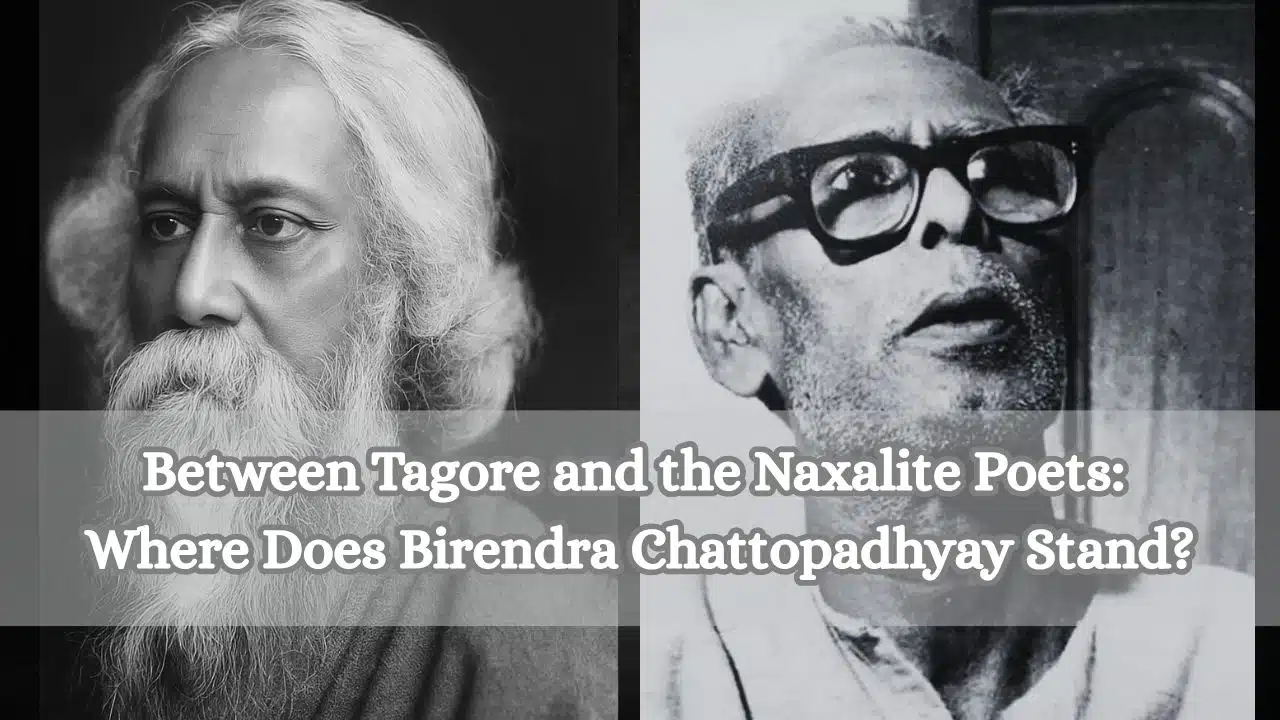
Bengali literature of the 20th century is often viewed through two dominant lenses: the towering presence of Rabindranath Tagore and the radical outburst of the Naxalite-era poets.
Tagore brought global recognition to Bengali poetry with his universal humanism and lyrical depth, while the young rebels of the 1960s and 70s gave voice to fiery protest and revolutionary anger.
Between these two extremes stood Birendra Chattopadhyay (1920–1985), a poet of balance, dignity, and conscience. His works ask us an essential question: Where Does Birendra Chattopadhyay Stand?
The Literary Spectrum of Bengal in the 20th Century
Rabindranath Tagore dominated Bengali literature like no other figure. His verses celebrated beauty, love, spirituality, and the eternal bond between humanity and nature. His Nobel Prize in 1913 gave Bengali poetry global recognition, and his songs became part of Bengal’s cultural identity. Yet, his vast shadow often left the next generation struggling to create a distinct voice.
The Radical Turn: Naxalite Poets
By the 1960s and 70s, Bengal witnessed political turbulence with the rise of the Naxalite movement. A group of poets broke away from lyrical traditions and chose the language of rebellion. Writers like Shakti Chattopadhyay, Sunil Gangopadhyay, and others aligned their art with the street, using raw and provocative imagery. Their poems carried the fire of revolution but often lost the quiet lyricism of earlier Bengali verse.
Birendra Chattopadhyay: The Poet in the Middle
Birendra Chattopadhyay found himself between Tagore’s lyrical romanticism and the anger of the Naxalite poets. He neither retreated into escapist dreams nor surrendered to revolutionary slogans. Instead, his poetry remained deeply humanist—concerned with dignity, compassion, and the everyday struggles of people.
His works earned him the Rabindra Award in 1982, a recognition of his ability to combine artistic beauty with social conscience.
The Stylistic Balance
His style stood apart. Unlike Tagore, his poems were less ornate, but they retained a lyrical rhythm. Unlike the Naxalite poets, he avoided violence and propaganda. Instead, he crafted verses that were simple, grounded, and profound. This stylistic middle path gave him a unique place in modern Bengali poetry.
His notable works include:
- Outcast (1944)
- For Ranu (1951)
- Lakhinder (1956)
- In front of the visa office (1967)
- Mahadev’s Door (1967)
- The Human Face (1969)
- Vietnam: India (1974)
- My Sacrificial Horse (1985)
Major Themes in Birendra Chattopadhyay’s Poetry
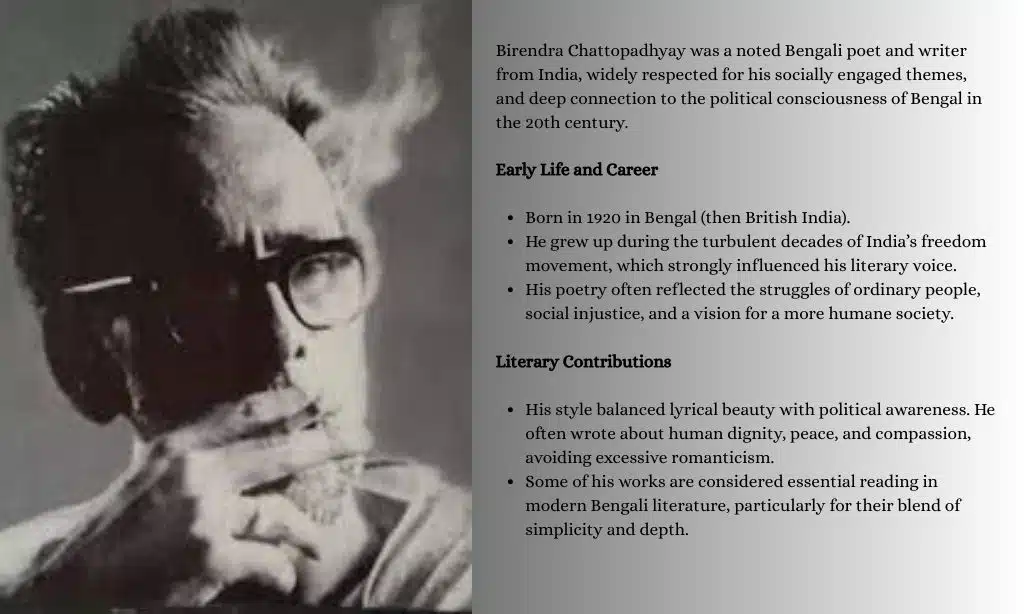
Birendra Chattopadhyay’s poetry is marked by a quiet depth that goes beyond surface beauty. He did not write only to impress with lyrical rhythm; instead, he used verse as a way to engage with life’s realities. His poems often explore the struggles of ordinary people, the silence of nature, and the tension between hope and despair.
Through recurring symbols and subtle political undertones, he built a body of work that was simple in language but powerful in meaning. These themes make his voice distinct in the crowded landscape of Bengali poetry.
The Common People
A defining quality of his work was his empathy for ordinary people. Farmers, workers, mothers, and children often appeared in his poems—not as abstract ideas but as living, breathing individuals. He gave voice to those often silenced in literary tradition.
Nature and Symbolism
Chattopadhyay often employed the sea (samudra) and the forest (aranya) as central symbols. The sea embodied vastness, uncertainty, and dreams of freedom. The forest symbolized solitude, struggle, and resilience. Through these natural metaphors, he captured the human condition.
Politics Without Propaganda
Although deeply political in outlook, Birendra Chattopadhyay never reduced his art to slogans. He resisted injustice with quiet determination rather than fiery rhetoric. His works remind us that poetry can be political without being didactic.
Where Does Birendra Chattopadhyay Stand in Bengali Poetry?
To answer the central question, we need to place Birendra Chattopadhyay in relation to his peers. He was neither as lofty as Tagore nor as rebellious as the Naxalite poets. Instead, he created a voice that was firmly his own. By balancing lyricism with realism, he built a position that resisted easy classification and continues to provoke thought even today.
His Distinct Position
So, where does Birendra Chattopadhyay stand? He stands as a bridge—a poet who connected reverence with rebellion, lyricism with realism, and politics with compassion. His poetry was less about extremes and more about balance, making him a voice of moderation and truth in a turbulent time.
Critical Reception and Legacy
Though Birendra Chattopadhyay was widely respected during his lifetime, his name is less frequently recalled today compared to other Bengali poets. Awards and recognition cemented his importance, but limited translations and overshadowing by more dramatic literary figures kept him away from the mainstream spotlight. Still, his legacy survives, waiting for rediscovery by new readers.
Recognition in His Lifetime
Birendra Chattopadhyay earned respect within Bengali literary circles. His Sahitya Akademi Award was a formal recognition of his contributions. Critics valued his ability to blend social awareness with poetic grace.
Why He Is Less Popular Today
Despite his achievements, his name is less widely remembered compared to Jibanananda Das, Shakti Chattopadhyay, or Sunil Gangopadhyay. One reason is the absence of dramatic literary identity—he was neither a dreamer like Tagore nor a radical like the Naxalites. Another reason is the lack of translations that could have introduced his works to the global stage.
Relevance in the 21st Century
In today’s fractured world, Birendra Chattopadhyay’s poetry has renewed relevance. His themes of compassion, dignity, and human resilience resonate with global audiences struggling with inequality and social unrest. Rediscovering him means rediscovering a voice of conscience.
Comparative Reflection
Sometimes the best way to understand a poet’s place is through contrasts. If Tagore embodied the dreamer and the Naxalite poets the flames of rebellion, Birendra Chattopadhyay emerged as the quiet realist and conscience-keeper. This comparative view highlights how his poetry offered balance in a time of extremes.
If Tagore Was the Dreamer, Birendra Was the Realist
Tagore’s poetry often celebrated universal humanism, sometimes at a distance from harsh realities. Birendra Chattopadhyay, in contrast, wrote of real struggles—hunger, poverty, and dignity. He turned from dream to reality without abandoning lyricism.
If Naxalite Poets Were the Fire, Birendra Was the Conscience
Where the Naxalite poets used fire, anger, and slogans, Birendra used quiet resistance. His poems remind us that conscience can be as powerful as rebellion. His balance between silence and speech gave him a rare literary identity.
Takeaways
The Bengali literary landscape of the 20th century was shaped by towering dreamers and fiery rebels. Yet in this landscape, Birendra Chattopadhyay carved his own middle ground. He was neither Tagore’s romantic successor nor a Naxalite propagandist. He was a poet of balance, human dignity, and quiet truth.
So, Where Does Birendra Chattopadhyay Stand? He stands at the crossroads of tradition and rebellion, offering a rare voice that connects lyricism with conscience. His poetry reminds us that literature does not always have to shout or sing—sometimes, it simply has to speak with honesty.































