
You may see Rick Rubin’s name on Blood Sugar Sex Magik and ask, what does rick rubin do. You hear a raw guitar or a tight beat and feel the spark, but you still feel puzzled. Many wonder why he strips tracks down to the bone, or how he lifts a song with one small tweak.
Rick Rubin co-founded Def Jam Recordings and shaped hip hop from Run-DMC to LL Cool J. He revived Johnny Cash with American Recordings in 1994. This guide will walk you through his lean beats, his raw production style, and his calm studio environment.
You will learn how fewer layers can hit harder. Read on.
Key Takeaways
- Rick Rubin cuts tracks to the bare bones. He uses gear like a Neumann U47 mic, an SSL 4000 console, a Studer A800 tape machine, and a single mic to capture raw vocals and space.
- In 1984 Rubin co-founded Def Jam Recordings with Russell Simmons at Yale. He produced LL Cool J’s “I Need a Beat,” shaped Run-DMC, Beastie Boys, Public Enemy, and in 1986 brought hip hop and rock together with “Walk This Way.”
- Rubin revived Johnny Cash in 1994 with American Recordings. He recorded Cash live with a ribbon mic and Studer A800, drove the album to #22 on the Billboard 200, and earned a 2003 Grammy for “The Man Comes Around.”
- He worked with top acts like Red Hot Chili Peppers (six albums, 1991–2011), Metallica’s Death Magnetic (2008), Black Sabbath’s 13 (2013), Slayer’s Reign in Blood at 200 BPM, Linkin Park’s Minutes to Midnight, and Adele’s 21 (30 million copies sold; 2012 Album of the Year).
- Rubin treats silence and space as key tools. He makes studios feel calm like a living room in Malibu, uses minimal tracks, and focuses on each artist’s raw emotion and vision.
Rick Rubin’s Approach to Music Production
Rick Rubin cuts tracks to their bare bones and swaps Pro Tools for a vintage reel-to-reel, so the sound stays raw and real. He uses a Neumann U47 mic and routes it through an SSL 4000 console to pull honest vocals from every artist.
Minimalist production style
He pares beats and chords to bare essentials. Fans hear his stripped-down sound. The track gains room to breathe. The producer Rick Rubin mines raw emotion. Analog mixing console moves fade extra layers.
He uses a single condenser mic to capture honest vocals. He shapes negative sonic space to boost feeling.
His approach revived Johnny Cash on American Recordings. Simplicity drove each guitar riff. A tape machine caught Cash’s deep voice. He cut echo and reverb to keep tracks clear. This brevity highlights emotional authenticity.
Top producers copy this space and silence trick now.
Emphasis on emotional authenticity
Rick Rubin strips away excess clutter. He moves the mic and cuts effects. He tweaks the Neve console less. He zooms in on raw singing. He records Johnny Cash live in one take. He trusts rough, honest vocal tracks.
He applied this to Def Jam rap and Run-DMC beats. He revived American Recordings songs, so Hurt sounds like a whisper in a church.
Rick seeks space and silence in the mix. He treats each pause as a vital part of the song. He uses a microphone and a four-track recorder. He guards each breath and each string pluck.
He guides Red Hot Chili Peppers to trim on Blood Sugar Sex Magik, and invites Linkin Park to play all parts in one room. He lives by The Creative Act: A Way of Being.
How Does Rick Rubin Produce?

Silence marks the first step. Rubin strips tracks till only the core remains. He uses an analog board and a digital audio workstation. He sits beside artists, listens hard, asks them to play from the gut.
That focus gave Johnny Cash his 1994 American Recordings sound. That method drew fresh tones on Metallica’s Death Magnetic in 2008 and Black Sabbath’s 13 in 2013.
Many tracks run through a single mic and a guitar amp. He drops reverb until the room feels alive. That leaves space between notes, a key to emotional authenticity. He honed that sparse style after starting Def Jam Recordings while at NYU.
That drew six albums from Red Hot Chili Peppers between 1991 and 2011. He shaped System of a Down pulses on The Subliminal Verses. Artists feel free to speak, jam, and find their own spark.
Key Contributions to the Music Industry
He co-founded Def Jam Recordings and gave Johnny Cash a new pulse on American Recordings. He stripped tracks with minimalism on a soundboard, tape machine, and recording software.
Co-founding Def Jam Recordings
Rick Rubin teamed with Russell Simmons in 1984 to create Def Jam Recordings on a Yale campus. The team grabbed a turntable, mixer, sampler and mic to sketch raw tracks in a cramped dorm.
LL Cool J’s “I Need a Beat” became the label’s first record that year.
Rubin then guided sessions for Beastie Boys, Run DMC, Public Enemy and Geto Boys. He shaped rap and rock with stripped-down sound and bold beats. That vibe stayed simple, so artists spoke their truth over clear drums.
It still echoes in modern hip hop.
Reviving careers with American Recordings
He left Def Jam in 1988 and formed Def American Records. The label took on the name American Recordings in 1993. Def American built a bold reputation for stripped-down sound. He placed Johnny Cash in a quiet room.
He tracked that voice with a Studer A800 tape machine and a ribbon mic. He cut away drums, bass, and big stacks. The result was the 1994 album American Recordings. It climbed to number 22 on the Billboard 200 chart.
He went on to make five more Cash albums. Each one found new fans across country and rock radio.
Shaping the sound of modern hip hop and rock
Rick produced the 1986 Run-DMC and Aerosmith Walk This Way hit. That track cracked open mainstream hip hop with a hard rock edge. Then he moved Beastie Boys from punk roots into rap hits.
He used record players, sampling device and analog mixing console. That approach shaped studio work for Def Jam artists.
He cut Slayer’s Reign in Blood at 200 BPM. That blazing pace rewrote rock rules. Rubin pulled back clutter, let drums pound. A drum machine and recording software teamed up. That blend inspires acts like System of a Down and Linkin Park.
The Creative Process
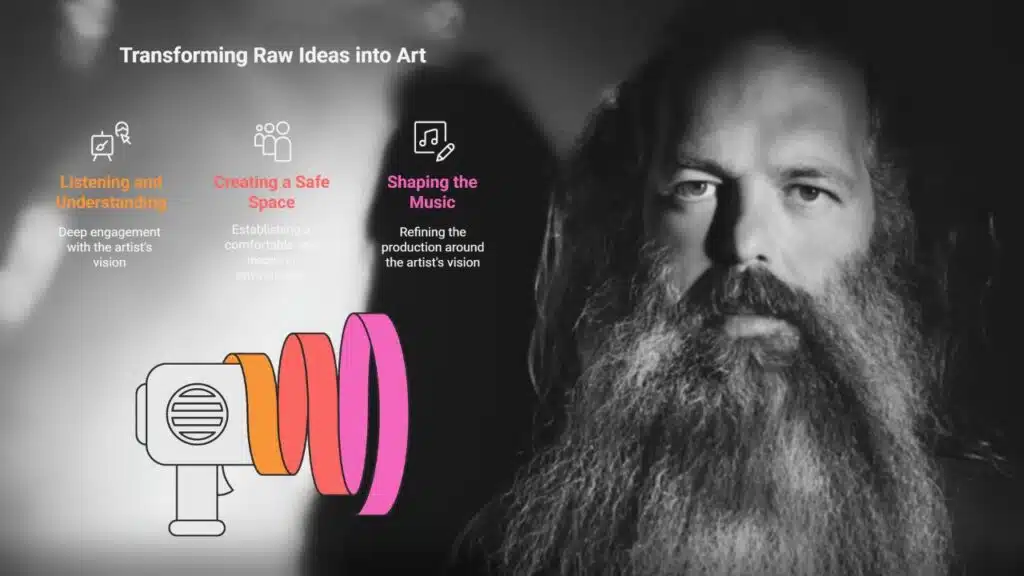
He lines up a simple digital audio workstation, a vintage microphone, and basic EQ moves, then he listens deep to shape raw ideas into real art—read on to learn more.
Focus on listening and understanding the artist
Rick Rubin dims the lights in the studio. He sets up a Neumann mic or a Shure SM57. He listens to every word, every pause. He sits with the artist in a leather chair. He holds off on advice at first.
He asks them to share their vision. He finds the spot in each song that holds real emotion. That feeling pulses on records from Def Jam to American Recordings. It shines on tracks by Run-DMC and Johnny Cash.
He values calm space over fast noise.
He makes the room feel safe from the start. He moves heavy gear aside. He fires up an analog console or Ableton Live. He invites artists to speak up, to share fears or dreams. He books time on a mixing desk.
He tracks every note. He gives the lead vocal room to breathe like fresh air. He shapes the music production around the artist, not the trend. He asks simple questions about drive and mood.
That focus sparks raw takes on Blood Sugar Sex Magik and Minutes to Midnight.
Creating a comfortable and inspiring studio environment
Rubin seats a plush sofa by the mixing console in Malibu, California. He tucks acoustic panels along the walls to tame harsh echoes. Soft lamps cast a golden glow, just like a sunset over the Pacific.
A microphone stands ready on a boom arm, plugged into a sleek audio interface. He invites artists, from hip hop icons to rock legends, to nestle into beanbags between takes. The setup feels like a living room, not a lab.
He tunes room acoustics with thick curtains and modular diffusers. A vintage lamp hangs near the studio monitors, adding warm light. Low shelves hold old vinyl, jazz records and Black Sabbath albums.
Vinyl grooves share space with notebooks and a coffee pot. Sessions can flow like free jazz, wild one moment, quiet the next. This cozy nest sparks ideas, even for Johnny Cash or Linkin Park.
Notable Collaborations
Rubin grips the mixing board, coaxes raw guitar riffs from the rock outfit, draws rich tones from the soul diva, and unlocks grit in the country legend—read on to learn more.
Work with Johnny Cash
Rick Rubin sat with Johnny Cash in Studio A, he cut all extra sounds, he used a lone acoustic guitar and a mic. He shaped American Recordings in 1994. That album won praise. In 2003 The Man Comes Around took a Grammy for Best Male Country Vocal Performance.
Fans loved that old man voice backed by a bare beat.
Johnny Cash chose Hurt by Nine Inch Nails. A lone mic captured his cracked voice. The stark cover became a defining moment. Fans saw a frail man staring down the end of the road in the video.
He let space in the mix and let Cash lead. That stripped-down style drove emotion home. American Recordings grew into a legend.
Collaborations with Adele and Linkin Park
Rubin sat behind an audio console in Malibu, coaxing raw emotion from Adele. He urged her, “Sing it straight from your soul.” He applied audio engineering skills to her vocals, piano, and percussion.
He captured each take with a digital audio workstation. Her record 21 won Album of the Year in 2012 and sold over 30 million copies. Fans felt each lyric hit like a punch to the heart.
He met Linkin Park at a recording studio in Hollywood. He guided songs on A Thousand Suns and Minutes to Midnight. He stripped back layers of distorted guitars and synth. He let silence breathe between each riff, so drums could thunder.
The band praised his stripped-down sound. It gave them a fresh creative spark.
The Philosophy Behind the Art
Rubin treats silence like a vital instrument, he places a ribbon mic on a raw guitar, and he shapes space with plate reverb—read on to learn more.
The power of simplicity in sound
He leaves only the heart of each take. That lets Johnny Cash’s voice fill every inch of silence. One mic runs into an analog board to capture raw feeling. Sessions under Rick Rubin feel open and warm.
Those steps use minimalism and audio mixing basics.
Beats go back to core drum hits. That minimal approach helped early Def Jam artists and a hip hop trio shine. Producers study space and silence like a masterclass. The result feels fresh, honest, and alive.
Rubin’s belief in the importance of space and silence
Rubin sees silence as a tool in his studio work. He cuts tracks down to bare bones. He uses negative sonic space to make vocals and guitars breathe. He guided Johnny Cash on American Recordings in 1994 to fill songs with empty moments that rattle the soul.
He also steered Red Hot Chili Peppers on 1991’s Blood Sugar Sex Magik, he let guitar chords hang in the air.
He shops for a quiet microphone, he sets up a recording console and a digital audio workstation with few tracks. He ducks drum hits, he holds back guitar layers. He lets empty bars speak louder than loud ones.
He crafts stripped-down sound with minimalist production style.
Takeaways
This text shows how a sound artist strips a song to its bones. Minimalist production gives music room to breathe. A mixing desk and a simple microphone spark creativity. Fans still sense magic in each stripped track.
His art proves that less can change more.
FAQs
1. What is Rick Rubin’s role as a music producer?
He leads the music production and guides artists in the studio. He helps shape songs so they feel true. He works with many acts, from rap crews to rock bands.
2. How did he work on Johnny Cash albums for American Recordings?
He signed Johnny Cash to American Recordings and cut back on extra gear. He let Cash sing with just his guitar. He made the tracks feel raw, honest, and full of heart.
3. How did he shape the Beastie Boys and other hip hop acts at Def Jam?
He produced the rap trio’s first records under Def Jam. He mixed hard beats and live guitars to spark rap hard rock. He also coached LL Cool J and Run–DMC on tight drums and deep bass.
4. How did he guide Red Hot Chili Peppers and Linkin Park?
He helped Red Hot Chili Peppers record Blood Sugar Sex Magik, with Give It Away and Under the Bridge. He then steered By the Way, I’m With You and Return of the Dream Canteen. He later worked on Linkin Park’s raw tracks for Living Things.
5. What is stripped-down sound in his work?
He cuts extra layers to let the core parts shine. He gave Slayer’s Reign in Blood a tight mix with few mics. It feels like you’re jamming in a garage, not a stadium.
6. What can new bands learn from his book and process?
He shares tips in The Creative Act: A Way of Being. He shows how honesty and calm reveal true art. He even offers advice to rock voices like Corey Taylor, so each note hits deep.