You might scroll TikTok and ask, what disease does hasbulla have. Hasbulla Magomedov has dwarfism from a growth hormone deficiency in his pituitary gland. We will explain his rare genetic disorder and how human growth hormone and hgh treatment work.
Keep reading.
Key Takeaways
- Hasbulla Magomedov has growth hormone deficiency (GHD), a rare genetic disorder of the pituitary gland that leaves him about 3 feet tall, with a childlike face and high-pitched voice.
- GHD means the brain’s master gland makes too little human growth hormone, so kids show stunted growth, delayed puberty, narrow shoulders, and small hands. Doctors use IGF-1 blood tests, MRI scans, and gene panels to confirm the diagnosis.
- He takes daily hGH injections at night under an endocrinologist’s care. Labs to check IGF-1 run every four weeks, and therapy can cost over \$10,000 per year—similar to Lionel Messi’s treatment at age 10 in 2005.
- Since 2021, Hasbulla’s TikTok and Instagram clips have hit over 2 million views, and he reached 9 million Instagram followers by 2023. He sparred online with Abdu Rozik and drew links to UFC stars like Khabib Nurmagomedov and Conor McGregor.
- His viral presence shines a light on pituitary health and hGH therapy, proving that a rare condition need not block big dreams.
What is Growth Hormone Deficiency (GHD)?
GHD is a rare genetic disorder where the brain’s master gland makes too little growth hormone, so kids show short stature and slowed growth. Doctors track bone growth, muscle strength, then fire up growth with hormone shots.
Definition and causes
Insufficient human growth hormone production leads to stunted growth and short stature. Doctors call this growth hormone deficiency, or GHD. Kids often show slow height gain. It often appears at birth.
Pituitary gland damage or malformation can trigger it. Some gene changes hamper hGH output. Blood levels stay too low and bodies miss growth milestones.
People notice narrow shoulders, small hands, and a childlike face. Hasbulla Magomedov and Abdu Rozik show these traits. Parents see the gap at checkups. Tests measure hGH in blood.
MRI scans reveal pituitary gland anomalies. A pediatric endocrinologist makes the call. Early spotting opens doors to treatment.
How it affects physical growth
Growth hormone deficiency stands like a roadblock in a child’s growth. The pituitary gland fails to release enough hgh. This rare genetic disorder leads to short stature. Kids often stop growing well before other kids do.
The body feels like a car running low on fuel. It can’t speed up growth.
Delayed puberty joins the hurdles. Teens may miss the growth spurt peers hit at 13 or 14. Doctors order blood tests and check growth charts fast. Like Abdu Rozik or mini Khabib, Hasbulla Magomedov shows big heart in a tiny frame.
Hormone replacement therapy can boost height if begun early.
Hasbulla and Growth Hormone Deficiency
Hasbulla lives with growth hormone deficiency, as his pituitary gland underperforms. He leans on human growth hormone therapy to chase bigger goals.
Symptoms and characteristics of his condition
He appears like a five-year-old boy, though he is older. His height stays around 3 feet, and he has a childlike face. His limbs look short and sturdy. Doctors diagnose a rare genetic disorder, growth hormone deficiency.
Low human growth hormone, or hgh, from the pituitary gland causes these signs.
Thin arms do not stop his bold moves. His voice rings high like a small bell. Fans compare him to Abdu Rozik in viral clips. Friends note his round cheeks and big eyes. The little frame and slow growth trace back to GH issues.
How GHD has shaped Hasbulla’s life
GHD slowed Hasbulla’s growth and gave him a high voice. His pituitary gland makes less human growth hormone. Hasbulla Magomedovich Magomedov lives with a rare genetic disorder. Doctors call it growth hormone deficiency.
TikTok users made him an internet sensation in 2021. He hit 9 million Instagram followers by 2023.
Growing up small felt like carrying a toy suitcase in a crowded airport. Hasbulla uses humor to break the ice, he makes fans grin in seconds. Fans call him mini Khabib after Khabib Nurmagomedov, and they cheer him on.
He sparred online with Abdu Rozik in playful clips. His posts help shine a light on this condition. Instagram reels show his journey.
Medical Details of Growth Hormone Deficiency
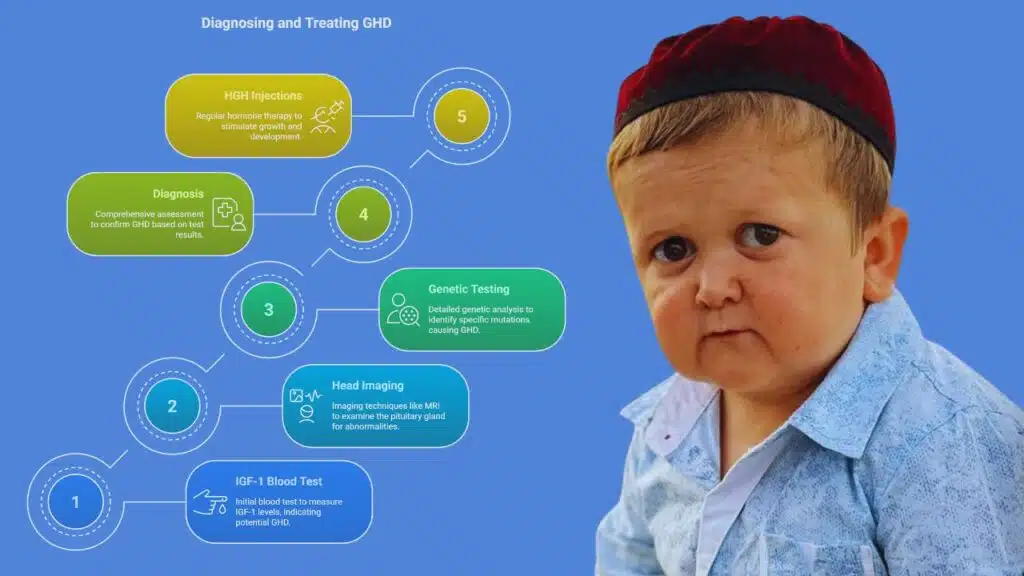
Doctors order an IGF-1 blood test, then scan the head with imaging to find pituitary issues. They dig into a gene panel like detectives to spot DNA variants that slow growth.
Genetic factors contributing to GHD
Mutations in the growth hormone gene cause growth hormone deficiency, they cut levels of human growth hormone in the blood. A change in the growth hormone releasing hormone receptor on the pituitary gland can block key signals, it acts like a broken switch.
Genetic testing can spot these errors, it guides a clear diagnosis.
Some families carry a rare genetic disorder that follows simple inheritance rules, they pass down these mutations from parent to child. Other genes like POU1F1 can tweak hormone release, they act as supporting cast in controlling growth.
Role of the pituitary gland
The pituitary gland sits at the base of the brain. It acts as a master gland for the endocrine system. It pumps out human growth hormone, or hgh, and sends signals to the thyroid, adrenal, and reproductive glands.
Doctors call it the “traffic cop” of hormones because it directs growth, metabolism, and other body processes.
Insufficient hormone production by the pituitary gland causes growth hormone deficiency. This lack slows bone lengthening and muscle mass gain in kids. Doctors use an MRI scanner to look for gland issues.
They often treat patients with regular hgh injections to boost growth.
Treatment Options for Growth Hormone Deficiency
Doctors give daily human growth hormone shots with a simple injection device, copying signals from the pituitary gland. It runs like a tune-up for a slow engine, as an endocrinologist tracks growth on charts and tweaks each dose after lab tests.
Hormone replacement therapy
Kids with growth hormone deficiency get daily shots. These hormone replacement therapy sessions fuel new growth.
- Endocrinologists prescribe daily hgh injections to boost pituitary gland output. They schedule shots at night to match the natural growth cycle.
- Families handle injection tools like insulin pens for easy dosing. They cool vials in a fridge and swap sites on the arm or leg.
- Lab teams measure IGF-1 levels every four weeks to tweak dosage. Growth patterns and blood tests guide safe therapy.
- Lionel Messi got these human growth hormone shots in 2005 at age 10. FC Barcelona paid for his entire treatment until he turned 18.
- Kids may feel jitters or see small bruises after each shot. Nurses teach fun distractions and massage moves to ease pain.
- Endocrinology teams track hormone response for years with MRI scans. They look at pituitary gland size and adjust plans.
Challenges in managing the condition
Hasbulla Magomedov lives with growth hormone deficiency. He needs daily injections of human growth hormone, hgh. His pituitary gland cannot spark normal growth. The shots must stay cold in a fridge.
Travel can break his strict routine. Costs can top $10,000 a year for therapy. Mood swings and extra fat can hit hard. Fans cheer for him as he fights fatigue.
Hasbulla’s Public Impact and Awareness
His viral clips push medical exams and body scans into the spotlight, sparking chats on GH therapy.
Fans pair him with UFC champ Khabib, driving clicks on master gland studies.
Raising awareness about GHD
Hasbulla Magomedov shares his growth hormone deficiency journey on Instagram and TikTok. The posts tag fighters like Khabib Nurmagomedov and Conor McGregor, sparking chatter from UFC 229 fans.
Hashtags like #human growth hormone and #pituitary gland spark discussion online. Viewers learn how the rare genetic disorder affects bone growth. His videos reach over two million views and prompt followers to ask doctors about hgh therapy.
Videos show him meeting Abdu Rozik at a promotional event. That scene links two figures who share a similar pituitary issue. Experts like Dana White and Chris Unger praise his medical posts.
Followers now research growth hormone (GH) online and consult specialists. Awareness grows each week across YouTube shorts, Reels, and online threads.
Inspiring individuals with rare conditions
People like hasbulla magomedov and abdu rozik show grit on camera. Fans often share his statement, “I can’t say that I’m handicapped, I can speak, I understand, I have arms and legs just like others.” He stars as an internet sensation with growth hormone deficiency, and he blends humor and charm in viral videos.
Abdu Rozik, a singer from Tajikistan, posts song clips and calls himself mini khabib. Both men prove a rare genetic disorder need not halt big dreams.
Tiny titans use social sites, like TikTok, Instagram, YouTube. Fans cheered on a shot with Dana White in Las Vegas. A viral clip brought tens of millions of views. He joined Khabib Nurmagomedov and Islam Makhachev near the octagon.
That moment sparked talk about pituitary gland health and human growth hormone. Chris Unger steps into ring talks with Mike Tyson. Rozik shares song clips, and mini Khabib cracks jokes.
Hope shines through every post.
Takeaways
Hasbulla fights bigger foes than size. His pituitary gland makes less human growth hormone. Doctors give hormone shots to spur his bones to grow. TikTok fans and UFC stars admire his drive.
His journey shines light on rare growth hormone disorders.
Discover more about Hasbulla’s personal life, including his marital status, by clicking here.
FAQs
1. What disease does Hasbulla Magomedov have?
He has growth hormone deficiency. A small pituitary gland in his brain makes too little hormone. This rare genetic disorder keeps him small.
2. How does human growth hormone therapy work?
Doctors inject human growth hormone, known as hgh, to raise his level. They watch his growth, tweak doses, track lab tests. Experts like Chris Unger study the method, to help patients grow.
3. How does his growth hormone deficiency affect his size compared to others?
He stays small, while Lionel Messi runs fast, Mike Tyson hits hard. Abdu Rozik and mini Khabib stand around his height. Khabib Nurmagomedov Jr grows more, thanks to hgh.
4. What do cage fighters think about him?
Cage fighters, and octagon contenders, love his feisty spirit. Conor McGregor cracks jokes, and connor mcgregor memes fly online. Dana White posts his clips. Charles Oliveira nods in respect. Khamzat Chimaev, Justin Gaethje, even Ali Abdelaziz share fan posts.
5. Why is he an internet sensation?
He sparks joy with bold moves, a wink and a grin. Islam Makhachev shares his highlights, and fans go wild. He rolls into chats, a pint-sized legend. That mix makes him an internet sensation.