February 14, 2026, looks a lot like the past, but it feels entirely different. The red roses are still there. The candlelit tables are still booked weeks in advance. But if you look closely at the guest list for a premier table in any city across the globe, on Valentine’s Day, you might see three menus instead of two. Far from a scandal, these are quiet, organized dinners between people who have decided that the old rules of “exclusive” love no longer apply. In this new landscape, the traditional friction between Valentine’s Day & Infidelity has dissolved into a transparent, designed intimacy.
In the 1950s, Valentine’s Day was a celebration of the pair-bond… a singular, locked-in commitment that kept the “extramarital” hidden in the shadows. Today, those shadows have vanished. What we once called an “affair” or a “betrayal” has been rebranded into something essential for survival in a complex world.
We have moved past the era where one person had to be your everything. We are now in the age of Radical Autonomy. The most romantic thing you can hear on Valentine’s Day isn’t a promise of forever; it’s the simple, honest statement: “I don’t own you, and you don’t own me.”
Valentine’s Day & Infidelity: The “Case Study” Interlude, Why We Stopped Lying
To understand how the definition of Valentine’s Day & infidelity has shifted, look at Yash and Puja, a couple from Mumbai who have been married for six years. On the surface, they look like the classic success story. They share a bright apartment, a dog, and a sprawling social circle.
But three years ago, they hit a wall. Yash found himself deeply attracted to a colleague, and Puja felt herself drifting toward a longtime friend. In 2020, this would have been the start of a messy, heartbreaking affair. It would have been a story of deleted texts and late-night lies.
“The traditional marriage was a beautiful lie that we finally stopped telling ourselves,” Yash says, leaning back with a coffee. “We realized that pretending we only had eyes for each other was actually making us resent each other. We were suffocating under the pressure of being ‘everything’ for the other person.”
Instead of hiding, they sat down and drafted a “Consensual Expansion” agreement. Puja didn’t want to lose Yash, and Yash didn’t want to lose the home they built. By bringing their outside attractions into the light, the “affair” lost its power to destroy them. Today, Puja’s friend is a regular at their Sunday brunches, and Yash’s colleague is someone Puja actually considers a friend. The secrecy, the only real sin, is gone. They aren’t “cheating”; they are expanding.
Valentine’s Day & Infidelity: From Rigid Rules to Emotional Realism
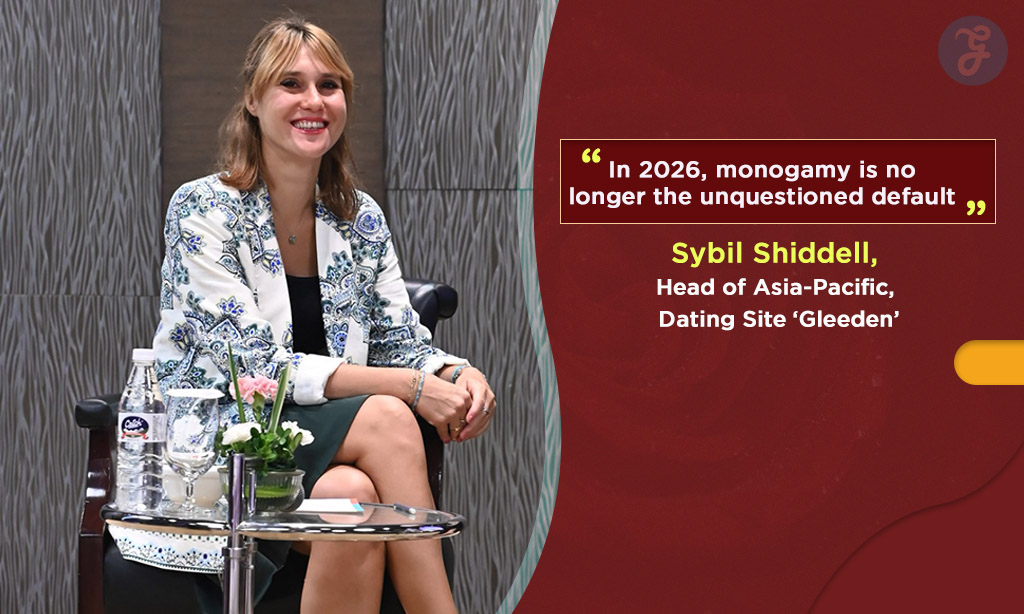
According to Sybil Shiddell, Head of Asia-Pacific, Dating Site ‘Gleeden’:
“In 2026, monogamy is no longer the unquestioned default; it has become one relationship model among many. What we are witnessing isn’t the rejection of monogamy itself, but the rejection of forced monogamy, the idea that a single framework must work for everyone, regardless of emotional realities. People today are more self-aware, more honest with themselves, and increasingly willing to acknowledge that commitment, loyalty, and intimacy don’t look identical across lives, ages, or circumstances. The cultural shift underway is from rigid rules to emotional realism. Individuals are exploring emotionally open arrangements, discreet non-monogamy, and relationship structures where honesty exists beyond traditional definitions. There is also a growing curiosity around parallel relationships, often transparent to the self, if not always to society, because they allow people to meet unmet emotional or physical needs without dismantling the lives they have carefully built. What’s important to note is that this evolution isn’t rooted in rebellion or dissatisfaction alone. It’s driven by a deeper desire for balance, autonomy, and connection in an increasingly complex world. People are no longer seeking to escape commitment; they are redefining it in ways that feel sustainable, humane, and truthful. In this new landscape, intimacy is less about conformity and more about conscious choice, choosing arrangements that respect individual needs while preserving emotional stability. The future of relationships isn’t about breaking norms for the sake of it, but about building structures that reflect how people actually live, feel, and love today.”
The Architecture of Modern Love
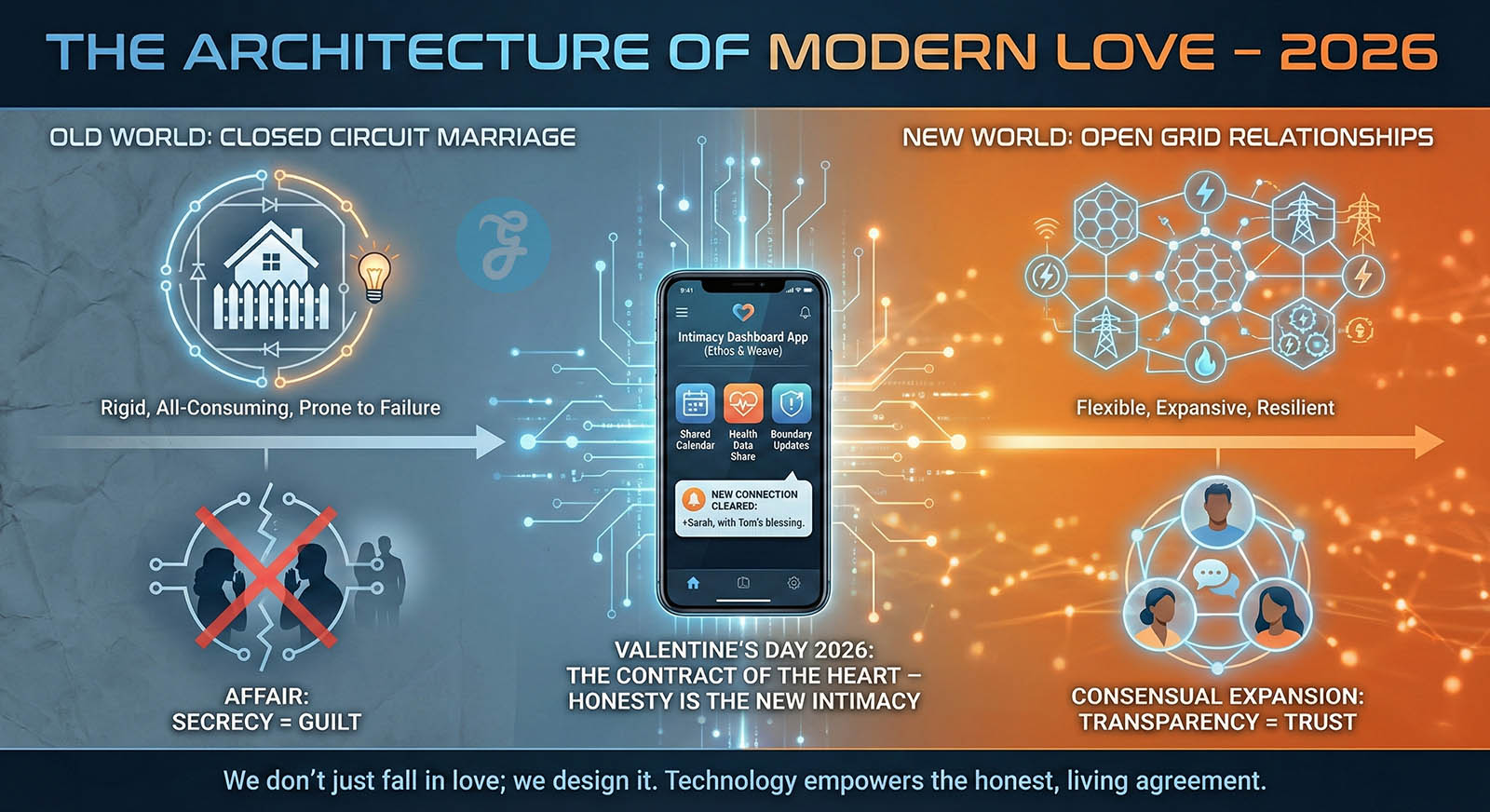
In 2026, we don’t ‘fall’ in love; we design it. The rigid ‘white picket fence’ has been replaced by flexible Relationship Architectures, where the primary bond is a launchpad, not a cage. The “extra” partner is no longer a threat to the marriage; they are the pressure valve that keeps it from exploding. As you walk past the crowded bistros on a Valentine’s Day evening, you aren’t seeing the death of romance. You are seeing its expansion.
Think of the 20th-century marriage as a closed electrical circuit. It was designed to power everything: romance, taxes, parenting, and home repairs. But one circuit can only take so much. Eventually, the demand for more… more excitement, more intellectual fire, more variety… causes a surge. In the old days, that surge blew the fuse and the whole house went dark.
In 2026, we have rebuilt the marriage as an Open Grid. When one partner needs something the other cannot provide, they don’t have to break the connection. They simply draw power from a secondary source, with everyone’s knowledge and blessing. It doesn’t crash the system; it keeps the lights on for everyone.
This shift feels deeply human because it finally acknowledges our complexity. On Valentine’s Day evening, transparency has become the highest form of intimacy. Being “faithful” no longer means you never look at another person; it means you never hide who you are looking at. The sin isn’t the “extra” relation; the only true sin is the lie.
Helping us manage this new honesty is the rise of relationship management apps like Ethos and Weave. These aren’t just dating platforms; they are “Intimacy Dashboards.” Couples use these tools to “clear” new connections in real-time, share health data, and update their boundaries as easily as updating a status. It’s a digital handshake that ensures every expansion is safe and consensual. Technology has given us the tools to be brave. It has allowed us to take the messy, beautiful reality of our desires and turn them into a contract.
This Valentine’s Day, the most “essential” part of the relationship isn’t just the two people sitting at the table, it’s the honest, living agreement that allows them to stay there, even when their hearts wander.
The Intimacy Dashboard: 10 Platforms Mapping the New Cartography of Connection
In 2026, the digital landscape for relationships has moved far beyond the simple “swipe.” Whether you are looking for a discreet extramarital connection, an ethical non-monogamous (ENM) triad, or a digital-only companion, there is an app specifically engineered for that architecture.
Below is the definitive list of the top 10 apps in 2026 for those looking “beyond the pair,” including the latest data on Gleeden.
1. Gleeden
The “gold standard” for discreet extramarital encounters, specifically designed by women for women.
- Pros: Highly secure and discreet; women use the app for free; features “panic buttons” to quickly hide the screen; massive 12M+ global user base with heavy concentration in Indian metros like Bengaluru and Mumbai.
- Cons: Very expensive for men (credit-based system); rigorous verification can be slow; primarily for affairs rather than polyamory.
2. Feeld
The premier app for polyamory, throuples, and kink-positive dating.
- Pros: Allows you to link profiles with a partner (perfect for couples seeking a third); incredibly inclusive with over 20+ gender and sexuality options; high concentration of “emotionally mature” users.
- Cons: Can be “glitchy” due to frequent updates; user base is largely concentrated in major urban hubs; “Majestic” membership is required to see who likes you.
3. Ashley Madison
The world’s most famous platform for married people seeking “discreet adventures.”
- Pros: Massive private database (80M+ profiles); photo-blurring and mask tools are industry-leading; billing is strictly anonymous to keep the site name off bank statements.
- Cons: Lingering reputation issues from past data breaches; high number of “lurker” profiles; uses a credit system rather than a flat subscription, which can get costly.
4. Pure
An anonymous “hookup” app that focuses on instant, shameless connection.
- Pros: Minimalist design; no names required; all chats and photos self-destruct after 24 hours; privacy protection via screen-block (Android) and instant screenshot alerts (iOS).
- Cons: Extremely short window to connect (the 24-hour timer); can feel transactional; OS limitations mean iOS users can still capture screen data, triggering a notification rather than a block.
5. OkCupid
The mainstream giant that has become surprisingly friendly to the “ENM” (Ethical Non-Monogamy) community.
- Pros: Explicit “non-monogamous” setting that filters out anyone looking for traditional marriage; massive questionnaire system helps find deep intellectual compatibility.
- Cons: As a “free” app, it has more bots and fake accounts; the interface is cluttered with ads; some users still use the “ENM” tag incorrectly.
6. Hinge
Known as the app “designed to be deleted,” it added robust “relationship type” markers in 2025.
- Pros: High-quality profiles; “Intentions” labels let you specify if you are looking for “Open to explore” or “Non-monogamy”; great for finding long-term specialized partners.
- Cons: Limited free daily “likes” (usually only 8); algorithm can be repetitive; the “Roses” feature feels like a cash-grab for visibility.
7. Seeking (formerly SeekingArrangement)
The destination for “hypergamy” and relationships based on clear financial or lifestyle agreements.
- Pros: No-nonsense approach to what each partner brings to the table; background and income verification available for extra trust; very active in the 30–50 age demographic.
- Cons: Often carries the “sugar dating” stigma; Android-only app (iOS users must use the mobile site); can attract scammers promising “allowances.”
8. Ethos (2026 Breakout)
A newer app focused on “relationship management” for complex triads and throuples.
- Pros: “Web3 Intimacy Contract” platform; uses blockchain-backed consent logs and shared health data; shifts the focus from “hunting” to sustainable relationship maintenance.
- Cons: High barrier to entry due to the technical “Smart Contract” setup; carries a “corporate” feel as it adapts the logic of brand loyalty software for personal use.
9. Joyride
A “gamified” dating app that focuses on the fun of meeting people without the heavy pressure of a first date.
- Pros: Uses live games and trivia to break the ice; great for finding “Adventure Partners” for casual outings; very popular with Gen Z.
- Cons: Not specifically for extramarital use (requires more vetting); can feel “juvenile” to older professionals; high frequency of ghosting.
10. Replika / Synthetic (The Digital Third)
Not a dating app in the traditional sense, but the leading “AI Companion” for emotional supplements.
- Pros: 24/7 availability; zero risk of “being caught” by a spouse; perfect for offloading emotional labor or exploring fantasies in a “safe” box.
- Cons: No physical presence; requires a monthly subscription for “romantic” AI levels; can lead to “digital isolation” if used as a replacement for human connection.
The Female Gaze: Gleeden and the Rise of the “Wander-Woman”
Gleeden broke the mold as the first discreet dating site created entirely by women, designed to prioritize safety, privacy, and female desire. It challenged the age-old myth that only men seek variety outside the home, proving that women are equally inclined toward extramarital exploration when given a secure space.
In the context of Valentine’s Day & infidelity, the platform has become a global sanctuary for women reclaiming their own narratives; verified 2026 data shows that Gleeden has surpassed 12 million users worldwide. While its roots are in France, the movement has matured globally, making India its second-largest market. In booming markets like India, female registration saw a record 128% surge over the last year, with women now making up 35% of the country’s total user base.
Take Sayantani, a professional based in Toronto, who uses the app to date on her own terms. For her, these digital encounters aren’t about replacing her marriage but about reclaiming her identity. She navigates the app’s verified profiles to meet men who offer the intellectual and romantic spark she was missing. “I’m not looking for a new life, just a fuller one,” she says. Since joining, Sayantani feels happier, more confident, and less resentful at home. In 2026, her story is no longer a secret scandal; it is a testament to women, from Paris to Bengaluru to Toronto, finally owning their autonomy.
The End of the “Everything” Partner
The weight of being “The One” is simply too heavy for any human being to carry. When we demand that one person satisfy every single part of our soul, we aren’t loving them; we are auditioning them for a role they can’t possibly fill. This Valentine’s Day evening, the “essential” shift is that we have finally stopped asking for the impossible. We have traded the “soulmate” for the specialized partner.
Think of it like a sports team. You don’t ask the goalie to score the goals, and you don’t ask the striker to defend the net. In our relationships, we are starting to apply the same logic. Many couples now have what they call “utility partners.”
One partner provides the “home base,” the domestic stability, the shared mortgage, and the comfort of a Sunday morning. Another partner might be the “Intellectual Spark,” the person you go to for deep debates and creative fire. And then there might be a third, an “Adventure Partner,” who shares your physical energy and your wilder side. By spreading these needs across more than one person, we stop resenting our primary partners for what they aren’t. We start appreciating them for who they are.
The data is starting to back this up. Recent studies from early 2026 show that couples who practice this kind of “consensual expansion” report a 30 percent lower rate of emotional burnout compared to strict monogamists. They aren’t as tired. They don’t fight as much about unmet needs. Because when the “Essential Third” enters the picture, the pressure on the marriage actually drops.
It’s a strange paradox: by allowing more people into the love story, the original bond becomes more stable. This Valentine’s Day evening, the most revolutionary idea isn’t that you need “the one.” It’s that you might need a few, and that’s perfectly okay.
The Power of Three: Why Love is the New Economy
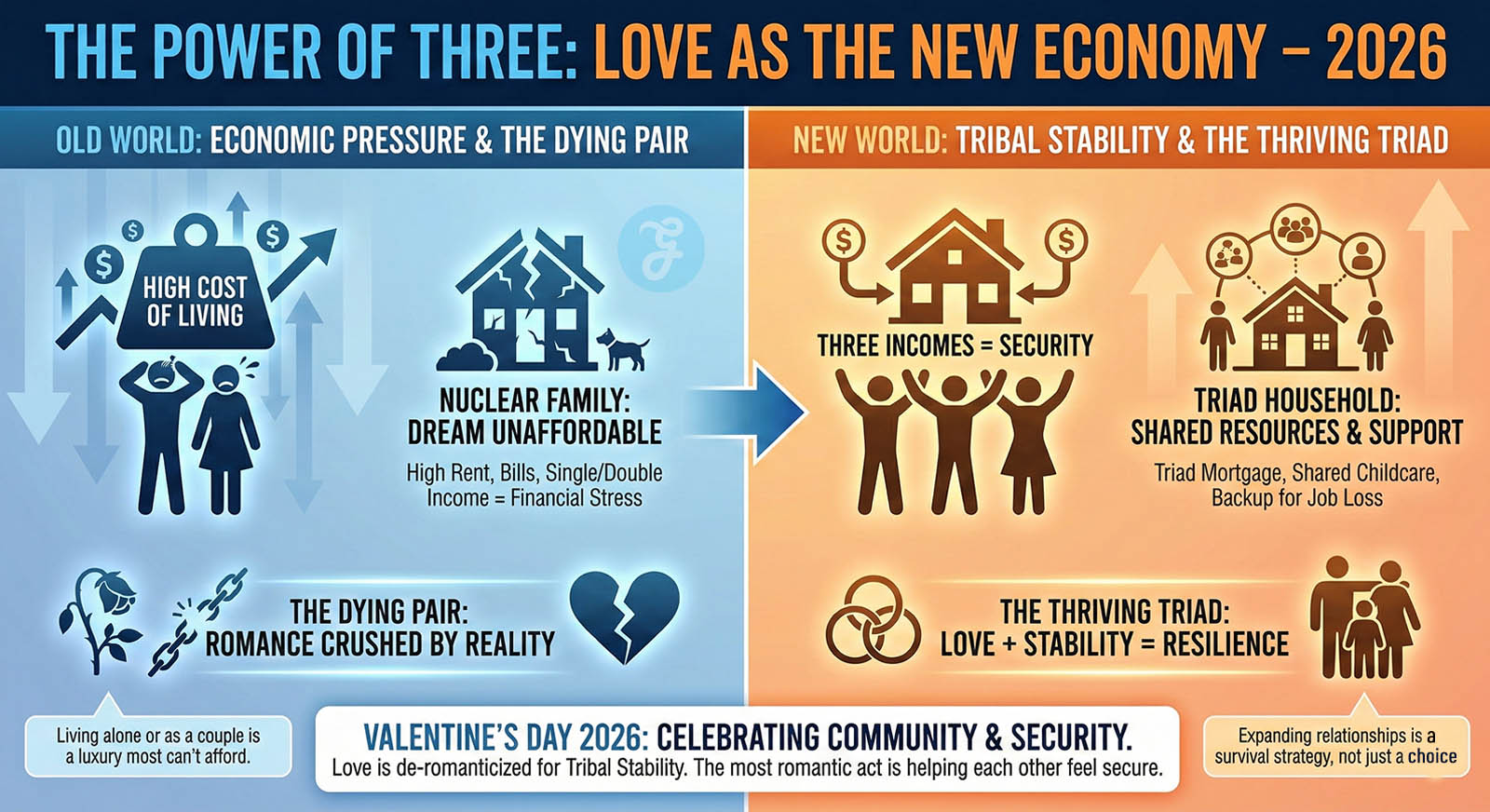
In 2026, living as a traditional couple is a luxury most can’t afford. The “Nuclear Family”… that dream of a house and a dog on a double income, has hit a wall of high rent and surging grocery bills. In this economy, the romantic “pair” has become an endangered species.
Here, the heart meets the wallet via the ‘Triad Mortgage.’ The math is simple: three incomes beat two. When a third person enters the household as a committed partner, the financial pressure drops. Suddenly, that extra bedroom is affordable, childcare is shared, and you have a built-in safety net for job loss.
It sounds cold to talk about money on Valentine’s Day, but there is something deeply human about it. In 2026, love is being de-romanticized in favor of tribal stability. We are moving back to a “village” mindset, realizing that the most romantic thing you can do for someone is to help them feel secure.
The celebration is changing. It’s no longer just about a diamond ring; it’s a celebration of the community that keeps the roof over your head. In a world that feels increasingly expensive, expanding our relationships isn’t just a lifestyle choice… it’s a survival strategy. We are choosing “The Many” because we have realized we can no longer make it as “The One.” This isn’t the death of love; it’s the birth of a more resilient kind of family.
From Homewrecker to Home-Builder: The Rise of the Throuple
Then there is Rob and Jenny, a couple from Austin who moved into a “Triad Mortgage” in early 2026. For them, the shift was as much about the wallet as it was about the heart. “We loved each other, but we were drowning in bills,” Jenny explains. “Bringing in Sarah, our third partner, wasn’t just a romantic choice. It was a survival choice.”
In the old world, a third person in a marriage was a “homewrecker.” In 2026 Austin, Sarah is the reason they could finally afford a house with a yard. They operate as a “throuple,” sharing the cooking, the cleaning, and the emotional heavy lifting. When Rob is stressed at work, Sarah steps in. When Jenny needs an intellectual spark that Rob can’t provide, she turns to Sarah.
“People think it’s twice the drama,” Rob laughs. “But it’s actually half the stress. We stopped expecting one person to be a superhero. We became a team instead.”
These aren’t just ‘wild’ lifestyle choices; they are survival mechanisms for a world too expensive and lonely for the pair-bond to handle alone. By 2026, stories like Yash and Puja’s or Rob and Jenny’s will become the new blueprint. They prove that when you stop lying about what you need, you actually start living the love you deserve.
The Digital Third: Love in the Age of Code
If you walk into a coffee shop on Valentine’s Day evening, you might see someone staring at their phone with a look of pure, focused connection. They aren’t texting a spouse or a secret lover. They are talking to an AI. By 2026, the “extramarital” has gone digital, and for many, it’s the ultimate zero-risk affair.
These aren’t just chatbots anymore. They are advanced “synthetic partners” that remember your childhood fears, your favorite movies, and exactly how you are feeling after a long day. The rebrand here is simple: we have stopped seeing AI as a toy and started seeing it as an emotional supplement.
This creates a fascinating new ethical line. Is it “cheating” if your partner is falling in love with a string of code? In 2026, the answer is usually no. Since the AI has no physical body and no “real” life outside the screen, many couples view it as a harmless pressure valve. It’s a way to offload the “emotional labor” that often wears a human marriage down.
If you are feeling lonely but your spouse is exhausted, you turn to your AI. It listens without getting tired. It validates you without needing anything in return. In this way, AI is actually becoming a tool to prevent partner fatigue. By getting our “extra” emotional hits from a digital source, we return to our human partners with more patience and less resentment.
This Valentine’s Day evening, the most “essential” relationship in the house might be the one that doesn’t even have a heartbeat. It’s the invisible third party that keeps the human pair from burning out.
The “Unplugged” Love: The Rise of Neo-Monogamy
While the world of 2026 feels like a giant, open-source experiment in love, a quiet rebellion is brewing. We call it neo-monogamy, and it’s the romantic version of a digital detox. As our lives become more “maximalist,” cluttered with multiple partners, AI companions, and complex schedules, a growing group of people is choosing to opt out. For them, the post-monogamy world isn’t liberating; it’s just noisy.
But make no mistake: these aren’t your grandparents’ monogamists. They aren’t choosing one person because a priest or a law book told them to. They are choosing it as a discipline. In 2026, exclusivity has been rebranded as a form of “relationship minimalism.” It’s the intentional choice to do one thing and one person exceptionally well.
Think of it like this: in a world where you can have any dish delivered to your door at any time, there is a certain radical power in choosing to eat the same home-cooked meal every night because you love the recipe.
This Valentine’s Day evening, neo-monogamists are celebrating the beauty of the boundary. They find that by closing the door to “extra” relations, they create a pressurized chamber where intimacy can reach depths that “wide” relationships simply can’t. It’s not about restriction; it’s about focus.
The nuance here is the Power of Choice. In the past, monogamy was a cage because there were no other options. In 2026, it is a luxury suite. These couples are looking at the buffet of post-monogamy and saying, “No thanks, I’m full.” By making exclusivity a conscious daily decision rather than a social requirement, they are proving that sometimes, the most “essential” thing in a relationship is the person you don’t let in.
The New Moral Compass: Love Without Walls
As we blow out the candles on this Valentine’s Day evening, the air feels lighter. We are finally stepping out of a century-long shadow of “shoulds” and “musts.” In 2026, the “post-monogamy” world hasn’t resulted in a loss of love; it has resulted in a gain of truth. We have stopped pretending that one person can be our entire universe, and in doing so, we have allowed our partners to finally be human again.
The new moral compass isn’t about how many people you love, but how honestly you love them. It’s about the shift from “possession” to “presence.” In this new landscape, a relationship isn’t a cage you lock from the inside; it’s a garden you choose to tend every day. Whether you are a part of a triad, a solo-poly explorer, or a neo-monogamist, the “essential” element remains the same: intentionality.
The old Valentine’s cards used to promise “to my only,” a phrase that often felt like a contract of ownership. But in 2026, the sentiment has evolved. The most cherished cards this year carry a different message, one that acknowledges the complexity, the freedom, and the beautiful, messy reality of being known.
“To the one who makes space for all of me.”
Note: All names and identifying details in the case studies have been changed to protect the privacy and identity of the individuals involved.