Global oil markets are bracing for severe disruptions as the United States has officially entered the ongoing military conflict between Israel and Iran. With the U.S. targeting Iranian nuclear sites in coordinated airstrikes, oil prices have reacted sharply, and traders are preparing for an extended period of uncertainty that could send crude above $100 per barrel.
Rising Prices Signal Market Anxiety
Early Asian trading hours saw oil futures climbing more than 2% as financial markets absorbed the implications of direct U.S. military engagement in the Middle East. U.S. benchmark West Texas Intermediate (WTI) rose to around $75.35 per barrel, while Brent crude—used as a global price standard—climbed to nearly $78.53 per barrel.
This immediate reaction reflected investor fears of long-term instability in one of the world’s most crucial energy-producing regions. Markets are also pricing in the growing possibility of retaliatory actions from Iran, which could further jeopardize oil transit routes and production infrastructure across the Gulf.
Strait of Hormuz at the Center of Global Supply Risks
At the heart of the current crisis is the Strait of Hormuz, a narrow but strategically vital waterway linking the Persian Gulf with the Arabian Sea. Roughly 20 million barrels of oil and refined petroleum products pass through this channel daily, accounting for nearly 20% of all global oil shipments.
Following the U.S. attacks on its nuclear sites, Iran’s parliament passed a resolution calling for the closure of the Strait of Hormuz to commercial shipping. Although this decision requires final approval from the country’s Supreme National Security Council to be enforceable, the move has added to global market jitters.
Even if Iran does not fully close the strait, intermittent threats or acts of harassment—such as deploying naval patrols, fast attack boats, floating mines, or missile deployments—could be enough to create bottlenecks and raise insurance premiums for oil tankers. These actions alone could significantly disrupt shipping schedules and drive oil prices higher, even without a complete shutdown.
How a Potential Blockade Could Reshape Oil Markets
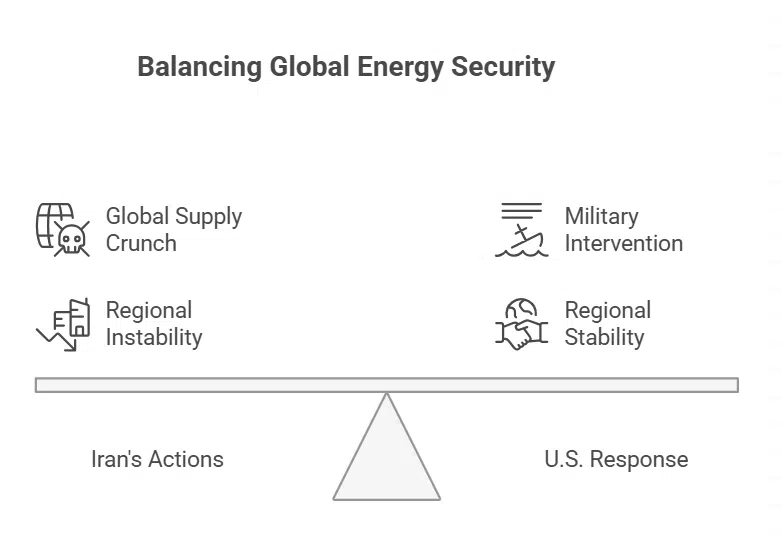
If Iran follows through on threats to close the Strait of Hormuz or even partially restricts access, the global energy market could face its most significant shock since the Russian invasion of Ukraine in 2022. In that instance, prices soared past $120 per barrel due to fears of long-term shortages.
A prolonged disruption in the strait could cut off millions of barrels of oil and liquefied natural gas (LNG) shipments per day. The immediate result would likely be a supply crunch that hits not just major importers like China, India, Japan, and South Korea, but also consumers across Europe and North America. Energy-dependent industries would face higher input costs, and everyday consumers would see rising fuel prices at gas stations.
Military analysts suggest that if Iran attempts to enforce a full closure of the strait, the U.S. and its allies would be compelled to intervene militarily to reopen it. Such a conflict could evolve into a drawn-out standoff, with naval battles, infrastructure sabotage, and threats to nearby oil fields in Saudi Arabia, the UAE, and Kuwait.
Price Forecasts Suggest Surge to $100+ per Barrel
Multiple energy analysts and financial institutions are updating their oil forecasts amid the rising tensions. If a full blockade lasts more than a few weeks, Brent crude could approach or exceed $100 per barrel. Some estimates suggest the price could rise to $110–$120 if Gulf infrastructure is damaged or other regional producers are pulled into the conflict.
Short of a full closure, even small-scale interference—such as delaying tankers or missile threats—could keep prices elevated for weeks or months. The perception of supply risk alone can push speculative buying in commodity markets, reinforcing a self-fulfilling cycle of price increases.
Moreover, if Iran or any associated proxy group targets oil production facilities in the Gulf or infrastructure like pipelines and refineries, the disruption could surpass the 2022 crisis both in scale and duration.
Volatility Near Ukraine War Levels
The volatility index for crude oil, which measures how much prices are expected to swing over the next 30 days, has surged to levels not seen since March 2022, shortly after Russia’s full-scale invasion of Ukraine. This reflects heightened investor anxiety and a lack of visibility regarding how the current geopolitical tensions will unfold.
Unlike past periods of price shocks driven by demand-side issues or market speculation, the present volatility is rooted in real and immediate supply-side threats. This increases the likelihood of sustained price swings rather than a temporary spike.
Global Economic Implications: Inflation, Fuel Prices, and Growth
A significant rise in oil prices would have immediate ripple effects across the global economy:
-
Fuel Costs: Consumers could see retail gasoline and diesel prices rise sharply, especially during the high-demand summer travel season. In the U.S., prices at the pump could climb by 20–30 cents per gallon or more if tanker delays begin affecting supply.
-
Inflation Pressure: Higher energy prices would feed into inflation statistics globally, making it more difficult for central banks to reduce interest rates. This could delay economic recovery in many advanced economies and increase borrowing costs for emerging markets.
-
GDP Impact: Economists warn that a long-term spike in oil prices could shave off global GDP growth by nearly 1% annually if the crisis drags on and energy costs become entrenched.
Historical Context: Repeating Past Crises?
This is not the first time Iran has threatened to close the Strait of Hormuz. Similar declarations were made in 2011 and 2018, during periods of heightened tension with Western nations over sanctions and nuclear agreements. In both cases, the threats were never fully acted upon, partly due to the massive economic consequences Iran itself would suffer.
However, the current crisis is markedly different due to the scale of direct military engagement, especially with the United States now actively involved. Unlike past threats, this moment features open exchanges of missile fire between nations and the risk of miscalculation or further escalation is significantly higher.
Signals from Both Sides: Avoiding Energy Infrastructure?
Despite the volatility, some market analysts note that, so far, neither side in the conflict has directly targeted energy infrastructure. Iranian oil export terminals and pipelines have not been attacked, and shipping through the Strait of Hormuz continues, albeit under higher security and surveillance.
This restraint suggests that both Iran and its adversaries may be deliberately avoiding a full-blown energy crisis—for now. But that balance is fragile and can be disrupted by a single escalatory event, especially if civilian casualties or retaliatory strikes provoke a more aggressive response.
Key Developments to Watch
1. Iran’s Strategic Decision on Strait Closure
The global market is watching whether Iran will convert parliamentary threats into action. A decision by the Supreme National Security Council could signal a major escalation.
2. U.S. and Allied Military Posture
Naval movements, defense drills, or escort missions through the Strait of Hormuz could suggest that Western forces are preparing for possible conflict over tanker routes.
3. Market Indicators
Oil price movements, volatility indexes, and insurance rates for Gulf shipping lanes will offer clues about how seriously traders are taking the threat.
4. Energy Infrastructure Attacks
If military strikes begin targeting refineries, oil fields, or LNG terminals, the conflict could enter a much more dangerous and economically destructive phase.
The U.S. airstrikes on Iran’s nuclear sites have transformed a regional conflict into a broader geopolitical crisis with serious implications for global energy markets. While prices have not yet exploded, the conditions are in place for a major oil shock if the Strait of Hormuz is disrupted or if Gulf energy infrastructure is attacked.
Oil prices have begun climbing steadily, and market volatility is approaching levels seen during previous major wars. Traders, governments, and consumers should all prepare for the possibility of sustained price increases, higher inflation, and broader economic fallout.
The next few days and weeks will be crucial. Much depends on whether Iran escalates, how the U.S. and its allies respond, and whether diplomatic channels can offer a path to de-escalation before the energy markets tip into full-blown crisis.