

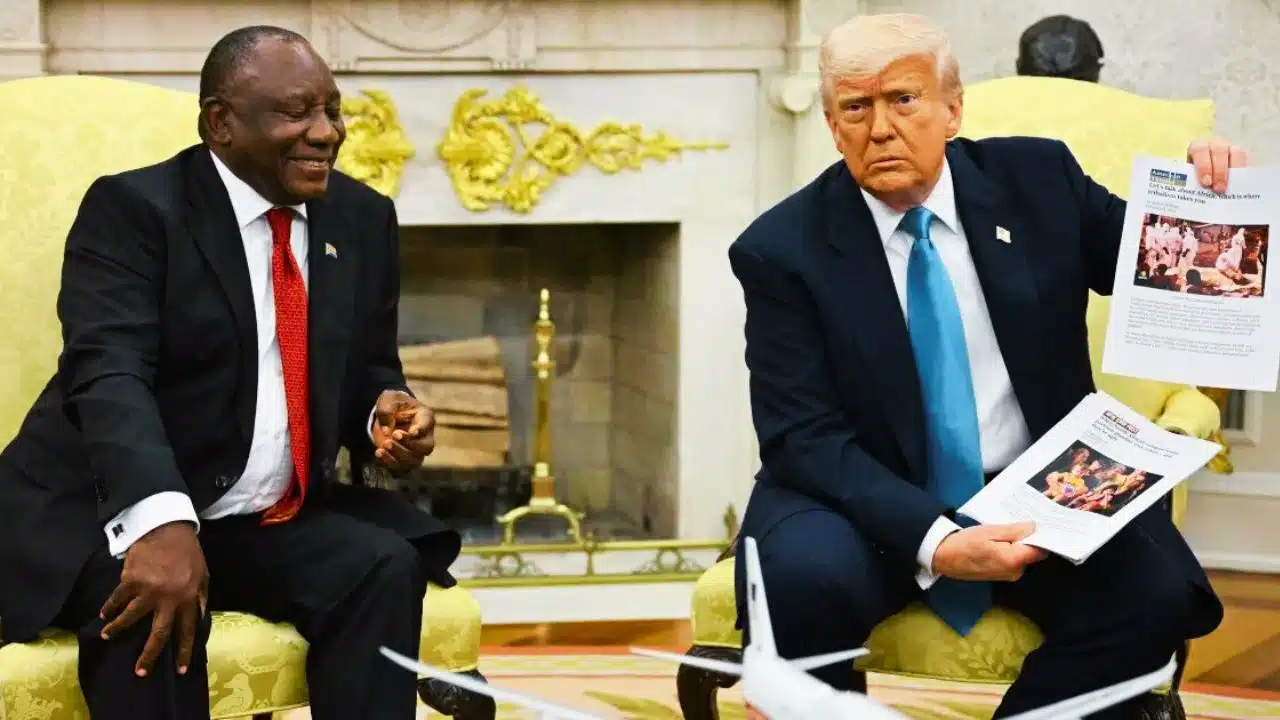
The United States has announced it will boycott this month’s G20 summit in South Africa, with President Donald Trump ordering a complete withdrawal of U.S. representation over his renewed and highly disputed claims that white South African farmers are facing systematic “abuse,” violent attacks and land seizures.
A Dramatic Boycott Order
In a post on his social media platform, Trump declared that “no U.S. government official” would attend the G20 leaders’ summit in Johannesburg, calling South Africa’s role as host “a complete disgrace.”
The decision means Vice President JD Vance, who had been scheduled to attend in Trump’s place, will no longer travel to Johannesburg, turning what was initially expected to be a downgraded presence into a full diplomatic boycott.
The summit, set for 22–23 November in Johannesburg and the first G20 leaders’ gathering ever hosted on African soil, was meant to showcase South Africa’s presidency under the theme of solidarity, equality and sustainable development.
Trump’s Claims About White Farmers
Trump justified the boycott by repeating allegations that South Africa is allowing or enabling widespread human rights abuses against white farmers, often referred to locally as Afrikaners.
He has claimed that these farmers face “violence, death, and the seizure of their land and farms,” language that echoes right‑wing narratives of a supposed “white genocide” in South Africa that have circulated for years despite repeated debunking by experts.
The administration has linked these claims to broader policy moves, including sharply restricting the annual U.S. refugee cap to 7,500 and signaling that a large share of those places should go to white South Africans “fleeing discrimination and violence.”
South Africa’s Forceful Rebuttal
The South African government, led by President Cyril Ramaphosa, has repeatedly rejected Trump’s characterizations as “false,” “baseless” and politically motivated, insisting that there is no state‑sanctioned campaign targeting white farmers.
Ramaphosa has said he personally told Trump that claims of systematic persecution are “entirely untrue,” stressing that South Africa’s high overall crime rates affect both Black and white citizens and that farm attacks do not amount to a racially targeted campaign.
Officials in Pretoria note that, more than three decades after the end of apartheid, white South Africans still enjoy a significantly higher average standard of living than the Black majority, undercutting the narrative of structural victimization advanced by Trump and his allies.
Land Reform at the Heart of the Dispute
At the core of Trump’s argument is South Africa’s contentious land reform agenda, including the Expropriation Act of 2025, which allows land to be taken in certain cases for “zero or nominal compensation” as part of efforts to redress historical dispossession under apartheid.
The Trump administration has portrayed this legislation as evidence that Pretoria is “confiscating” white‑owned farms, even though South African authorities and independent analysts say there is no evidence of a systematic program of racial expropriation or mass seizures.
For Ramaphosa’s government, land reform is framed as a cornerstone of social justice and economic inclusion, designed to give Black South Africans greater access to land and opportunity rather than to strip any single group of its property on racial grounds.
A Relationship Already Under Strain
The boycott marks the most dramatic rupture yet in a U.S.–South Africa relationship that has steadily frayed during Trump’s second term, particularly over Pretoria’s domestic policies and foreign alignments.
Earlier this year, Secretary of State Marco Rubio skipped a G20 foreign ministers’ meeting in protest at what Washington described as an overly “ideological” focus on diversity and climate change in the agenda.
Trump has also signed an executive order cutting all U.S. financial assistance to South Africa, accusing the government of pursuing “anti‑white policies” at home and supporting “bad actors” abroad, including Hamas and Iran, claims Pretoria strongly denies.
Domestic Politics and the ‘MAGA’ Lens
Critics inside and outside South Africa argue that Trump’s intensely public focus on white Afrikaners is tightly bound up with his domestic political messaging, particularly to his conservative base.
Some Afrikaner community leaders have publicly distanced themselves from the U.S. president’s rhetoric, warning that their identity and real security concerns are being instrumentalized “to further the MAGA movement’s interests,” as one activist told NPR.
Analysts say the administration’s spotlight on white South African farmers contrasts sharply with its much more restrictive stance on refugees from other conflict zones, reinforcing accusations that the policy is less about universal human rights than about race and ideology.
Global Response and G20 Fallout
South African officials have dismissed the U.S. boycott as “their loss,” with Ramaphosa arguing that Washington must “think again whether boycott politics actually works” in an era of complex, interlinked global crises.
The Johannesburg summit was envisioned as a showcase for Africa’s development agenda within the G20, with priorities including inclusive growth, food security and the role of artificial intelligence in sustainable development.
While most other G20 leaders are still expected to attend, the absence of the United States—the world’s largest economy and incoming G20 president for 2026—introduces a new layer of uncertainty over the forum’s ability to deliver ambitious collective commitments.
What the Boycott Signals
Beyond the immediate diplomatic fallout, the boycott underscores how the G20 itself is being pulled into wider ideological and geopolitical battles, from land justice and race to climate policy and global alignments.
For South Africa, the snub is both a challenge and an opportunity: a test of whether it can still leverage its historic role as the first African G20 host to push forward an agenda centered on inequality, development and multilateralism without Washington at the table.
For U.S. allies and rivals alike, Trump’s move raises fresh questions about how reliably Washington will engage with multilateral institutions, and whether domestic culture‑war themes will increasingly dictate which global forums the United States chooses to embrace—or abandon.






























