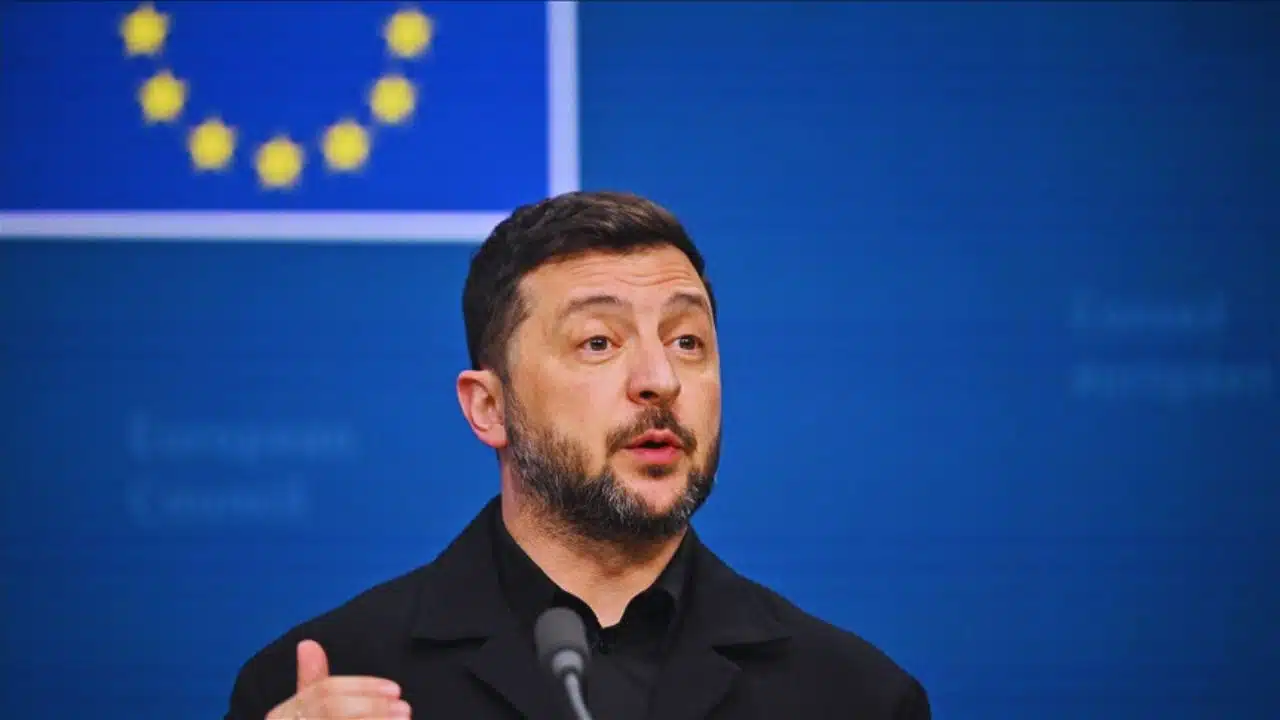
US captures Maduro in a surprise Caracas operation and flies him toward New York to face U.S. charges, prompting international alarm and a debate in Washington—while Ukraine’s President Volodymyr Zelenskyy publicly suggests the move shows how dictators can be handled, hinting at Vladimir Putin.
What happened in Venezuela
U.S. President Donald Trump said U.S. forces carried out a major overnight operation in Caracas that resulted in the capture of Venezuelan President Nicolás Maduro and his wife, Cilia Flores.
Trump said the pair were removed from Venezuela and taken first onto a U.S. vessel and then transported to New York state as U.S. authorities prepared the next legal steps.
U.S. military leadership briefed that the mission involved large-scale air, sea, and intelligence coordination and included an extraction force that came under fire near the target compound before Maduro and Flores surrendered into custody.
Key timeline (reported)
| Date (2026) | Development | Why it matters |
| Jan 2–3 | Operation conducted overnight in Caracas; Maduro and Flores taken into custody. | Marks a sharp escalation: direct U.S. action to seize a sitting head of state. |
| Jan 3 | Trump says the U.S. will temporarily “run” Venezuela during a transition. | Raises immediate questions about governance, sovereignty, and exit strategy. |
| Jan 3 | U.N. Secretary-General’s office voices alarm about escalation and international law implications. | Signals fast-moving diplomatic fallout and potential multilateral pressure. |
The legal case the U.S. cites
U.S. officials pointed to longstanding U.S. criminal allegations against Maduro, including accusations tied to large-scale cocaine trafficking and links to armed criminal groups, and said the case is being handled through the federal court system in New York.
The U.S. attorney general’s office referenced a superseding indictment in the Southern District of New York, while U.S. officials described the operation as fundamentally an arrest of indicted fugitives supported by the military.
In Washington, lawmakers from both parties publicly challenged the administration’s process and legal footing—especially around Congress’s role in authorizing hostilities—while the administration argued advance notice risked operational leaks and mission failure.
Political shockwaves inside Venezuela and abroad
Maduro’s allies condemned the seizure as an illegal “kidnapping” and framed it as an attack on Venezuelan sovereignty, while demanding his return and insisting he remains Venezuela’s only legitimate president.
Trump, in contrast, said the U.S. intends to oversee a transition and emphasized restarting Venezuela’s oil infrastructure and production, language that immediately fueled criticism that the operation mixed security claims with energy and regime-change goals.
At the United Nations, Venezuela’s representation sought an emergency Security Council discussion, and the U.N. Secretary-General’s office warned the escalation could set a dangerous precedent if international law is not respected.
Zelenskyy’s remark—and the Putin implication
After the Venezuela operation, Ukraine’s President Volodymyr Zelenskyy was asked publicly about Maduro’s capture and responded with a pointed line suggesting that if dictators can be dealt with this way, “the United States knows what to do next,” widely interpreted as a jab aimed at Russian President Vladimir Putin.
The remark landed amid continued uncertainty over ceasefire diplomacy and the broader question of whether pressure on Moscow will rise or fall in 2026.
Zelenskyy’s comment did not announce a specific plan, but it highlighted how Kyiv is watching U.S. actions outside Europe for signals about Washington’s appetite for risk, coercion, and decisive operations against leaders it labels authoritarian.
Why this matters beyond Venezuela
The seizure of a foreign leader by U.S. force—paired with talk of temporarily “running” another country—has quickly become a test case for how far major powers will go in pursuing security objectives across borders.
U.S. lawmakers and officials openly raised “precedent” concerns, warning that if Washington asserts a right to capture foreign leaders it accuses of crimes, rivals could claim similar authority against U.S. partners or even against U.S.-aligned leaders.
For Ukraine, the episode injects a new—and unpredictable—dimension into how deterrence is discussed: Zelenskyy’s quip reflects a desire for tougher action against Putin, while critics argue that normalizing cross-border leader seizures could backfire strategically.
Final thoughts
In Venezuela, the immediate next question is who holds real authority on the ground and whether a transition can occur without prolonged violence, fragmentation of the security forces, or competing claims to legitimacy.
In the U.S., Congress is likely to intensify demands for briefings and a clear legal rationale, especially as the administration’s own critics argue the mission blurred lines between law enforcement, war powers, and regime change.
In Europe, Zelenskyy’s “what to do next” message underscores that Ukraine’s leadership sees global events—far from the front lines—as potential indicators of how the world might eventually approach Putin and the wider Russia-Ukraine war.