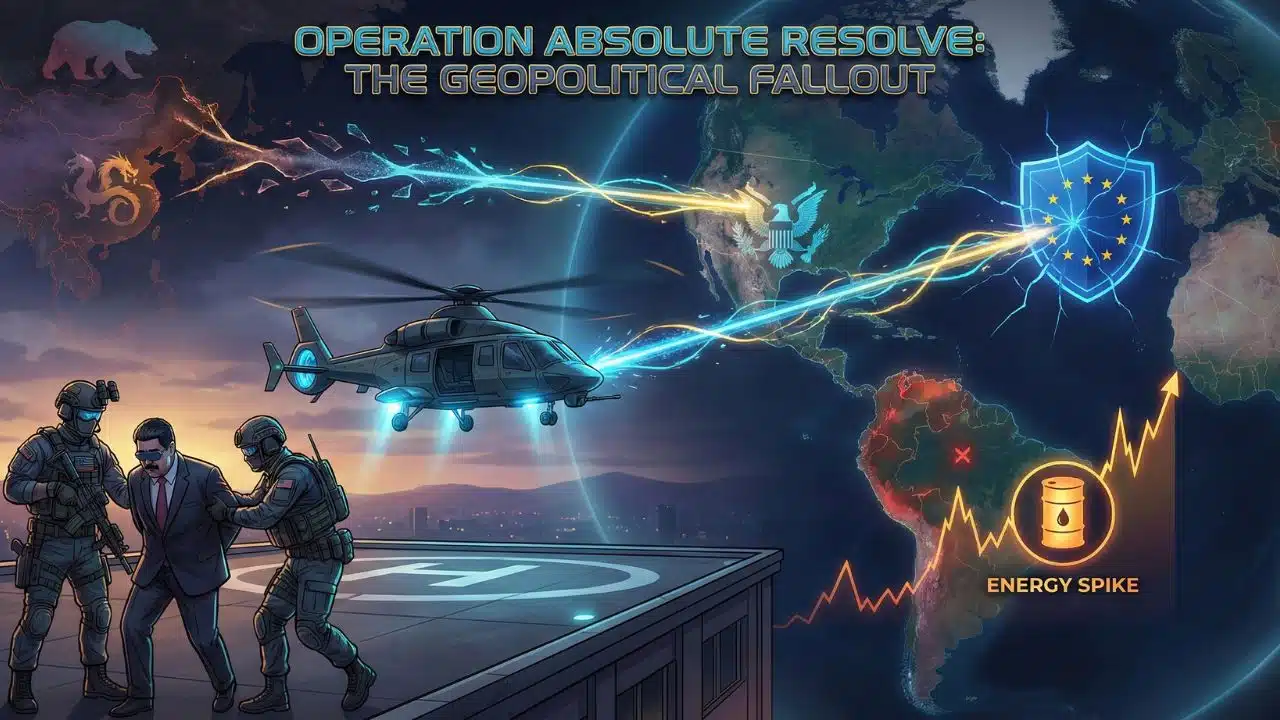
The unprecedented US special forces operation to capture Venezuelan President Nicolás Maduro has shattered the status quo in the Western Hemisphere, forcing the European Union into a precarious balancing act between transatlantic solidarity and the defense of international law. The dawn raid on January 3, 2026, codenamed ‘Operation Absolute Resolve,’ is not merely a regime change; it is a kinetic redefinition of sovereignty that will echo from Brussels to Beijing.
The Road to ‘Absolute Resolve’
To understand the gravity of this moment, we must look beyond the immediate shock of the Delta Force raid. This operation was not an impulsive act but the culmination of a systematic escalation strategy initiated by the Trump administration in early 2025. The “Trump Corollary” to the Monroe Doctrine, outlined in the 2025 National Security Strategy, explicitly declared the Western Hemisphere a zone of “exclusive strategic interest.”
The path to Caracas began in earnest in August 2025, when the US deployed three guided-missile destroyers to the Caribbean, ostensibly for counter-narcotics operations. By November, this had swelled to a full naval blockade involving amphibious assault ships, effectively choking off Venezuela’s oil exports to non-US sanctioned entities. The intelligence groundwork was laid by declaring the Tren de Aragua gang a “Foreign Terrorist Organization,” creating a legal pretext for military action on foreign soil. When weather conditions cleared on the night of January 2, 2026, the US moved from containment to decapitation, aiming to neutralize what it termed a “narco-terrorist regime” in a single stroke.
Core Analysis: The Structural Shifts
1. The Monroe Doctrine 2.0: A Return to Kinetic Realpolitik
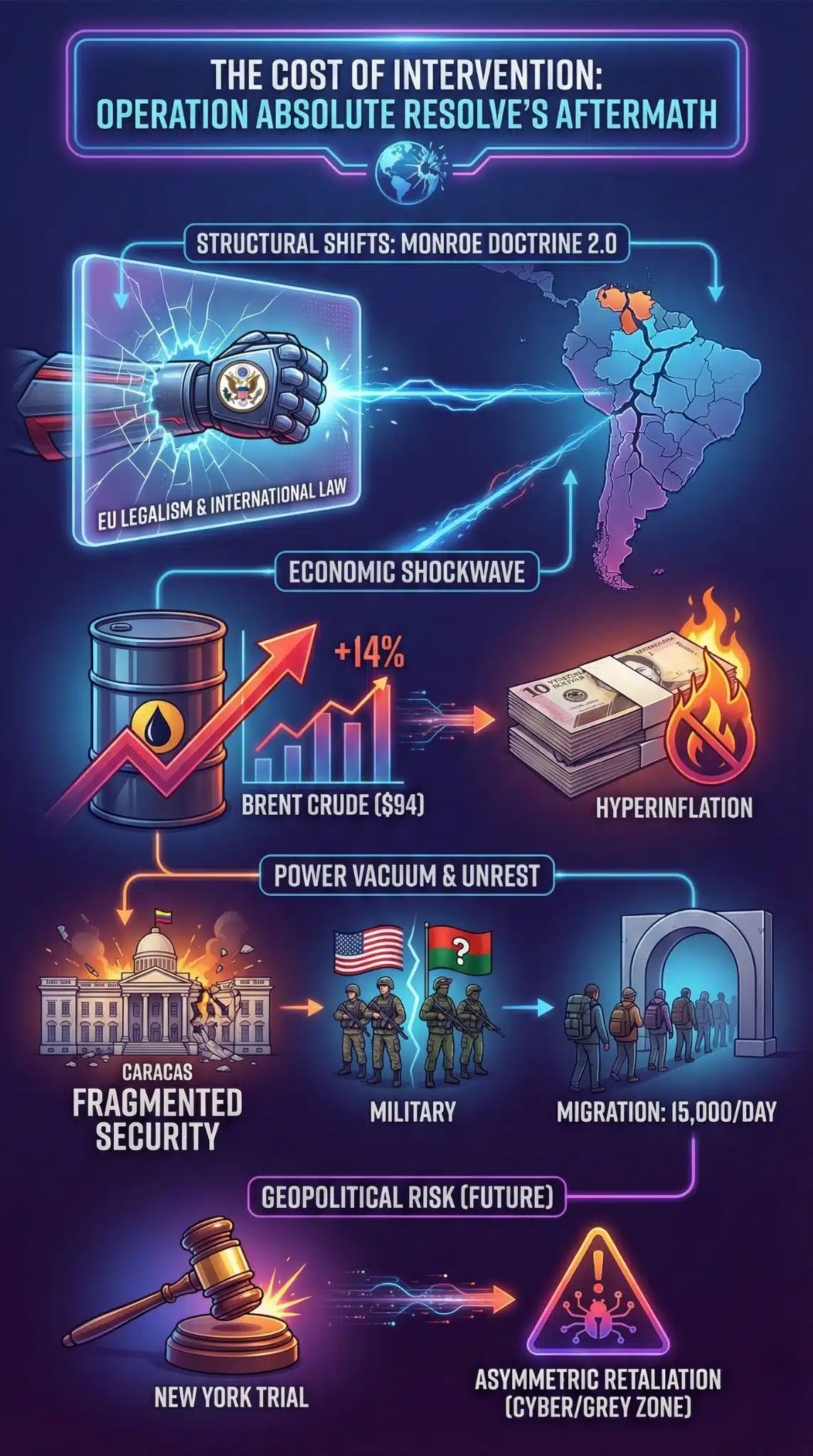
The most immediate implication is the resurrection of the Monroe Doctrine, stripped of its Cold War subtleties. Unlike the covert interventions of the 20th century, this was an overt, made-for-TV projection of power. By physically removing a head of state and flying him to New York to face trial, Washington has signaled that it no longer recognizes the Westphalian sovereignty of nations it deems “criminal enterprises” within its near abroad. This challenges the EU’s preferred “soft power” approach, rendering tools like sanctions and dialogue momentarily irrelevant. The message to Havana, Managua, and potentially Mexico is stark: diplomatic immunity has been revoked.
2. The Transatlantic Rift: Legalism vs. Action
The European Union finds itself in a strategic bind. High Representative Kaja Kallas’s call for “restraint” and insistence that “international law must be respected” highlights a widening philosophical gap. For Washington, the operation was a pragmatic solution to a security threat; for Brussels, it is a violation of the UN Charter that sets a dangerous precedent.
The EU fears that endorsing this action implicitly validates similar moves by other great powers. If the US can decapitate a regime in its sphere of influence, what arguments remain to deter Russia from escalating in Georgia or Moldova, or China in its periphery? Brussels is now forced to play “good cop” to the US “bad cop,” attempting to maintain channels with the Global South while not fully alienating its primary security guarantor.
3. The Power Vacuum and Civil Unrest
The removal of Maduro does not equate to the removal of Chavismo. Vice President Delcy Rodríguez has already assumed the mantle of acting president, denouncing the “kidnapping.” The real danger lies in the fragmentation of the Venezuelan security apparatus. The military (FANB) faces a prisoner’s dilemma: defect to the US-backed transition in exchange for amnesty (and potentially access to frozen funds) or dig in and fight a guerrilla war alongside the paramilitary colectivos. Early reports of internet blackouts and the jamming of the electrical grid suggest the US is trying to paralyze command and control, but a protracted civil conflict could unleash a new migration wave of 500,000+ refugees into Colombia and Brazil within weeks.
4. Energy Markets: The Fear Premium
The strike triggered an immediate 12% spike in Brent Crude prices, hitting $94/barrel. While Venezuela’s production was already depressed, the market is pricing in the risk of sabotage against infrastructure and the potential for a wider regional conflict involving Guyana or maritime shipping lanes.
Key Data: The Cost of Intervention
Table 1: Economic & Political Indicators (Pre vs. Post Operation)
| Metric | Status (Dec 2025) | Status (Jan 5, 2026) | Trend/Forecast |
|---|---|---|---|
| Brent Crude Oil | $82.50 / barrel | $94.10 / barrel | +14% (Volatile Upside) |
| Venezuelan Inflation | 340% YoY | Est. 1,200% (Annualized) | Hyperinflationary Spiral |
| PDVSA Production | 750k bpd | < 200k bpd (Halting) | Near-total collapse likely |
| EU Defense Stocks | Stable | -4.5% (Dip) | Investor fear of escalation |
| Migration Flows | ~2,000 daily | ~15,000 daily (Projected) | Border Crisis Imminent |
Table 2: Global Reaction Matrix
| Bloc | Key Actors | Stance | Strategic Motivation |
|---|---|---|---|
| The Architect | USA (Trump/Rubio) | Celebratory | Domestic political win; reassert hegemony. |
| The Skeptic Ally | EU (Kallas/Von der Leyen) | Cautious/Critical | Uphold Int’l Law; fear of precedent; refugee worry. |
| The Pragmatist | UK (Starmer) | Neutral/Wait-and-See | balancing US trade ties with legal norms. |
| The Antagonist | Russia/China/Iran | Hostile/Condemning | Leverage event to label US as “aggressor” in UN. |
| The Neighbors | Brazil (Lula) / Colombia (Petro) | Alarmed | Fear of spillover violence and refugee crisis. |
Expert Perspectives
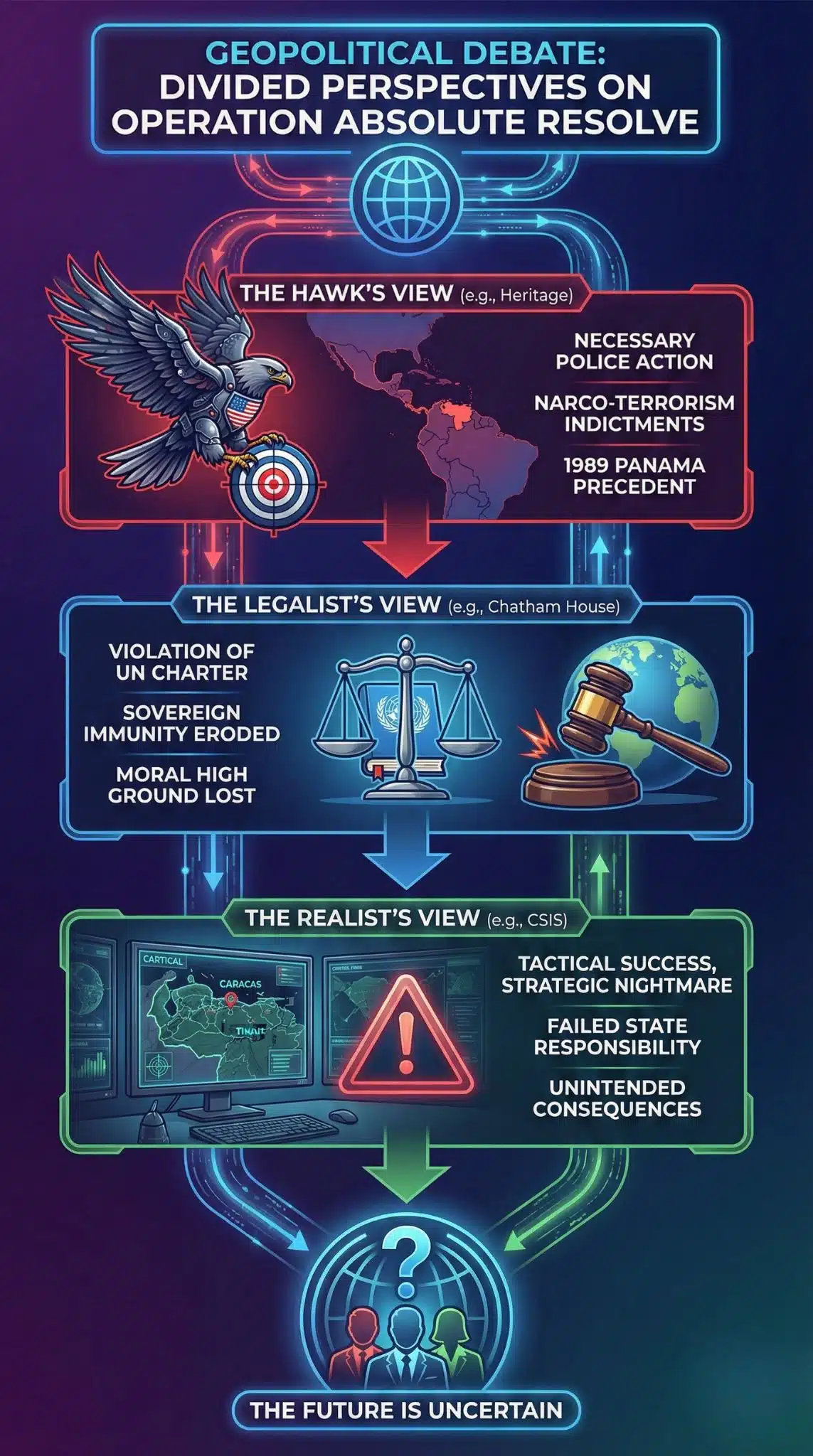
To maintain objectivity, we must synthesize the diverging viewpoints currently dominating the think-tank circuit:
- The Hawk’s View (e.g., Heritage Foundation): Analysts argue this was a necessary “police action” against a criminal cartel masquerading as a government. They point to the 2020 narco-terrorism indictments as sufficient legal cover, comparing it to the 1989 invasion of Panama to oust Noriega.
- The Legalist’s View (e.g., Chatham House/HRW): International law experts warn that “abducting” a recognized head of state—regardless of their domestic legitimacy—violates the core tenets of the UN Charter. They argue this erodes the moral high ground the West has tried to maintain regarding Ukraine.
- The Realist’s View (e.g., CSIS): Geopolitical strategists suggest the tactical success of the raid (controlling the skies, jamming radars) masks a strategic nightmare: “You break it, you own it.” The US is now effectively responsible for the governance of 28 million people in a failed state.
Future Outlook: What Comes Next?
As we look toward the remainder of 2026, three critical phases will define the outcome:
- The New York Trial (Q1-Q2 2026): The spectacle of a sitting president on trial in Manhattan will be a media circus unmatched in modern history. Expect the defense to argue “sovereign immunity,” forcing the US Supreme Court to weigh in on the limits of executive power abroad.
- The Transition Council (Q1 2026): The US will likely attempt to install a transitional governing body, perhaps led by opposition figures. The EU’s recognition of this body is the key milestone. If Brussels delays recognition, the transatlantic rift will deepen.
- Asymmetric Retaliation (Ongoing): We should not expect a conventional military response from Venezuela’s allies. Instead, look for cyberattacks on US energy infrastructure or increased “grey zone” harassment of Western assets by Russian or Iranian proxies, justified as “reciprocal measures.”
Final Thoughts
Operation Absolute Resolve has ended the stalemate in Venezuela but replaced it with chaos. For business leaders and policymakers, the lesson is clear: in 2026, geopolitical risk is no longer theoretical or gradual—it is kinetic and instantaneous. The era of static containment is over; the era of interventionism has returned.