
The “Race to the Bottom” is officially over. In the freelance economy of 2026, the real money isn’t found by bidding lower than your competitors; it’s found by proving you are elite. If you are a high-level freelancer analyzing Upwork Expert-Vetted vs Fiverr Pro, you have likely realized that standard “Top Rated” badges are no longer enough to command premium rates.
Today, the platforms have bifurcated: there is a crowded marketplace for the 99%, and a gated, lucrative “Talent Cloud” for the top 1%. While both badges promise access to high-budget clients, they require fundamentally different strategies. Upwork’s Expert-Vetted program is a corporate compliance tool designed for Fortune 500 hiring managers, whereas Fiverr Pro is an agency-style credential that validates your professional pedigree.
This guide provides a rigorous breakdown of the Upwork Expert-Vetted vs Fiverr Pro process, updated for the 2026 algorithmic landscape, to help you decide which elite tier is worth your time.
Key Takeaways
- Access: Upwork Expert-Vetted is primarily invitation-only, targeting the top 1% of talent for enterprise clients. Fiverr Pro is open to applications for anyone with a strong offline portfolio.
- Vetting: Upwork focuses on a live, 30-minute behavioral and technical interview. Fiverr Pro focuses on a manual audit of your external career history and education.
- AI Integration: In 2026, Upwork’s Uma AI prioritizes vetted talent for enterprise searches, while Fiverr’s Neo AI matches Pro sellers to complex, high-budget briefs.
- Income Potential: Upwork offers better stability through long-term hourly contracts (avg. $60-$150/hr). Fiverr Pro offers higher “per-project” pricing power (avg. $1,500+ fixed price).
What is Upwork Expert-Vetted? [The Enterprise Gatekeeper]
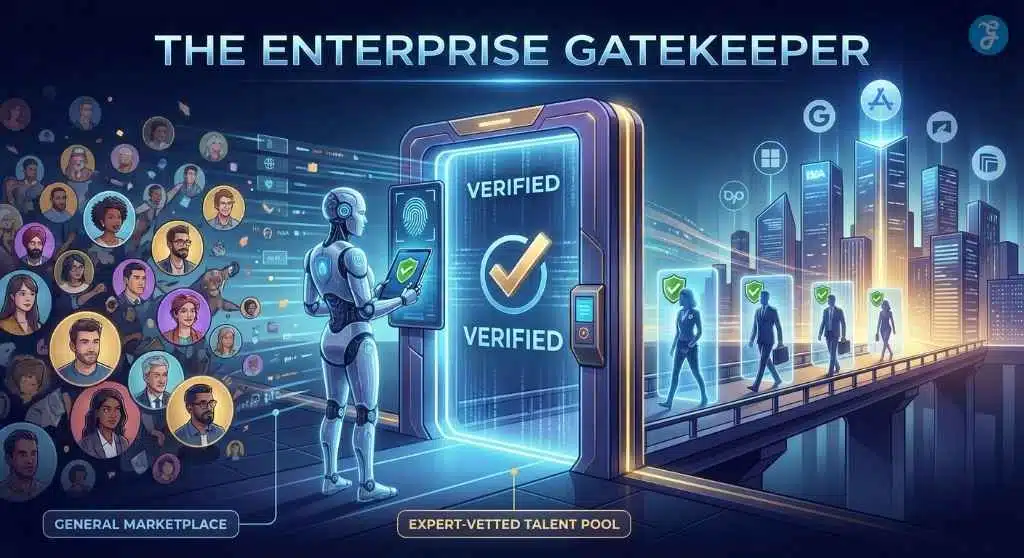
Upwork Expert-Vetted is not just a badge; it is a pre-screening service that Upwork sells to its largest clients. When companies like Microsoft, Airbnb, or Nasdaq hire on Upwork, they don’t browse the general marketplace. They use a separate interface, the Enterprise Talent Cloud, populated exclusively by freelancers who have passed a human vetting process.
Unlike “Top Rated Plus,” which is awarded algorithmically based on earnings and feedback, Expert-Vetted is purely manual. You cannot earn it simply by making money; you must be selected.
The 2026 Criteria: Beyond “Good Work”
To be considered, you generally need to fall into one of the high-demand “Enterprise” categories: Web & Mobile Development, Marketing, Design, Data Science, or HR. However, the 2026 criteria have evolved to include:
- Hard Skills Supremacy: Developers must often pass a CodeSignal test or a live coding challenge. Marketers must demonstrate knowledge of enterprise-grade tools (e.g., Salesforce, HubSpot, Tableau) rather than just general social media skills.
- Corporate “Soft Skills”: This is the biggest filter. The Talent Managers are assessing if you are “safe” to put in front of a Fortune 500 executive. Do you speak clearly? Do you understand NDAs and IP protection? Can you integrate into an Agile workflow?
- The “Uma” Factor: Upwork’s AI companion, Uma, now powers the search for Enterprise clients. Uma is trained to prioritize profiles with the Expert-Vetted data tag because these profiles have verified data points. Without the badge, you are mathematically less likely to appear in an Enterprise search result in 2026.
Who Is It For?
- Senior Developers looking for 6+ month contracts.
- Management Consultants charging $150+/hour.
- Agencies that want to bypass the bidding war and receive direct invites.
How to Get Expert-Vetted on Upwork
The most frustrating aspect of this badge is its exclusivity. As of early 2026, the program remains 90% invitation-only. Upwork’s Talent Managers continually scan the marketplace for top performers to invite. However, you can engineer your profile to trigger an invitation.
1. The “Backdoor” Strategy: Optimize for Discovery
You cannot click an “Apply” button, but you can wave a flag. Talent Managers use internal search tools to find candidates for vetting.
- Keyword Optimization: Enterprise clients don’t search for “writer.” They search for “White Paper Strategist” or “B2B SaaS Copywriter.” Update your title to reflect specialized, corporate roles.
- Rate Signaling: Raising your hourly rate can paradoxically increase your chances of an invite. A rate of $30/hr signals “General Marketplace.” A rate of $95/hr signals “Potential Expert.”
- The “Open Window” Alert: Occasionally (1-2 times per year), Upwork sends an email to Top Rated Plus freelancers in specific niches inviting them to apply. If you receive this email, treat it with high urgency; the window often closes in 48 hours.
2. The 30-Minute Vetting Interview
If you receive an invite, you will schedule a video call with a Talent Manager (usually a domain expert in your field). This is not a “get to know you” chat; it is a job interview.
| Interview Stage | What They Assess | How to Prepare |
| 0-5 Mins: The Pitch | English proficiency, camera presence, professionalism. | Have a 60-second “elevator pitch” ready that summarizes your experience and value proposition for big companies. |
| 5-15 Mins: Technical Deep Dive | Depth of knowledge. (e.g., “Explain your process for debugging a React Native memory leak.”) | Be ready to discuss your process, not just your results. Use industry-standard terminology. |
| 15-25 Mins: Behavioral Questions | Reliability and conflict resolution. (e.g., “Tell me about a time a client disagreed with your strategy.”) | Use the STAR Method (Situation, Task, Action, Result). Focus on how you de-escalated tension and delivered value. |
| 25-30 Mins: Logistics | Availability and tool stack. | Confirm you are comfortable with time tracking, Jira/Asana, and Slack. |
Pro Tip: Treat this call like a corporate meeting. Dress professionally, ensure you have a neutral background, and test your microphone. The interviewer is essentially deciding: “Would I be embarrassed if I recommended this person to a VP at Microsoft?”
Vetting Deep Dive: What the Interview Looks Like [By Niche]
While the general interview format is standard, the content of your 30-minute vetting call changes drastically depending on your industry. Upwork’s Talent Managers are often paired with domain experts to test your actual depth.
For Developers & Data Scientists
- The Test: You may be asked to complete a live CodeSignal assessment or a “whiteboard” architectural problem (e.g., “Design a scalable database schema for a ride-sharing app”).
- The Trap: The interviewer isn’t just looking for the right code; they are looking for clean documentation habits. In 2026, Enterprise clients fear “spaghetti code.” You must explain why you chose a specific library, not just how to use it.
- Key Question: “Tell me about a time you had to push back against a Product Manager’s technical requirement because it would cause technical debt.”
For Designers & Creatives
- The Test: They will ask you to screen-share your raw files (Figma, Adobe, Sketch). They don’t want to see the polished final image; they want to see your layer management.
- The Trap: A disorganized workspace suggests you cannot handle complex, multi-stakeholder enterprise workflows.
- Key Question: “Walk me through a project where the client hated your initial concept. How did you handle the revision process without taking it personally?”
For Marketers & Consultants
- The Test: This is pure ROI (Return on Investment) analysis. You must speak in numbers. Do not say, “I managed their SEO.” Say, “I increased organic traffic by 40% in Q3, resulting in $50k net new revenue.”
- The Trap: Focusing on “vanity metrics” (likes/followers) instead of business metrics (leads/sales).
- Key Question: “If a client gave you a $10,000 monthly budget for a B2B SaaS launch, how would you allocate it across channels and why?”
What is Fiverr Pro? [The Agency Standard]
If Upwork Expert-Vetted is about “Corporate Compliance,” Fiverr Pro is about “Premium Pedigree.” Fiverr Pro is a distinct tier that separates “Gig Workers” from “Professional Consultants.”
The key difference? Anyone can apply. You could have zero sales on Fiverr, pass skill tests, and still be accepted as a Pro if your offline career is impressive. This makes Fiverr Pro the best fast-track option for experienced professionals new to the platform.
The 2026 Requirements
Fiverr’s vetting team reportedly accepts less than 1% of applicants. They are looking for:
- Educational Background: A degree from a reputable university is a strong signal.
- Big Brand Experience: Have you worked for (or freelanced for) recognizable companies? (e.g., Google, Nike, local government).
- Portfolio Quality: They ignore your platform stats and look at your Behance, GitHub, Dribbble, or personal website. They want to see “Agency-Level” work.
The “Neo” Advantage
Fiverr’s new AI matching system, Neo, is designed to help buyers with complex needs. When a buyer types, “I need a complete rebranding strategy,” Neo almost exclusively routes this query to Pro sellers. Additionally, Pro sellers now have access to “Project Briefs,” a feature that mimics Upwork’s job feed, allowing Pros to send proposals to high-end clients.
The Step-by-Step Fiverr Pro Application Process
Since you can apply proactively, your success depends entirely on the quality of your application. Do not rush this.
Step 1: The Personal Statement [The Narrative]
You will be asked to describe your business. Do not write: “I am a graphic designer with 5 years of experience.”
Instead, write: “I run a boutique branding consultancy specializing in D2C e-commerce launches. I have led design strategy for 3 startups that went on to raise Series A funding…”
Strategy: Position yourself as a business owner or consultant, not a worker.
Step 2: Portfolio Curation
You will need to upload work samples.
- Do not upload generic work.
- Do upload case studies. Instead of just an image of a logo, upload a PDF showing the “Before & After,” the sketches, the strategy, and the final application on merchandise.
- External Links: You are allowed (and encouraged) to link to your professional website or LinkedIn. Ensure your LinkedIn profile is fully updated, as the vetters will check it to verify your employment history.
Step 3: The Vetting Wait
The process is manual and slow. In 2026, wait times are averaging 4 to 8 weeks. You may receive an email asking for “Additional Information” (usually proof of identity or a diploma scan). Respond to this immediately.
The “Red Flags”: Why Top Talent Gets Rejected
Even freelancers with 10 years of experience get rejected. In 2026, the rejection reasons have shifted from “Lack of Skill” to “Lack of Trust Signals.”
1. The “Ghost” Profile (Fiverr Pro Killer)
Fiverr’s manual vetters are investigators. If you claim to be a “Senior Branding Expert” on your application, but your LinkedIn profile is empty, has no photo, or lists you as a “Student,” you will be instantly rejected.
- The Fix: Your digital footprint must match your application. Ensure your LinkedIn work history aligns perfectly with the portfolio you submit.
2. The “Yes Man” Syndrome (Upwork Killer)
During the Upwork vetting interview, many freelancers try to be too accommodating. They say “Yes, I can do that” to every hypothetical request.
- The Reality: Enterprise clients hire experts to lead them, not just follow orders. If you don’t demonstrate the ability to say “No” or suggest a better alternative, you are viewed as a junior executor, not an Expert-Vetted consultant.
3. The “Jack of All Trades” (Both Platforms)
In 2026, specificity is currency.
- Rejection Trigger: “I am an expert in Logo Design, SEO, and Python Development.”
- The Fix: Pick one lane. You can be an “Expert-Vetted React Developer” or an “Expert-Vetted UI Designer,” but rarely both. The platforms want specialists, not generalists.
Critical Comparison: Upwork vs. Fiverr Pro
Which path offers the path of least resistance for your specific situation?
| Feature | Upwork Expert-Vetted | Fiverr Pro |
| Entry Method | Invite Only (Passive wait) | Application (Active pursuit) |
| Primary Requirement | High Platform Stats & Soft Skills | High Offline Career Achievement |
| Client Type | Fortune 500 Enterprise Teams | High-Budget SMEs & Business Owners |
| Project Style | Long-term hourly integration | High-ticket fixed price “Productized Services.” |
| Vetting Style | Live Video Interview | Manual Document/Portfolio Review |
| Pricing Power | Medium-High ($60 – $200/hr) | Very High ($1,000+ per order) |
| Platform Fee | Flat 10% (plus Connects costs) | Flat 20% (No bidding costs) |
The “Hidden” Cost of Maintenance
- Upwork: Maintaining Expert-Vetted status requires consistency. If your Job Success Score (JSS) drops below 90%, you may be temporarily removed from the Enterprise cloud until it recovers.
- Fiverr Pro: Once you have the badge, it is yours to keep, provided you don’t violate Terms of Service. However, expectations are higher. A Pro seller who delivers late or communicates poorly will get harsh reviews that are more damaging, given the high price point.
Financial Implications: Which Badge Pays More?
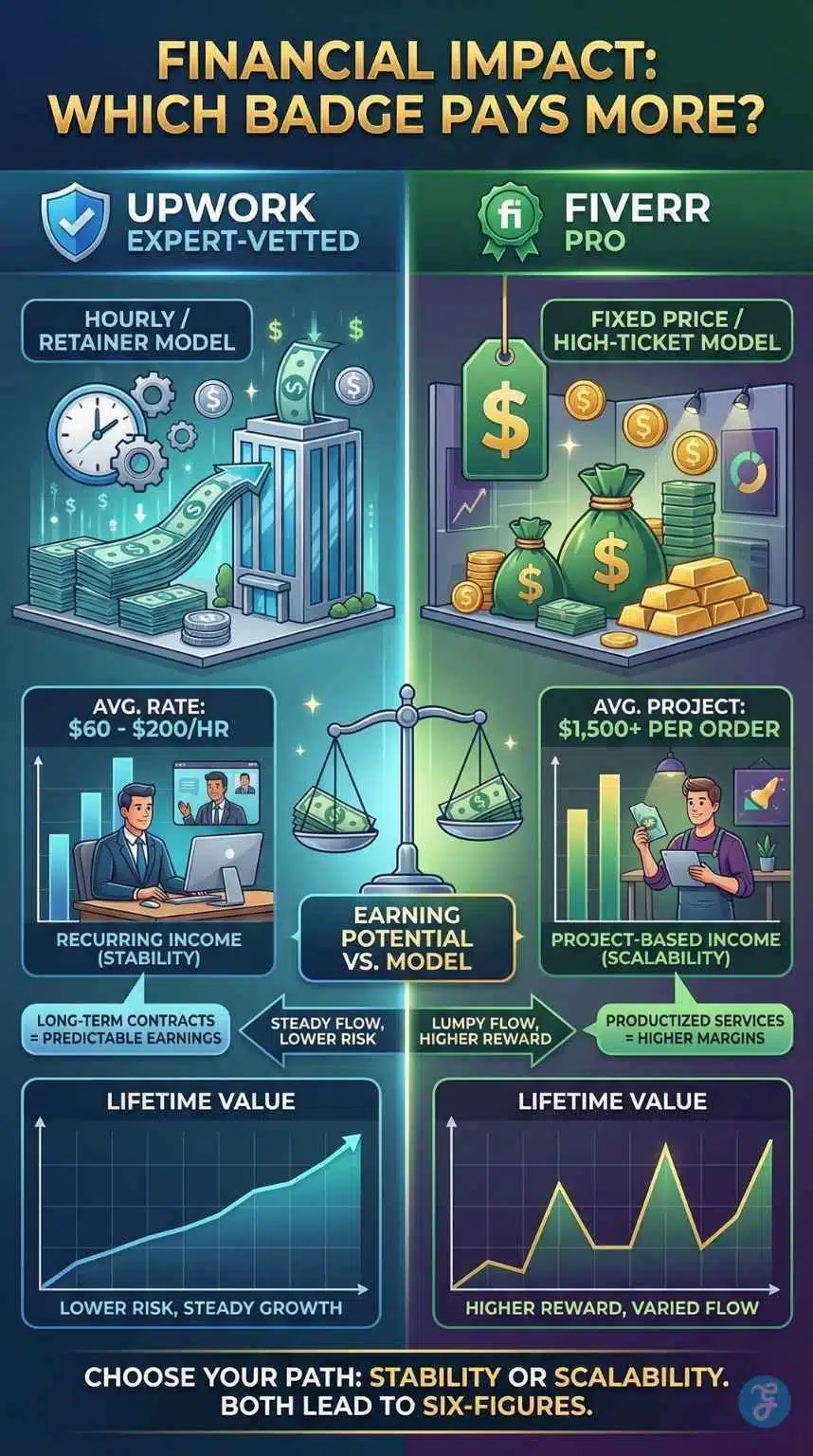
In 2026, the data suggests a divergence in how you earn, rather than just how much.
The Upwork Model:
Expert-Vetted freelancers often land “retainer-style” contracts.
- Example: A Vetted React Developer is hired by a Microsoft team for 20 hours/week at $90/hour.
- Result: $7,200/month recurring revenue. The stability is high, but the ceiling is capped by your hours.
The Fiverr Pro Model:
Fiverr Pro sellers thrive on high-margin, productized services.
- Example: A Pro Copywriter sells a “Website Copy Overhaul” package for $2,500.
- Result: They only need to sell 3 of these a month to hit $7,500. The work is more sporadic, but the “effective hourly rate” can be significantly higher if you work fast.
Verdict: Upwork is better for Stable Income Replacement. Fiverr Pro is better for High-Margin Scaling and agency building.
The Role of AI in 2026: Why Badges Matter More Than Ever
The explosion of Generative AI has flooded freelance platforms with low-quality, AI-generated proposals. Clients are overwhelmed by spam.
- The “Trust Gap”: In response, platforms have tweaked their algorithms to heavily favor verified humans.
- Search Visibility: On Upwork, if a client checks the “Expert-Vetted” filter (which Enterprise clients default to), 99% of the competition disappears instantly. You are competing with 5 people, not 5,000.
- AI Assistants: As mentioned, tools like Upwork, Uma, and Fiverr Neo are the new gatekeepers. They are programmed to recommend “Safe” choices to buyers. A verified badge is the primary data point that tells the AI, “This person is a Safe Choice.”
Post-Badge Strategy: How to Monetize Your Elite Status
Congratulations, you have the badge. Now, if you don’t change your behavior, you are leaving money on the table. The badge acts as a “Trust Multiplier,” allowing you to change your pricing psychology.
1. The “2x” Pricing Rule
The moment you receive the Expert-Vetted or Fiverr Pro badge, you should audit your pricing.
- Psychology: Clients see the badge and expect premium pricing. If you are Expert-Vetted but charge $20/hour, you create cognitive dissonance (“Is this person actually good? Why are they so cheap?”).
- Action: Raise your rates by at least 30-50% immediately. The badge validates the increase.
2. Update Your “Elevator Pitch”
Your proposals should no longer start with “Hi, I can do this job.”
- The New Opener: “As an Expert-Vetted consultant (Top 1% on Upwork), I specialize in solving exactly this type of [Problem X]…”
- Why it works: It immediately frames you as the “Safe Choice,” which is what Enterprise clients care about more than price.
3. Leverage the Badge Off-Platform
You earned the status; use it everywhere.
- LinkedIn Headline: “Senior Developer | Upwork Expert-Vetted (Top 1%)”
- Email Signature: Add the badge logo to your cold outreach emails.
- Website: Add a “Vetted By” section.
- Benefit: Even clients who don’t hire you through Upwork or Fiverr respect the validation. It proves a third party has audited your skills.
Which Badge is Worth It? [The Verdict]
You should not necessarily view this as an “Either/or” choice. Many elite freelancers hold both badges to diversify their lead flow. However, if you must prioritize one focus for Q1 2026:
Choose Upwork Expert-Vetted If:
- You prefer long-term relationships over constant selling.
- You have strong “Corporate Soft Skills” (Email etiquette, Zoom presence).
- You are already active on Upwork and close to Top Rated Plus status.
Choose Fiverr Pro If:
- You have a strong portfolio from outside the platform, but you are new to freelancing online.
- You hate bidding on jobs and writing proposals.
- You offer a defined creative or digital service (e.g., Logo Design, Explainer Videos) that can be packaged at a high price.
Final Thought: The Badge is Just the Beginning
Getting the Upwork Expert-Vetted vs Fiverr Pro gets you in the room, but it doesn’t close the deal. The “Expert-Vetted” status on Upwork gets your profile viewed by a Talent Manager at Airbnb, but your portfolio still needs to wow them. The “Pro” badge on Fiverr justifies your $1,500 price tag, but your customer service must back it up.
In 2026, these badges are the new baseline for a six-figure freelance career. They are the passport to the premium economy. If you have the skills, stop playing in the sandbox with the $5 bidders. Polish your LinkedIn, audit your portfolio, and apply for the status you deserve.