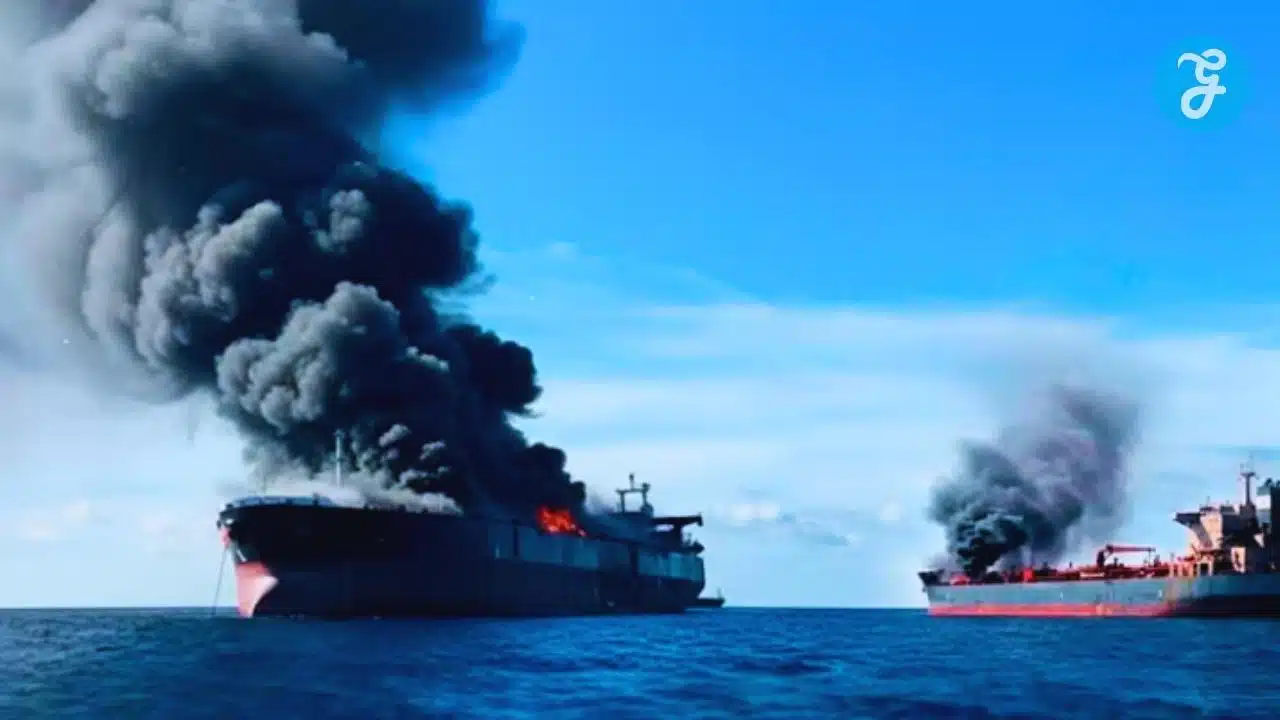
Ukraine’s Special Operations Forces carried out a daring strike on two Russian vessels in the Caspian Sea, targeting ships loaded with weapons and military equipment originating from Iran to bolster Moscow’s ongoing war efforts against Ukraine. This operation, announced on Friday, represents one of the farthest-reaching attacks by Kyiv into Russian-controlled waters, disrupting a critical supply line that has evaded international scrutiny for months.
Strike Targets and Coordination
The vessels hit were the Composer Rakhmaninov and the Askar-Sarydzha, positioned close to the coastline of Russia’s Republic of Kalmykia in the northern Caspian Sea. These ships have long been implicated in shadowy logistics, shuttling sensitive cargo like drone components, ballistic missile parts, and other munitions from Iranian ports in the south to Russian facilities up north. Both are under stringent US sanctions imposed by the Treasury Department back in September 2024, specifically naming the Composer Rakhmaninov as property linked to MG-Flot, a shadowy shipping firm notorious for facilitating these illicit transfers. Ukrainian forces executed the mission in tight collaboration with Black Spark, a pro-Ukrainian partisan network operating within Russia.
This local resistance group played a pivotal role by delivering real-time intelligence on the ships’ positions, cargo manifests, and patrol patterns, allowing for precise timing amid heightened Russian naval vigilance. While Kyiv has kept the exact method of attack under wraps—speculation ranges from long-range drones to sabotage divers or even sea-skimming missiles—the operation unfolded against fierce resistance from onboard security and nearby patrols, underscoring the high stakes involved in penetrating such a remote theater over 1,000 kilometers from Ukraine’s front lines.
Caspian Sea Escalation and Iranian Supply Chain
This naval hit builds directly on Ukraine’s bold precedent just two days earlier on December 11, when SBU operatives unleashed a swarm of drones against the massive Vladimir Filanovsky oil platform, a Lukoil jewel in the Caspian’s depths. That assault crippled operations across more than 20 production wells on a field pumping out up to 120,000 barrels of oil per day, marking Kyiv’s inaugural strike on Russian hydrocarbon infrastructure in this landlocked sea—fully 700 kilometers from the nearest Ukrainian border. The Caspian has emerged as a shadowy lifeline for Russia’s war machine, with Iran leveraging its fleet of “ghost ships” to ferry Shahed drone kits, explosive warheads, and guidance systems northward.
These vessels routinely ghost off AIS tracking radars while transiting from Bandar Anzali or Amirabad in Iran to Astrakhan or Makhachkala in Russia, evading satellite detection through mid-sea handoffs and decoy maneuvers. Analysts from groups like Caspian Policy Center have mapped this network extensively, noting how it circumvents Black Sea blockades and air routes vulnerable to Ukrainian intercepts. By severing these threads, Ukraine aims to starve Russia’s drone production lines, which have hammered civilian targets in Kyiv, Kharkiv, and beyond with relentless barrages.
Broader Geopolitical Ripples
Timing amplified the strikes’ impact, coinciding with seismic shifts in Europe’s financial warfare against Moscow. EU member states locked in an indefinite freeze on €210 billion ($220 billion) of Russian central bank reserves scattered across European depositories, invoking emergency clauses to ditch the old six-month renewal ritual that often sparked internal squabbles. Predominantly held at Euroclear in Belgium, these assets now stand immobilized until Russia halts its aggression and coughs up reparations, paving the way for G7-backed loans to Ukraine potentially worth tens of billions. Diplomatically, Kyiv handed Washington a revamped 20-point peace blueprint, tweaking stances on territorial referendums, Zaporizhzhia nuclear safeguards, and phased ceasefires in response to US pressure for concessions amid President Trump’s incoming administration.
On the ground, President Zelenskyy made a morale-boosting frontline trek to Kupiansk, the battered Donetsk hub where Russian propaganda crowed about full capture last November—yet Ukrainian defenders, bolstered by fresh Western kit, clawed back key districts amid grinding house-to-house clashes, signaling resilience as winter deepens the stalemate. These moves collectively pressure Russia’s flanks, from sea lanes to sovereign wallets to battlefield momentum.