Navigating the UK crypto market in 2026 requires a balance between finding competitive trading costs and ensuring your assets are held by FCA-registered institutions. As the regulatory environment has matured, the “hidden” costs like spreads and withdrawal fees have become just as important as the advertised maker/taker rates.
How We Selected Our 17 Best UK Crypto Exchange Facts
To provide this comparison, we synthesised real-time data from March 2026 across major UK-accessible platforms. Our selection criteria focused on three metrics: real-world execution cost (including spreads), FCA registration status for consumer protection, and security architecture (such as Proof of Reserves and cold storage percentages). We prioritised exchanges that offer direct GBP pairs via Faster Payments, as these remain the most cost-effective entry points for British investors.
17 Essential Facts About Top UK Crypto Exchanges
The following facts break down the current landscape of fees and security protocols across the most prominent platforms available in the United Kingdom today.
1. Bitpanda’s Unique Leverage Offering
As of March 2026, Bitpanda is currently the only FCA-registered platform offering crypto leverage to UK retail investors. Through its UK entity, it provides up to 3x spot margin trading on over 100 assets.
-
Best for: Experienced retail traders seeking regulated leverage.
-
Why We Chose It:
-
It maintains a high trust rating with 98% of assets held in cold storage.
-
It offers zero deposit and withdrawal fees for GBP via bank transfer.
-
-
Things to consider: Its standard “Broker” fees can be as high as 1.49%, so using the advanced interface is necessary for lower costs.
2. The Kraken Pro Fee Advantage
Kraken remains one of the most cost-effective “major” exchanges for UK users. Its tiered fee structure for Kraken Pro starts at 0.16% for makers and 0.26% for takers, which is significantly lower than Coinbase’s entry-level pricing.
-
Best for: Active traders and high-volume investors.
-
Why We Chose It:
-
It consistently publishes “Proof of Reserves” audited by third parties.
-
It supports direct GBP/BTC and GBP/ETH pairs with deep liquidity.
-
-
Things to consider: The “Instant Buy” feature carries much higher fees (around 1.5%), so the Pro interface is essential for savings.
3. Coinbase Advanced vs. Standard
Coinbase has simplified its UK offering by merging features, but the price gap remains. Standard trades often incur a spread of up to 1.5%, while Coinbase Advanced offers maker/taker fees starting at 0.40% and 0.60%.
-
Best for: Beginners who want a path to professional tools.
-
Why We Chose It:
-
It is a publicly-traded company with SOC 2 Type II security compliance.
-
It offers integrated “Coinbase Wallet” for easy transition to self-custody.
-
-
Things to consider: It is generally the most expensive of the “Big Three” (Kraken, Gemini, Coinbase) for small retail trades.
4. Bitget’s Aggressive Fee Undercutting
In 2026, Bitget has emerged as a leader in fee reduction, offering a flat 0.1% fee on spot trades, which can be further reduced to 0.08% if paying with their native BGB token.
-
Best for: Altcoin hunters and “fee-sensitive” optimisers.
-
Why We Chose It:
-
It maintains a massive $300M User Protection Fund.
-
It hosts over 800 trading pairs, more than most UK-registered rivals.
-
-
Things to consider: While popular, users should always verify the latest FCA status for specific high-yield “Earn” products.
5. Gemini’s Focus on Compliance
Gemini remains the “safety-first” choice for many UK institutions and high-net-worth individuals. Their ActiveTrader interface offers competitive fees starting at 0.20% for makers.
-
Best for: Security-conscious investors and institutional-grade compliance.
-
Why We Chose It:
-
It was one of the first to secure both an EMI licence and FCA registration.
-
It provides high-level insurance coverage for hot-wallet assets.
-
-
Things to consider: The asset selection (around 70+ coins) is smaller than rivals like Crypto.com or Bitpanda.
6. Revolut X’s Professional Pivot
Revolut has moved beyond its “banking app” roots with Revolut X, a dedicated pro-trading platform for UK users that offers 0% maker fees and a low 0.09% taker fee.
-
Best for: Existing Revolut users who want professional exchange features.
-
Why We Chose It:
-
It allows for instant, free transfers between your bank account and trading account.
-
It provides an easy bridge for those already using Revolut for FX and stocks.
-
-
Things to consider: These ultra-low fees are only available on the “X” interface, not the standard Revolut app.
7. eToro’s Simple 1% Flat Fee
eToro has standardised its crypto pricing to a flat 1% fee (plus market spread) for all buy and sell orders, eliminating the confusion of maker/taker tiers.
-
Best for: Beginners and those interested in “CopyTrading.”
-
Why We Chose It:
-
It is fully FCA-registered and offers a demo account with $100k virtual funds.
-
It allows users to manage crypto alongside traditional stocks and ETFs.
-
-
Things to consider: The 1% fee is applied when you open and close a position, which can be costly for frequent day traders.
8. Crypto.com’s Ecosystem Incentives
Crypto.com offers a competitive 0.075% maker/taker fee on its Exchange platform, but these rates are often tied to the amount of “Cronos” (CRO) a user has staked.
-
Best for: Users who want a “one-stop-shop” with a debit card and high-yield options.
-
Why We Chose It:
-
It holds one of the highest security certifications (ISO/IEC 27701:2019).
-
It supports over 350+ cryptocurrencies for UK residents.
-
-
Things to consider: Navigating the app versus the exchange can be confusing, and card-based fiat top-ups can incur 2.99% fees.
9. CoinJar’s Fee-Free GBP Deposits
The Australia-born, UK-registered CoinJar remains a favourite for “on-ramping” due to its zero-fee GBP deposits via Faster Payments and its simple 1% instant buy fee.
-
Best for: Quickly moving small amounts of GBP into the crypto market.
-
Why We Chose It:
-
It offers a crypto-backed Mastercard that is widely accepted in the UK.
-
Its “CoinJar Exchange” features fees as low as 0.1% for takers.
-
-
Things to consider: The interface is more basic compared to the deep analytical tools of Kraken or OKX.
10. Uphold’s “Anything to Anything” Swaps
Uphold is unique in the UK for allowing users to swap directly between crypto, gold, and fiat currencies in a single transaction, though its spread-based fees range from 0.8% to 1.5%.
-
Best for: Investors who want to diversify across different asset classes instantly.
-
Why We Chose It:
-
It operates on a 100%+ reserve model, meaning they don’t lend out user funds.
-
It provides high spending limits on its UK-exclusive debit card.
-
-
Things to consider: The “zero commission” marketing can be misleading, as the cost is built into the asset spread.
11. CEX.IO’s Low Entry Barrier
CEX.IO offers one of the lowest taker fees for smaller traders, starting at just 0.25%, making it a strong alternative to the more expensive Coinbase Standard.
-
Best for: Small-scale traders who want lower fees without a complex interface.
-
Why We Chose It:
-
It has a long-standing reputation for security and regulatory transparency.
-
It supports multiple GBP withdrawal methods including credit/debit cards.
-
-
Things to consider: Their liquidity on certain altcoin pairs can be lower than global leaders.
12. OKX’s Advanced Altcoin Liquidity
OKX has become a top choice for UK traders seeking deep liquidity in altcoins and stablecoins, with maker/taker fees starting around 0.08% and 0.10%.
-
Best for: Advanced traders looking for institutional-grade liquidity.
-
Why We Chose It:
-
It offers a “Web3 Wallet” that integrates seamlessly with DeFi and NFT markets.
-
It provides robust 2FA and cold storage security for all UK accounts.
-
-
Things to consider: Some of its more complex derivative products may be restricted for UK retail investors under FCA rules.
13. Luno’s Educational Approach
Luno focuses on a smaller selection of “blue-chip” coins (BTC, ETH, SOL, etc.) with a 0.75% fee for instant buys, aimed at long-term “HODLers.”
-
Best for: First-time buyers who want a simplified, safe experience.
-
Why We Chose It:
-
It provides extensive educational resources through its “Learning Portal.”
-
It is owned by Digital Currency Group (DCG), one of the largest firms in the sector.
-
-
Things to consider: The lack of altcoins and advanced trading tools makes it unsuitable for active traders.
14. Bitstamp’s Reliability for Institutions
Bitstamp is the longest-running exchange in the world and maintains a “no-frills” approach to security and fees, with taker fees starting at 0.40%.
-
Best for: Large-volume traders who prioritise a “clean” regulatory record.
-
Why We Chose It:
-
It has a history of high uptime and reliable GBP Faster Payments integration.
-
It is widely used by institutional “on-ramps” for its deep order books.
-
-
Things to consider: Its interface is functional but lacks the “gamified” features found on newer apps.
15. MoonPay’s High-Convenience, High-Cost Model
MoonPay is often integrated into wallets (like MetaMask), offering “instant” buys via Apple Pay or Google Pay, but this convenience comes with fees often exceeding 4.5%.
-
Best for: One-off, urgent purchases where speed is more important than cost.
-
Why We Chose It:
-
It allows for instant checkout without needing to deposit to an exchange first.
-
It is highly accessible for those who don’t want to manage an exchange account.
-
-
Things to consider: It is by far the most expensive way to buy crypto in the UK.
16. The “Withdrawal Fee” Trap
Many exchanges offer low trading fees but charge high fixed “withdrawal fees” for moving crypto to a private wallet. For example, some platforms still charge 0.0005 BTC (~£30+) regardless of the network’s actual cost.
-
Best for: Users planning to hold assets long-term on the exchange.
-
Why We Chose It:
-
Platforms like Kraken and Bitstamp are known for keeping withdrawal fees close to the real network cost.
-
It is a critical factor for those who move funds frequently to cold storage.
-
-
Things to consider: Always check the “Fixed Withdrawal Fee” list before committing a large deposit.
17. The FCA’s “Financial Promotion” Safeguards
Since 2025, all UK-accessible exchanges must include a “24-hour cooling-off period” for new customers and provide clear risk warnings. This security layer is designed to prevent “impulse buying” in a volatile market.
-
Best for: Protecting new investors from making hasty financial decisions.
-
Why We Chose It:
-
It ensures that all marketing is “fair, clear, and not misleading.”
-
It forces platforms to verify that users understand the high risks involved.
-
-
Things to consider: This can add a slight delay to your first trade on a new platform.
An Overview Of UK Exchange Costs And Security Protocols
While fees are the most visible cost, the underlying security of your assets is the true metric of an exchange’s value. In 2026, the industry standard has moved toward 1:1 Proof of Reserves and mandatory 2FA.
Overview Comparison Table
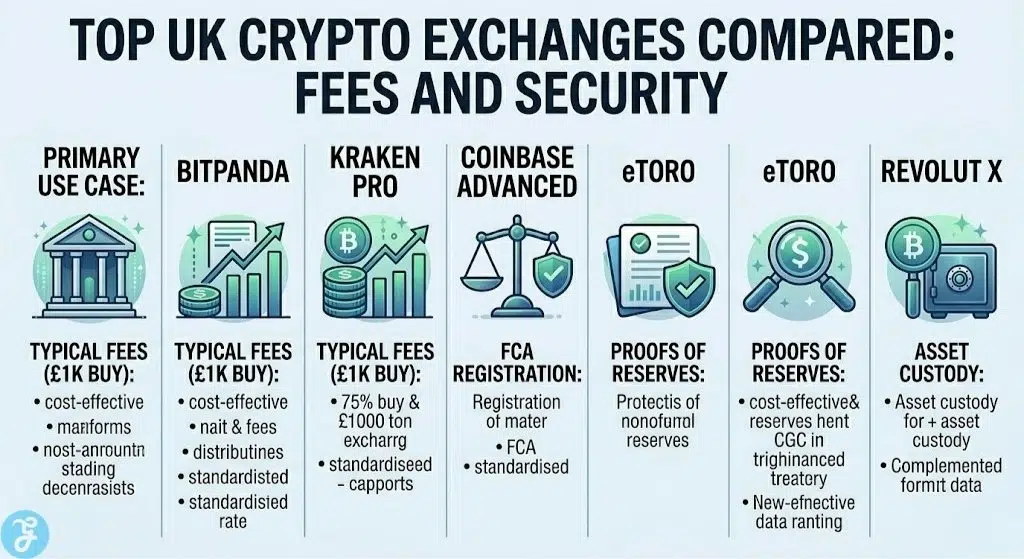
The following table compares the typical costs for a £1,000 “Buy and Hold” trade on the most popular UK platforms.
| Exchange | Trading Fee (£1k) | Spread Estimate | Total Cost (Buy) |
| Kraken Pro | £2.60 (0.26%) | <0.1% | ~£3.60 |
| Bitpanda (Advanced) | £3.50 (0.35%) | ~0.2% | ~£5.50 |
| Coinbase Advanced | £6.00 (0.60%) | ~0.5% | ~£11.00 |
| eToro | £10.00 (1%) | Variable | ~£12.50+ |
| Luno (Instant) | £7.50 (0.75%) | ~1.0% | ~£17.50 |
Our Top 3 Picks and Why?
Of the 17 platforms discussed, Kraken, Bitpanda, and Revolut X stand out in 2026. Kraken remains the champion of security-to-fee ratio; Bitpanda offers the most unique regulated features (leverage); and Revolut X provides the lowest fees for those who are already integrated into its banking ecosystem.
Buyer’s Guide: How to Choose the Right UK Crypto Exchange by Yourself?
Your strategy should dictate your platform choice. A casual saver has very different needs than a high-frequency day trader.
The Selection Framework:
-
Fee Structure: Do you want a flat 1% (eToro) or are you willing to learn a “Pro” interface for 0.2% (Kraken)?
-
Regulatory Peace of Mind: Is the exchange FCA-registered, or are they an offshore firm “directing” services at the UK?
-
Asset Mobility: Does the platform allow for cheap withdrawals to a hardware wallet, or do they “trap” liquidity with high exit fees?
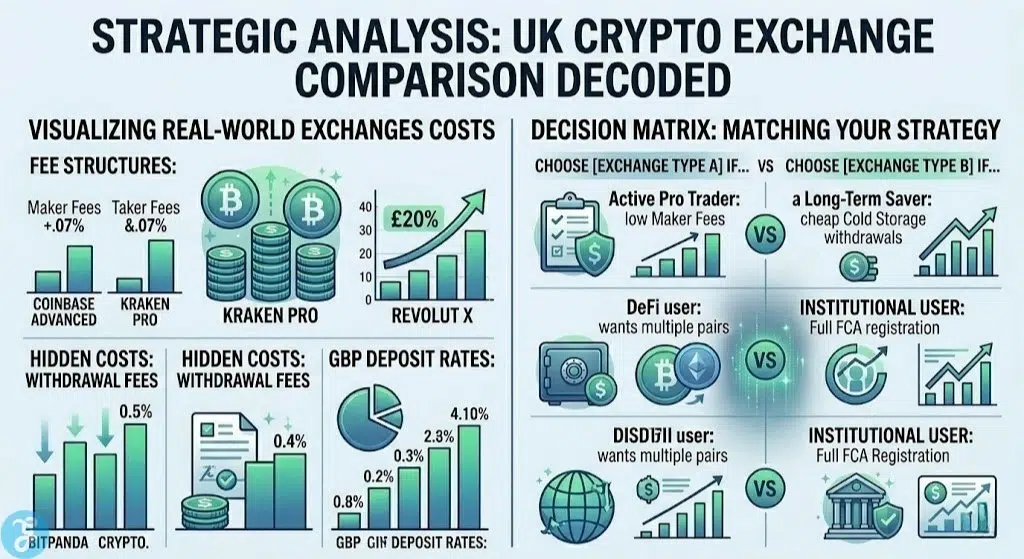
Decision Matrix (Table):
| Choose Platform A if… | Choose Platform B if… |
| You want the lowest possible fees (Revolut X/Bitget). | You want the highest regulatory safety (Gemini/Coinbase). |
| You want to use a crypto card for daily spending (CoinJar/Uphold). | You want to trade hundreds of rare altcoins (Bitpanda/Bitget). |
| You are a first-time buyer wanting simple apps (Luno/eToro). | You need professional charting and API access (Kraken/OKX). |
The Final Checklist: 5 Things to Check Before Depositing GBP
-
Is the exchange listed on the FCA’s Financial Services Register?
-
Does the platform support “Faster Payments” for free, instant GBP deposits?
-
Have you enabled App-based 2FA (like Google Authenticator) instead of SMS?
-
Is the “Pro” or “Advanced” interface available to reduce your trading fees?
-
What is the fixed withdrawal fee for your target asset (e.g., BTC or ETH)?
The Professionalisation of the UK Crypto Gateway
By 2026, the “gap” between traditional finance and crypto in the UK has narrowed. With standard security protocols and clearer fee structures, investors can now focus on their portfolio strategy rather than worrying about the safety of their exchange.