A major ruling from the U.S. Court of Appeals for the Federal Circuit has dealt a significant blow to President Donald Trump’s trade agenda. In a 7–4 decision, the court determined that Trump unlawfully relied on emergency powers under the International Emergency Economic Powers Act (IEEPA) to impose broad import tariffs earlier this year. The judges ruled that IEEPA, enacted in 1977, was never intended to give presidents unilateral authority to impose taxes or tariffs, powers that the Constitution reserves for Congress.
The court stressed that tariff authority is one of the most important legislative functions, alongside taxation, and therefore cannot be broadly delegated to the executive without explicit statutory language. Because Congress deliberately excluded terms like “tariff,” “duty,” or “tax” when drafting IEEPA, the court concluded that Trump had overreached by using this law to reshape global trade policy.
Background: How the Tariffs Were Imposed
President Trump announced sweeping new tariffs in early 2025, branding them as “Liberation Day” tariffs. These included a 10% baseline tariff on nearly all imports and additional reciprocal tariffs targeting countries such as China, Mexico, and Canada. They were justified on the grounds of combating economic threats linked to fentanyl trafficking and foreign trade imbalances.
The tariffs became a centerpiece of Trump’s second-term economic strategy. He argued they would revive American manufacturing, reduce reliance on foreign goods, and force U.S. trading partners to renegotiate agreements more favorable to Washington. Unlike previous tariffs imposed under Section 232 of the Trade Expansion Act (which cover steel, aluminum, and automobiles), these new tariffs rested entirely on IEEPA. That reliance opened the door to legal challenges.
Lawsuits and Lower Court Decisions
Soon after the tariffs were announced, lawsuits were filed from multiple directions. The Liberty Justice Center, representing small businesses including wine importer VOS Selections, challenged the tariffs as unconstitutional and damaging to small enterprises. Simultaneously, twelve Democratic-led states filed suit, arguing that the president’s use of emergency powers unlawfully undermined state economies and international trade arrangements.
In May 2025, the Court of International Trade (CIT) ruled against the administration, finding that IEEPA did not authorize the president to impose tariffs of such broad scope. The CIT issued a nationwide injunction blocking the tariffs. However, the Trump administration appealed, sending the case to the Federal Circuit.
Federal Circuit Ruling: Majority vs. Dissent
The Federal Circuit consolidated the two lawsuits and issued its ruling on August 29, 2025. The majority opinion reaffirmed the lower court’s view that Congress never granted the president wide-ranging tariff authority under IEEPA. Judges emphasized that imposing taxes or duties of this scale required explicit congressional approval, especially given the constitutional separation of powers.
While the majority blocked Trump’s use of IEEPA for these tariffs, they declined to strike them down immediately. Instead, they stayed their ruling until October 14, 2025, allowing the administration time to appeal to the U.S. Supreme Court.
In dissent, four judges argued that IEEPA’s broad emergency provisions could be interpreted as giving presidents the power to regulate importation through tariffs in extraordinary circumstances. They pointed to the law’s history of enabling executive flexibility in foreign affairs. However, their arguments failed to carry the bench.
Tariffs Still in Effect for Now
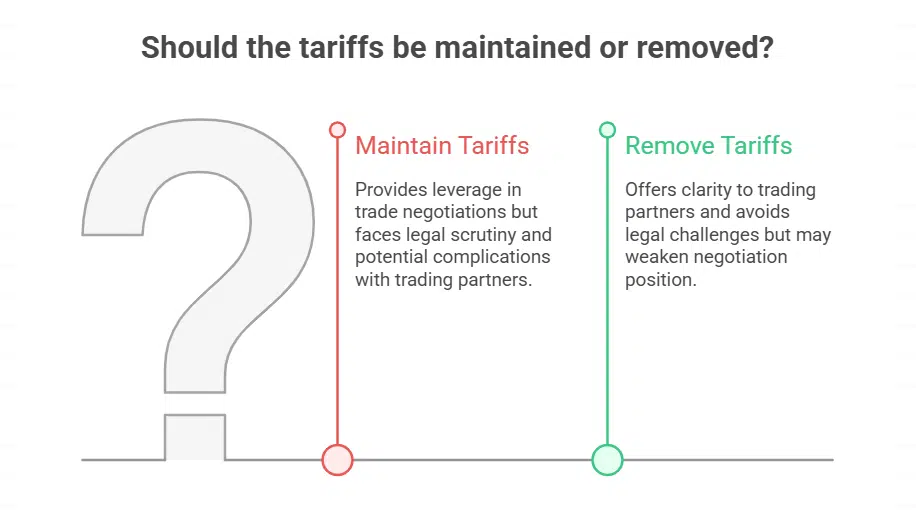
Despite the ruling, the tariffs remain in place because of the delayed enforcement. This means businesses, consumers, and U.S. trading partners must continue operating under the existing tariff structure until at least mid-October.
This temporary reprieve is crucial for the Trump administration, which has been using the tariffs as leverage in trade negotiations. Treasury Secretary Scott Bessent had indicated earlier that talks with allies like the European Union, United Kingdom, and Japan could wrap up by Labor Day. But the appeals court decision has complicated the timeline, as foreign governments now want clarity on whether the tariffs will survive legal scrutiny.
Administration Response and Next Steps
The White House immediately defended the president’s actions, asserting that the tariffs were lawfully imposed to protect national and economic security. Administration officials warned that suspending the tariffs would undermine U.S. credibility in trade talks and invite retaliation from other countries.
Commerce Secretary Howard Lutnick filed a statement with the court cautioning that overturning the tariffs could unravel agreements already announced with major allies. Treasury Secretary Bessent also warned that halting tariffs would damage ongoing negotiations and harm America’s diplomatic standing.
Attorney General Pam Bondi confirmed that the Justice Department will appeal the ruling to the Supreme Court. If the case proceeds, it will test the limits of presidential authority under IEEPA, potentially creating a landmark precedent for executive powers in trade policy.
Impact on Businesses and Global Trade
The uncertainty surrounding the tariffs has already had consequences for U.S. businesses. Importers of consumer goods, small retailers, and manufacturers dependent on foreign components face higher costs due to the duties. If the tariffs remain in place, businesses warn of potential price increases that could affect consumers across multiple sectors, from electronics to food and beverages.
At the international level, trading partners are reassessing their negotiations with the United States. Some foreign governments have indicated they may wait for a final Supreme Court ruling before committing to new trade terms. Others are considering retaliation if the U.S. maintains tariffs they view as unlawful.
Broader Constitutional Stakes
Beyond the immediate trade impacts, the ruling carries broader constitutional significance. Legal experts argue that it reasserts the principle that major economic powers lie with Congress, not the presidency. While past presidents have used emergency powers expansively, this case underscores judicial willingness to draw a line when executive actions alter core constitutional functions like taxation.
The plaintiffs’ attorney Neal Katyal described the ruling as a constitutional safeguard, ensuring that no president can unilaterally impose sweeping taxes. If upheld by the Supreme Court, the decision could permanently reshape the balance of power between Congress and the White House on trade and economic policy.
The Federal Circuit’s decision against Trump’s use of emergency powers for tariffs marks a pivotal moment in U.S. trade law and constitutional governance. For now, the tariffs remain in force while the administration prepares its appeal, but the legal foundation underpinning them has been severely weakened.
The final outcome, likely to be decided by the Supreme Court, will determine not only the future of Trump’s economic strategy but also the scope of presidential power in matters of trade and taxation. Until then, businesses, consumers, and America’s trading partners face an uncertain landscape shaped by tariffs that may not survive the legal tests ahead.