

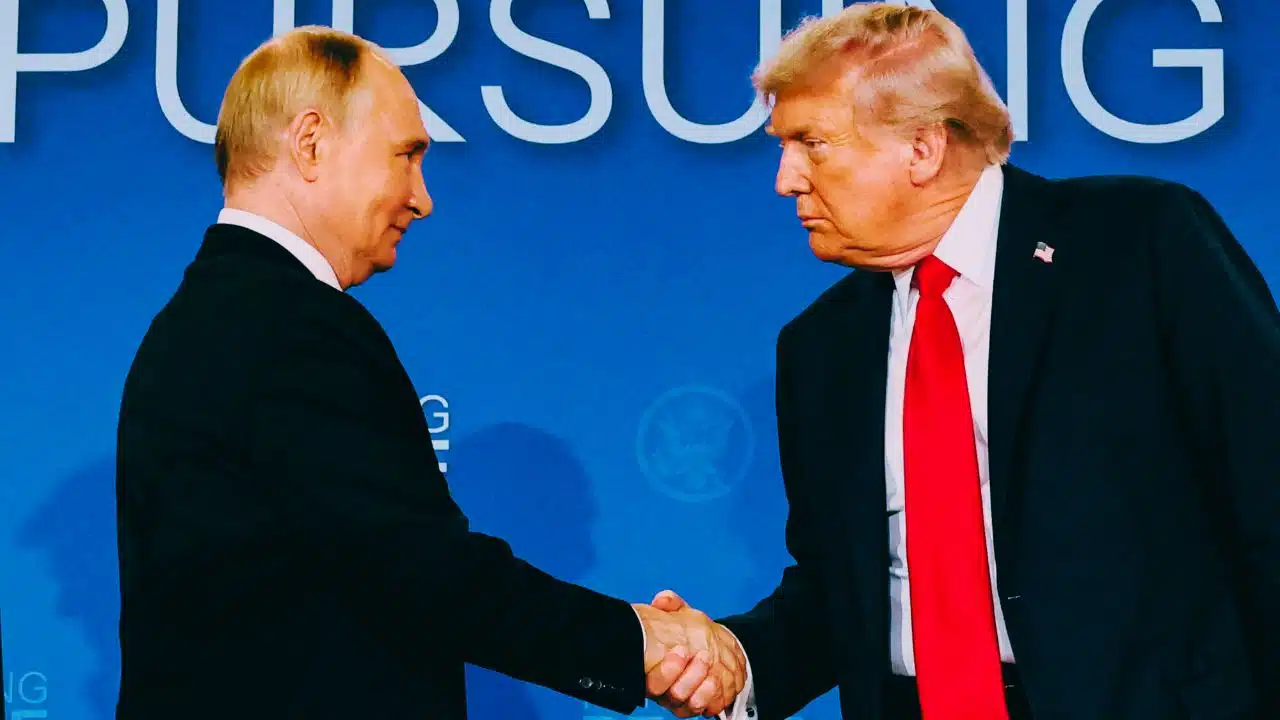
In a stunning diplomatic development that bypasses official Washington channels, President Donald Trump will meet with Russian President Vladimir Putin next month in Budapest for direct talks aimed at forging a peace settlement for the war in Ukraine.
The announcement, which came after what sources described as a “productive and lengthy” phone call between the two leaders earlier this week, has sent shockwaves through Western capitals and drawn a wary response from Kyiv. This move marks the most significant intervention yet by a former U.S. leader in an active global conflict.
Quick Take: What You Need to Know
- The Meeting: President Donald Trump and Russian President Vladimir Putin have agreed to a face-to-face summit in Budapest, Hungary, tentatively scheduled for mid-November 2025.
- The Goal: To discuss a “framework for a rapid de-escalation and a permanent cessation of hostilities” in Ukraine, according to a statement from Trump’s office.
- The Host: The meeting will be hosted by Hungarian Prime Minister Viktor Orbán, who has maintained ties with Moscow and has been a vocal critic of the Western strategy on Ukraine.
- Official U.S. Stance: The Biden administration has stated it was not involved in planning the talks, emphasizing that official U.S. policy and support for Ukraine remain “ironclad and unchanged.”
- War Context: The talks come as the conflict, now in its fourth year, has settled into a brutal war of attrition, with front lines largely static and casualties mounting on both sides.
- Financial Toll: Combined Western military and financial aid committed to Ukraine since February 2022 is estimated to have surpassed $275 billion as of September 2025.
A Diplomatic Bombshell: How the Summit Unfolded
The news first broke late Thursday evening via a post on President Donald Trump’s Truth Social platform. “I will be meeting with President Putin of Russia to get this horrible, wasteful war, which should never have started, finished,” Trump wrote. “It will be done quickly. The killing MUST STOP!”.
Within hours, the Kremlin confirmed the plan. In a more measured statement, Kremlin spokesperson Dmitry Peskov told reporters, “President Putin has always remained open to dialogue aimed at achieving a realistic resolution based on the security interests of the Russian Federation. We can confirm preparations are underway for a meeting with Mr. Trump in Budapest next month.”
The choice of Budapest as the venue is highly symbolic. Prime Minister Orbán has frequently broken ranks with his EU and NATO counterparts, opposing sanctions on Russia and blocking aid packages to Ukraine. By hosting the summit, Orbán positions himself as a key European peacemaker, a role he has long coveted. Sources within the Hungarian foreign ministry, speaking on condition of anonymity, said Budapest is “proud to facilitate a dialogue that others are unwilling to have.”
Latest Data: The Grinding Reality of a Forever War
The Trump-Putin initiative comes against the backdrop of a conflict that has become a grim, grinding stalemate. After initial rapid advances and dramatic Ukrainian counter-offensives in 2022, the war has largely devolved into trench warfare reminiscent of World War I, exacting a staggering human and economic toll.
- Human Displacement and Casualties: The United Nations High Commissioner for Refugees (UNHCR) latest report, dated September 30, 2025, estimates that over 15.2 million Ukrainians have been displaced at some point since the full-scale invasion began, with 6.5 million currently registered as refugees globally. While precise military casualty figures are closely guarded state secrets, Western intelligence estimates reported in August 2025 placed combined military losses (killed and wounded) for both sides at over 700,000.
- Economic Devastation: The World Bank’s October 2025 economic outlook projected that Ukraine’s economy will require over $750 billion for post-war reconstruction, a figure that grows with each passing month of conflict. The war has also crippled its agricultural exports and devastated its industrial base. Russia’s economy, while strained by sanctions, has transitioned to a war footing, but its long-term prospects remain bleak.
- A Static Front Line: Analysis from the Institute for the Study of War (ISW) on October 15, 2025, shows that territorial control along the nearly 1,000-kilometer front has shifted by less than 1% for either side in the past six months. This highlights a deadly equilibrium where massive resources and human lives are expended for minimal strategic gain.
Official Responses: A Chorus of Caution and Concern
The reaction from official government channels has been a mix of diplomatic restraint and palpable anxiety.
The White House: Walking a Tightrope
The Biden administration finds itself in a precarious position. Publicly condemning a “peace” initiative is politically difficult, yet endorsing a process that excludes the current government and Ukraine is untenable.
In a brief press conference, National Security Advisor Sarah Donlan stated, “We were not consulted on this meeting. Our position is clear: any resolution to this conflict must be guided by Ukraine and respect its sovereignty and territorial integrity. There should be nothing about Ukraine without Ukraine.”
Kyiv’s Fear of Betrayal
In Kyiv, the news was met with deep unease. Ukrainian officials have long feared that a second Trump presidency could lead to a deal with Putin made “over their heads,” forcing them to cede territory for peace.
“True peace can only be achieved with the complete withdrawal of Russian troops from all of our sovereign land,” said Ukrainian Foreign Minister Andriy Ivanov in a statement. “We appreciate all efforts to end the war, but we will not accept any agreement that trades our land for an illusory peace. We trust our official partners in Washington.”
European Allies Divided
The reaction in Europe has been fractured. Eastern European nations like Poland and the Baltic states have expressed alarm, viewing the talks as a potential legitimization of Russian aggression. In contrast, officials in Paris and Berlin have offered cautious, non-committal statements, acknowledging the need for dialogue while reiterating their support for Kyiv.
Expert Analysis: A High-Risk, Unpredictable Gambit
Foreign policy experts are divided on the potential outcomes of the summit. Some see it as a dangerous and destabilizing move that undermines the unified Western front.
Dr. Evelyn Farkas, former Deputy Assistant Secretary of Defense for Russia, Ukraine, and Eurasia, described the meeting as a “high-risk, high-reward gambit characteristic of Donald Trump’s approach to foreign policy.” In an interview, she stated, “On one hand, it could shatter the diplomatic logjam and force a conversation that established channels have failed to produce. On the other, it risks legitimizing Putin on the world stage, fracturing the NATO alliance, and potentially pressuring Ukraine into a disastrously unjust peace.”
Others argue that with the war at a seeming impasse, an unconventional approach may be the only way to avert a frozen conflict that could last for decades.
The View from the Ground
For those living through the daily reality of war, news of the talks has been met with a mixture of hope and deep-seated skepticism.
“We have heard about peace talks before,” said Oksana Petrenko, a 45-year-old refugee from Kharkiv now living in Warsaw, in a field interview with the Associated Press. “My home is gone. My brother is fighting. For us, peace is not a headline. It is the silence of the air raid sirens. We will believe it when we see it.”
What to Watch Next
The coming weeks will be critical. Key questions remain unanswered:
- Will a firm date for the summit be set, and will it actually take place?
- What specific proposals will Trump bring to the table? Rumors suggest it could involve freezing the conflict along current lines of control.
- How will the Biden administration and NATO allies coordinate their response to prevent being sidelined?
- Will there be any preliminary engagement with Ukrainian officials, or will they remain entirely on the outside?
Regardless of its outcome, the planned meeting between Donald Trump and Vladimir Putin has single-handedly altered the diplomatic landscape of the Ukraine war. It is a bold assertion of influence by a political figure operating outside the confines of traditional statecraft, challenging the established international order. For a world exhausted by years of brutal conflict, it represents either a reckless gamble that could embolden an aggressor or the last, best hope for a peace that has remained tragically out of reach. The stakes could not be higher.






























