

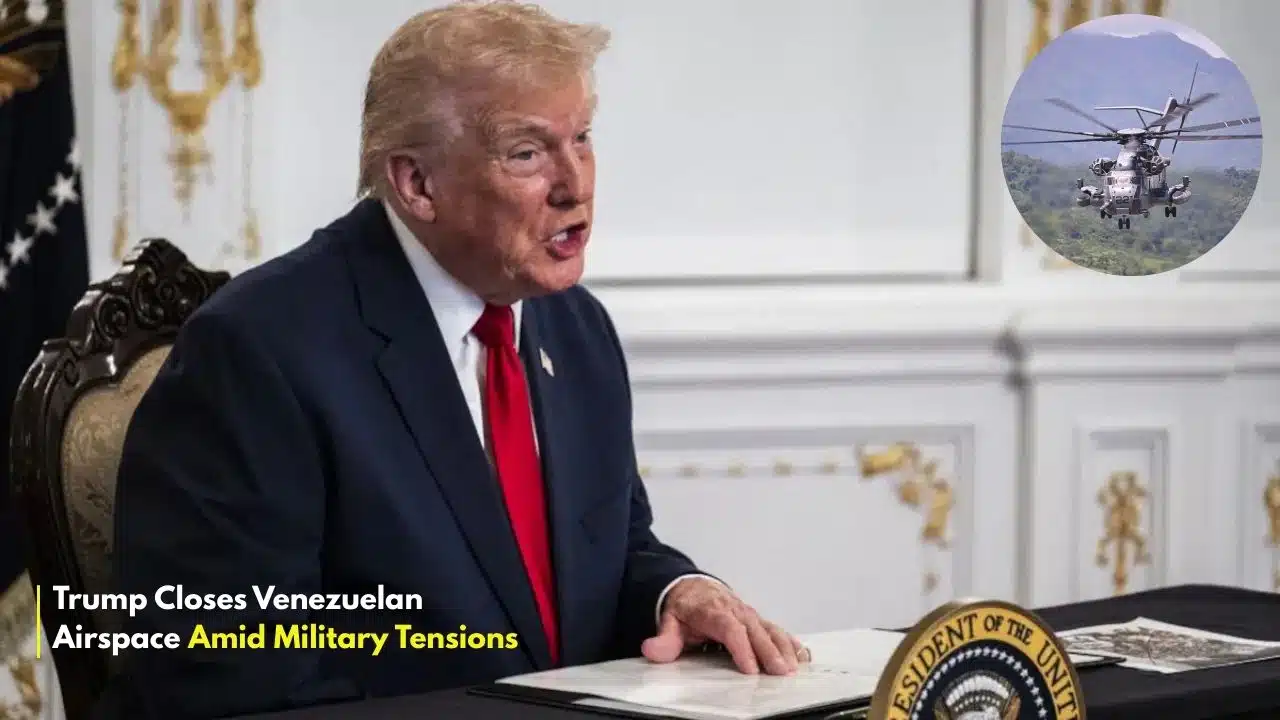
President Donald Trump has issued a sweeping declaration that the airspace above and surrounding Venezuela is to be considered “completely closed,” escalating tensions with the Maduro government and signaling a new phase in the U.S. campaign against drug trafficking organizations and political opponents in the region. The announcement, made via social media, was directed at airlines, pilots, drug dealers, and human traffickers, warning them that any flight in the area could be considered hostile and subject to military intervention. This move comes amid a massive U.S. military buildup in the Caribbean, including the deployment of the USS Gerald R. Ford aircraft carrier group and thousands of troops, raising fears of imminent military action and a potential regional crisis.
Trump’s Declaration and Immediate Reactions
On Saturday, President Trump posted on his Truth Social platform, urging all airlines, pilots, drug dealers, and human traffickers to “please consider AIRSPACE SURROUND VENEUELA BE CLOSED IN ITS ENTIRETY.” This directive was echoed by U.S. officials, who stated that the airspace closure is intended to deter both commercial and illicit flights, as well as to signal that any unauthorized aircraft in the region could be treated as a security threat. The White House did not provide further operational details, but the message was clear: the U.S. is taking a hardline stance against Maduro’s regime and its alleged involvement in drug trafficking and organized crime.
Venezuela has yet to issue an official response to Trump’s announcement, but regional allies such as Cuba have denounced the U.S. posture as “aggressive” and warned of the dangers of military escalation. International airlines are now assessing the risks of operating in or near Venezuelan airspace, with many expressing concern about the safety of their crews and passengers. The Federal Aviation Administration (FAA) had previously warned pilots to exercise caution due to increased military activity, but Trump’s directive goes further, essentially treating the region as a no-fly zone.
Military Buildup and Regional Implications
The airspace closure is the latest escalation in a months-long campaign by the Trump administration to pressure the Maduro government. Since September, the U.S. has conducted nearly twenty known strikes against suspected drug-laden vessels in the Caribbean, resulting in at least 82 fatalities. These operations have been carried out under the rationale that Venezuela is a hub for international drug trafficking, with the administration designating several Venezuelan criminal organizations, including the Cartel de Los Soles, as foreign terrorist organizations. This designation allows the U.S. to use the full force of its counterterrorism statutes, including lethal strikes and financial sanctions, against these groups.
The military buildup in the region is unprecedented in recent decades. The USS Gerald R. Ford, the world’s largest aircraft carrier, has arrived in the Caribbean, accompanied by a strike group that includes destroyers, submarines, and thousands of troops. The deployment is the largest U.S. military presence in Latin America since the 1962 Cuban Missile Crisis, and is intended to demonstrate both the U.S.’s resolve and its capability to enforce its demands. In addition to naval forces, the U.S. has deployed Air Force bombers and special operations units, and has authorized covert operations within Venezuela by the CIA.
Legal and Diplomatic Controversy
Trump’s declaration of a closed airspace has sparked significant legal and diplomatic controversy. The United States does not have the legal authority to close another country’s airspace, as this is a sovereign right reserved to the state in question. However, the U.S. directive is likely intended to deter commercial airlines and private operators from flying in the region, thereby isolating Venezuela economically and diplomatically. Critics argue that such actions could constitute a violation of international law and may provoke retaliatory measures from Venezuela and its allies.
Human rights organizations and several U.S. allies have condemned the recent military strikes against vessels, describing them as extrajudicial killings that lack legal justification. The French Foreign Minister has expressed concern that the strikes could breach international law, while Colombia and the UK have also voiced reservations about the U.S. actions. The lack of transparency and evidence provided by the U.S. government regarding the targets of these strikes has further fueled international skepticism.
Maduro’s Response and Regional Fallout
Venezuela’s government has not yet issued a formal response to Trump’s airspace closure, but the country has been preparing for a potential military confrontation. In recent weeks, Maduro’s forces have conducted military exercises and increased their presence along the border with Colombia and the Caribbean coast. The Venezuelan military has also received support from allies such as Russia and Iran, both of which have expressed concern about U.S. aggression in the region.
The crisis has deepened regional divisions, with some Latin American countries calling for dialogue and de-escalation, while others have aligned themselves with the U.S. position. Cuba, Bolivia, and Nicaragua have condemned the U.S. actions as imperialist and have called for solidarity with Venezuela. Meanwhile, Colombia and Brazil have expressed support for the U.S. campaign against drug trafficking, though both have urged caution to avoid a wider conflict.
Economic and Humanitarian Impact
The airspace closure and military buildup are likely to have significant economic and humanitarian consequences for Venezuela. The country is already facing a severe economic crisis, with hyperinflation, shortages of basic goods, and a collapsing healthcare system. The isolation of Venezuelan airspace could further disrupt trade and humanitarian aid, exacerbating the suffering of ordinary citizens.
International airlines may suspend flights to and from Venezuela, cutting off vital connections for both business and personal travel. The disruption of air traffic could also affect the delivery of medical supplies and food, which are already in short supply due to the ongoing crisis. The U.S. sanctions and military pressure have already led to a sharp decline in Venezuela’s oil exports, a key source of revenue for the government.
Prospects for De-escalation
Despite the heightened tensions, there have been some indications that both sides may be open to dialogue. Last week, President Trump reportedly spoke by phone with Maduro, discussing the possibility of a meeting between the two leaders. Maduro has previously offered investment opportunities in Venezuela’s oil fields and other sectors to the United States, in an effort to ease tensions and attract foreign investment. However, U.S. officials have rejected these overtures, insisting that Maduro must step down as a precondition for any negotiations.
The international community has called for restraint and a peaceful resolution to the crisis. The United Nations and several regional organizations have urged both the U.S. and Venezuela to avoid military action and to seek a diplomatic solution. However, with both sides digging in their heels, the risk of a wider conflict remains high.
Conclusion
President Trump’s declaration that Venezuelan airspace is “closed in its entirety” marks a dramatic escalation in the ongoing standoff between the United States and Venezuela. The move is part of a broader campaign to pressure the Maduro government, combat drug trafficking, and potentially pave the way for regime change. However, the legal, diplomatic, and humanitarian implications of such actions are profound, and the risk of a wider regional conflict is real. As both sides continue to prepare for the possibility of military confrontation, the international community faces a critical challenge: to prevent the crisis from spiraling out of control and to seek a peaceful and sustainable resolution.




























