For nearly a decade, Donald Trump has dominated the political landscape by shaping stories, amplifying conspiracies, and wielding control over the Republican Party. He was often the one creating narratives that aligned with the fears and frustrations of his base. But the tide has shifted. Now, Trump is being consumed by a narrative he cannot control — the revived scandal surrounding Jeffrey Epstein’s death and alleged client network.
Trump’s longstanding alliance with conspiracy theorists is now becoming a liability. The same fringe voices that once defended him are now accusing his administration of being part of the establishment cover-up. It’s a rare and unexpected reversal for the man who built his brand as the ultimate outsider.
MAGA Loyalists Break Ranks Over Epstein Memo
Frustration has erupted among influential figures in the Make America Great Again (MAGA) movement following the Justice Department’s recent memo on Epstein. The document stated that there is no credible evidence that Epstein was murdered or that he maintained a secret list of clients, a statement meant to close the chapter on the issue.
Instead, it ignited more suspicion.
Several high-profile MAGA personalities have expressed dismay, interpreting the memo as an institutional effort to suppress the truth. Some Trump supporters are now accusing the administration of protecting powerful elites — the very same group they believed Trump was fighting against.
Tensions within the administration are rising. Disputes between Attorney General Pam Bondi, FBI Director Kash Patel, and Deputy FBI Director Dan Bongino have begun to surface. These clashes are beginning to mirror the internal dysfunction of Trump’s first term, during which multiple appointees clashed over ideology, media exposure, and loyalty to the president.
Trump’s Attempt to Dismiss the Controversy Fuels More Doubts
The Justice Department hoped that a direct denial of conspiracy claims would calm public concerns. Instead, it had the opposite effect.
Trump’s supporters are intimately familiar with how conspiracies grow — because they’ve seen Trump himself use them effectively in the past. His rise to power was marked by provocative claims: questioning President Barack Obama’s birthplace, insisting he won the 2020 election, and alleging voter fraud in key swing states. These narratives mobilized his base and eroded public trust in traditional media and government institutions.
Now, when the same administration claims that there is no deeper truth to the Epstein saga, many of his followers find it difficult to believe. They perceive it as a betrayal of Trump’s anti-establishment image.
Political Fallout Overshadows Policy Wins
Privately, Trump is reportedly growing more frustrated. The White House has tried to spotlight recent accomplishments — such as economic growth indicators, immigration crackdowns, and international agreements — but these headlines are being drowned out by relentless coverage of the Epstein case.
The continued focus on Epstein threatens to weaken Trump’s standing with the grassroots activists and influencers who fuel his political machine. Unlike traditional policy disagreements, the Epstein controversy taps into the deeper emotional core of the MAGA movement: a fear of elite corruption and a belief in hidden truths.
Risk of Losing Enthusiasm in the MAGA Base
There is growing concern among Republican strategists that the issue could fracture the conservative base if left unresolved. Trump’s firm grip on the Republican Party has been undeniable, but cracks may now be forming.
Political insiders warn that a loss of even 10% of Trump’s hardcore supporters could have a devastating effect in the 2026 midterms. Some projections suggest that even a modest decline in voter turnout or enthusiasm could cost the GOP control of the House, with as many as 40 seats at risk.
This scenario is especially concerning given that Trump himself will not be on the ballot in the midterms. Without his name on the ticket to rally supporters, Republican candidates may struggle to maintain the energy and loyalty of MAGA voters who feel disillusioned by the Epstein fallout.
The Trump Administration’s Internal Conflict Escalates
The political crisis has exposed fractures not only in Trump’s base but also within his inner circle. Attorney General Pam Bondi is facing intense scrutiny. Once a reliable ally, she now finds herself under pressure from both within the administration and from conservative media voices.
Trump has publicly backed Bondi in recent days, appearing with her at major events like the FIFA Club World Cup Final. But insiders say that the president’s patience could wear thin if she fails to control the narrative. Trump has a history of turning on his appointees when they become politically inconvenient.
Deputy FBI Director Dan Bongino’s future is also uncertain. Although Trump values Bongino’s public loyalty, White House sources say his position may not be secure if the crisis worsens.
House Speaker Mike Johnson has offered some political cover, expressing continued trust in Bondi and Trump’s leadership. However, the fact that congressional leaders are being asked about the controversy at all suggests growing concern among Republican lawmakers.
Trump Tries the Old Playbook — But It Isn’t Working
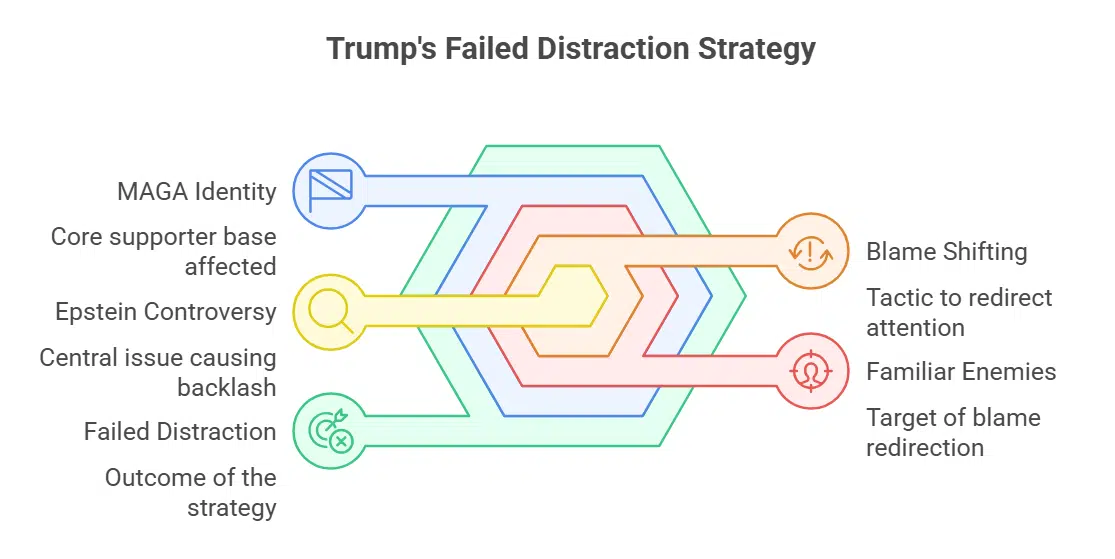
Facing backlash, Trump tried returning to one of his most-used tactics: shifting blame to Democrats. He accused his opponents of delaying the release of Epstein-related files during previous administrations.
This strategy has worked for Trump many times before. By redirecting outrage toward familiar enemies, he has often managed to unite his supporters around him. But this time, the distraction is falling flat. The controversy has become too personal, too central to the MAGA identity.
Instead of moving past the story, Trump’s comments have only drawn more attention. His critics have pounced, framing the administration’s actions as part of a broader pattern of dishonesty and political manipulation.
Epstein Controversy Strains MAGA Unity
Influential voices within the conservative media ecosystem are demanding answers. At the Turning Point USA conference and on major right-wing podcasts, hosts and speakers have kept the Epstein case front and center.
They’re asking hard questions: Where did Epstein’s money originate? Who were his clients? Who benefited from his silence? These are questions that the Justice Department’s memo failed to adequately address, at least in the eyes of the movement.
For many MAGA supporters, Epstein represents more than a criminal figure — he symbolizes the corruption of America’s elite. That image, reinforced by years of speculation and half-truths, now threatens to consume the movement that Trump once tightly controlled.
The Bigger Threat: Collapse of Institutional Trust
Beyond the political calculations, the Epstein firestorm highlights a much deeper societal issue — the breakdown of public trust in institutions.
Trump and his allies have spent years eroding confidence in the FBI, the DOJ, the media, and even the electoral system. By constantly framing themselves as victims of a shadowy “deep state,” they have cultivated a political environment where truth itself is up for debate.
Now, the same distrust is being turned inward. MAGA followers who once believed Trump was fighting the system are now questioning whether he has become part of it.
This erosion of trust not only weakens Trump politically, but also undermines the core missions of federal institutions. When law enforcement agencies are viewed as political tools, their ability to combat crime, protect national security, and administer justice becomes compromised.
What About the Average Voter?
Amid all the drama, one critical group has been largely ignored: the everyday voter.
Millions of Americans who supported Trump in 2024 were not motivated by conspiracies. They voted based on tangible concerns — rising grocery prices, housing affordability, education, and health care.
To these voters, the Epstein controversy may seem like a distraction from real issues. If the GOP is consumed by scandal and internal fighting, it risks alienating the broader coalition that helped Trump reclaim the presidency.
A Moment of Reckoning for Trump and the GOP
The Epstein controversy represents more than a fleeting political headache. It’s a moment of reckoning — for Trump, for the MAGA movement, and for the Republican Party.
Trump’s once-unquestioned ability to control the narrative is being tested. His loyalists are pushing back. His cabinet is divided. And his base is no longer monolithic.
If the storm continues to grow, Trump may face a choice: either confront the controversy head-on with full transparency or risk watching his political empire begin to crack under the weight of its own contradictions.
And as the Republican Party looks toward 2026 and beyond, it must decide whether it will continue to follow Trump wherever the narrative leads — or begin preparing for life after the conspiracist-in-chief.