
The Trump administration has started a large-scale dismissal of federal employees, a move that intensifies political tensions during the ongoing government shutdown. The decision marks one of the most sweeping reductions in the federal workforce in decades and signals a fundamental shift in how the administration is handling prolonged budget deadlocks in Washington.
According to the Office of Management and Budget (OMB), reductions in force—commonly known as RIFs—have formally begun across multiple federal departments. This marks the first time in modern U.S. history that a government shutdown has coincided with active layoffs of thousands of federal employees rather than the traditional furlough process used in past shutdowns.
A New Strategy During the Shutdown
White House budget officials have confirmed that these layoffs are intended to reduce operational costs and, in their view, streamline the size of government during a funding lapse. The administration’s approach breaks sharply from past practice: in previous shutdowns, federal employees who were furloughed typically returned to work once a budget was passed and received back pay for the period they were unable to work.
This time, however, the administration is not relying solely on temporary furloughs. Instead, it has initiated permanent layoffs that affect a wide range of agencies, from financial oversight and public health to education, energy, and housing. The move has drawn immediate resistance from unions, Democrats, and public service advocates who describe the decision as an attempt to use the shutdown as leverage in budget negotiations.
The government’s partial shutdown began ten days ago when lawmakers failed to agree on a funding bill that would extend federal spending. With no compromise in sight, the administration has escalated its efforts to reshape the federal workforce according to its long-standing promise of reducing bureaucracy.
Thousands of Federal Employees Affected
Initial reports from the OMB indicate that at least seven major federal agencies have started issuing layoff notices, affecting more than 4,000 employees in the first round of cuts.
-
Department of the Treasury: Approximately 1,446 employees are being notified of termination. This department, which manages the nation’s finances and debt, is facing the largest share of cuts, reflecting the administration’s view that the Treasury’s workforce can be consolidated under automation and digitization efforts.
-
Department of Health and Human Services (HHS): Between 1,100 and 1,200 employees are being notified. Many of these employees are tied to health research, public welfare programs, and administrative operations that depend on annual congressional funding.
-
Department of Education and Department of Housing and Urban Development (HUD): Each is expected to lose around 400 staff members. The cuts may affect policy analysis, grant management, and regional assistance programs that support low-income housing and school improvement initiatives.
-
Departments of Commerce, Energy, and Homeland Security: These departments will also see reductions ranging from 176 to 315 employees each. The Energy Department’s layoffs reportedly include environmental analysts and clean energy program staff, while the Department of Homeland Security is targeting administrative divisions, including personnel within its Cybersecurity and Infrastructure Security Agency (CISA).
The Environmental Protection Agency (EPA) has issued “intent to RIF” notices to around 20 to 30 employees, informing them that their positions are under review for possible elimination in the near future. Additional agencies may follow as budget uncertainty continues.
The total number of layoffs could rise significantly if the shutdown persists into the coming weeks, with internal government projections suggesting that more than 10,000 employees could ultimately be affected.
Legal Pushback and Union Opposition
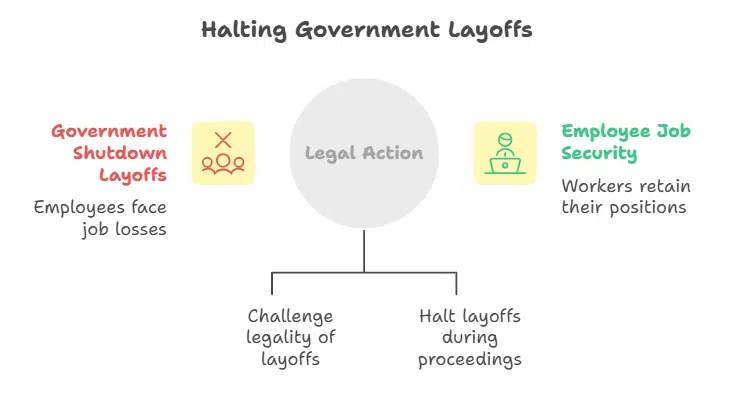
Two of the largest public sector unions — the American Federation of Government Employees (AFGE) and the AFL-CIO — have filed lawsuits challenging the legality of conducting layoffs during a government shutdown. They argue that the administration is violating civil service laws requiring due process, notification periods, and protections for employees during funding lapses.
Union leaders have characterized the layoffs as politically motivated and harmful to public welfare, emphasizing that many of the affected employees work in essential community-based services. They maintain that the administration is exploiting the shutdown to make permanent cuts to departments it has long sought to downsize or privatize.
In response, the Department of Justice’s lawyers, representing the OMB, have filed counterarguments asserting that the executive branch retains broad authority to determine how agencies are organized, especially during periods when funding is unavailable. They argue that blocking the layoffs through a court injunction would impede the government’s ability to manage its workforce efficiently.
The unions have requested a temporary restraining order from a federal court in Northern California to halt the layoffs while legal proceedings continue. The case is expected to move quickly given the urgency of the situation, as thousands of livelihoods hang in the balance.
A Historic Break From Shutdown Tradition
Traditionally, when the U.S. government shuts down due to the failure to pass a budget, federal agencies are required to suspend operations for non-essential staff. These employees are typically furloughed — temporarily placed on unpaid leave — until funding resumes, at which point they are reimbursed for lost pay.
This administration’s approach diverges from that precedent. Instead of waiting for Congress to act, the White House has chosen to treat the shutdown as an opportunity to initiate long-term workforce reductions. This strategy aligns with the administration’s long-standing campaign to limit the size of government and reduce federal payrolls permanently.
Observers describe this as an unprecedented move — one that could redefine how future administrations manage budget impasses. Critics warn that these mass layoffs could weaken key federal functions ranging from public health monitoring and housing assistance to cybersecurity protection and environmental oversight.
The impact may not be immediately visible to the public, but experts suggest that extended layoffs could disrupt everything from federal grant distributions to infrastructure maintenance and tax processing.
A Pattern of Workforce Reduction
The Trump administration has repeatedly emphasized the need to “reinvent” the federal workforce. Since returning to office in January, the White House has implemented multiple cost-cutting programs under the Department of Government Efficiency (DOGE), a new initiative designed to identify redundant roles and reduce administrative overhead.
According to data compiled by the Partnership for Public Service, a bipartisan research group that tracks government employment trends, the federal workforce has already shrunk by about 200,000 employees since early 2025. These reductions have occurred through voluntary buyouts, forced resignations, hiring freezes, and structural reorganizations.
A separate analysis by career consultancy Challenger, Gray & Christmas found that in 2025 alone, the government sector announced over 299,000 planned job cuts, with nearly 289,000 of them attributed to federal agencies influenced by DOGE’s recommendations. The agency was initially led by billionaire entrepreneur Elon Musk, who was appointed as a senior advisor on efficiency and innovation.
These latest RIFs appear to be an extension of that broader campaign, with shutdown-related layoffs acting as a catalyst to accelerate reductions that had already been under consideration.
Political Divisions Deepen
The mass terminations have deepened the standoff between Republicans and Democrats in Congress. Republican leaders have defended the layoffs, arguing that the administration is making tough but necessary choices to prioritize spending and eliminate wasteful programs during a funding shortfall.
Democrats, on the other hand, accuse the White House of deliberately creating chaos and using working Americans as bargaining chips. They insist that any budget deal must include the restoration of key social programs, such as health insurance tax credits and Medicaid protections, that the administration has sought to scale back.
The political stalemate has left hundreds of thousands of federal employees uncertain about their future. Nearly 40% of the federal workforce — around 750,000 workers — are currently affected by the shutdown, either through unpaid furloughs or layoffs.
Traditionally, furloughed workers receive back pay once a shutdown ends, but the administration has suggested that this policy could be reconsidered, raising concerns among federal employees who have gone days without paychecks.
Economic and Social Impact
The economic consequences of such widespread layoffs could be substantial. Federal employees contribute significantly to local economies, particularly in regions such as Washington, D.C., Virginia, Maryland, and parts of the Midwest that rely on government contracts and administrative jobs.
Economists warn that if these layoffs become permanent, the ripple effects could include slower consumer spending, reduced local tax revenues, and long-term disruptions in public service delivery. Financial analysts also note that the uncertainty surrounding federal employment may weaken the overall U.S. labor market in the short term.
For communities dependent on programs administered by federal departments—such as housing subsidies, rural healthcare grants, and education funding—the impact could be severe. With fewer staff to process applications, monitor compliance, or provide oversight, program delays are expected to grow.
What Comes Next
Under federal law, government agencies are required to provide at least 30 days’ notice before terminating employees. This means that even as notices are distributed, some employees will remain on the payroll until late November unless the shutdown ends or the courts intervene.
If Congress reaches a budget agreement, agencies could still rehire staff, though the reemployment process could take months. If the shutdown continues, additional waves of layoffs are expected.
Legal experts predict that the court battles over the RIFs could set major precedents regarding executive authority in times of fiscal impasse. If the courts uphold the administration’s power to lay off workers during a shutdown, future presidents could use similar tactics to reshape federal agencies during political gridlock.
For now, tens of thousands of federal employees remain in limbo, uncertain whether they will receive pay, lose their jobs permanently, or see their roles redefined under a leaner federal structure.
The Long-Term Vision
The Trump administration’s broader goal is to create what it describes as a “smaller, more efficient” federal government, one that relies more on technology, private sector partnerships, and decentralized operations. This aligns with the president’s earlier campaign rhetoric promising to eliminate what he called “bloated bureaucracies.”
However, critics caution that such sweeping workforce reductions could erode institutional knowledge, weaken essential safety nets, and compromise national security functions.
Political analysts view these layoffs not merely as a cost-cutting measure but as a calculated political maneuver—one that underscores the administration’s willingness to use the shutdown as both a policy tool and a test of power in Washington.