The global conversation about climate change often feels paralyzed by doom and gloom, but look closer at the municipal level and you will find a different story. While nations argue over treaties, cities are simply getting the work done. In 2026, we are witnessing a tipping point where “sustainable” is no longer a buzzword for future planning—it is the operational standard for leading urban centers.
This year has brought a wave of milestones. We are seeing former industrial hubs transform into green sanctuaries and desert towns running entirely on wind and sun. The top renewable energy cities 2026 lists aren’t just about who has the most solar panels; they are about who is fundamentally redesigning the urban experience to decouple growth from carbon emissions.
We analyzed global data, including the latest Carbon Disclosure Project (CDP) reports and the European Green Capital awards, to bring you the cities defining the future of energy this year.
Why Cities Are the Real Power Players
National grids are slow to change, weighed down by bureaucracy and legacy infrastructure. Cities, however, can move fast. They control building codes, public transit, and waste management.
-
Density is Efficiency: Urban areas consume 78% of the world’s energy. Fixing them fixes the planet.
-
Direct Accountability: Mayors face their constituents daily. If the air is dirty or the power goes out, the feedback loop is immediate.
-
Economic Incentive: In 2026, renewables are cheaper than fossil fuels in most regions. Cities switching to clean power aren’t just saving the earth; they are saving millions in operating costs.
10 Top Renewable Energy Cities 2026
Here are our picks for the top 10 cities that excell in renewable energy:
1. Guimarães, Portugal
European Green Capital 2026
Taking the crown as the European Green Capital for 2026, Guimarães is a masterclass in transformation. Once known primarily as a historic medieval city, it has aggressively retrofitted its ancient infrastructure for a net-zero future. The city has integrated a massive ring of green spaces—the “Green Corridor”—that connects urban areas with biodiversity hotspots, doubling as a natural cooling system to combat rising temperatures.
What makes Guimarães stand out is its holistic approach. It isn’t just about plugging in solar panels; it is about circular economy principles. The city has achieved record-breaking waste recycling rates and implemented a zero-emission public transport network that serves as a model for smaller European cities. Their 2026 “Net Zero Neighborhoods” pilot is currently being watched by urban planners globally as a blueprint for retrofitting heritage zones without damaging their cultural value.
| Feature | Details |
| Primary Energy | Hydro, Wind, Biomass |
| Key 2026 Milestone | European Green Capital Title Holder |
| Transport | 100% Electric Public Fleet |
| Innovation | Heritage Building Energy Retrofits |
2. Canberra, Australia
The Battery Capital of the South
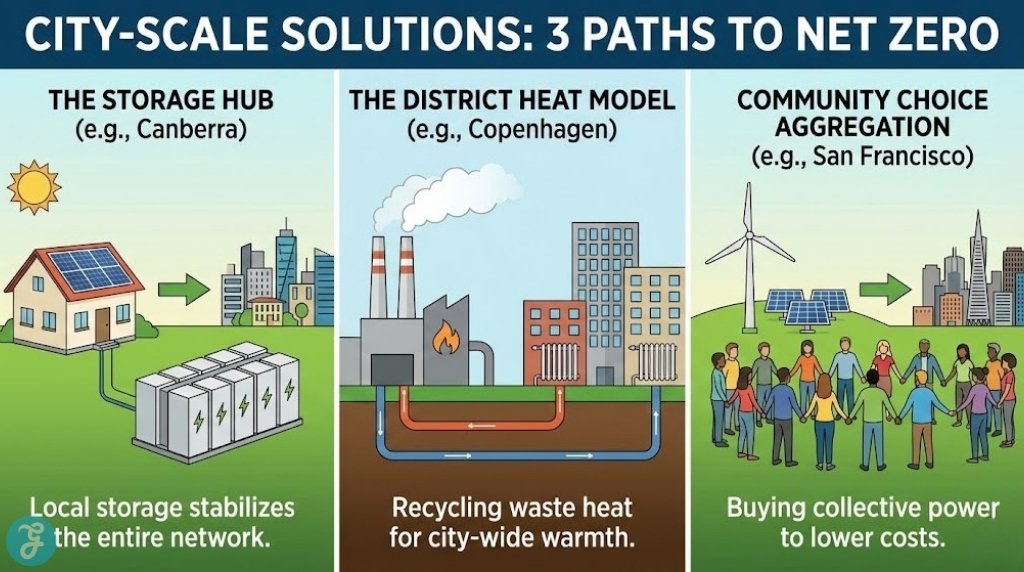
Canberra achieved 100% renewable electricity years ago, but in 2026, it is solving the next big problem: storage. The “Big Canberra Battery” ecosystem is now fully operational. Instead of one giant Tesla mega-pack, this is a distributed network of neighborhood-scale batteries that stabilizes the grid and allows residents to store their excess rooftop solar energy.
The Australian Capital Territory (ACT) has also banned the sale of new fossil-fuel cars ahead of the national curve. If you drive into Canberra today, you will notice the silence; the density of EVs is among the highest in the world. Their 2026 initiative to offer zero-interest loans for households to disconnect from the gas grid completely is driving the final nail into the coffin of fossil fuel reliance.
| Feature | Details |
| Primary Energy | Solar, Wind |
| Key 2026 Milestone | “Big Canberra Battery” Ecosystem Launch |
| Renewable Status | 100% Renewable Electricity (Since 2020) |
| Innovation | Neighborhood-Scale Distributed Storage |
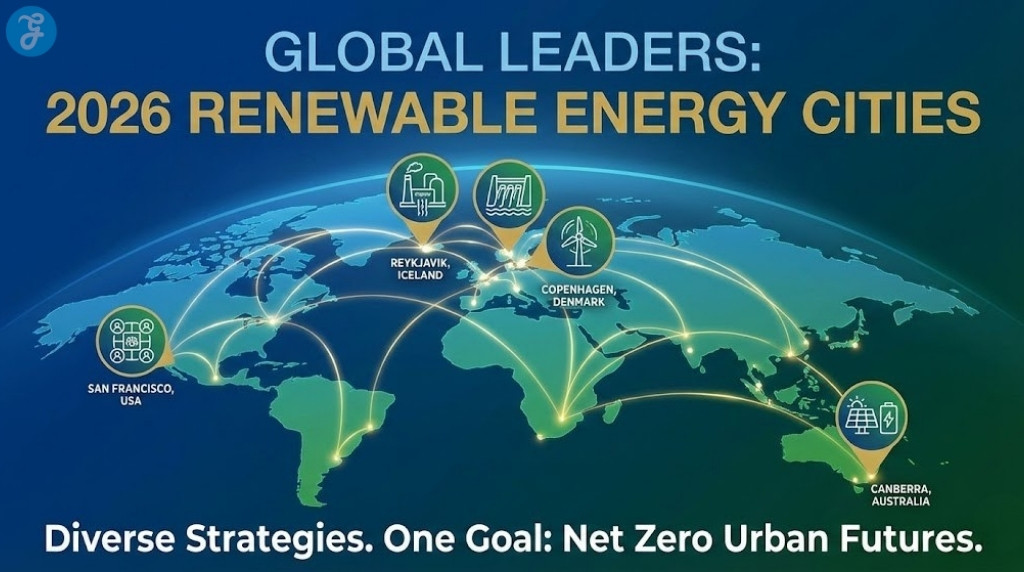
3. Reykjavik, Iceland
The Geothermal Giant
Reykjavik remains the undisputed heavyweight champion of clean energy. It sits atop a volcanic hotspot, allowing it to power 99.9% of its electricity and district heating with geothermal and hydroelectric power. In 2026, they are pushing the envelope with the Carbfix project, which doesn’t just stop emissions but actively turns CO2 into stone underground.
The city is now exporting this expertise. Engineers from Reykjavik are currently advising cities in East Africa and the Philippines on how to tap into their own geothermal potential. For residents, this means dirt-cheap energy bills and heated sidewalks that melt snow automatically—a luxury that costs the environment nothing.
| Feature | Details |
| Primary Energy | Geothermal, Hydro |
| Key 2026 Milestone | Expansion of Carbfix Carbon Capture |
| Renewable Status | 99.9% Renewable |
| Innovation | Carbon Mineralization Tech |
4. Burlington, Vermont, USA
The Proof of Concept
Burlington was the first American city to hit 100% renewable electricity, and it remains the North Star for US municipalities. While other cities make pledges for 2050, Burlington is living the reality today. They rely on a mix of local hydro, wind, and a unique biomass plant that burns sustainably harvested wood chips.
In 2026, Burlington’s focus has shifted to “Net Zero Energy”—tackling the harder sectors of heating and transport. The city utility now offers incentives that make it practically negligent not to switch to a heat pump. Their district energy system is expanding to capture waste heat from commercial buildings, creating a thermal loop that drastically cuts winter energy demand.
| Feature | Details |
| Primary Energy | Hydro, Biomass, Wind |
| Key 2026 Milestone | Net Zero Thermal Energy Expansion |
| Renewable Status | 100% Renewable Electricity |
| Innovation | District Heat Recovery Systems |
5. Adelaide, South Australia
Running on pure Sunshine
Adelaide is arguably the most exciting energy market on earth right now. In 2026, they are regularly hitting periods where the entire state runs on 100% solar and wind for days at a time. The abundance of cheap midday solar energy has birthed a new industry: Green Hydrogen.
The massive hydrogen electrolyzers commissioned near the city are now soaking up that excess solar power to produce fuel for heavy industry and export. Adelaide proves that renewables aren’t just “feasible” for a modern economy; they are a competitive advantage. The city’s “Virtual Power Plant” (VPP), connecting thousands of home batteries, is now the largest in the southern hemisphere.
| Feature | Details |
| Primary Energy | Solar, Wind |
| Key 2026 Milestone | Green Hydrogen Export Hub Operational |
| Renewable Status | 100% Net Renewables (Target 2027) |
| Innovation | World’s Largest Virtual Power Plant |
6. Oslo, Norway
The EV Capital of the World
Oslo’s “Climate Budget” is stricter than its financial budget. If a department exceeds its carbon limit, it’s treated as a fiscal crisis. This level of discipline has transformed the city. In 2026, the noise pollution in Oslo has dropped significantly because nearly the entire public transit fleet and a massive chunk of private cars are electric.
The city is now tackling “indirect” emissions. All municipal construction sites in Oslo must be zero-emission. You see electric excavators and battery-powered cranes building the skyline. It is a quiet revolution, literally. They are on track to slash emissions by 95% by 2030, a goal that seemed impossible five years ago but now looks inevitable.
| Feature | Details |
| Primary Energy | Hydro |
| Key 2026 Milestone | Zero-Emission Construction Sites |
| Renewable Status | 98% Renewable Electricity |
| Innovation | Carbon Budgeting Governance |
7. San Francisco, California, USA
Community Power Wins
San Francisco has always been green, but the success of “CleanPowerSF” in 2026 is a game-changer. This community choice aggregation program has allowed the city to bypass the traditional utility monopoly and buy its own power. The result? They just lowered rates by 25% while increasing the renewable mix.
It turns out that cutting out the profit motive makes green energy cheaper. The city is leveraging this financial freedom to heavily subsidize battery storage for low-income neighborhoods, ensuring that the energy transition doesn’t leave the poor behind. Their Hetch Hetchy hydro system continues to provide carbon-free baseload power, the backbone of their grid.
| Feature | Details |
| Primary Energy | Hydro, Solar, Wind |
| Key 2026 Milestone | 25% Rate Reduction via CleanPowerSF |
| Renewable Status | 100% Greenhouse Gas-Free Supply |
| Innovation | Community Choice Aggregation (CCA) |
8. Georgetown, Texas, USA
Red State, Green Power
Georgetown is the ultimate counter-argument to the idea that renewable energy is a “liberal” obsession. This conservative Texas town switched to 100% wind and solar for one reason: math. It was simply cheaper and more predictable than fossil fuels.
In 2026, Georgetown is reaping the rewards. While other parts of the Texas grid struggle with price volatility, Georgetown’s long-term wind contracts have kept rates stable. They have become a magnet for tech companies and manufacturers looking for green credentials and stable operating costs. It is a pragmatic, profit-driven model of sustainability that is being replicated across the American Midwest.
| Feature | Details |
| Primary Energy | Wind, Solar |
| Key 2026 Milestone | Grid Stability during extreme weather |
| Renewable Status | 100% Renewable Electricity |
| Innovation | Fixed-Rate Long-Term Renewables |
9. Copenhagen, Denmark
The Cycling Utopia
Copenhagen’s goal to be the world’s first carbon-neutral capital is agonizingly close. In 2026, their CopenHill waste-to-energy plant—which doubles as a ski slope—is an icon of dual-use infrastructure. But the real hero is the bicycle.
Over 62% of commutes in Copenhagen are done by bike. This isn’t just about painting lines on a road; it is about “Green Waves,” where traffic lights are timed for cyclists, not cars. The city’s district heating system is now almost entirely fueled by wind, biomass, and waste, removing the need for individual gas boilers in homes.
| Feature | Details |
| Primary Energy | Wind, Biomass |
| Key 2026 Milestone | Carbon Neutral Goal Target Year |
| Renewable Status | Near 100% Carbon Neutral |
| Innovation | CopenHill (Waste-to-Energy + Recreation) |
10. Vilnius, Lithuania
The Green Tech Hub
Fresh off its stint as the 2025 European Green Capital, Vilnius has not slowed down. In 2026, it is emerging as a sandbox for green tech startups. The city has opened its data to developers, leading to apps that optimize everything from trash pickup routes to street lighting efficiency.
Vilnius has focused heavily on biodiversity, turning “grey” Soviet-era concrete blocks into vertical gardens. Their district heating system has transitioned rapidly away from imported gas to local biomass and heat pumps, a move driven by energy security as much as climate concern. It is a model of resilience for Eastern Europe.
| Feature | Details |
| Primary Energy | Biomass, Solar |
| Key 2026 Milestone | Post-Green Capital Tech Integration |
| Renewable Status | Rapid Decarbonization |
| Innovation | Open Data for Urban Efficiency |
What Makes a “Top Renewable Energy City”?
We didn’t just pick these cities out of a hat. There is a specific set of criteria that defines the top renewable energy cities of 2026.
Grid Independence
Leading cities are moving toward “island mode” capabilities. Places like Adelaide and Canberra are building enough local storage to keep the lights on even if the national grid fails. This resilience is the new gold standard.
The “Prosumer” Economy
In top cities, citizens aren’t just consumers; they are producers. The regulatory frameworks in places like San Francisco and Burlington allow homeowners to easily sell their excess power back to the grid, turning every roof into a mini power plant.
Decarbonizing Heat
Electricity is the easy part. The real challenge is heating. Cities like Copenhagen and Reykjavik have solved this with district heating—pumping hot water underground to thousands of homes from a central, clean source. This is the frontier where the next battles will be won.
Common Myths About Renewable Cities
Here are 3 of the most common myths surrounding renewable cities:
-
“It’s too expensive.” As Georgetown, Texas proves, renewables are often the lowest-cost option long-term. The upfront capital is high, but the “fuel” (wind and sun) is free forever.
-
“It only works in sunny places.” Burlington, Vermont, and Reykjavik, Iceland, have harsh winters and less sun, yet they are leaders. It is about matching the resource (hydro, wind, geothermal) to the geography.
-
“The grid can’t handle it.” With 2026 battery tech and smart software, variability is managed. Adelaide runs a stable grid with massive wind/solar penetration thanks to smart load management.
Final Thoughts
The transition is no longer a theory; it is a construction project. The top renewable energy cities 2026 highlight are proving that a net-zero life isn’t a sacrifice. It is a life with cleaner air, quieter streets, and more stable energy bills.
Whether it is the high-tech battery networks of Canberra or the community-driven power of San Francisco, the blueprint for a sustainable future has already been drawn. Now, the rest of the world just needs to build it. If you are looking for a place to move, invest, or just find hope, look to these cities—they are living in the future we all want.