
Keeping up with changing rules is tough. Have you ever tried to patch a critical bug while the system is still live and users are active? That is exactly what handling compliance feels like for many fintech founders today. You might worry about staying legal or avoiding fines as new laws pop up fast. Missing a small step could cost you big, and old ways of keeping track just cannot keep pace. It is like trying to run a modern React app on a browser from 2010.
Here is a number that might wake you up. In 2024 alone, crypto and fintech companies faced nearly $6 billion in fines globally for missing compliance steps. That is not just a line item; that is a budget-breaking error. RegTech trends now shape how financial technology grows. Smart tools help make rule-following easier and quicker every day. I will walk you through what RegTech is and how it acts as the automated testing suite for your business.
I want to show you how simple tech updates can protect you from risk without the extra stress. So, let’s break down RegTech trends, and it’s shaping the future of Fintech.
What Is RegTech?
RegTech helps companies follow rules in finance using smart tools. Think of it as the difference between manually checking every line of code for errors versus running an automated linter. These solutions keep businesses fast and safe while rules keep changing.
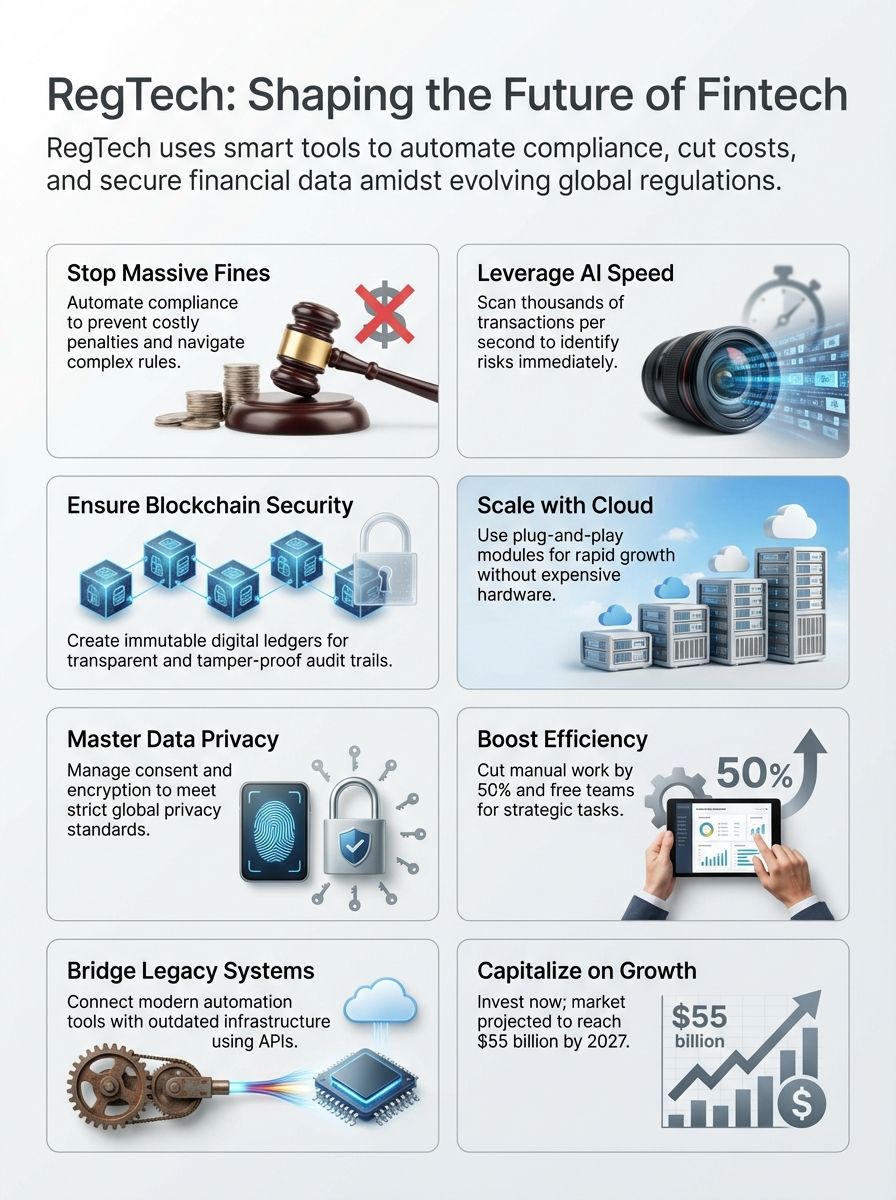
Definition and purpose
Regulatory technology, or RegTech, uses digital tools to help fintech companies follow legal rules. These laws keep people’s money safe and stop crimes such as fraud or money laundering. In my engineering work, I view this as the “security layer” of the financial stack.
Fintech firms use RegTech to check customer identities fast, monitor risky transactions, and file reports with regulators on time. Platforms like Socure and Alloy provide APIs that make this process simple. They integrate directly into your onboarding flow, verifying a user in milliseconds rather than days.
Banks save both time and cash by using smart software instead of piles of paperwork. With growing data privacy laws like the California Privacy Rights Act (CPRA) or the EU’s GDPR, staying compliant matters more than ever. A 2024 study by Juniper Research found that RegTech spending will likely exceed $200 billion by 2028, proving that this is a necessary infrastructure upgrade.
This tech helps firms avoid big fines while keeping trust high with users. Next, we will look at how these solutions fit into the larger fintech system.
Importance in the fintech ecosystem
RegTech acts like a safety net for fintech companies. Laws and rules change fast. Just look at the Financial Crimes Enforcement Network (FinCEN) in the US; they frequently update reporting requirements for beneficial ownership.
RegTech tools step in to help companies keep up with these patches. They spot risks early, automate compliance checks, and save time on paperwork. Banks once needed whole teams to track rules. Today, smart software can scan thousands of pages and flag issues in seconds.
“Speed alone does not win the race; accuracy carries it across the finish line.”
Fintech players use these tools for risk management, fraud detection, and a better user experience. Small startups find it easier to enter the market because technology cuts down costs linked to legal requirements.
Errors drop when machines handle complex parts. Trust grows between customers and banks as a result. Next, let’s see how artificial intelligence shapes these changes in real-time compliance work.
Key Trends Shaping RegTech in Fintech
Technology keeps evolving, and regulatory tools are racing to keep up. Fast changes bring fresh ways for companies to follow the rules with less stress.
Artificial intelligence (AI) and machine learning (ML) in compliance
RegTech tools use AI and ML to spot risky activity fast. They scan thousands of transactions each second, much faster than any human team. For example, Feedzai uses heavy-duty machine learning to build risk profiles that stop fraud before the transaction even completes.
These systems learn from past data. They catch new tricks as scammers change their methods. It is similar to how a spam filter learns to block new types of junk mail over time.
AI in compliance also helps follow tough rules without slowing work. Firms can check records and generate reports with fewer mistakes. A recent report from NVIDIA in 2024 highlighted that financial services using AI for fraud detection saw a 20% reduction in false positives. This saves both money and stress for fintech companies trying to keep up with changing regulations.
Blockchain for regulatory transparency and security
Big banks and fintech firms use blockchain to keep records safe and open. Every step gets locked in a digital ledger that no one can undo or change in secret. Think of it like a Git commit history that is impossible to force-push over.
This cuts out shady deals and keeps everyone honest. J.P. Morgan’s Onyx platform is a prime example. It uses blockchain to share liability and compliance data instantly between institutions, removing the need for slow manual reconciliation.
Regular audits get easier since the data stays in real-time. It is ready for quick checks by regulators or auditors. Financial technology tools built with blockchain help spot fraud fast and meet tough rules without slowing business growth. Blockchain gives both security and clear proof. Companies can show they follow every regulation line by line.
Real-time regulatory monitoring and reporting
Blockchain brings transparency, but real-time monitoring gives fintech firms an edge. Software scans each transaction as it happens. Law changes can trigger alerts at once.
Money trails get flagged in seconds for risky moves. With the rollout of the FedNow service in the US for instant payments, real-time monitoring is now a requirement, not a luxury. You cannot wait 24 hours to check a transaction that settles in 20 seconds.
RegTech tools read new laws from agencies like the SEC fast. They scan huge data sets for issues before problems snowball. Machine learning learns patterns and warns teams right away. This cuts risk and saves time for staff who no longer have to dig through endless spreadsheets.
Cloud-based RegTech solutions for scalability
Cloud-based RegTech lets even small firms grow fast. Companies use the cloud to process lots of data at once. This makes compliance simple rather than stressful.
With this setup, updates and rules roll out quickly. There is no need for big tech teams or expensive tools on-site. It is just like spinning up a new instance on AWS; you pay for what you use.
Banks now analyze records in seconds instead of hours. This helps spot threats and avoid fines before trouble strikes. Providers like NICE Actimize offer services right from the internet. This shrinks delays and breaks down old barriers between regulators and fintechs alike.
The rise of RegTech-as-a-service (RaaS)
RegTech-as-a-service, or RaaS, makes compliance much easier for fintech companies. Firms can now use modular solutions that plug right into their systems via API. These cloud-based tools help with regulation, risk management, and automation.
Startups do not need big in-house teams anymore. They can pick services as needed. Companies like ComplyAdvantage allow developers to integrate anti-money laundering (AML) checks with just a few lines of code.
RaaS gives real-time updates on changing legal frameworks across the globe. Smaller banks save costs while meeting strict data privacy regulations. This approach streamlines work and boosts efficiency. It allows quick scaling without starting from scratch each time a new rule appears.
Regulatory Changes Driving RegTech Adoption
Rules in finance change fast. Fresh laws keep tech companies on their toes and spark new ways to solve problems.
Data privacy and protection regulations
Data privacy laws push fintech companies to handle customer data with care. These rules ask firms to get clear permission before collecting any personal information. In the US, the California Privacy Rights Act (CPRA) has set a high bar, allowing fines of up to $7,500 per intentional violation.

In 2023, fines for breaking GDPR in Europe reached over $2 billion. Businesses pay close attention to these numbers. RegTech helps by tracking consent, encrypting records, and keeping audit trails ready at a moment’s notice.
Financial technology relies on trust. Customers want their details locked up tight. New regulations pop up fast in different countries. Think of Brazil’s LGPD or India’s DPDP Act. Each has its own twist on what counts as private data.
Automated compliance tools sort out these demands. They flag risky behavior early. This helps avoid penalties that can drain both money and reputation faster than a data breach.
Cross-border compliance challenges
Tighter rules on data privacy highlight how tricky overseas regulations can be. Every country sets its own laws and checks. These often clash with others. A startup in New York must follow not just US compliance but also the EU’s GDPR if it serves European customers.
Banks juggle hundreds of legal frameworks at once. The Financial Action Task Force (FATF) sets global standards. Yet, local agencies like Singapore’s MAS or Australia’s APRA add extra steps.
Even a simple payment across borders may require checks that differ from place to place. The “Travel Rule” is a classic example. It requires crypto exchanges to share sender data for transactions over a certain amount. Technology helps track these rules, but keeping up remains a real challenge for fast-moving teams.
Sustainable finance regulations
Sustainable finance regulations now push companies to focus on green investments. These rules track how banks lend money, manage risk, or even report carbon footprints.
In the US, the SEC’s Climate Disclosure Rules are pushing public companies to be transparent about their climate-related risks. Financial technology faces pressure to prove that products do not harm people or the planet.
Automation tools in RegTech check if firms meet these strict standards fast. As innovation climbs, compliance teams deal with more reports about social impact. Regulatory technology helps make sense of this flood so businesses stay on the right side of the law.
How RegTech Is Transforming Financial Services [Use Cases]
Banks today use RegTech tools to stop fraud fast. These tools flag strange money moves in real time. For example, Chime, a leading US fintech, relies on advanced machine learning to spot account takeovers instantly.
This move protects users without freezing legitimate spending. Many fintech firms now automate customer ID checks with facial scans and digital documents. Companies like Plaid help connect user bank accounts securely, ensuring data is valid before a loan is even approved.
Cloud-based solutions help small financial businesses keep up with rules without hiring more staff. Payment providers track every transaction. They spot risks before they grow into trouble spots.
Global banks face strict data privacy laws. RegTech makes audits easy by storing records safely during inspections from groups like the SEC. Here is how the old way compares to the new way:
| Feature | Traditional Compliance | RegTech Compliance |
|---|---|---|
| Speed | Days to clear alerts | Milliseconds (Real-time) |
| Cost | High headcount expenses | Predictable software fees |
| Accuracy | Prone to human error | Consistent, algorithmic checks |
With these tech tools, teams work smarter while meeting all legal requirements at once. No sweat, no paper chase needed.
Benefits of RegTech in Fintech
RegTech makes financial compliance easier, faster, and sharper. Stick around to learn how it changes the game.
Enhanced efficiency and automation
Software now checks transactions much faster than any human team. Financial technology companies use automation to process thousands of compliance reports in minutes. It is a massive upgrade from the days of manual spreadsheets.
AI tools scan for errors or fraud while people focus on more important decisions. Banks like Wells Fargo use these solutions to manage their immense data loads. As a result, teams catch risks early and keep data clean for audits.
Cloud-based platforms help firms scale up fast without slowing down workflows. RegTech tools reduce manual work significantly. A report by Thomson Reuters suggested that some firms spend up to 10 hours a week just tracking regulatory changes. Automation gives that time back.
Improved accuracy and fraud detection
RegTech uses smart tools like artificial intelligence and machine learning. These spots make mistakes faster than people can. Banks use RegTech to check thousands of transactions each second.
They catch fraud, typos, and fake accounts with more detail. This helps companies follow regulatory rules with fewer slip-ups. It is like having a linter that catches syntax errors before you even compile your code.
Teams once checked records by hand. Now, software watches in real time for risky actions. If a hacker tries to trick the system, alerts pop up right away. Stronger accuracy means safer money for everyone.
Cost-effective compliance solutions
Banks and fintech firms save money by using automation tools. Automated checks spot errors fast, cut human mistakes, and lower fines. Cloud-based options mean companies do not spend much on servers.
- Reduced Headcount: You don’t need an army of analysts for data entry.
- Subscription Models: Pay for the API calls you use, which is great for startups.
- Avoided Fines: Preventing a single violation can save millions in penalties.
Smaller teams now handle big workloads thanks to these new systems. Startups also benefit since they avoid high upfront costs. Compliance does not have to drain budgets anymore.
Challenges in Adopting RegTech
Change can be difficult. Many teams hit bumps that test their patience and grit when installing new systems.
Data security concerns
Hackers keep chasing sensitive data. RegTech tools must shield user information from leaks. Many firms store client details in the cloud, so a single weak spot can cause disaster.
In 2023, the Verizon Data Breach Investigations Report showed that the financial sector is still a top target for cyberattacks. New rules, such as the CPRA, make strong protections a legal requirement.
Firms use encryption, multi-factor authentication, and regular audits to stop threats. AI detection tools also watch for odd activity around the clock. However, bad actors always look for backdoors into systems that manage personal data.
Integration with legacy systems
Data security grabs the spotlight, but getting RegTech solutions to work with old financial technology is another big hurdle. Old banking systems often run on outdated software.
“Many banks still use systems written in COBOL from the 1970s. Connecting modern APIs to these mainframes is like trying to charge a Tesla with a potato.”
Integration can slow down innovation. Clunky connections create ‘technical debt’ that engineers have to pay interest on later. It makes the system harder to maintain and update.
Fintech firms crave quick results. Yet, bridging new regulatory technology and legacy infrastructure is tough. Some banks now invest in middleware solutions to bridge the gap without disrupting user experience.
Legacy systems slow down updates, but shifting rules crank up the pressure. Banks and fintechs watch legal frameworks shift constantly. New laws on privacy force quick changes in compliance tools.
Regulators push for more transparency with digital transformation. In 2024, the Consumer Financial Protection Bureau (CFPB) finalized rules like Section 1033 to boost open banking. This forced many US institutions to rapidly update their data-sharing capabilities.
RegTech acts as a compass here. It uses automation to keep companies alert to new requirements. Clear reporting dashboards help teams spot changes early. The right technology keeps fintech innovation moving even while regulations shift around them.
The Future of RegTech in Fintech
Tomorrow’s RegTech will spark bold shifts in finance. Watch as new tech brings partners together, changing how companies deal with rules.
Projections for market growth
RegTech is booming. Experts at Grand View Research project the global market size to reach over $55 billion by 2030. Strong growth comes from tougher regulation and more fintech firms needing better tools.
Banks and startups want quick solutions. RegTech answers this demand with automation. Reports show a big jump in spending on cloud-based Regulatory Technology platforms.
North America leads the pack. However, the Asia-Pacific region is catching up fast as new rules pop up in India and Singapore. Investors pour money into RegTech startups that promise fewer errors and lower costs.
Collaboration between RegTech and financial institutions
Growth projections shine a bright light on partnerships. Banks, credit unions, and startups team up with RegTech firms more than ever. This teamwork helps them meet strict regulations fast.
For example, Citi has partnered with various RegTech startups to automate its trade surveillance. Small banks use cloud-based platforms to manage compliance checks without hiring big teams.
Working together boosts efficiency. RegTech solutions fit into daily financial tasks like customer checks. These tools catch mistakes early and help each business stay within the law’s lines. Fast updates allow both big players and newcomers to keep their footing.
The Bottom Line
RegTech changes how financial technology companies handle compliance and risk management. Tools like AI spot fraud faster, and automation cuts busywork costs. Banks once spent billions yearly on manual compliance tasks, but smart software now slashes those numbers significantly.
Regulation keeps shifting. RegTech solutions help firms stay one step ahead without losing sleep or breaking budgets. It is the upgrade your financial infrastructure desperately needs. Innovation in digital transformation makes things easier for users, too. Modular solutions fit different needs. Even older banks can upgrade piece by piece without starting from scratch.
Good governance and clear data security rules make everyone safer. Smoother processes build trust with customers. RegTech puts efficiency front and center, turning strict rules into a strategic lever rather than just a checklist.