To stay competitive in the 2026 e-commerce landscape, “good enough” inventory management is no longer an option. With customers expecting instant shipping and marketplaces like Amazon and TikTok Shop demanding 100% stock accuracy, a single spreadsheet error can result in de-listed products or thousands in lost revenue.
If you are currently drowning in manual updates, this guide is for you. We have analyzed the market to bring you the 12 top inventory management systems for e-commerce in 2026, categorized by business size, technical needs, and growth goals.
12 Top Inventory Management Systems for E-commerce (2026 Review)
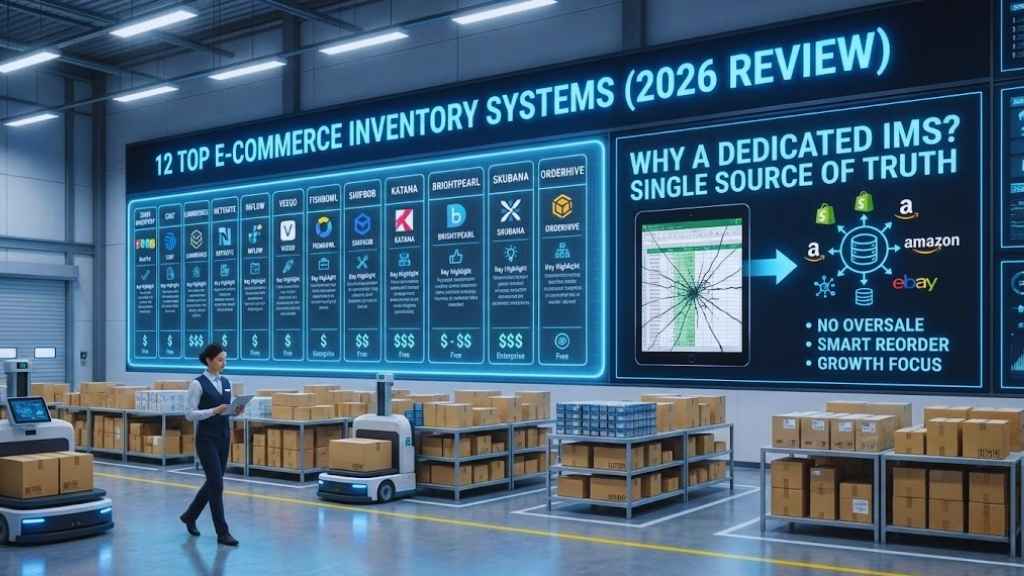
| Software | Best For | Key Highlight | Price Range |
| Zoho Inventory | Small Businesses | Best value & ecosystem | $ (Low) |
| Cin7 | Multi-channel Brands | Built-in POS & EDI | $$ (Mid) |
| Linnworks | High-Volume Sellers | Superior automation | $$$ (High) |
| NetSuite | Enterprise | Full ERP integration | (Enterprise) |
| inFlow | B2B & Wholesale | Ease of use | $$ (Mid) |
| Veeqo | Shopify Sellers | Free for many users | Free / $ |
| Fishbowl | Manufacturers | QuickBooks integration | $$ (Mid) |
| ShipBob | Outsourced Logistics | Fulfillment + Inventory | Custom |
| Katana | D2C Manufacturers | Visual shop floor control | $$ (Mid) |
| Brightpearl | Mid-Market Retail | Real-time “Retail OS” | $$$ (High) |
| Skubana | Operations Pros | Profitability analytics | $$$ (High) |
| Orderhive | Growing Startups | Fast sync speeds | $ (Low) |
Why Your E-commerce Business Needs a Dedicated Inventory System
Most founders start with a basic spreadsheet or the native inventory tool inside Shopify or WooCommerce. However, you will eventually hit the “spreadsheet ceiling.”
When you sell on multiple channels (e.g., your website, Amazon, and eBay), a dedicated Inventory Management System (IMS) acts as your “Single Source of Truth.” Without it, you risk:
- Overselling: Selling a product on Amazon that just sold out on your website.
- Dead Stock: Capital tied up in products that aren’t moving because you didn’t have the data to stop reordering.
- Operational Chaos: Spending 10+ hours a week manually updating stock levels instead of growing your brand.
12 Best Inventory Management Systems for 2026
The e-commerce landscape in 2026 is defined by “unified commerce.” It’s no longer just about tracking boxes in a warehouse; it’s about managing a complex web of TikTok Shop orders, Amazon FBA shipments, and local brick-and-mortar pickups—all in real-time. To help you navigate this complexity, we have vetted dozens of platforms based on their API stability, AI-driven forecasting capabilities, and ease of integration.
The following list represents the “cream of the crop” for various business models. Whether you are a solo founder looking for your first automation tool or an operations director at a global enterprise, these systems have been selected for their proven ability to reduce human error and maximize capital efficiency.
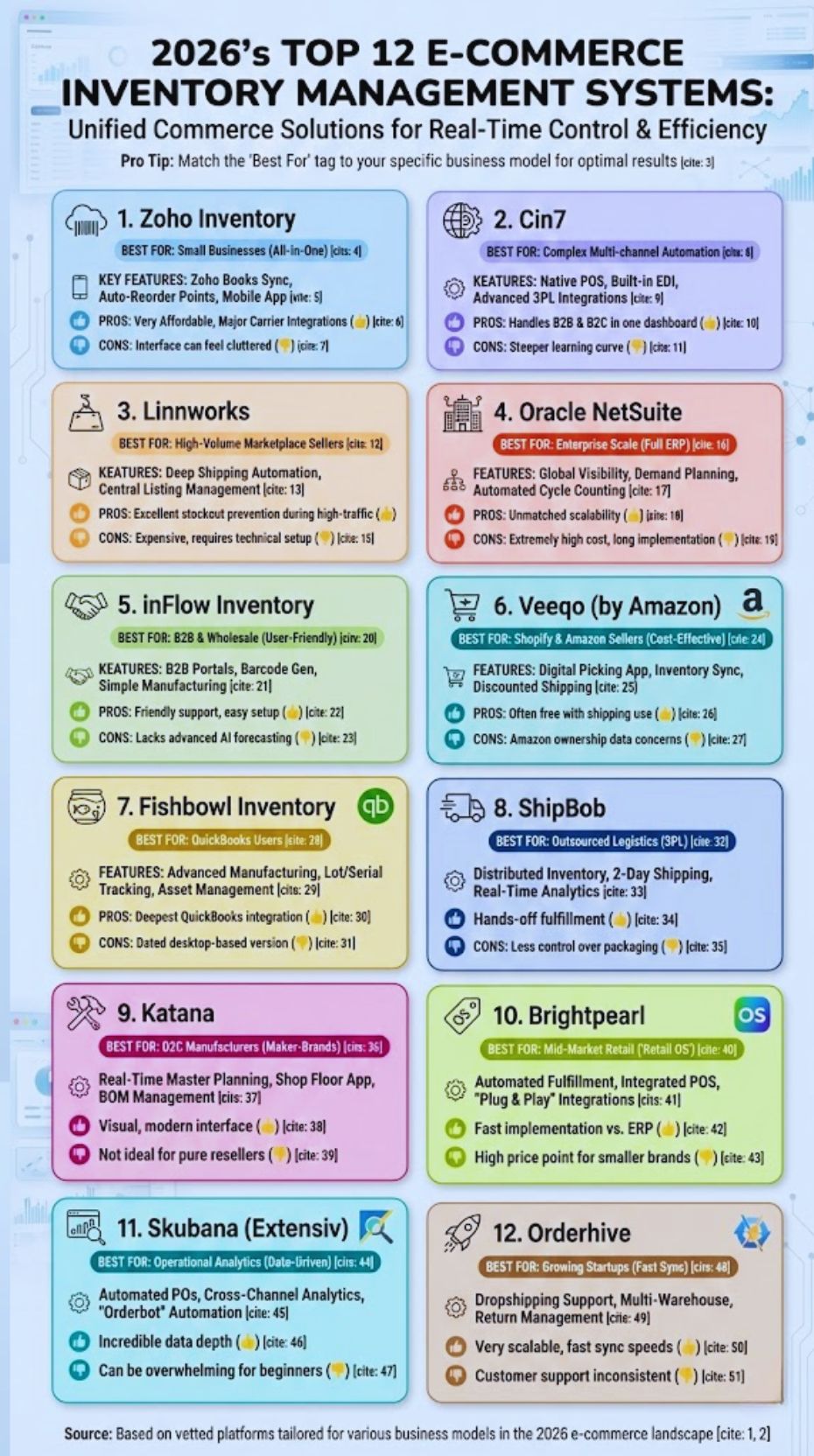
Pro Tip: When reviewing these options, pay close attention to the “Best For” tag. A tool that is perfect for a high-volume dropshipper might be a nightmare for a handmade furniture manufacturer.
1. Zoho Inventory – Best All-in-One for Small Businesses
Zoho Inventory remains the gold standard for startups and SMEs. It is incredibly affordable but doesn’t skimp on features like barcode scanning and multi-warehouse management.
- Key Features: Seamless integration with Zoho Books (accounting), automated reorder points, and a robust mobile app.
- Pros: Very low entry cost; integrates with almost every major shipping carrier.
- Cons: The interface can feel a bit cluttered as you add more modules.
- Best For: Small businesses looking for a professional tool without the enterprise price tag.
2. Cin7 – Best for Complex Multi-channel Automation
Cin7 is designed for brands that sell everywhere—online, in-store (POS), and via wholesale (EDI). It’s a powerhouse for keeping stock levels perfectly synced across disparate platforms.
- Key Features: Native POS system, built-in EDI for big-box retailers, and advanced 3PL integrations.
- Pros: Handles both B2B and B2C workflows in one dashboard.
- Cons: Steeper learning curve than basic apps.
- Best For: Mid-sized brands expanding into physical retail or wholesale.
3. Linnworks – Best for High-Volume Marketplace Sellers
Linnworks is the “heavy lifter” of the group. It is built to handle thousands of orders per day across global marketplaces like Amazon, Walmart, and eBay.
- Key Features: Deep automation rules for shipping and order routing; centralizes listing management.
- Pros: Excellent at preventing stockouts during high-traffic events like Black Friday.
- Cons: Expensive for small sellers; requires technical setup.
- Best For: High-volume retailers who need total commerce automation.
4. Oracle NetSuite – Best for Enterprise Scale
NetSuite is more than an inventory tool; it is a full Enterprise Resource Planning (ERP) suite. It manages your finances, CRM, and supply chain in one massive ecosystem.
- Key Features: Real-time global inventory visibility, demand planning, and automated cycle counting.
- Pros: Unmatched scalability; you will never “outgrow” this system.
- Cons: Extremely high cost and long implementation times (months).
- Best For: Large corporations with complex global operations.
5. inFlow Inventory – Best for B2B & Wholesale
If you find most software too “techy,” inFlow is your answer. It features a clean, Windows-style interface that is highly intuitive for warehouse staff.
- Key Features: B2B portals for customer self-ordering, barcode generation, and simple manufacturing (assemblies).
- Pros: Friendly customer support and very easy to set up.
- Cons: Lacks some of the advanced AI forecasting seen in competitors.
- Best For: Wholesalers who need to manage physical stock and quotes easily.
6. Veeqo (by Amazon) – Best for Shopify & Amazon Sellers
Veeqo was acquired by Amazon, which means it has some of the best Amazon integrations on the market. Better yet, it is currently free for many users who use their shipping labels.
- Key Features: Digital picking via mobile app, inventory syncing, and discounted shipping rates.
- Pros: No monthly subscription fee if you meet shipping requirements.
- Cons: Ownership by Amazon makes some multi-channel sellers nervous about data.
- Best For: Sellers looking to keep costs low while scaling on Shopify and Amazon.
7. Fishbowl Inventory – Best for QuickBooks Users
Fishbowl has long been the #1 inventory solution for QuickBooks users. It bridges the gap between your warehouse and your accounting department perfectly.
- Key Features: Advanced manufacturing tools, lot/serial tracking, and asset management.
- Pros: Deepest QuickBooks integration on the market.
- Cons: The desktop-based version can feel a bit dated compared to cloud-native apps.
- Best For: Manufacturers and distributors who live and breathe QuickBooks.
8. ShipBob – Best for Outsourced Logistics
ShipBob is a 3PL (Third-Party Logistics) provider that offers its own proprietary software. If you don’t want to manage a warehouse yourself, ShipBob is the way to go.
- Key Features: Distributed inventory (splitting stock across multiple warehouses), 2-day shipping, and real-time analytics.
- Pros: You don’t have to touch a single box.
- Cons: You lose some “hands-on” control over your packaging.
- Best For: Scaling D2C brands that want to outsource fulfillment.
9. Katana – Best for D2C Manufacturers
If you make what you sell (like a custom furniture brand or a skincare line), Katana is built for you. It focuses on the “Raw Material to Finished Good” pipeline.
- Key Features: Real-time master planning, shop floor app for workers, and Bill of Materials (BOM) management.
- Pros: Very visual and modern interface.
- Cons: Not ideal for pure resellers who don’t manufacture.
- Best For: Maker-brands and small-scale manufacturers.
10. Brightpearl – Best for Mid-Market Retail “Operating System”
Brightpearl describes itself as a “Retail Operating System.” It’s designed specifically for retailers, meaning it understands things like seasonal trends and returns better than a generic ERP.
- Key Features: Automated fulfillment logic, integrated POS, and “Plug & Play” integrations.
- Pros: Fast implementation compared to NetSuite.
- Cons: High price point; tailored for $1M+ revenue brands.
- Best For: Established retailers who have outgrown basic apps but aren’t ready for a 6-month ERP rollout.
11. Skubana (Extensiv) – Best for Operational Analytics
Skubana (now part of Extensiv) is built for “Ops Pros.” It goes deep into the data, helping you understand the exact profitability of every SKU across every channel.
- Key Features: Automated PO generation, cross-channel analytics, and “Orderbot” automation.
- Pros: Incredible data depth.
- Cons: Can be overwhelming for beginners.
- Best For: Data-driven brands that want to optimize every cent of their profit margin.
12. Orderhive – Best for Growing Startups
Orderhive offers a great balance of speed and features. It’s known for having some of the fastest sync speeds in the industry, which is critical for preventing overselling.
- Key Features: Dropshipping support, multi-warehouse management, and return management.
- Pros: Very scalable; great automation “if-this-then-that” rules.
- Cons: Customer support can be inconsistent at times.
- Best For: Fast-growing startups that need a reliable, middle-of-the-road solution.
E-commerce Inventory Management Systems: Key Features to Look in 2026
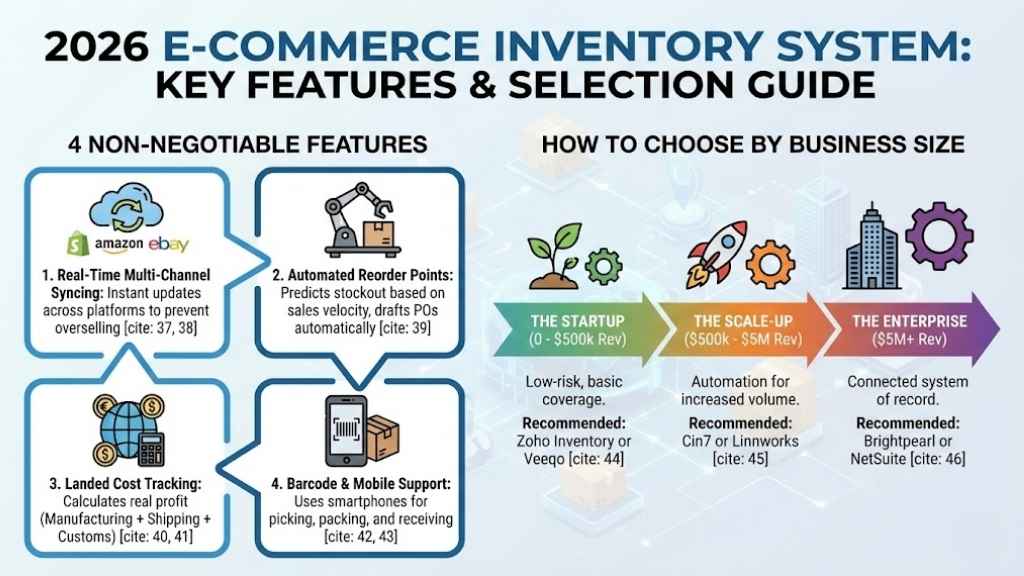
When evaluating these systems, don’t just look at the price. Look for these four “non-negotiables”:
1. Real-Time Multi-Channel Syncing
Your software must update your Shopify store the second a sale happens on Amazon. Even a 5-minute lag can lead to an oversell during a flash sale.
2. Automated Reorder Points
The system should “predict” when you’ll run out of stock based on sales velocity and lead times, then automatically draft a Purchase Order (PO) for your supplier.
3. Landed Cost Tracking
In 2026, shipping and tariff costs are volatile. Your IMS should calculate your Landed Cost (Manufacturing + Shipping + Customs) so you know your real profit.
4. Barcode & Mobile Support
Manually typing in SKUs is a recipe for disaster. Look for a system that allows your team to use their smartphones as barcode scanners for picking, packing, and receiving.
How to Choose the Right System for Your Size
- The Startup (0 – $500k Rev): Stick with Zoho Inventory or Veeqo. They are low-risk and cover all the basics.
- The Scale-up ($500k – $5M Rev): Look at Cin7 or Linnworks. You need the automation to handle the increased order volume without hiring 5 more people.
- The Enterprise ($5M+ Rev): Invest in Brightpearl or NetSuite. You need a “system of record” that connects your warehouse, finance, and marketing teams.
Final Thoughts
Choosing an inventory management system is like picking a foundation for a house. If you pick the wrong one, the whole structure will eventually crack. For 2026, the trend is clear: Automation is no longer a luxury; it’s a requirement.
Take advantage of free trials. Import a small portion of your data, test the sync speed, and see how the mobile app feels in your hand. The right system won’t just track your boxes—it will give you the freedom to focus on building your brand.